The 5 Best Tennis Rackets For Doubles

The 5 Best Tennis Rackets For Doubles

Recent Articles

How Does Tennis Scoring Work? (By Former PRO)


Tennis Scoring Rules

When you are first being introduced to tennis, one of the most confusing and overwhelming aspects of it is its scoring system. There are several different terms you need to learn, including points, games, advantage, sets, and tie-breaks. You also need to learn how to count points in a completely new way (0, 15, 30, 40) – and which makes absolutely no sense. You need to learn when each player serves, and when they switch sides.

This is no easy task, especially when you are still not even sure if you like the sport. My wife has been watching me play tennis for about 4 years now, and she is still not sure how the scoring rules work. And I don’t blame her, because I understand how difficult it can be to understand how scoring works at first. 

However, there’s no need to panic! Once you have a basic understanding of how the point system works, it actually becomes very easy to follow tennis matches. Today we will try to explain the tennis scoring rules in an easily digestible way, so even absolute beginners will be able to count tennis points after reading this article – without a headache!

The tennis scoring system works in a way in which players accumulate points, games, and sets. Tennis points are counted as 0, 15, 30, and 40. The first player to win 4 points wins a game, and the first player to win 6 games wins a set. In order to win the match, a player must win 2 sets.

I know, this is a lot to understand. I’ve done my best to explain it in one paragraph, but if you’re still not sure what everything means, I’ve explained everything a lot more in-depth below. If you continue reading, I’ll guarantee you will understand the tennis scoring system when you are done. Enjoy!

How To Score Points In Tennis

Points are the foundation of the tennis scoring system. You can think of them as the building blocks of a tennis match. When a tennis player accumulates points, he or she will eventually score a game. Once enough games are accumulated, the player will score a set. Depending on which tournament the player is participating, he or she will need to win 2 or 3 sets to win the whole match. 

The first point in a tennis score is called “15”. The second, third, and fourth point are called “30”, “40”, and “game.” When learning how to count points in tennis, it is important to remember that the score of the server comes first (15×0 if the server wins the first point).

We can draw a parallel to our standard numeral system. First, we begin counting with units (1, 2, 3, …). Eventually, when we accumulate enough units, we move to tens (10, 20, …). After we have enough tens, we move on to hundreds (100, 200). Finally, after we get enough hundreds, we arrive at thousands (1,000, 2,000). Put it simply, this is how our standard numeral system works: 

Units → Tens → Hundreds → Thousands 

The same principle applies to tennis. Below is the basic structure of the tennis scoring system:

Points → Games → Sets → Match 

So how can a player score points in tennis? The basic principle of tennis is that a player needs to hit the ball over the net, into a delimited area called the court. Your opponent will try to do the same, and if both of you are successful, you will engage in a rally (a ball going from one side of the court to the other). Based on that principle, there are 5 ways a player can score points in tennis: 

  1. Your opponent misses two serves in a row, either at the net or outside of the box (called a double fault)
  2. Your opponent misses at the net during a rally (called error)
  3. Your opponent hits a shot over the net, but outside your court (also called error)
  4. You hit a shot that goes past your opponent (called a winner)
  5. You hit a shot that bounces twice on your opponent’s court before he or she can hit it (called double bounce)

Provided you can win a point by any of the methods mentioned above, you will start accumulating points. Eventually, these will turn into a game (see below).

What Is A Game In Tennis?

A game in tennis is the second stage of the scoring system. In essence, it is an accumulation of 4 or more points won by the same player. After winning 6 games, a player wins a set.

When a tennis match starts, one player starts serving and the other starts receiving. The game begins at 0x0. 

The first player to win a point will get a nominal score of “15”. If the player who is serving wins the first point, the score, therefore, will be 15 x 0. On the other hand, if the player who is receiving wins the first point, the score will be 0 x 15. The sequence of tennis points within a game is the following: 

0 (Love) → 15 → 30 → 40 → Game

As players keep winning points, their score will move from 0 to 15 to 30 to 40, and he or she will eventually score a game. Basically, the player who first wins 4 points scores a game. However, if both players win 3 points in a game (and the score is 40 x 40), one of them will need to get a margin of 2 points in order to win the game. Both players will keep playing the game until one of them gets a 2-point lead. 

To make it easier to understand, we will show a sample game situation below. Let’s assume player A is serving during this game.  

Point OutcomePlayer A ScorePlayer B Score
Game begins00
Player A wins the point150
Player B wins the point1515
Player A wins the point3015
Player A wins the point4015
Player B wins the point4030
Player B wins the point4040
Player B wins the point40Advantage
Player A wins the point4040
Player A wins the pointAdvantage40
Player A wins the point (and the game)(+1 Game) 00

As you can see, if no player can obtain a 2 point margin, the scoring will keep going from 40 x 40 to Advantage x 40. Once one player finally wins the game, he or she will get a little closer from winning a set (see below). The player who was serving will then receive, and vice-versa. The point scoring will go back to 0 x 0 and will start again. 

What Is A Set In Tennis?

A set is the third stage of the tennis scoring system. Once a player accumulates enough games (as mentioned above), he or she will win a set. Generally, a player will win a set if he can win 6 games before his opponent can win 5. If one of the players can do that, he will win a set, both players will take a break, and both the point and game counting will go back to 0 x 0. For example, if player A wins 5 games, then player B wins 4, followed by player A winning 1 more, player A will have won a set by 6 x 4 and the score will go back to 0 x 0. 

However, if both players tie at 5 games to 5, one of them will need to win by a margin of 2 games. That means that one of them would need to win 2 games before his opponent can win 1 game. If that happens, the player who does so wins the set by 7 x 5 and the point and game counting goes back to 0 x 0. 

Finally, if both players tie at 6 games to 6, they will need to play a tiebreak, which is some sort of “special game” in tennis. We will cover the tiebreak rules below. But first, we will show how a standard tennis set would work.

Game OutcomePlayer A Game ScorePlayer B Game Score
Set begins00
Player A wins the game10
Player A wins the game20
Player A wins the game30
Player B wins the game31
Player B wins the game32
Player B wins the game33
Player A wins the game43
Player B wins the game44
Player A wins the game54
Player B wins the game55
Player B wins the game56
Player A wins the game66
Player A wins the game (and the set)(+1 Set) 00

What Is A Tiebreak In Tennis?

A tiebreak is a special type of game, designed to break a tie between two players (hence the name). Normally, a tiebreak occurs when both players are tied at 6 games to 6. The scoring system in a tiebreak game works differently than regular games (0, 15, 30, 40), and you should count the points using the regular numerical system (0, 1, 2, 3, 4, …). Normally, the first player to reach a total of 7 points wins the tiebreak, also winning the set. If both players tie at 6 x 6 points in the tiebreak, the winner will be whoever gets a 2 point advantage (for example 8 x 6 or 9 x 7).

Once the tiebreak is over, both the point scoring and the game scoring goes back to 0 x 0, and the regular tennis scoring starts over (0, 15, 30, 40). During the tiebreak, the player who begins serving (player A) serves for one point. The other player (player B) will then serve for 2 points. After that, each player will serve for 2 points until the game is over. 

On a side note, during a tiebreak, players will switch court sides whenever the sum of points equals 6 or any multiple of 6 (4×2, 3×3, 6×6, 9×9, …). 

How To Win A Tennis Match

Now that we have covered how to win tennis points, games, and sets, it is time to explain how a player can win a match. If you understand how the rest of the scoring system works, understanding how to win a match should be a breeze. 

In order to win a tennis match, a player needs to win either 2 out of 3 sets or 3 out of 5 sets, depending on the tournament he or she is playing. The vast majority of tennis tournaments works under the “2 out of 3 rule”. What that means is that, in order to win a match, a player needs to win 2 sets before his or her opponent. Possible final scores are 2 sets to 0 or 2 sets to 1. Some possible game scores would be 6×3 7×5 (2 sets to 0 win) or 2×6 6×4 7×6 (2 sets to 1 win). 

Very few tournaments throughout the year apply the “3 out of 5 rule”. Mostly, such a scoring system is only used in Grand Slams. In order to win the match, a player needs to be the first one to win 3 sets. Possible scores are 3 sets to 0, 3 sets to 1, or 3 sets to 2. These matches end up taking a lot longer, usually with a duration of more than 3 hours (or even 11 hours!!). 

Below are some sample scores for a “3 out of 5” match:

ExampleSet 1Set 2Set 3Set 4Set 5
3 sets to 06×36×26×1
3 sets to 16×44×67×56×2
3 sets to 26×26×43×65×76×4

Alternative Scoring Methods

If you have managed to read up to this point, you should by now be ready to play (and understand) a basic tennis match. I would say about 90% of every tennis tournament follows the rules above, so you can rest assured that you are well prepared. 

The other 10% of tournaments might follow special rules, but they are just slight adaptations of the traditional rules. We will cover some of them below, in case you are interested in being a tennis master.

Long 5th Set

This rule has been used less and less, and it is extremely unlikely that you will ever play a match with such a rule. The “Long 5th Set” rule used to apply to every Davis Cup match and every Grand Slam, but most of those tournaments have now eliminated such rule. As of 2020, the only tournament that still uses the “Long 5th Set” rule is the French Open (Roland Garros). 

When this rule is applied, players do not play a tiebreak in the fifth set once they tie at 6 games to 6. Instead, they just keep playing until one of them obtains a 2-game advantage. The reason tournaments have decided to drop this rule is that it can cause too big of a burden to players. For instance, in 2010 John Isner and Nicholas Mahut had to play for 11 hours because there was no tiebreak, and the final result was 70 games to 68 in favor of Isner. 

Wimbledon used to use the Long 5th Set rule, but it dropped it in 2019. Now, players at Wimbledon have to play a variation of the normal counting system, where they play a tiebreak if the fifth set is tied at 12 games to 12. 

10-Point Tiebreak

A much more common alternative scoring method is the “10-point tiebreaker rule”. Also called super tiebreak, this rule is used in some professional doubles tournaments and in a lot of club tournaments. According to this rule, when both players win a set each, instead of playing a regular 3rd set, they just play a tiebreak that goes to 10 (instead of 7). The super tiebreak follows the same counting system as a regular tiebreak, and whoever wins it takes the whole match. 

Some tournaments choose to apply the 10-point tiebreaker rule as it is less exhaustive and allows players to recover faster from their matches. 

8-Game Pro-Set

Another alternative scoring method used by some club tournaments is the 8-Game Pro-Set. A such, instead of playing 3 or 5 sets, players only play 1 long set. It follows the regular point counting system, but the winner is the player who scores 8 games first. If both players tie at 7 games to 7, they play a 7-point tiebreak. Whoever wins the tiebreak then wins the match. 

The reason tournaments might choose to apply the 8-Game Pro-Set rule is that it may need to fit too many matches in one day, so it needs matches to be faster. 

4-Game Set

Finally, a new tennis scoring format that has been recently adopted is the 4-Game Set. This format has been introduced as a way to shorten the amount of time players need to spend on the court. It is currently only used in two tournaments throughout the year: the NextGen Cup and the Hopman Cup. 

The 4-Game Set rule is an adaptation of the regular scoring system. Instead of having to win 6 games in order to win a set, a player only needs to win 4. If both players tie at 3 games to 3, they play a deciding tiebreak. Instead of playing a 7-point tiebreak, they only play it up to 5 points. If the tiebreak is tied at 4 points to 4, a single deciding point is played. Whoever wins that point, wins the tiebreak and consequently the set. 

Another change in the 4-Game Sets is that, when the point count is tied at 40 x 40, a single deciding point is played. Whoever wins the point, wins the game. Therefore, players do not need to win games by a margin of 2 points. 

Tennis Scoring Cheat Sheet
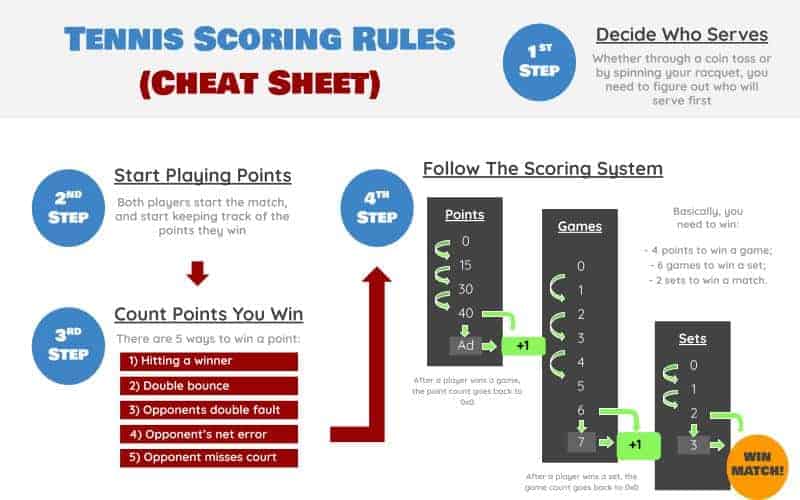
Tennis Scoring Rules Cheat Sheet

Tennis Scoring Terms

Below you can find a quick definition of the terms mentioned above, in case you need to brush up on something:

  • Point: The first step of the tennis scoring system. Normally follow the 0, 15, 30, 40 progression, but follows the regular numerical system (0, 1, 2) during tiebreaks. Starts with one of the players serving and can end with either a winner, error, double fault, or double bounce. When a player accumulates points, he or she eventually wins a game.
  • Serve: Tennis stroke with which a player begins the point. Usually the player hits the ball above his head, and he needs to hit it over the net and inside the service box located diagonally to him. 
  • Winner: When a player hits a shot that is not returned by the opponent. One of the 5 ways to win a point.
  • Error: When a player hits a ball at the net or outside the court. These are 2 of the 5 ways to win (or lose) a point.
  • Double Fault: When a player misses 2 consecutive serves, either at the net or outside the service box. It results in a lost point. 
  • Double Bounce: When a player hits a shot that bounces twice on the opponents’ court before he or she can hit it back. One of the 5 ways to win a point.
  • Game: An accumulation of points won by the same player. In order to win a game, a player needs to win 4 points before his opponent. If both players tie at 3 points to 3 (40 x 40), a player needs to obtain a 2-point advantage in order to win the game.
  • Set: An accumulation of games won by the same player. In order to win a set, a player needs to win 6 games before his opponent. If both players tie at 5 games to 5, a player needs to reach 7 games before his opponent. If both players tie at 6 games to 6, a tiebreaker will be played to determine the winner of the set.
  • Tiebreak: A special type of game, designed to break a tie between two players. It does not follow the standard tennis counting system, and instead follows the regular numerical counting system: 0, 1, 2, 3, etc. The first player to reach 7 points wins the tiebreak and consequently the set. If both players tie at 6 points to 6, the first player to establish a 2-point advantage wins the set.
  • Match: An accumulation of sets won by the same player. In order to win a match, a player needs to win 2 out of 3 sets or 3 out of 5 sets, depending on the rule used by the tournament.
  • 2 Out Of 3: Rule applied to most tennis tournaments. A player needs to win 2 sets before his opponent in order to win the match.
  • 3 Out Of 5: Rule applied to Grand Slams. Players need to win 3 sets before opponent in order to win the match. 
  • Long 5th Set: Alternative scoring method. If a tournament follows this format, no tiebreak is played in the 5th set. Instead, in order to win the set, a player needs to obtain a 2-game advantage.
  • 10-Point Tiebreak: Alternative scoring method. A tiebreak that is won by reaching 10 points instead of 7. Normally played as a substitute to a 3rd set.
  • 8-Game Pro Set: Alternative scoring method. Players only play 1 set instead of 3 or 5. The player who scores 8 games first wins the set. If both players are tied at 7 games to 7, they play a tiebreak to decide who wins the set.
  • 4-Game Set: Alternative scoring method. Sets that end when a player wins 4 games. If players are tied at 3 games to 3, they play a 5-point tiebreak. If the tiebreak is tied at 4 points to 4, a single deciding point is played to determine the winner. 

Tennis Scoring History & Origin

Now that you have mastered the tennis scoring system, you have earned the right to ask yourself “Who was bored enough to come up with this thing?” Seriously though, I think it’s fair to say that there were a lot of simpler scoring formats they could have come up with. 

While it is hard to determine exactly how the tennis scoring system started, it is believed that it goes all the way back to 15th Century France. Tennis had its origin in France, and the sport became very popular among the elites. It is believed that the first tennis players used a clock in order to keep score, and each point was represented by a quarter-hour on the clock. This means that the original scores were 0, 15, 30, 45, and 60 – which would have made more sense. However, since a player needs to win a game by a margin of 2 points, they later changed it to 0, 15, 30, 40, 50, and 60 (game). With time, the “50” became what is now know as Advantage, and the 60 was completely dropped. 

As I think about it, this theory makes sense. With a lack of better technologies to keep score, a clock would have done a pretty good job. If you think about it, in order to win most matches a player needs to win 12 games. And in order to win a game, he needs to win 4 points. If you translate each point into a quarter-hour, that means that winning one match (48 points) would equal a perfect circle around the clock (48 x ¼ hour = 12 hours). 

The Top 10 Longest Tennis Matches Ever (w/ Videos)


If you consider yourself a tennis fan, you probably know how amazing it is when tennis matches go the distance. If you have ever watched a close 5 set match, you know how exciting and nerve-wracking watching such matches can be. You can see players becoming more nervous, the crowd becoming more involved, and rallies becoming longer and more intense. The match becomes almost a show, and sometimes you wish that it could go on forever. 

And yet, if you’re not a big fan of tennis, any tennis match will feel like it is going on forever. If you’re not interested, watching a little yellow ball bouncing from one side to the other can get quite tedious. I get it. Nonetheless, you might still find yourself respecting (and even admiring) tennis players who can push the limits of the human body by playing for hours and hours. 

While a tennis match could technically go on forever, the average tennis match lasts between 1 and 2 hours for 3-set matches and a little more for 5-set matches. Eventually, players get tired and start making silly mistakes, which leads to the victory of one of them. Still, some players have been able to play matches in which no player wanted to give in, and the match ended up lasting an extraordinary amount of time. 

The longest tennis match ever lasted 11 hours and 5 minutes, and it was played over a course of 3 days due to the lack of natural light. The match happened in 2010, between John Isner and Nicholas Mahut in Wimbledon. Isner won the match with a score of 70 games to 68 in the 5th set.

It is by far the longest match ever, as the #2 match lasted “only” 6 hours and 43 minutes. Crazy, right? I get tired just thinking about it. 

There were a few more matches that, across the years, ended up going the extra mile. Some of those will be forever remembered on the tennis books, so we wanted to give them a proper mention. Below, we’ll cover the Top 10 Longest Singles Tennis Matches Ever. 

#10 – Radek Stepanek vs Ivo Karlovic, 2009 Davis Cup – 5:59 Hours

The tenth longest tennis match ever finished just under the 6-hour mark, lasting a total of 5 hours and 59 minutes. The match between Radek Stepanek and Ivo Karlovic happened during the semifinals of the 2019 Davis Cup between Czech Republic and Croatia. Stepanek won the match 6–7(5–7), 7–6(7–5), 7–6(8–6), 6–7(2–7), 16–14, and there were only 3 breaks of serve during the whole match. 

It was in this match that the giant Ivo Karlovic established the world record for the most aces hit in a single match, with a total of 78 aces. When you think about it, that’s the equivalent of winning almost 20 games without having to hit a single shot. Props to Stepanek for staying in the match and managing to come out with the win. The match was played on clay, and a total of 493 points were played. Stepanek’s win helped the Czech Republic to reach the Davis Cup finals, where it lost to Spain. 

Below you can see the match point of this match.

#9 – Harry Fritz vs Jorge Andrew, 1982 Davis Cup – 6:01 Hours

The 9th match in our list happened during a Davis Cup match between Canada and Venezuela 38 years ago. The match played between Harry Fritz (Canada) and Jorge Andrew (Venezuela) lasted 6 hours and 1 minute, beating the #10 match by only 2 minutes. The match was valid for the Sub-Zonal (qualification round) Semifinals of the Davis Cup, and it happened before tie-breaks were introduced to tennis. The final score was 16–14, 11–9, 9–11, 4–6, 11–9 (a total of 100 games played) in favor of Fritz.

Fritz’s win helped Canada to beat Venezuela by 4×1, taking Canada to the Inter-Zonal final where it lost to Paraguay by 4×1. 

#8 – Horst Skoff vs Mats Wilander, 1989 Davis Cup – 6:04 Hours

Number 8 in the list was also a Davis Cup match, this time in a 1989 duel between Austria and Sweden. The quarterfinal match between Horst Skoff and Mats Wilander ended with a score of 6–7(5–7), 7–6(9–7), 1–6, 6–4, 9–7 in favor of Skoff, lasting a total of 6 hours and 4 minutes. 

Skoff’s win was considered a big upset since he was ranked about 30 in the world at the time, while Wilander was one of the top 5 players in the world. Unfortunately for Austria, the heroic win by Skoff was not enough to defeat Sweden. In the end, Sweden defeated Austria by 3×2, and Sweden made it all the way to finals, losing to West Germany by 3×2. 

That match was played on a clay court, and you can watch the matchpoint below. 

https://youtu.be/JYF4nnvC1_8?t=177

#7 – Jose Luis Clerc vs John McEnroe, 1980 Davis Cup – 6:15 Hours

The 7th longest singles match of all-time happened in 1980 and it was the first of 3 marathons played by John McEnroe. The match happened in the finals of the Americas Inter-Zonal, played between Argentina and the United States. Argentina defeated the US by 4×1, propelled by Jose Luis Clerc’s win over McEnroe by 6–3, 6–2, 4–6, 14–12 – which lasted a total of 6 hours and 15 minutes. 

This match also happened before tie-breaks were introduced, and it was also played on clay. Interestingly, this is the only match in the top 10 list in which only 4 sets were played. Since there were no tie-breaks, the 4th set went the distance, finishing with a 14-12 win by Clerc. 

This was John McEnroe’s first-ever loss in a Davis Cup match. It happened in Argentina, where fans are wild and courts are very slow – which was McEnroe’s worst nightmare. Below is an old video of the matchpoint. 

https://youtu.be/v6CIttvDOA8?t=198

#6 – Boris Becker vs John McEnroe, 1987 Davis Cup – 6:21 Hours

Once again, McEnroe goes the distance. Once again, he comes up short. The #6 match in our list happened, once again, on a Davis Cup. The match played between tennis legends Boris Becker and John McEnroe lasted 6 hours and 21 minutes and ended with Becker’s win by 4–6, 15–13, 8–10, 6–2, 6–2. 

This match happened during the relegation play-offs between the United States and Germany, which ended with a win by Germany by 3×2. Interestingly, there were a total of 3 5-set matches, and Boris Becker won 2 of them. 

Even though the quality is not great, you can watch the matchpoint in the video below. 

#5 – John McEnroe vs Mats Wilander, 1982 Davis Cup – 6:22 Hours

Third time is the charm. John McEnroe finally comes up on top, this time at his longest match ever. During the 1982 Davis Cup match between the United States and Sweden, John McEnroe defeated Mats Wilander in 6 hours and 22 minutes, with a final score of 9–7, 6–2, 15–17, 3–6, 8–6. As you can imagine, this match happened before tie-breaks were introduced in tennis matches. 

This was one of the most nerve-wracking matches of all time since the overall tie was tied 2×2 in the quarterfinals. McEnroe and Wilander dueled like 2 gladiators until the end, and McEnroe came out on top. The United States grabbed some momentum and ended up going all the way to the end, defeating France in the finals by 4×1 and winning the title. 

You can watch the matchpoint below.

#4 – Fabrice Santoro vs Arnaud Clement, 2004 French Open – 6:33 Hours

The first match in our list that did not happen during a Davis Cup tie happened at the French Open in 2004. Interestingly enough, the match was played between fellow Frenchmen Fabrice Santoro and Arnaud Clement. The “Magician” Santoro came out on top, defeating Clement by 6–4, 6–3, 6–7(5–7), 3–6, 16–14. 

The match happened in the first round of the tournament, and Santoro went on to win another 5-set match afterward, before falling in the 3rd round. At the time, the duel became the longest tennis match ever played, a record that was held for 6 years. It is still, to this day, the longest match ever played in Roland Garros. 

#3 – Kevin Anderson vs John Isner, 2018 Wimbledon – 6:36 Hours

The most recent match to make the list happened in the semifinals of the 2018 edition of Wimbledon, between big-servers Kevin Anderson and John Isner. The match lasted 6 hours and 36 minutes and ended with a win by the South-African Anderson by 7–6(8–6), 6–7(5–7), 6–7(9–11), 6–4, 26–24. This is the longest Grand Slam semifinal ever played. 

Interestingly, both players played college tennis at the start of their careers. Anderson played for the University of Illinois, while Isner played for the University of Georgia. Anderson went on to the finals, losing to Novak Djokovic. 

While this time Isner was not able to come out on top, he still reigns as the winner of the longest tennis match ever. And I think he will do so for a while. 

Here is the match point of the match.

#2 – Leonardo Mayer vs Joao Souza, 2015 Davis Cup – 6:43 Hours

The second-longest match of all time happened in a Davis Cup match between long-time rivals Brazil and Argentina. In 2015, Argentina’s Leonardo Mayer defeated Brazil’s Joao Souza in 6 hours and 43 minutes, with a score of 7–6(7–4), 7–6(7–5), 5–7, 5–7, 15–13. This match is the longest match ever played on a clay court. It is also the longest Davis Cup singles match ever played. 

The match was valid for the first round of the Davis Cup when Brazil was beating Argentina by 2×1. Mayer had 9 match points before he finally won the match. After his win, Federico Delbonis defeated Thomaz Bellucci, giving Argentina the win. Argentina went all the way to the semifinals, losing to Belgium by 3×2. 

You can watch the matchpoint below.

#1 – John Isner vs Nicholas Mahut, 2010 Wimbledon – 11:05 Hours

And finally, sitting at the #1 position as the longest tennis match ever is the legendary 2010 Wimbledon match between John Isner and Nicholas Mahut. The match, valid for the first round of the main draw, began on June 22, 2010, on court 18 of the All-England Lawn Tennis Club. At the end of the fourth set, the match had to be stopped due to a lack of natural light. Play resumed the next day, but once again they had to stop due to no natural light. Finally, the match resumed and finished on June 24th, with Isner winning by a score of 6–4, 3–6, 6–7(7–9), 7–6(7–3), 70–68. 

Yes, 70 games to 68 games in the final set. The fifth set by itself lasted 8 hours and 11 minutes, which would already beat the #2 match on this list. With a total of 183 games played, the whole match lasted 11 hours and 5 minutes, making it by far the longest tennis match ever played. Both players hit over 100 aces, which means that they both broke Karlovic’s record established on match #10. 

With the win, Isner advanced to the second round, where he played Thiemo De Bakker. Isner was defeated in only 74 minutes and did not hit a single ace, with a score of 6×0, 6×3, 6×2. Clearly, the match against Mahut was too much for him. And well, I don’t blame him. 

Some interesting facts about the match:

  • When the 5th set was tied at 47/47, the scoreboard broke as it was not programmed to go beyond that point;
  • Mahut spent the following 3 months after the match dealing with depression and a back injury;
  • Mahut also wrote a book about the match;
  • A total of 980 points were played;
  • Players held serves for 168 consecutive games;
  • Both players dueled again the following year in the first round of Wimbledon, but this time Isner won in 3 sets.

You can watch the video below and see a short summary of the match. Enjoy!

Summary of the 10 Longest Singles Tennis Matches Ever

RankingWinnerLoserScoreDurationTournament
#10Radek StepanekIvo Karlovic6–7(5–7), 7–6(7–5), 7–6(8–6), 6–7(2–7), 16–145 hours and 59 minutesDavis Cup 2009
#9Harry FritzJorge Andrew16–14, 11–9, 9–11, 4–6, 11–96 hours and 1 minuteDavis Cup 1982
#8Horst SkoffMats Wilander6–7(5–7), 7–6(9–7), 1–6, 6–4, 9–76 hours and 4 minutesDavis Cup 1989
#7Jose Luis ClercJohn McEnroe6–3, 6–2, 4–6, 14–126 hours and 15 minutesDavis Cup 1980
#6Boris BeckerJohn McEnroe4–6, 15–13, 8–10, 6–2, 6–26 hours and 21 minutesDavis Cup 1987
#5John McEnroeMats Wilander9–7, 6–2, 15–17, 3–6, 8–66 hours and 22 minutesDavis Cup 1982
#4Fabrice SantoroArnaud Clement6–4, 6–3, 6–7(5–7), 3–6, 16–146 hours and 33 minutesFrench Open 2004
#3Kevin AndersonJohn Isner7–6(8–6), 6–7(5–7), 6–7(9–11), 6–4, 26–246 hours and 36 minutesWimbledon 2018
#2Leonardo MayerJoao Souza7–6(7–4), 7–6(7–5), 5–7, 5–7, 15–136 hours and 43 minutesDavis Cup 2015
#1John IsnerNicholas Mahut6–4, 3–6, 6–7(7–9), 7–6(7–3), 70–6811 hours and 5 minutesWimbledon 2010

Final Thoughts

In 2019, Wimbledon introduced a new rule that establishes a tie-break will be played if players are tied at 12/12 in the fifth set. The new rule was applied for the first time in the finals of 2019 when Djokovic beat Federer 13×12 in the final set. Many people say that the final could have entered the top 10 longest tennis matches ever –  if it weren’t for the new rule. 

With the adoption of the new rule and the changes in the Davis Cup format (3 sets instead of 5), it becomes increasingly unlikely that the records above will be broken. Currently, the only tournament that does not have a tie-break in the fifth set is the French Open, but we might see that change sometime soon. If that’s the case, it is very unlikely that someone will ever beat the historic Isner x Mahut match. 

Tennis Approach Shots: 5 Drills To Improve Them


Ohh the approach shot. It is one of those shots in tennis where it appears to be very simple but in reality it can be quite tricky. We are all guilty of watching a tennis player miss what looks like an easy approach shot and think to ourselves “how did he miss that? It was such an easy shot!!”. It is also a frustrating miss because in order to be in the position to hit an approach shot, it means you played the point well so missing or hitting a bad approach can be extra annoying (trust me, I know!!).

In order for you to improve your volleys it is indispensable that you set aside time to hit approach shots in every practice. During practice sessions, most of us spend over 80% of the time hitting from behind the baseline so we are used to that range. Once we move inside the baseline, it is new territory; the distance to the baseline is shorter and the amount of power and spin you need to use changes. Tennis is a game of sharpness and repetition so here are 5 drills that you can incorporate to your training that will help you hit better and more consistent approach shots.

Drill #1 – Hand Fed Approach Shots

I like to work with drill progressions, meaning that each drill I do will help me do better on the next one. So let’s start with a very simple drill: approach shots hand fed by your friend/coach. Watch the video below:

Subscribe to MytennisHQ

As you can see, the goal here is to hit as many balls as you can and to work on your range. The key is to feel like you are hitting the same ball over and over. A few things to keep in mind when doing this drill:

1 – Make sure you turn your body early and move laterally to the ball. Don’t sprint straight to it;

2 – Don’t jump when you hit the ball;

3 – Your body should move towards the target. Hit the shot and pretend you are actually moving to the net for a couple steps;

4 – Focus on the depth of the shot, DON’T focus on power;

5 – Increased racket head speed. You need get the ball over the net but it needs extra topspin in order to drop before the baseline;

This is fairly simple drill but simplicity is your friend, trust it!

Drill #2 – Feeding From the Opposite Side of the Court

This drill is practically the same as drill #1 but with your coach feeding you from the other side of the court. On drill #1, you need to generate the power entirely yourself because of the hand feed, which can be challenging. Drill #2 will feel a little bit more realistic. Take a look:

Subscribe to MyTennisHQ

The same tips from drill #1 apply to drill #2. Only thing I would add is to make sure you don’t rush yourself. There is no need to take the ball too early. Instead, focus on creating the right amount of space between you and the ball and then move towards the target after you make contact with the ball. When you feel comfortable, add one volley to the drill.

Drill #3 – Half Court Points

Now let’s introduce point play into the training. By now, you hit a number of approach shots so it is time to see if the work paid off. Start with the following point situation:

Subscribe to MyTennisHQ

Granted, this drill can feel a bit odd because you are hitting right at your opponent but don’t worry about winning or losing; worry about how effective your approach shots were during the game. Play to 10 and afterwards assess the following:

1 – Was I making too many mistakes of the approach shots or was I being consistent?

2 – Were my approach shots deep and difficult for my opponent?

3 – Was my opponent hitting more of his back foot (meaning your approach was deep and pushed him back) or his front foot (meaning your shots were short and he was able to be offensive)?

After drills #1 and #2, the objective of drill #3 is for you to assess how effective your approach shots are in a point situation. In addition, you can gauge your level of comfort when moving in. Make sure you have fun with it.

Drill #4 – Full Court Points

You did it! You made it to full court points. Now let’s play full out. The drill is simple: both of you start at the baseline – your friend/coach feeds you an approach shot – you hit it down the line – the first passing shot should go to you (it can be as hard as possible, as long as it is not a clean pass) – the court is open from there. Watch it below:

Subscribe to MytennisHQ

Play a few tiebreakers then repeat the self questioning from drill #3. Try to take an analytical approach to how the tiebreakers were played. Perhaps you lost but focus on how effective your approach shots were. The main goal in this drill progression is that, by the time you get to drill #4, you feel more comfortable hitting approach shots.

Drill #5 – Looking For Short Balls

Drill #5 is the most advanced one and I would only recommend it to intermediate and advanced players. If you are a beginner, skip this one. This drill is all about looking for opportunities to go to the net. Our opponents hit the ball short more often than we realize and if you are attentive, you can capitalize on those chances. Take a look:

Subscribe to MytennisHQ

Let me first summarize how the drill works:

1 – On your side of the court, pick an appropriate depth and put two cones that create an imaginary line across them;

2 – During the rally, your friend can hit anywhere he desires. You, on the other hand, are more limited. If your friends shot lands pass the cones, you HAVE to hit crosscourt. But if he hits it short of the cones, you HAVE to hit down the line and move to the net.

3 – Once you hit down the line the point is completely open; anything goes

This drill is very advanced. As you can see in the video, often I had to force moving to the net. That is totally ok, however. The goal of drill #5 is for the person who is doing it to be constantly looking for that short ball. It is imperative that you pay extra attention to the ball coming off your friend’s racket because the earlier your recognize that the ball will land short, the better your chances are of hitting a good approach shot. I am fully aware that this drill can be tricky and that often you don’t feel like it is the right shot to move in. But embrace that, be ok with being uncomfortable on the tennis court because that is the only way you can improve.

You can watch the full lesson below:

Subscribe to MytennisHQ

6 Ways How Tennis Players Get Paid (And How Much)


How Do Tennis Players Get Paid?

At one point or another, we have all wondered what it would feel like to live the life of a famous athlete. You get to be recognized for your talent anywhere you go, you get to do what you love in front of millions of people, and – on top of that – you still get paid more money than you can possibly count. 

According to Forbes, Lionel Messi (soccer) was the highest-paid athlete in 2019, cashing in a total of $127 million. Yes, 127 million dollars in one year. That equals about $10.6 million per month, $348 thousand per day, and about $14.5 thousand per hour. If Lionel Messi sleeps for 7 hours a night, he makes a little more than $100,000 while he sleeps. Every night. 

The majority of the highest-paid athletes play team sports like soccer, football, or basketball since a great share of their income comes from the salary they get paid by their team. Tennis players do not get paid a salary, so they rely mostly on other sources of income. And yet, the top tennis players still get paid pretty well – Roger Federer was the #5 highest-paid athlete in 2019, making about $93.4 million, while Novak Djokovic came in #17, with a total of $50.6 million. 

So how do tennis players get paid? Professional tennis players get paid through 6 different income sources: tournament prize money, appearance fees, endorsement deals and sponsorships, exhibition fees, bonuses, and club tennis deals. The ranking, nationality, and popularity of players will determine how much they get paid from each source. 

Players who qualify to play in Grand Slams and in big tournaments will earn significantly more money than players who get most of their points playing Futures or Challenger tournaments. In addition, popular players can score more lucrative sponsorship deals. We will cover the 6 ways tennis players get paid more in-depth below. 

#1 – Prize Money

One of the main ways tennis players get paid is through the prize money they receive from participating and winning rounds in tournaments. The level of tournaments a player participates in will determine how much money he or she will make. In 2019, Roger Federer made $7.4 million in prize money (roughly 8% of his total income), while Djokovic made $20.6 (about 41% of his total).

Tennis players get paid even if they lose. The way the prize money works is that – before a tournament starts – the tournament’s organization announces how much money a player will make depending on which round he or she exits the tournament. There is always a flat amount that players will receive just for participating, even if they lose in the first round. If players continue winning, they will increase the amount they get paid. 

Below is the prize money distribution for the 2019 US Open, in which you can see how much each player gets paid depending on the round they exit the tournament. The numbers are the same for both men and women. 

Exit RoundPrize Money (in US Dollars)
1st Round$58,000
2nd Round$100,000
3rd Round$163,000
4th Round$280,000
Quarterfinals$500,000
Semifinals$960,000
Runner-Up$1,900,000
Winner$3,850,000

Pretty hefty amounts, no? Making $58,000 for one match doesn’t sound too bad after all. However, notice that in order to qualify for a Grand Slam like the US Open, you mostly need to be ranked among the 104 best players in the world (see all ways to qualify for a Grand Slam here). Unfortunately, this reality is not enjoyed by every professional player. Below is a breakdown of the prize money of a 125 Challenger tournament, which is played mainly by players in the 80 – 200 ranking range. 

Exit RoundPrize Money (in US Dollars)
1st Round$780
2nd Round$1,560
3rd Round$2,580
Quarterfinals$4,380
Semifinals$7,530
Runner-Up$12,720
Winner$21,600

Notice a difference between those numbers? That is the reality of the players ranked between the 100 and 300 best players in the world. The difference is outrageous. But hold on, it gets worse. Below is the breakdown of the biggest tournaments players ranked between 500 and 1500 can play, a 25K Future. 

Exit RoundPrize Money (in US Dollars)
1st Round$260
2nd Round$430
Quarterfinals$730
Semifinals$1,255
Runner-Up$2,120
Winner$3,600

So just to recap, this is how much the winner of each tournament makes:

  • US Open: $3,850,000
  • 125 Challenger: $21,600
  • 25K Future: $3,600

This just goes on to show that while some tennis players get to enjoy a pretty glorious life, others struggle to just break even. And they need to find other sources of income, which is one of the other options below. 

#2 – Appearance Fees

In addition to taking a share of the official prize money, the best players still get some big checks when it comes to appearance fees. The top players like Federer, Nadal, and Djokovic already have so many ranking points that they have very little incentive to play smaller ATP tournaments. However, every tournament director dreams and hopes to have these main players in their tournaments, since they are able to sell more tickets and make more money. 

In short, every time a tournament’s organization requests a tennis player to play a tournament in which that player won’t sum a lot of points, the tournament organization pays an appearance fee to the player. Since the player is now making money, he or she has an incentive to participate in the tournament. 

It is estimated that Roger Federer charges about $1.1 million in appearance fees in order to participate in smaller tournaments like ATPs 250. Rafael Nadal and Novak Djokovic, in turn, charge roughly $900,000. Players who rank between 30 and 50 might get appearance fees for playing in challenger tournaments, but their income will be a lot smaller. 

#3 – Endorsements / Sponsorships

The biggest source of income from most players is endorsement deals and sponsorships. In 2019, Roger Federer was sponsored by Rolex, Mercedez-Benz, Credit Suisse, Jura, Barilla, Moet & Chandon, Lindt, Wilson, Uniqlo, Netjets, Sunrise, Rimowa, and On Running. These deals paid him an estimated $86 million in one year. 

Other players who made the Forbes’ Top 100 were Novak Djokovic (roughly $30 million in endorsements), Kei Nishikori ($33 million), Rafael Nadal ($26 million), and Serena Williams ($25 million). 

In endorsement and sponsorship deals, all a tennis player needs to do is to be an ambassador for the brand. Players will show up in a few commercials for the brand or wear gear provided by the brand, and in return make a lot of money. Brands generally look for players who have a strong fan base and who will represent the brand in a good way. 

A player’s nationality plays a big role when it comes to endorsement deals. In some countries, like Spain and Argentina, tennis is one of the main sports and the number of fans is larger, giving brands a greater incentive to sponsor athletes. In other countries, tennis is somewhat of a neglected sport and players have a harder time getting good deals. It is also interesting that the deals a player gets will depend on how many other popular tennis players a country has. For instance, Kei Nishikori is by far the best Japanese tennis player of all time; consequently, he makes over $30 million a year in sponsor deals. In contrast, Roberto Bautista Agut – who is ranked better than Nishikori – comes from Spain, the same country as Rafael Nadal, so he ends up being left aside and not scoring great deals. 

#4 – Exhibitions

Another way tennis players can make some big money is by playing exhibition matches. This is a good source for income not only for the top 100 players but for players from every ranking. Whether you are a respected player worldwide or in your small town, you might get paid for showing up, playing, and entertaining a crowd. 

In 2019, Roger Federer played a set of 5 exhibition matches in South America, and it was estimated that he received about $2 million dollars per match. One of the matches ended up being canceled, so Federer was left with a total of $8 million for the week. Not that bad, at the end of the day. 

The ranking established by Forbes only takes into consideration the money players make from endorsements and prize money, so anything players make from exhibitions and appearance fees is on top of the recorded numbers. The exact numbers for exhibition fees are hard to determine since these transactions are done behind the scenes. However, players generally play about 3 or 4 exhibition matches a year, so that can bring in roughly another $1 to $5 million for the top players. 

Players with much lower rankings will only receive a much, much lower fraction of that amount. However, earning a few thousand dollars can help significantly – especially considering that winning a lower-level tournament only pays you $3,600. 

#5 – Bonuses

The 5th way players get paid is through bonuses related to their performance. These bonuses are structured into mostly every player’s sponsorship contract, whether they are sponsored by a racquet manufacturer or a candy brand. These bonuses give the players incentive to perform better, which means that the brand will get more exposure. 

Another source of bonuses comes from tournaments themselves. The ATP Finals, which is played by the 8 best players in the season, gives bonuses to players after every match they win. One of the biggest bonuses given in tennis used to come from the US Open Series, which was awarded by the United States Tennis Association. Players use to gain points for their results in a series of US tournaments and the player with the most points after the US Open used to get an extra check for over $1,000,000. Unfortunately, this award was discontinued after 2017. 

#6 – Club Tennis 

The last way tennis players get paid is by playing club tennis. The US has a club league that has been growing in popularity recently, called the World Team Tennis. Yet, the most popular club tennis leagues are in Europe, mainly in Germany and Italy. It is not uncommon to see players ranked in the top 30 playing some matches in such leagues. 

What is appealing about these club tennis is that they are great ways for players ranked outside the top 100 to make more money than they make in official prize money throughout the year. These leagues only last for a few months over the summer, and clubs will pay players over $10,000 for their participation. In addition, most clubs provide housing and food for players. 

Club tennis is a great way for players with lower rankings to pay for their expenses throughout the years. I’ve had several friends who went to Europe for 2 or 3 months, played some club tennis, and made more money than they did playing professional tournaments. They were also able to play Futures and Challengers in weekends when they didn’t have club matches, which allowed them to maintain their rankings. If a player is not ranked high enough to get into the big tournaments or score good sponsorship deals, club tennis can be a great alternative. 

Closing It Out

There are several ways tennis players can get paid. Even without a salary, the top tennis players are ranked among the highest-paid athletes in the world. The reason behind it is that the top tennis players can make a lot of money from endorsement deals and appearance fees. 

While the top players get paid millions of dollars every year, players outside the top 50 need to make money from different sources. Depending on which level of tournament a player qualifies for, he or she can break even with prize money. However, the majority of lower-ranked players gets paid by finding local exhibitions to play in or by spending a few months in Europe playing club tennis. 

1 Minute Lesson #2 – How to Put Away More Volleys


I find volleying to be both simple and difficult at the same time. While it is important to have good technique, players who possess great instincts at the net often find themselves to be more successful when coming in. So let’s simplify it. First, watch the video below:

https://youtu.be/76Y808DeWaA

Let’s Break It Down

All I am focusing today is showing you how effective firm and short volleys can be. I want you to keep that inside your head every time you go to the net. Let me give you quick breakdown on my thought process as I move forward:

1 – My approach shot needs to push my opponent back. Power isn’t a priority; depth is.

2 – I will be paying close attention to my opponents racket as I move forward. Why? Because there is a moment in everyone’s swing where they completely made the decision on where they want hit the ball; there is no turning back. It is in that moment where I will pounce forward in order to cover more of the net and go towards the ball (watch the video again, from the close up angle. Pay attention to my split step and how I move forward afterwards).

3 – My goal in most volleys is to hit them firm, short and away from the opponent. I aim around the service line and keep my wrist and hands firm through contact. It will help me have better control through the shot.

In summary:

  1. Deep approach shot
  2. Move as close as you can to the net
  3. Good split step followed by the pounce forward
  4. Don’t wait for the ball, GO GET IT!!
  5. Firm hands and wrists through contact
  6. Aim close to the service line and away from your opponent

This isn’t a technical lesson, this is a mindset lesson. Putting away more volleys requires good instincts more than anything else. Have a set of rules when moving to the net, don’t just improvise. Play the point the way you want it to be played; not how your opponent wants. And remember to keep it simple, aim short, hit it firmly and I guarantee you will put away more volleys the next time you play.

The 8 Basic Tennis Shots & Skills (Explained)


The 8 Basic Tennis Shots & Skills (Explained)

If you’re just now considering learning tennis, chances are you might get quickly overwhelmed. You always imagined you would be able to at least hit the ball with your racquet, because how hard could that be, right? Well, if you’re like the vast majority of beginners, chances are that you will eventually swing as hard as you can – just to watch the ball go straight past you. And that’s ok, because every advanced tennis player has done the same thing at some point. 

When you’re beginning to learn tennis, all you want to focus on is hitting that ball and getting ready to play matches as soon as possible. You may not really care about the name of the shot you’re hitting, as long as it’s going over the net. And yet, whether from your coach or other players, you will keep hearing things about serves, volleys, and on-the-run-forehand-inside-outs (what?!?). 

The 8 basic shots in tennis are the serve, return, forehand, backhand, slice, forehand volley, backhand volley, and overhead. Beginners must become comfortable with these 8 shots before they can be considered intermediate players and learning new, advanced skills.  

So why do these names exist? And most importantly, why should you care about them?

The names of basic tennis shots exist in order to facilitate communication between coaches, players, and tennis fans. They make it much easier for people to understand what they are learning and what they need to do about it. It is just like how we have defined subjects in school, – math, biology, history – technically we don’t need the definition, but it makes understanding a whole lot easier. And why should you care about the names of basic tennis shots? Well, because if you don’t you may end up like the guy below. 

Now that you’re hopefully convinced, let’s get to the good part. Below we will dive in a little bit more in-depth into what each one of those shots means and how you can become quickly learn them. If you’re interested in learning them further, at the bottom of this post we have included links to our full tutorials for specific shots.

Tennis Shots vs Strokes

One important step is to first establish the difference between tennis shots and strokes. While people may disagree on this topic, most believe that there are only possible 6 tennis strokes you can hit: serve, forehand, backhand, forehand volley, backhand volley, and overhead. Each one of these strokes, on the other hand, can be executed in different ways and therefore produce different shots. For instance, a forehand stroke can produce different shots, like a crosscourt forehand, a down-the-line forehand, a passing shot, or even a lob. 

If you struggle to remember the difference, just remember that shots are “subdivisions” of strokes. 

In this article, we will be covering the 8 basic tennis shots. While a forehand is technically a stroke, we’ll be calling it a shot – so you can understand the fundamentals of it. As you become more advanced, you will be able to execute different shots with that one forehand stroke. Now, let’s get to the nitty-gritty. 

Serve & Return – The Ones That Start The Point

Until you become comfortable with serves and returns, you will not be able to play a tennis match. The reason is that at the beginning of each point in a tennis match, you will either serve or receive. So if you don’t know how to serve and return, your tennis practice will be limited to drills and exercises, which is not as fun as playing matches! On average, you will serve on 50% of the points and receive on the other 50%, so it is a worthwhile investment to master these skills. 

#1 – Serve

Probably the most difficult stroke for beginners to learn, the serve is also one of the most important skills to develop for every player. First, because it is the only shot in which you have absolute control over it. Second, because having a good serve will give you an edge compared to your opponents, regardless of which level you are playing at.  

So, in tennis, what is a serve? The serve is the stroke that begins every single shot in a tennis match. While one player is serving, the other is receiving, and they take turns after the end of every game. Serves can take different shapes and forms, but they are generally characterized by a movement where the player swings the racket above his head, while still standing behind the baseline. 

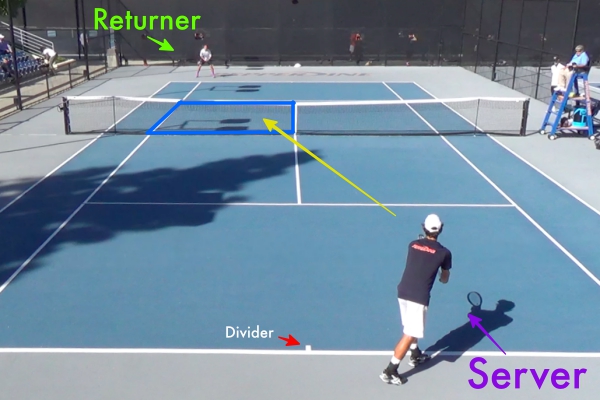
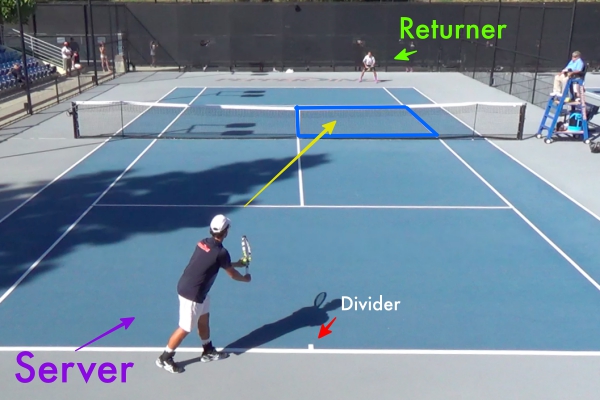
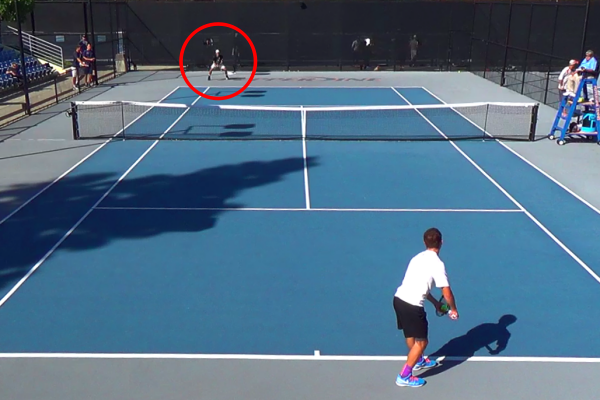
At the start of each new game, the player who is serving begins at the right side of the court divider (see below), and needs to serve the ball across the court and over the net to the service box on his left side (indicated by the blue box in the picture). After the point is played, the player who is serving needs to start the new point at the left side of the court divider, and serve towards the service box on his right side. The player keeps alternating sides until the game is over. 

Players start serving on the right side of the divider
On the next point, they serve on the left side. Then, they alternate until the game ends.

It is also important that the player does not step on the line while serving. If that happens, it is considered a “foot fault” and the serve will be counted as a miss. 

Players can add different spins to their serves, which will characterize the serve as either a flat, slice, or kick serve. Depending on the where the serve lands inside the service box, it will be called either a wide, body, or T serve. In addition, players have begun to use the underhand serve, which is considered legal but was seen as unethical until recently. Below is a video with examples of underhand serves in 2019. 

#2 – Return

Since at the start of every point in a tennis match one player is serving, that means that the other player is returning. Returns are very difficult at the advanced levels since serves are extremely fast, but having good returns can benefit players at every single level. Returns are especially important when your opponent is not a great server since you can fully take advantage of that weakness. 

So in tennis, what is a return? A return is a shot where one player waits to see where the other player’s serve lands and then attempts to hit the ball back to the other side. A return can be executed in several different ways, with a forehand, backhand, slice, block, or chip. The most important aspect of a return is just getting the ball back to the other side, no matter how. 

If one player successfully executes a serve, and his opponent successfully executes a return, the point is now “open” and groundstrokes and volleys will come in play. 

Groundstrokes – The Ones You’ll Hit The Most

During a tennis match, about 60 to 75% of all the shots will hit will be groundstrokes. They’re the foundation of every tennis player’s game, and you will spend the majority of time practicing them. They are the ones that make tennis games enjoyable to watch and are probably the first thing you will learn when you start playing tennis. 

#3 – Forehand

Forehands are, for the vast majority of players, their strongest weapon. A player hits a forehand when he allows the ball to bounce once on his court before hitting it, and hits it with his dominant side. With very few exceptions, players hit forehands using only one arm. 

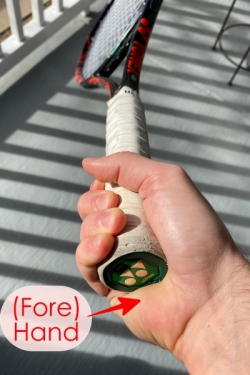
The reason why forehands are called forehands is because normally, the front (fore) of your hand holding the racquet will be facing your opponent. 

Generally, when people refer to forehands, they mean a forehand with topspin – which means that the player hits the ball on the top, causing it to spin forwards. Technically, a forehand can be hit with slice, but people mostly refer to that as slices (see below). For right-handed players, a forehand is executed on the right side. For left-handed players, it is executed on the left side. 

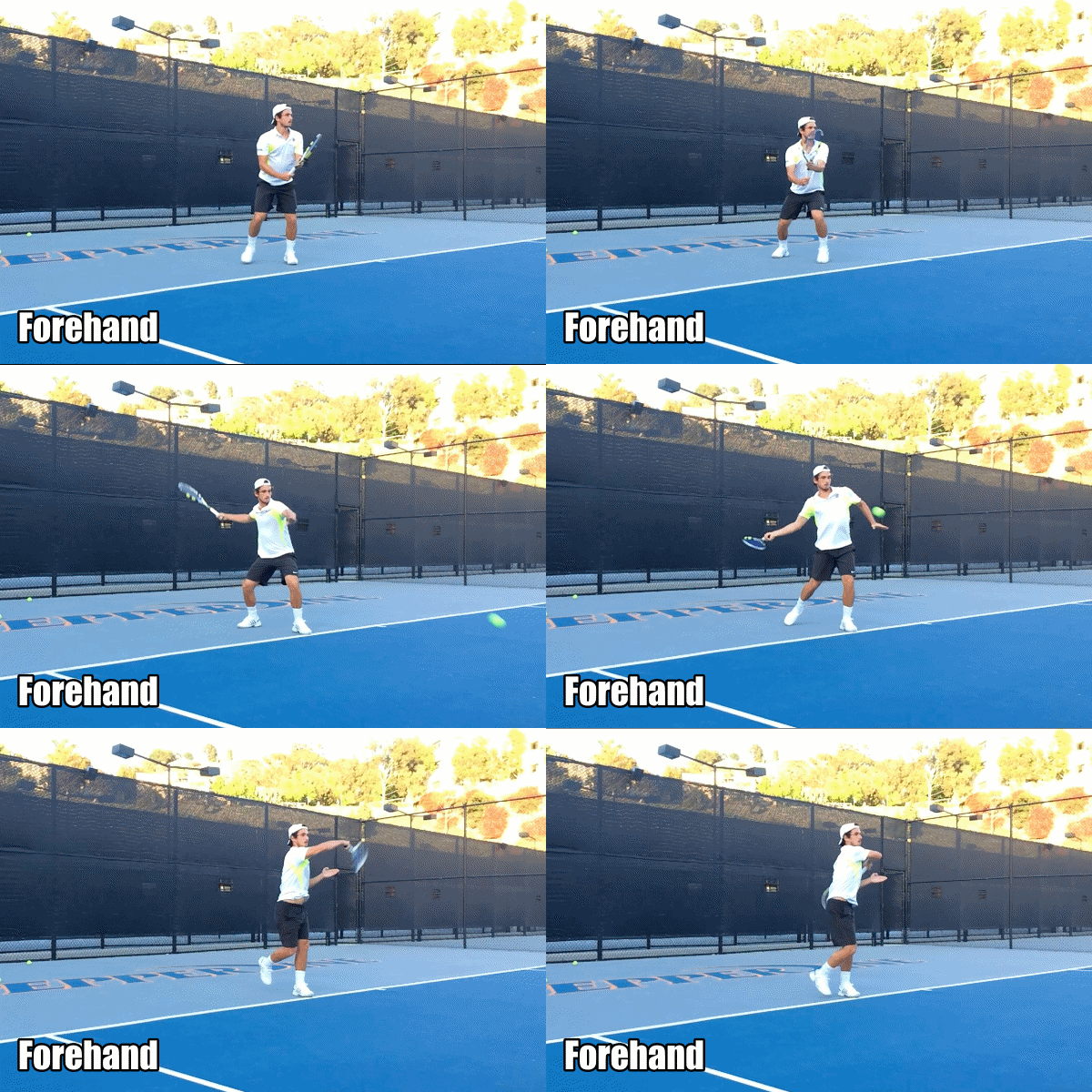
This is what a standard forehand progression looks like

#4 – Backhand

The backhand is another one of the main shots in a tennis game. It is the equivalent of the forehand but executed on the player’s non-dominant side. For instance, if a player is right-handed, the backhand will be executed on the left side. If a player is left-handed, the backhand will be executed on the right side. 

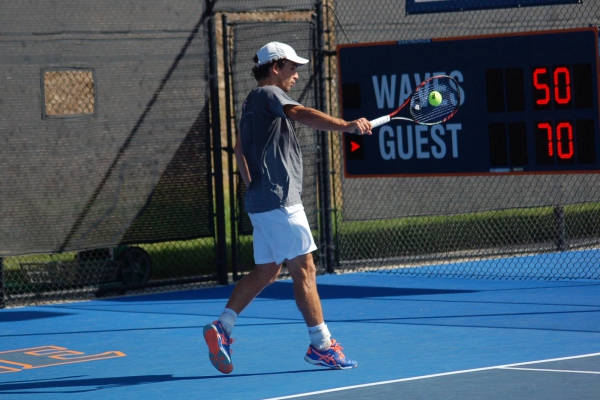
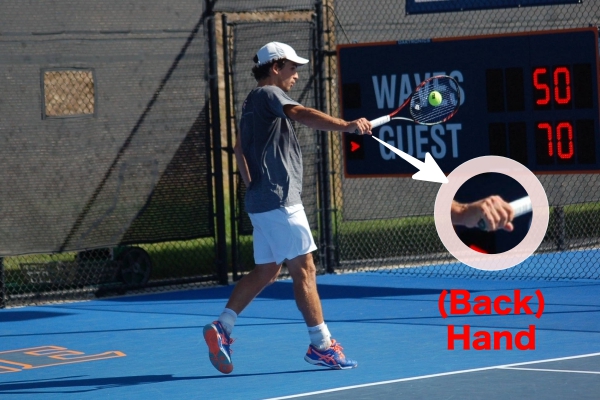
The reason why backhands are called that is that the back of the player’s dominant hand is facing the opponent. If you look at the picture below, you will have a better understanding. 

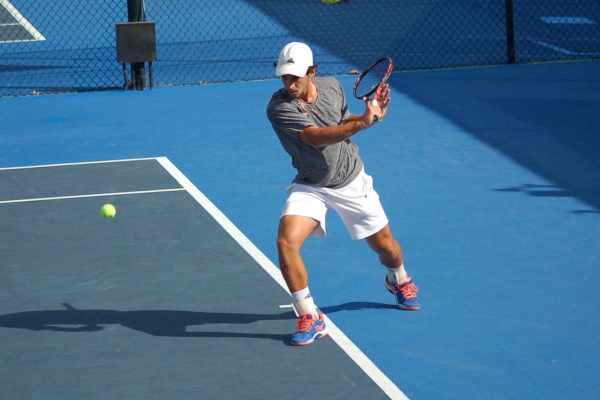
Backhands can either be one-handed or two-handed. One-handed backhands (like the one above), generally get more power and more spin. Two-handed backhands (like the one below), give the player more control. With very few exceptions, players stick to one type of backhand. 

Another shot that is similar to the topspin backhand is the backhand slice, which we will cover below. 

#5 – Slice

A slice is essentially a variation of the backhand shot. Instead of hitting the ball on the top, your racquet swings through the bottom of the ball. That adds underspin to the shot, so after the ball bounces on the other side, it stays low and close to the ground. 

A slice can be used either on your dominant or your non-dominant side, but it is most commonly used as a backhand slice. Players usually use slices in order to change the pace of the game and add some variation. You can see 

Top Spin Effect

This is how the ball rotates when you hit it with topspin

Slice Effect

This is how the ball rotates when you hit it with slice

Net Game – The Ones That Will Make You Win The Most

The last 3 basic shots are part of your net game, which means that you will hit them without letting the ball touch the ground before you hit it. These shots are mainly used to finish the point, after you were able to move your opponent around by hitting successful groundstrokes. They are also used a lot more frequently during doubles matches. Mastering the last 3 basic shots will take your game to the next level.  

#6 – Forehand Volley

The forehand volley is a fairly simple movement, in which you use only one arm to hit a ball by your dominant side, without letting the ball touch the ground. It requires firm hands and fast reflexes. 

Volleys are not used as often as they used to be in the 1990s. As the game has become increasingly slower, players become too vulnerable when they go to the net – since their opponents have a lot more time to react. 

#7 – Backhand Volley

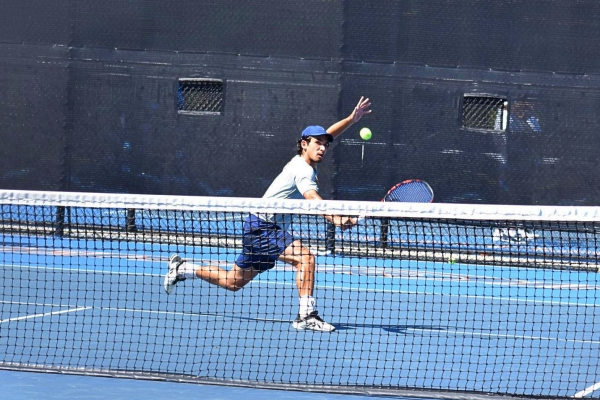
The backhand volley looks a lot like a backhand slice, but without letting the ball touch the ground. Once again, a volley usually occurs when you are standing close to the net. A backhand volley always happens on your non-dominant side. 

Backhand volleys are an important part of your net game since they will allow you to shorten the points and take time away from your opponent. 

#8 – Overhead

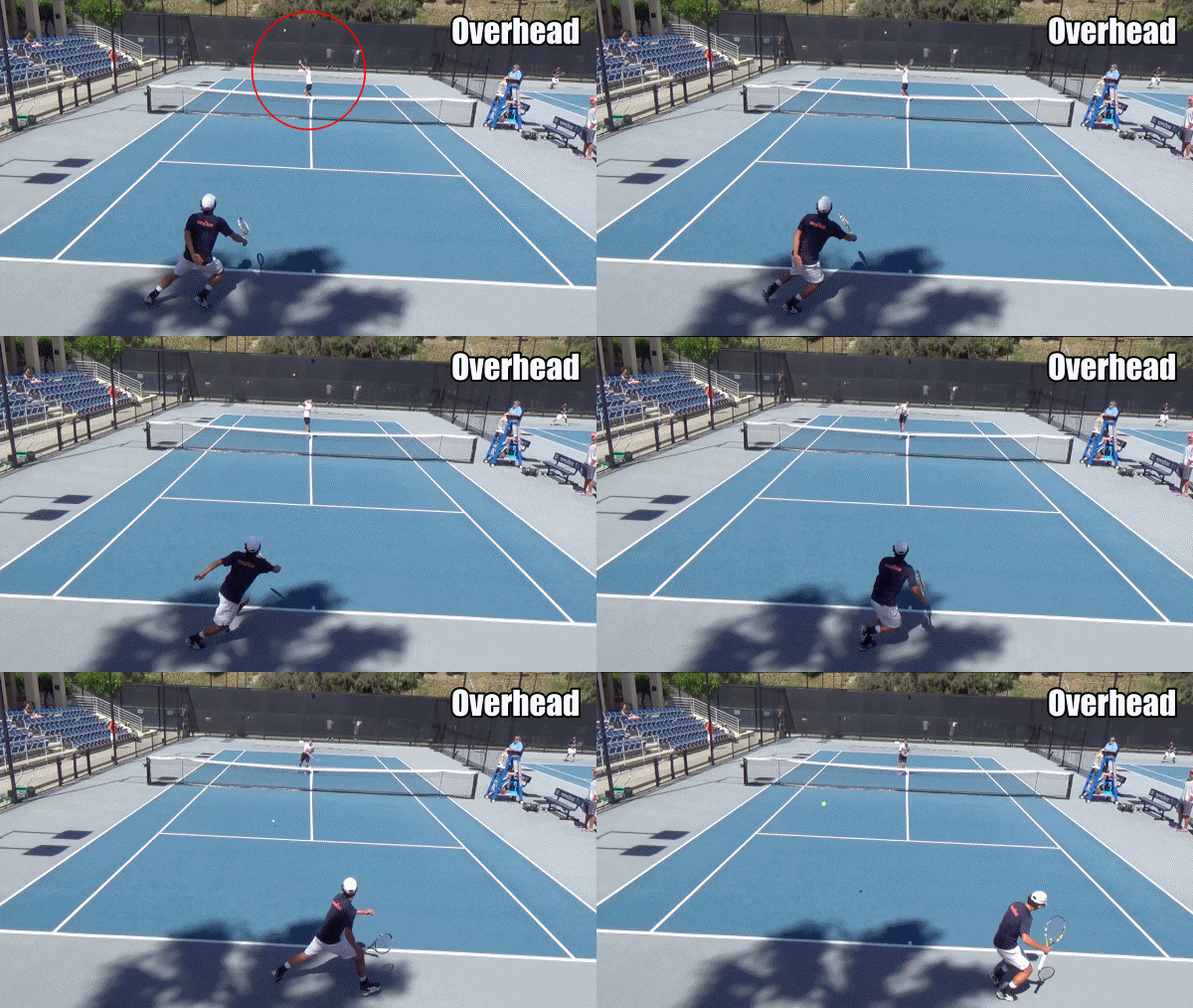
The last basic shot you should become comfortable with is the overhead (also called smash in some countries). You must be standing close to the net and hit the ball without bouncing. You need to hit the ball over your head (similarly to a serve), and that is why this shot is named the way it is. 

Overheads are usually used to finish a point, as it is considered a fairly easy shot in which you can hit it very hard. It is important to master this shot so you make sure you win those points. 

Recap

Now that we have covered them individually, let’s recap the 8 basic tennis shots:

  1. Serve
  2. Return
  3. Forehand
  4. Backhand
  5. Slice
  6. Forehand Volley
  7. Backhand Volley
  8. Overhead (or Smash)

If you’re looking to learning more about these specific shots, we have full guides that will not only teach you about the importance of each shot but also how to execute each one – and you can check them out here:

If you are looking to improve your tennis game, these are the 8 shots you should become comfortable with. Remember that each one of these can be developed into several other variations, in terms of where you hit them and which type of spin you add to the shot. As you become familiar with the basics, you will learn the variations as well.