The 5 Best Tennis Rackets For Doubles

The 5 Best Tennis Rackets For Doubles

Recent Articles

Why Is Tennis Scored 15, 30, 40? (Beginner’s Guide)


Why Is Tennis Scored 15, 30, 40?

Beginner tennis players often have a hard time understanding the rules of the game. Granted, tennis has one of the most interesting (yet confusing) set of rules of all sports. This is especially true when it comes to the tennis scoring system, which follows a very interesting progression – 0, 15, 30, and 40.

Two theories aim to explain why tennis is scored 15, 30, 40. The first one credits tennis’ scoring system to a sport called jeu de paume, in which players would advance 15, 15, and 10 feet after the first 3 points won. The second theory credits the fact that clocks were used to keep track of the score, and each point advanced the minute hand to 15, 30, and 40 – until a game was finally won. 

Both of these theories go back to the time tennis was invented, the late 1800s in France. Both of them seem to make sense, and yet only one of them must be right. We’ll dig in deeper into both, so you can make up your mind as to which one is the right theory.

Theory #1 – Jeu De Paume

The first theory explaining the origin of why tennis is scored 15, 30, and 40 claims that these numbers come from the antecessor of tennis, a game called jeu de paume. 

This game originated in France in the 1800s, and it is played indoors. Originally, players used their bare hands to hit the ball over the net and into the opponents’ court. As time went on, players started wearing gloves, then some sort of bat, and eventually began using rackets.

While jeu de paume is not a popular sport nowadays, it was certainly popular a century ago. Most people believe the rules of this game were the rules upon which modern tennis was built – and this is why tennis is scored the way it is.

Advocates of this theory claim that, at some point, jeu de paume was playing in courts that measured 90 feet in length – which means that each side measured 45 feet. A player would start the game behind the line, and the rules would allow the player to move 15 feet closer to the net if he or she won a point. After the second point, he would move another 15 feet. And finally, after the 3rd point, he would move another 10 feet, which would leave him 5 feet away from the net – a big advantage (apparently). 

Below you can watch what a real match of jeu de paume looks like. 

Theory #2 – Clock Scoreboard

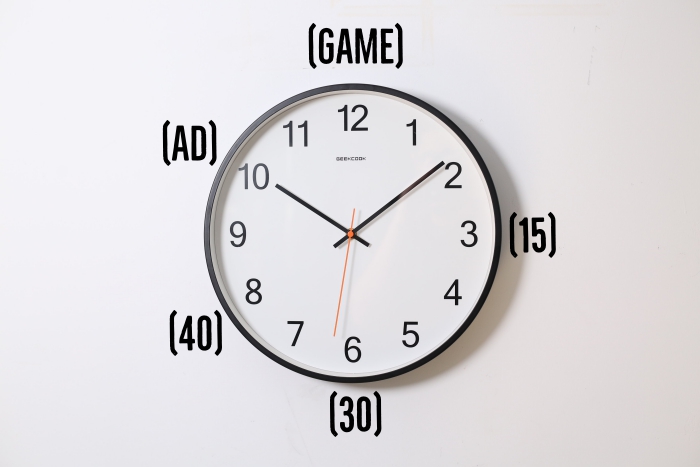
The second explanation behind tennis’ strange scoring system is that players used to use a clock to keep track of the score. Instead of counting the points as 1, 2, and 3, counting them as 15, 30, and 40 was a better fit for how clocks are structured.

This theory explains that originally the scoring was actually counted as 15, 30, and 45 – which meant that after every point the clock’s minute head would advance one quarter. After the 4th point was won, the minute head would reach 60 – which would cause the hour head to advance to the number 1 (equivalent to 1 game). 

However, since in tennis a player needs to win a game by a margin of 2 points, players realized that if they counted the third point as 45, the next point would reach 60 and there would be no way of “bringing the score back”, as a game would already have been scored. For that reason, 40 was chosen as the official score. This way, once players tied at 40×40, the player who won the next point would have a score of 50 (also known as Ad or Advantage), and the next point would finally win the game (60). If the player’s opponent won the point, however, the score could be easily brought back to 40×40.

This theory would also explain why a set is played up to 6 games. Once the clock got to its halfway point (6), another set could start, with the first person to finish a full circle around the clock (hitting 12) would win the match.
Which Theory Explains It Better?

As I think about it, the second theory makes more sense. With a lack of better technologies to keep score, a clock would have done a pretty good job. If you think about it, in order to win most matches a player needs to win 12 games. And in order to win a game, he needs to win 4 points. If you translate each point into a quarter-hour, that means that winning one match (48 points) would equal a perfect circle around the clock (48 x ¼ hour = 12 hours).

What Does Love Mean In Tennis?

In tennis, love is used as a term for a score of zero. Instead of counting the score as “fifteen-zero”, the norm is to count it as “fifteen-love”. The origin of the term love is uncertain, but it is one of the oldest traditions in tennis.

There are two theories as to why this term is used: the first one is rooted in the term “to play for love” – a reference to the tradition and sportsmanship of tennis. The second theory proposes that love is used because it sounds the same as l’euf, the French word for egg (and eggs look like zeros).

If you’re interested in learning more about when and how to use the term love when you’re playing, we have written a quick guide that you can check in here – What Does Love Mean In Tennis?

Final Thoughts

We understand that tennis rules can be quite complex, especially if you are just starting out. With that in mind, we have written a full Beginner’s Guide for Tennis Rules, which covers everything you need to know in order to play the sport. In case you’re more of a visual learner, we have included a very thorough video that lays it all out in a very simple way – and you can check it all out in here. 

Best Female Tennis Players Today


The women’s side of the tour is exciting and has been gaining traction over the past few years. Now more than ever, you see a unique clash between the familiar names of the last 2 decades and fresh, young, up and coming teenagers.

Just looking at a rankings list can be misleading, especially on the women’s tour because the winners are so unpredictable. There are so many women’s players that have the potential to break through and win a grand slam in the next couple of years, so we do our best to break it down with who we think has the best chance of doing that.

In this article we will cover the top players on the tour now. Additionally, we will provide you with some names to watch so that you can follow the future of the game a little bit closer. Let’s jump right in.

Best Current Female Tennis Players

Serena Williams

It’s hard to argue Serena’s greatness over the last 2 decades. In her career, she holds an astonishing 23 Grand Slam titles and has spent a total of 319 week at #1 in the world. She is widely regarded as the greatest female tennis player of all time. Though she does not hold the most Grand Slam titles of all time (Margaret Court, 24) most argue that Serena has played in an astronomically more competitive era, therefore her career is far more impressive than Court’s.

As far as today goes, Serena is still a force to be reckoned with. Even with the volatility of the women’s tour so prevalent, Serena is still considered a favorite to win any tournament. Watch out for Serena to have some serious results in the final years of her career.

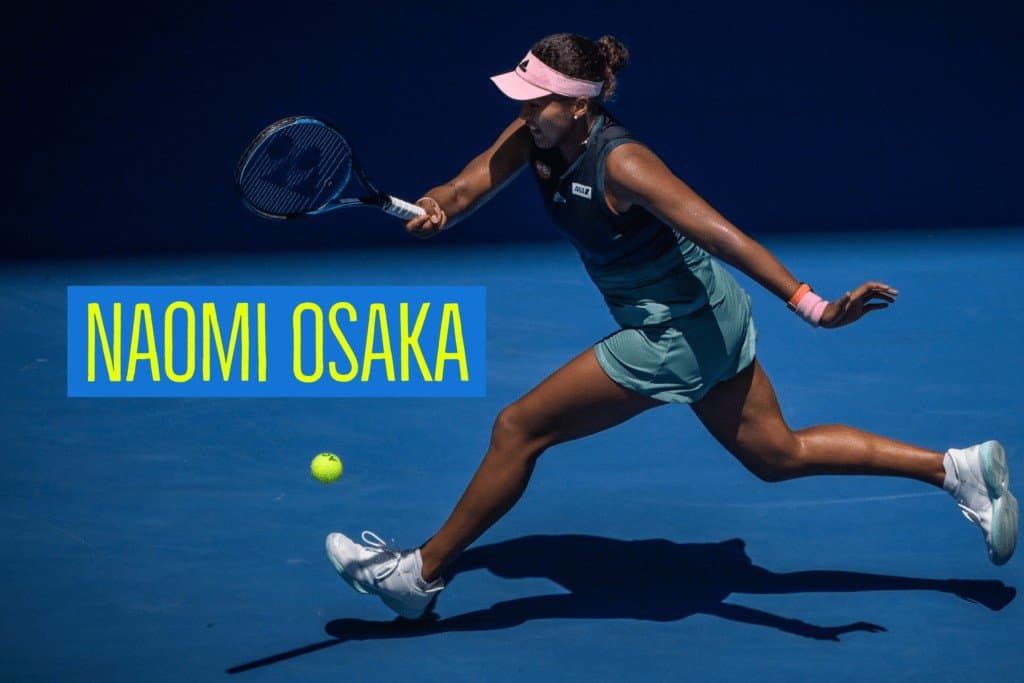
Naomi Osaka

At only the age of 22, Naomi Osaka has made a firm stance as one of the best female tennis players in the world. It didn’t take long for her to make a name for herself, as she already holds 2 Grand Slam titles and has been #1 in the world. Off the court, she is one of the most marketable athletes, male or female, in the world. In 2019, she raked in a record-breaking $37.4M through endorsements and prize money.

After winning the Australian Open in 2019, the rest of her year did not meet her expectations. We definitely expect her to have a breakout 2021 season (especially because MyTennisHQ’s Karue Sell has joined her team as a hitting partner). Naomi has all the tools to chase Serena’s dominance over the rest of her young career, and you can be sure to see her succeed right when the tour picks up again.

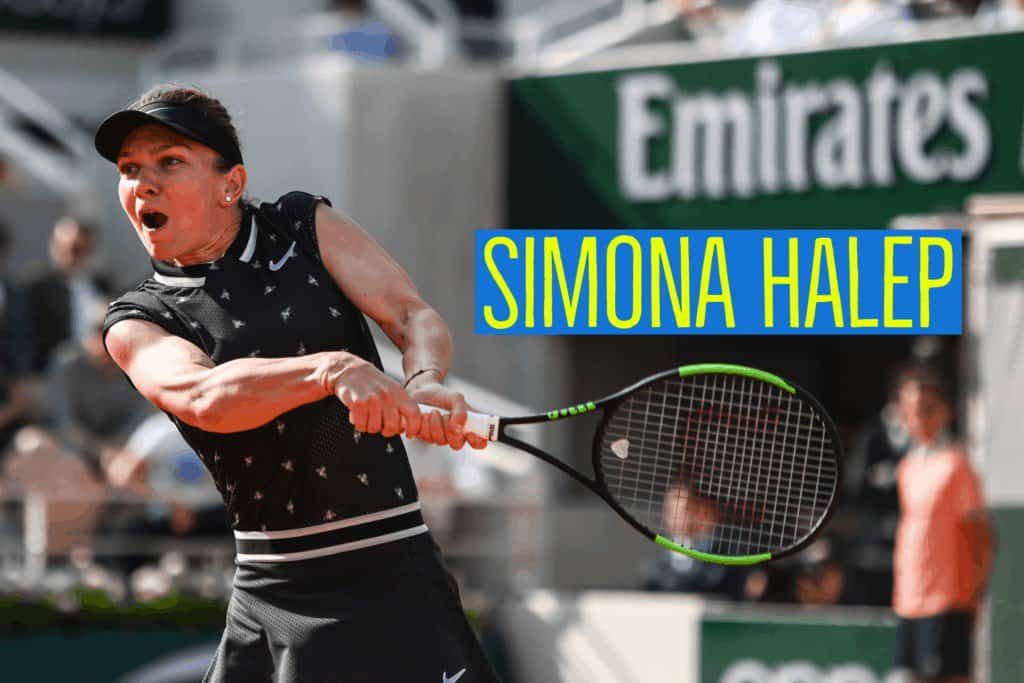
Simona Halep

This Romanian has really come into her own in the last 4 years. In 2017, she became world #1 for the first time and has since spent a total of 64 weeks at the top spot since. She holds 2 Grand Slam titles, one French Open and one Wimbledon.

When #1 in the world, Simona had expectation to win Grand Slams and it weighed heavily on her shoulders. She missed a few opportunities because of this, but now that she has her first and second Grand Slams in the bag, there is no doubt that she has the potential to run with it. She is currently ranked #2 in the world rankings and she has proved to be one of the most consistent players on tour during the past several years.

Bianca Andreescu

Andreescu has proven herself incredibly quickly on the tour. In the year 2018, she did not compete in one match at the WTA level. In 2019, she won her first WTA Premier title at Indian Wells. She was not ranked high enough to qualify for the main draw, so she needed a wildcard for entry. This shot her up the rankings and though she battled injury for a good portion of the rest of the year, she was able to finish #5 in the world.

Going into 2020, she was unable to compete as she was still battling a knee injury. The coronavirus pandemic has suspended the tour, so hopefully Bianca is able to come back and compete when everyone else can. Based on the big time matches and tournament she has won in her limited career, it is safe to say that Bianca Andreescu is going to be hard to stop for years to come if she can stay healthy.

Karolina Pliskova

This Czech player really broke through on the tour in 2014, when she leaped up the rankings from #67 to #24. Since then, she has consistently improved each year. She gradually accomplished the following: top-10 ranking, US Open Runner-up, top-5 ranking, world #1. Though she is still seeking her first Grand Slam title, it is clear that her level is consistently there on a year to year basis. Watch out for Karolina Pliskova to have multiple chances at a Grand Slam before her career is finished.

Ashleigh Barty

One of the most likable players on tour, Ash Barty sits at #1 in the world as of the March 2, 2020 list. Her path to #1 is unconventional. Ash was a good junior player, as she made the finals of Junior Australian Open doubles when 16 years old. However, she decided to take a break from tennis is 2014 and picked up professional cricket. She was signed to an Australian pro team even though she had no formal training inn the sport. In 2016, she picked up tennis again and was world #17 by the end of 2017.

In 2019, Ash won the French Open to claim her first Grand Slam title. In her time on tour she has won 8 singles titles, but it is safe to say there are many more to come. It is clear that Ash Barty is one of the greatest raw athletes we have seen on tour. At just 24 years of age, we can expect that this is just the beginning for her.

Petra Kvitova

This heavy-hitting Czech veteran has become a force over the last 10 years of her career. She currently holds 2 Grand Slam titles, both at Wimbledon, and has been ranked as high as #2 in the world.

In 2016, Kvitova was tragically attacked in her own home in the Czech Republic. The robber got away after slashing her hand with a knife, leaving her with lacerations to her tendons and nerves in her playing hand. After surgery and uncertainty of whether or not she would be able to return to tennis, she came back to the sport at the French Open in late May.

This story has made her a fan favorite anywhere she goes. She has stayed consistent in her results throughout the years since, but has battled some injuries along the way. Though she is 30 years of age, she definitely has a few more years of high level tennis left in her.

Final Thoughts

The WTA tour is exciting because of how unpredictable it is. Going into any given Grand Slam, there are legitimately 20+ contenders for the title. Just take the 2020 Australian Open for example. Sofia Kenin, the eventual champion, wasn’t even on many experts’ radar to win the event. The real experts have come to the conclusion that it is nearly impossible to make predictions on the women’s side of the tour.

The names listed above have all seen their fair share of success while on tour. You can see that there is great diversity in the age, nationality, and game style each of them. Next time you tune in to a women’s pro event, watch for these names to make deep runs in the draw.

How Much Do Tennis Players Make? – The Ugly Truth


When we think of tennis players, we usually think of wealth and luxury – living in a mansion in Monte Carlo, owning a nice yacht, and travelling around the world. While this lifestyle is indeed possible for a select number of players, the reality for the vast majority of players is something more like “driving an old car to the next tournament at a remote country club (with only a handful of expectators), sleeping on a friend’s couch, and wondering where the money for next week’s tournament is going to come from.” A lot less luxurious than the first lifestyle, I know. 

With the rise of social media in recent years, tennis players who compete at the lower levels of the professional tour have been gaining their own space and their own voice. With this newly found voice, several of them have been trying to bring awareness to the incredible inequality that exists in tennis today, hoping to start a movement that will change how these players are treated and compensated. 

You may be thinking ‘well, it can’t be that bad. Don’t all professional athletes get compensated decently?’ Well, it turns out it is that bad, and if every player knew how little they might make they would probably think twice before starting their journey as a professional tennis player.  

So how much, on average, do tennis players make? The average tennis player salary between 2015 and 2019 was $113,478 per year (or $1,940 per match) in prize money. The average salary for the #1 ranked player was $14,406,932 per year, while players ranked #1927 made only $1,126 per year.

This average number above is very deceiving, as only 195 (13%) players made more than $100,000 per year, another 69 (5%) made more than $50,000, and 124 (8%) others made more than $20,000. That means that 76% of all players made less than $20,000 a year.

Not great, right? If you continue reading, I’ll show you some more numbers that will paint a good picture of what the current reality of professional tennis players looks like. 

The Average Tennis Player Salary

Tennis players can make money in 6 different ways, with prize money and endorsements being the most profitable ones. Prize money is the amount players receive for doing their job – playing tennis – well. Depending on the type of tournament played and on the round reached by the player, this amount changes significantly. 

Endorsements, on the other hand, have a lot more to do with the player’s charisma, nationality, or what he or she looks like. These are deals offered by brands who want to have their products associated with a certain player, and seen by millions of people when the player is on TV. While the top players make most of their money from endorsements, these deals are not accessible to lower-ranked players – which means that they rely mostly on prize-money. 

Therefore, when determining the average tennis player salary, I will only take into consideration the prize money amount they receive. I’ll touch on how much players can make from endorsement deals at the end, but for purposes of a fair comparison, I’ll keep them out of the calculations. 

How Much Do Tennis Players Make A Year?

Being a tennis player can be a very financially-rewarding career – if you can make it all the way to the top. Several of the top tennis players make over $1,000,000 every year in prize money, on top of what they make with exhibitions and endorsement deals. In 2020, Roger Federer was selected as the highest paid athlete in the world, beating names like Lionel Messi, Cristiano Ronaldo, and Lebron James. 

On average, the top 5 tennis players in the world make $7,973,904 a year, while players ranked 50 to 100 make an average yearly salary of $510,456. In contrast, players ranked 500 to 1,000 rake an average of $6,996 per year.

The chart below illustrates the difference in pay per year for different levels of rankings. Notice that the yearly salaries for players ranked outside the top 400 are represented in the chart – but the difference between them and the top salaries makes it almost impossible to see those bars. 


If you’re interested in learning how much tennis players make per year at different ranking levels, we have included a table with specific numbers. The table below shows the average pay for players at different levels during the years of 2015 and 2019. For reference, we have also included jobs that offer similar pay, so you can keep a better overall perspective. 

RankingAverage Prize Money / YearJob With Similar Pay
Top 5$7,973,904CEO of Chipotle
5-10$3,314,918CEO of Columbia Sportswear
11-15$2,105,633CEO of Carvana
16-20$1,613,983CEO of Chase Corp.
21-25$1,419,484CEO of Exela Technologies
26-30$1,191,946CEO of Ingles Market
31-35$1,058,999CEO of Axsome Therapeutics
36-40$992,805CEO of NextDecade Corp
41-50$858,914CEO of Lululemon
51-60$708,794CEO of KEMET Corp
61-70$639,344CEO of Miller Industries
71-80$478,822CEO of Premier Financial Corp
81-90$373,679US President
91-100$351,638CEO of Park Aerospace
101-120$298,359High-Paid Doctor
121-140$217,381Lawyer / Finance
141-160$157,616Corporation Manager
161-180$120,832Controller
181-200$106,215Programmer
201-233$88,089Physician’s Assistant
234-266$60,978Entry Level Financial Analyst
267-300$41,671Athletic Trainer
301-350$30,238Bookkeeper
351-400$21,370Substitute Teacher
401-450$16,955McDonald’s Crew Worker
451-500$12,832Living on SS Disability
501-550$11,313Part-Time Substitute Teacher
551-600$8,965Part-Time Grocery Bagger
601-650$11,271Below Minimum Wage
651-700$7,589Below Minimum Wage
701-750$9,554Below Minimum Wage
751-800$5,191Below Minimum Wage
801-850$5,362Below Minimum Wage
851-900$3,753Below Minimum Wage
901-950$3,615Below Minimum Wage
951-1000$3,347Below Minimum Wage
1001-1100$2,726Below Minimum Wage
1101-1200$2,403Below Minimum Wage
1201-1300$1,863Below Minimum Wage
1301-1400$2,763Below Minimum Wage
1401-1500$1,108Below Minimum Wage
1501-1927$828Below Minimum Wage

As you can see, only players ranked in the top 300 in the world can make what you would consider reasonable salaries. However, you need to consider the fact that tennis players have very high expenses – coaches’ salaries, traveling, equipment, hotels, meals – which means that only players ranked better than 150 can break even. 

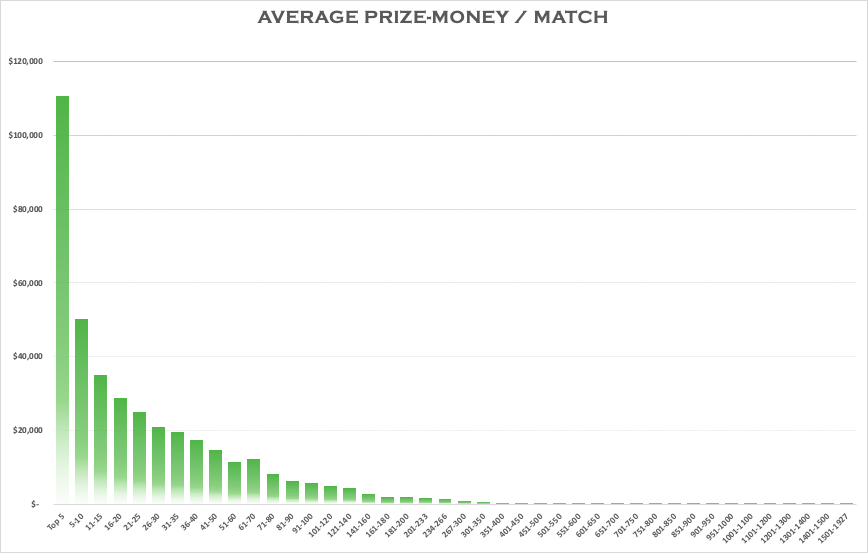
How Much Do Tennis Players Make Per Match?

If you’re wondering how much those salaries would mean on a per-match basis, we have broken it down for you. While players at the top do indeed play more matches than players at the bottom, the difference in pay-per-match is still quite insane. 

RankingAverage PrizeMoney / Match
Top 5$110,697
5-10$50,296
11-15$35,118
16-20$28,820
21-25$24,933
26-30$20,877
31-35$19,712
36-40$17,520
41-50$14,714
51-60$11,576
61-70$12,303
71-80$8,303
81-90$6,328
91-100$5,633
101-120$4,884
121-140$4,288
141-160$2,819
161-180$2,100
181-200$1,917
201-233$1,799
234-266$1,372
267-300$809
301-350$573
351-400$429
401-450$368
451-500$301
501-550$261
551-600$208
601-650$231
651-700$222
701-750$260
751-800$165
801-850$206
851-900$141
901-950$144
951-1000$137
1001-1100$139
1101-1200$127
1201-1300$113
1301-1400$144
1401-1500$107
1501-1927$110

How Much Do Tennis Players Make Per Tournament

The unequal prize money distribution happens due to the difference in payout for different tournament levels. As you can see in the table below, The prize money for Grand Slams and ATP tournaments are extremely higher than Challenger or Future tournaments. 

The winner of the US Open makes $3,850,000, which is 1,782x what the winner of a Futures 15K makes ($2,160). Even a first round loser in a Grand Slam makes $58,000, which is roughly 27 times what a Futures 15K winner makes. 

In order to qualify for Grand Slams, a player usually needs to be ranked among the 104 best players in the world – which means that once you reach that ranking your career goes to a whole new level (financially speaking). 

Average Tennis Top 100 Salary

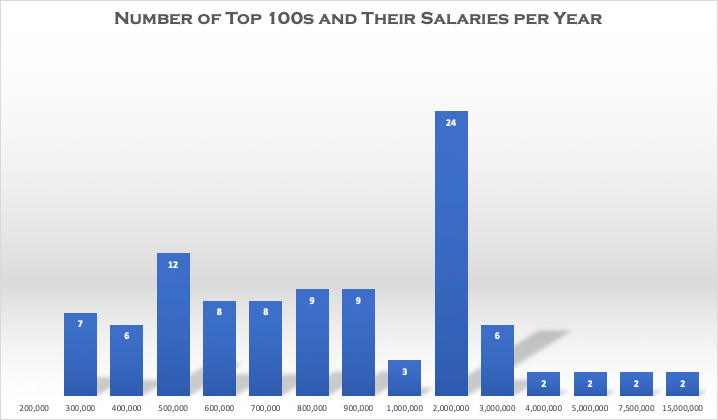
The average top 100 salary during 2015 and 2019 was $1,345,662, but that number is skewed because of the extremely high salaries at the top. The median salary is significantly lower, at $787,746 per year. 

The chart below shows how many of the top 100 players make a certain amount of salary per year. 

Final Thoughts

As you have probably realized by now, being a tennis player can only be a profitable profession for a very small number of players. For those who do make it, life is great and you will probably not need to work after your 30’s. However, the vast majority of tennis players on the tour cannot break even, and is left having to retire and pursue a career as a tennis coach or trying to break into the corporate world. Players across the world are trying to develop proposals for better redistribution of prize money, but none have been accepted thus far. If you want to check out some ideas that have been proposed, you can check out two excellent articles written by current professional tennis players here: Quick Fixes for Prize Money Redistribution and Gambling Issues in Pro Tennis and Futures Level Winners Should Be Awarded Challenger Wildcards: Here’s Why

Can You Volley a Serve Back in Tennis?


There are a lot of rules in tennis, and it can be overwhelming to learn them all, especially if you are just starting to get into it. With serves and returns, there are a few guidelines that must be met to start the point “legally.” As a returner, you may be wondering if you can take the ball out of the air before it lands in the box.

So, can you? The simple answer is no. While it may be tempting at times to take that first ball out of the air, this is not allowed. The servers ball must hit the ground inside the correct service box in order for the point to be started. If the returner makes contact with the ball before it hits the ground, regardless of if the ball was going to be in or not, the returner loses the point.

This article will answer a few more questions on this issue that address technicalities going along with this rule. Keep reading your answer to those “what if…” questions you may be having.

What if I don’t intentionally hit the ball in the air, but I couldn’t move out of the way of the serve?

It doesn’t matter, you still lose the point in this scenario. It is unfortunate, as you weren’t trying to make contact with the serve out of the air, but this rule is firm. If the ball hits your body or your racket in the air before it touches the ground, you lose the point.

So if your opponent is aiming for you intentionally rather than the service box, they can earn a point by hitting you? Technically, yes. However, this never really becomes an issue. One, that is a pretty unsportsmanlike way to earn a point, and two, hitting someone out of the air is pretty hard to do, especially if the returner is paying attention.

What if the serve hits the net, then comes over to hit the returner?

Generally, a serve that hits the net and trickles over into the proper service box is called a “let.” In this case the serve is taken over as a redo.

If the serve hits the net tape and goes over to hit the other player out of the air, the point is counted as a let. The player who makes contact with the ball in the air does not lose the point, but the serve is replayed. This is the only instance in which a player who makes contact with a serve before it bounces does not lose the point straight away.

Typically when this happens, the serve was not going to land in the service box. However, this does not matter. The ball is played as if it were going to land in the box, and therefore the point is replayed.

What if, in doubles, a serve hits the returner’s partner in the air?

If the returner’s partner is hit in the air by a serve, the returning team loses that point. The reasoning behind this rule is that the returner’s partner could have interfered with the path of the serve, therefore they forfeit the point.

If the returner’s partner is hit by a “let” serve in the air, a let is played. The rule is that you must assume the ball would have landed in the correct service box, even if it is clear that it would not have.

This scenario is actually most common on the doubles court, as a returners partner positions themself right next to the server’s target service box. If this happens to you, it is best to chalk it up to bad luck. I have seen it happen only a few times in my life, but it does happen every once in a while.

Final Thoughts

This rule is pretty clear as far as what you do intentionally. Most questions come up in the technicalities of the rule where a player does not mean to make contact with the return out of the air. More often than not, if this happens you likely just didn’t have enough time to move out of the way of a serve that came in hot. It can be a frustrating way to lose a point, but I can assure you that it won’t happen too often.

Hopefully this article was helpful in answering some of your questions. If you have any questions we weren’t able to answer, let us know below so we can do our best to get back to you!

Better Path for Development: ITF Junior Tour or USTA Nationals?


By Drew Baird

May 27, 2020

Disclaimer: The following piece was written by a guest writer. This writer‘s views do not necessarily align with ours at MyTennisHQ.

Two years ago, I was in Milan playing a lead up tournament to French Open Juniors. It was my last year before heading to college, and by this point I was a seasoned veteran with all of the travel associated with the ITF Junior Tour. Since then, I’ve tackled my first season at UCLA alongside a talented group of guys who have all sacrificed plenty to land at such a historic program.

At the same time that my brother graduated high school and committed to a small Division I program in South Carolina, I received a unique opportunity to train full-time at IMG Academy in Florida. I was only 14 years old and didn’t fully understand what commitment was until I went to IMG. I was confined with international players in shoebox dorm rooms who’d kill to be pros. Over the course of my 4 years there I played 59 ITFs in 16 different countries, played every junior slam, and represented team USA in the Youth Olympics. My brother, Will, had the chance to showcase his talent to college coaches around the country by following the USTA path, and got exactly what he wanted out of the sport. I went a different route due to my dream of playing on the pro tour, and I can say that the ITF route gave me a better opportunity to pursue that dream.

There’s deliberation on whether top American juniors should pursue the USTA or ITF tournament path to reach success in college and pro tennis. Luckily, there are clear advantages to both that can be utilized to reach your specific goal. I competed mostly on the ITF Junior Circuit, while my brother competed in USTA sectional and national events until he went to college. Both systems have their pros and cons, and it is important to know which is the best fit for you. I think that if the USTA could implement some of the things the ITF tour does, it would lead to a better system funneling Americans to college and beyond without having to leave their country.

I believe the main thing that separates ITF players from USTA national players is the overall commitment to the game, which consequently raises the level. You won’t come across a machine from Uzbekistan who will do whatever it takes to beat you, ever, at any USTA event. In my experience playing the ITF Junior Tour, I’ve had my strings cut out by opponents prior to matches, been conspired against by home country players and referees, stayed in subpar hotels in El Salvador, and hand washed countless loads of laundry in bathtubs. These experiences are tough, but they significantly increased my motivation to win. You learn to win the small moments, and beat the guys you’re supposed to beat before you can move up in the world. As a teenager, these events led to a quick maturation. Coaches told me, “you grow in stressful situations,” and that couldn’t be more true about the ladder it takes to climb the ITF rankings, on and off the court.

When it comes to scheduling, the ITF has it down to a science. Every tournament, no matter the level or location, is a week long with no more than 1 singles match a day, as long as weather permits. There’s a select group of supervisors that travel around and administer every ITF event, cutting out the chance for an inexperienced club coach to ruin the week. There’s always a physical trainer on site, transportation/food/hospitality at Grade 3s and higher, and a “followed- by” schedule for the order of play. While USTA’s lower level tournaments are tailored so that it’s participants don’t miss any school, the higher level ones are a week long with zero financial help. If the USTA could create a more professional environment on a week to week basis by including some of these things, there’d be less top American players choosing to play ITFs and more playing nationally. This would consequently create a level of competition that could better prepare players for pros.

Today, I am confident in the fact that I have the competitive edge that will bring my tennis game through this pandemic. I attribute this to the experiences I had on the ITF tour and in college. I’m on a team at UCLA with great players who’ve gone down their respective paths, all with a special opportunity to make it on the ATP Tour after being a Bruin. There’s nothing stopping a national player from becoming the next Federer, but for me, I’m not sure I’d be where I am today without witnessing true brutality on court. I think that if the USTA could adopt some aspects from the ITF Junior Tour, more players would develop to be better in the later stages of their careers.

MyTennisHQ.com wants to hear your expert opinion on topics in the tennis world such as this one. Want to express your thoughts? Here is your platform. Send us a message on instagram @mytennishq and we will give you the details you need to start writing.

Drew Baird had a successful junior career, reaching #12 in the world for the ITF junior tour. Following that, he decided to play at UCLA. He spent his freshman year playing exclusively at the #3 singles and #2 doubles slots. Drew’s ultimate goal after developing his game at school is to play on the professional tour. You can find Drew on Instagram @drewbaird18.

Quick Fixes for Prize Money Redistribution and Gambling Issues in Pro Tennis


By Julian Cash

May 25, 2020

Disclaimer: The following piece was written by a guest writer. This writer‘s views do not necessarily align with ours at MyTennisHQ.

One of the biggest talking points when it comes to the lower ranks of the professional circuit (ITF Futures and ATP/WTA Challengers) is income for the players. As it currently stands, it is almost impossible to break even financially if you’re ranked outside of the top 300 in the world. In my opinion, this is a real shame. We are lucky enough to play a sport that generates vast amounts of revenue across all the levels and it is only at the very top of the game that you’ll be rewarded as a player.

If I compare tennis to another sport that only sees money at the very top, such as track and field, you see a totally different issue. Track and field athletes simply don’t have much money in the sport, so providing an income to the lower ranked professionals just isn’t feasible. In tennis, there is money in the sport and the distribution of that money through the ranks lies in the hands of the governing bodies. 

In 2019, the ATP 250, 500, and 1000 events saw 91.8% ($140.4M) of the total prize money, while the ATP challenger tour events saw just 8.2% ($12.5M) of the total prize money. These figures don’t count the grand slams, which would make the disparity even greater.

This leads me onto the implications of betting on the sport of tennis. Like any sport, betting is easily accessible and very common for fans to participate in the top of the game. The real issue, again, lies lower down the ranks. The ITF sells the betting data every year for vast amounts of money and the players see none of it. Not only does this seem unfair and arguably immoral, but the players have to deal with the hate mail this generates every single match, win or lose, and it is the players who have to deal with these bettors on site watching their matches. Technically the bettors aren’t allowed into the tournament sites, but all players will agree that not much is done to actually control them from entering the venues and stop them from watching the matches or keeping them away from players. Unlike what we see in the top ranked ATP/WTA events, there isn’t much player security at the ITF level. Tournaments often lack restricted areas designated only players/accredited personnel, so there is regular potential for contact between bettors and players.

When you link these issues of low prize money, people betting on matches and lack of monitoring who is allowed into these venues to watch, it comes as no surprise that betting scandals are currently at an all-time high in the ITF level of the game. Players on the road are broke, collecting paychecks of under $100 at times with their expenses through the roof. Meanwhile, bettors are trying to find any way they can to take advantage of the players.

I believe that this problem is growing year on year, consistently worsening, because the ITF takes no responsibility for the effects of selling the betting data and continuing to pay the players so poorly.

These problems we face not only tarnish the image of the sport we love, but they also mean that many players get sucked into illegal betting activities or end up having to quit the sport due to a lack of income. Although these issues seem large and ingrained in the structure of the sport, I believe it wouldn’t take much to fix them.

Firstly, some of the money at the top of the game needs to be redistributed down the ranks. I am not saying that the top players don’t deserve significant financial reward, because they do. What I am saying is that skimming some of the prize money from the later stages of ATP/WTA events and Grand Slams could solve a huge amount of the financial issues the lower ranked players face. This would still maintain a high income for everyone at the top.

Secondly, when it comes to betting there are a couple of solutions. Betting can either be scrapped all together at the ITF level. As much as I think this would be great, I also believe that financially it would be impossible as a substantial amount of the ITF’s funding does come from the betting organizations. Another option would be that some of the money generated by selling the betting data could be passed onto the players through additional prize money. Along with that, much greater measures could be taken at tournaments to protect players from on-site bettors.

We would achieve greater prize money at the ITF level by redistributing some of the money from the top of the game, while additionally using some of the revenue generated by selling the ITF betting data. With this done, I truly believe we would see the sport of tennis thrive, provided player protection standards are met. We would see more and more players able to afford a professional career and we would see less betting scandals, as players would have a sustainable income at the lower levels of the game. 

MyTennisHQ.com wants to hear your expert opinion on topics in the tennis world such as this one. Want to express your thoughts? Here is your platform. Send us a message on instagram @mytennishq and we will give you the details you need to start writing.

Julian Cash attended Mississippi State University for one year before transferring to compete at Oklahoma State University. He was a 3x All-American and was ranked top 10 in the country for doubles with multiple partners. Following school, he began his pro career but due to multiple serious injuries, Julian has played a more limited schedule than planned. However, he has still managed career high rankings of #935 in singles and #676 in doubles. You can find him on Instagram at @julian_cash.