The 5 Best Tennis Rackets For Doubles

The 5 Best Tennis Rackets For Doubles

Recent Articles

How To Choose Tennis Balls – The Ultimate Guide


If you’re looking to purchase the best tennis balls for your needs, you have come to the right place. I need to admit that even though I’ve played tennis my whole life, I didn’t always know the difference between each tennis ball, and I now realize that most times I was not using the right ones. 

If you think about the fact that you’re hitting hundreds (if not thousands) of balls every practice, you should realize how important using the right tennis balls is. If you’re playing with the wrong balls, you’re forming habits that may be difficult to change later on – so it’s better to start off right. 

So how can one go about choosing tennis balls? You need to first assess what your tennis needs are and then choose the balls that match those needs. If you’re buying tennis balls for your kids, you should buy slower balls. If you’re playing on hard courts, you should choose extra duty balls so they last longer. If you live in a high-altitude place, you should choose pressureless balls in order to get the most out of your game. 

If choosing the right tennis balls seems like an overwhelming task, you should find the answers to your questions below. We have broken down the major aspects you should consider when purchasing them, and what you should look for depending on your level, age, and court surface. Lastly, we have selected a list of the best tennis balls for each specific situation. 

Tennis Balls Pressurized vs Pressureless

One of the greatest differences you will find between tennis balls is the fact that some of them are pressurized while others are pressureless. Pressurized tennis balls are made through a process that adds internal air pressure to the balls, which causes them to bounce quite high. Pressurized tennis balls are the most common balls you can find, and they are the official balls of all major tennis tournaments.

Pressureless tennis balls, on the other hand, do not have compressed air inside of them. Because of that, they do not bounce nearly as high as pressurized balls, which also means that they are considered “slower” balls.

Since the standard is for tennis balls to be pressurized, you will usually find some indication in the package that should say the balls are pressureless. However, if you are still in doubt, it is safe to assume that if the balls come inside a package that you need to “pop” (vacuum-sealed), they are pressurized balls. If they are packaged with a box or mesh, they are usually pressureless. 

Tennis Balls Regular Duty vs Extra Duty

One other significant difference you will find in tennis balls is between regular duty and extra duty balls. While the difference in feel will not be nearly as noticeable as the difference between pressurized vs pressureless, the main difference will be regarding how long the balls will last. 

Extra duty tennis balls are made with more nylon than wool, while regular duty ones are made with more wool than nylon. Extra duty balls will feel fluffier than regular ones, which means that they will move a little slower and will last longer on hard courts. 

Regular duty balls are less fluffy and move a little faster, which makes them a good fit for softer surfaces like clay or grass, which do not wear out tennis balls as fast as hard courts do. 

Professional vs Championship Tennis Balls

Finally, the last important distinction between tennis balls that you should be aware of is between professional vs championship tennis balls. Professional balls usually give the player a better feel, but they are more expensive and will not last as long. For those reasons, they are usually the choice for professional tournaments. 

Championship tennis balls are more affordable and durable, and they are the ones you can find in most stores. These balls are still great in quality and they are the percet choice if you’re looking for tennis balls to use for practice or club matches. 

Now that you have a better understanding of the differences between tennis balls, we will go over how to decide which tennis balls you should choose. The first question you need to consider is ‘who will be using the balls?’

Who Are The Tennis Balls For?

Before you purchase tennis balls, it is extremely important to consider who will be using them. A 5-year old kid will have very different needs than a 180-pound professional tennis player, so you need to choose the appropriate equipment. The great news is that tennis ball manufacturers are aware of those different needs, and they make different kinds of balls that are targeted to different players. 

Kids

If you are looking for tennis balls for young kids or kids who are just starting to play tennis, it is important to choose balls that will both facilitate the learning process and keep them away from injuries. Thankfully, you can find tennis balls that are specifically made for kids of different ages. 

First, you can find foam tennis balls, which are larger than regular balls and significantly slower, which means that they are the easiest balls to make contact with and the least demanding ones. They are perfect for beginners and kids under 8 years old. 

Second, you can find red felt tennis balls that are specifically made for kids between 6 and 8 years of age. These balls are about 75% slower than regular ones, and they are slightly larger. 

The next step would be orange felt tennis balls, which are the same size as regular tennis balls but are about 50% slower. Orange felt balls are a great fit for kids aged between 9 and 10. 

The final stage for kids before reaching the traditional tennis balls is the green felt. These are the same size as regular tennis balls but travel about 25% slower. They are great for kids aged between 11 and 13. 

Beginners 

Beginner tennis players (whether teenagers or adults), should try to stick to softer tennis balls in order to minimize the risks of injury. There are tennis balls that are made specifically for learning; they feel and play the same as a traditional ball but they are better for your arm. 

Juniors

Junior players who are playing at a competitive level should consider alternating between softer tennis balls during practice, and switching to championship or professional balls as they approach a competition. This will help them to stay injury-free but still prepare well for tournaments. 

Recreational Players

If you are a tennis player who likes to just come out and play a few times a month, you should consider choosing tennis balls that are very durable. This will limit the amount of times you will need to go out to buy new balls, which will be one less excuse not to play.

Professionals

Professional tennis players should choose the same balls that will be used in the tournaments they will compete in. 

Players with Injuries

Similarly to beginners, players with injuries should choose tennis balls that will help them not aggravate any injuries. Specially if you struggle with tennis elbow, choosing tennis balls wisely can help minimize the pain.

Your Playing Conditions

After considering the type of player you are choosing tennis balls for, it is important to consider a few other factors that affect your playing conditions. Choosing balls that are appropriate to your playing conditions can ensure that your playing experience will feel much better. 

High Altitude

If you live in a place that is significantly above sea level, you should consider purchasing pressureless tennis balls. Since high-altitude places have significantly higher natural air pressure, tennis balls will automatically travel much faster than if you were playing at sea-level. In some places, it becomes too difficult to play with pressurized tennis balls, and for that reason pressureless balls are the smarter choice. 

I’ve had the opportunity to play in high-altitude places like Bogota, Colombia and Provo, Utah, and in both of these places the tournament organization chose to use pressureless balls. 

Dry vs Humid Weather

If you live in a place that is either quite humid or quite dry, you may want to take that into consideration when deciding which tennis balls to choose.

The general belief is that tennis balls tend to absorb moisture in humid weather, which causes the ball to become fluffier and heavier. If you have injuries or if you struggle generating power in your shots, fluffy and heavy balls may make your life even more difficult.

On the other hand, if you live in a place with dry weather, you can choose to go with softer and heavier balls.

Surface Type

Last but not least, one of the major factors that will influence which balls you should choose is the type of court surface you usually play on. Clay courts are more gentle on tennis balls, which means that they don’t wear out so fast. Hard courts, on the other hand, can make balls go dead fairly quick. So if you don’t want to stop at the tennis shop every week, you want to purchase balls that will last you a little longer.

Our Top Choices

After going over the major factors that should influence your decision-making when it comes to purchasing tennis balls, we came up with a list of our top tennis balls for each different scenario.

Keep in mind that there are several quality brands out there, but the ones below are our favorites.

Best Tennis Balls

  • For kids aged 6 or less: Wilson Starter 36′ Red Foam
  • For kids aged 6 to 8: Penn QuickStart Tennis 36′ Red Felt
  • For kids aged 9 to 10: Penn QuickStart Tennis 60′ Orange Felt
  • For kids aged 11 to 13: Penn Control Plus Green Dot
  • For junior players: Wilson US Open RD
  • For beginners: Pro Penn Marathon Regular Duty
  • For professional players: Dunlop Australian Open
  • For players with injuries: Pro Penn Marathon Extra Duty
  • For altitude play: Dunlop ATP High Altitude
  • For clay courts: Pro Penn Marathon Regular Duty
  • For hard courts: Penn Championship XD
  • Grass courts: Slazenger Wimbledon
  • For dry & cold weather: Pro Penn Marathon Regular Duty
  • For hot & humid weather: Wilson Championship XD

USTA NTRP System Guidelines and Explanation: What is your rating?


With so many tennis rating systems out there, it can get confusing even for the most heavily invested tennis fans. But don’t worry, we’ve got you covered. This article will explain everything you need to know about the USTA’s NTRP (National Tennis Ratings Program) rating system. 

The USTA uses NTRP to categorize players in order to strive for fairness in competition. This is a classification system that generally describes a player’s on-court abilities. NTRP is most popular among adults, but it does exist for juniors as well. It was designed so that any tennis player can be placed somewhere on the scale. The system starts at 1.5 and goes all the way up to 7.0, ranging from “basic beginner” to a touring professional. Most tournaments within the USTA system will be held between 2.5 and 5.5. This is because any player lower than 2.5 likely isn’t ready for tournaments, and any player higher than 5.5 is likely playing in a different class such as “men’s opens” or professional tournaments.

Here is what their ratings scale looks like from bottom to top:

RATINGLEVEL OF PLAY
1.5Working on getting the ball in the court. Limited understanding of technique.
2.0Able to find the court when the ball is fed in their strike zone, but cannot sustain a rally with another player yet. 
2.5Can sustain a slow rally with another player at a similar level. Movement is inefficient, but if the ball is hit generally at them they will be able to make fair contact with the ball. 
3.0Comfortable with a medium paced rally down the middle, especially with balls hit to their strengths. Can consistently put the ball in the court, but not to specific spots on the court with intent. Struggles with balls out of their strike zone and movement to balls far from them. 
3.5Able to consistently direct their ball to general locations. For example, this player often knows how to control their ball down the line or crosscourt, but can’t quite intentionally place the ball deep or short yet. 
4.0Able to control the ball sufficiently side to side and deep or short in moderately paced rallies. From the baseline, this player generally feels that they can be consistent from both their forehand and backhand side. Many players at this level lose points due to impatience, as they are consistent enough to stay in the point but get overly eager to finish it. 
4.5Able to apply different spins and paces at will based on strategy. Generally has become more comfortable with movement and can move to balls and make contact in their strike zone simultaneously. Strategy becomes more of a factor in matches.
5.0Begins to anticipate where the next ball will be, as the game has now become a bit faster. Regularly able to finish points when given a weak ball. Has found their identity as a player, constructing points around their own strengths and weaknesses. 
5.5Has developed pace and consistency as a major weapon. Can typically rely on their normal aggression level in the highest pressure situations.
6.0-7.0This is a large range, but it is hard to determine where players in this range fall to this scale. These players don’t use this rating system in their tournaments, they use national and sectional rankings. Many of these players compete at the collegiate level, national men’s level, or professional level.  

For a more in depth explanation of these levels, see the USTA’s in depth flyer on that here.

Why is it used?

Many tournaments use this scale to determine who should be playing in which draws. For example, a club may hold a tournament and have one draw strictly for 3.0 players and another draw for 4.5 players. This way players can be more sure that they will play competitive matches. Some draws, due to lack of entries, will be combined as a 3.0-3.5 draw and so on. 

Many clubs also use this system outside of formal tournaments. For example, if a player who is new to the club looks for a Sunday morning match, this rating system can give them a better idea of who they should be playing with before they even hit a ball. Obviously it is imperfect, but works well for the most part. 

An example would be that a regular group of 4 is missing a person and trying to fill the last spot for their doubles game. The group can know that Tim, a man nobody has seen play before, is a good fit because he is a 4.0 and everyone else in the group is around that level. 

The difference between “rating” and “ranking”

Many tennis players get “ratings” and “rankings” confused. Here’s what you need to know.

A rating, such as NTRP, reflects a player’s level more generally. So something like, “Janet is a 3.5. She can get the ball moving and have some great rallies.” Ratings are usually used to put players on a scale that each player falls into, so multiple people can be rated the same thing at once.

A ranking will give a player an idea of where exactly they stack up against other people in an exact order. So something along the lines of, “Matt is ranked number 9 in the men’s 50+ division for Southern California. He has done well in his sectional tournaments.”  In a rankings list, no two players can be ranked the same number. For example, Federer and Djokovic can’t both be #1 in the world at the same time, just the same as Susan and Carol can’t both be ranked #11 in their section for the women’s +55 division.

Both rating and rankings put a number on level, but the main difference is rating is on a scale and rankings is on a list.  

Final Thoughts

The USTA NTRP system is a great way to get people playing matches at their level. The more competitive matches you can play, the more fun you will have and the more you can improve. 

I will say this, though: don’t take this rating too seriously. Too many club players out there let this rating define their game and they get too caught up in it. Relax a little and enjoy the game. If you are good enough to compete at the next level up, your results will show that with time. If you have goals to get better and move on, that is awesome too! But be sure to work on your game, compete hard, and have fun in the process.

If you have any questions about where you fit into this scale, reach out to us in the comments or on Instagram @mytennishq. We are always happy to help!

Is Hitting Around The Net Post Legal In Tennis? – Tennis Rules


One of the first things people learn when they start their tennis journey is that you are supposed to hit the ball over the net. In fact, the net is your first opponent in a tennis match. If you can’t hit the ball over the net, your opponent won’t have to do anything in order to beat you. However, there is no rule against hitting around the net post and that is what we will talk about today.

In tennis, hitting around the net post is completely legal because the rulebook has no restrictions on the height of the ball, meaning that the ball does not have to travel above the height of the net in order to be considered a legal shot. The only requirement is that the ball lands within the court limits of play (singles or doubles lines, depending on what you are playing). According to the official ITF Rulebook, a ball will be considered a “good return” if it is “returned outside the net posts, either above or below the level of the top of the net, even though it touches the net posts, provided that it hits the ground in the correct court (ITF Rule #25c.). 

As you can see, hitting a shot around the net post is allowed but there are a few situations that we need to make it clear in case you hit a fantastic around the post shot next time you step on the court. So let’s get to it.

What is “Hitting Around The Net Post”

For those who are unfamiliar, hitting a tennis shot around the post is one of the coolest shots you can pull off. The shot can only happen when your opponent hits a ball with so much angle that it is possible to hit around the net post and still make it within the boundaries of the court. (see video below) The reason why it is an enjoyable shot to both hit and watch is because it’s incredibly rare that you’ll have the opportunity to do so. And even then, it is super hard to make it so it is a rare shot to see. Here is a compilation of around the post shots so you can see what I am talking about:

Source: ATP Tour

Professional Tennis Vs Amateur Tennis

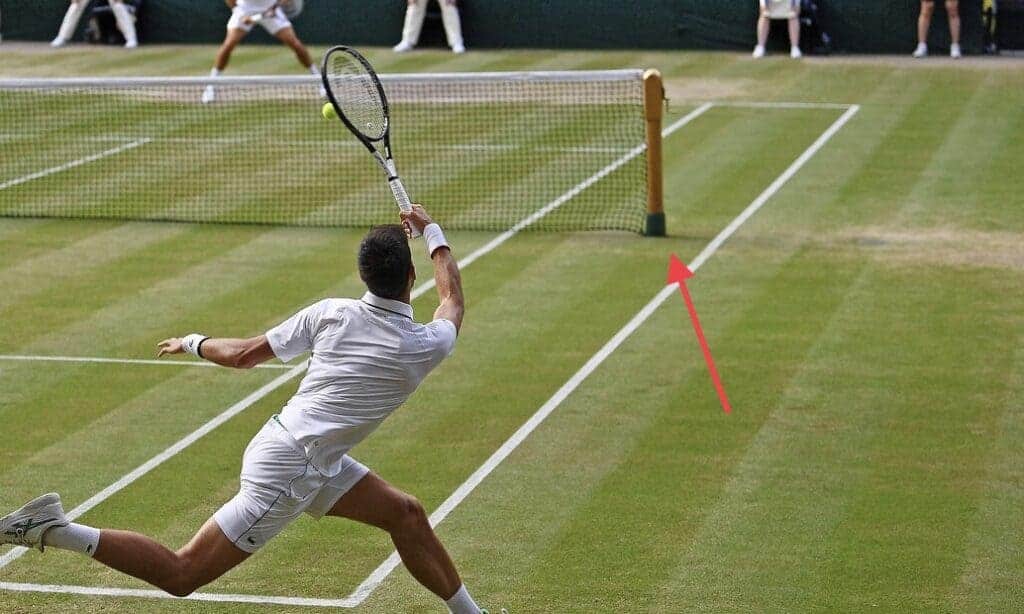
The main reason why around the post shots happen more often in professional tennis is because the courts are built so the net post can be set up in both the singles position and doubles position (see image below). This is not necessarily a rule, most courts at tennis events utilize the normal set up, with the net post outside the doubles alley and singles sticks for singles play. However, in big center courts like at Wimbledon, it is common to see the net post set up inside the doubles alley.

Net Post Set in Singles Position at Wimbledon. Source NY Times

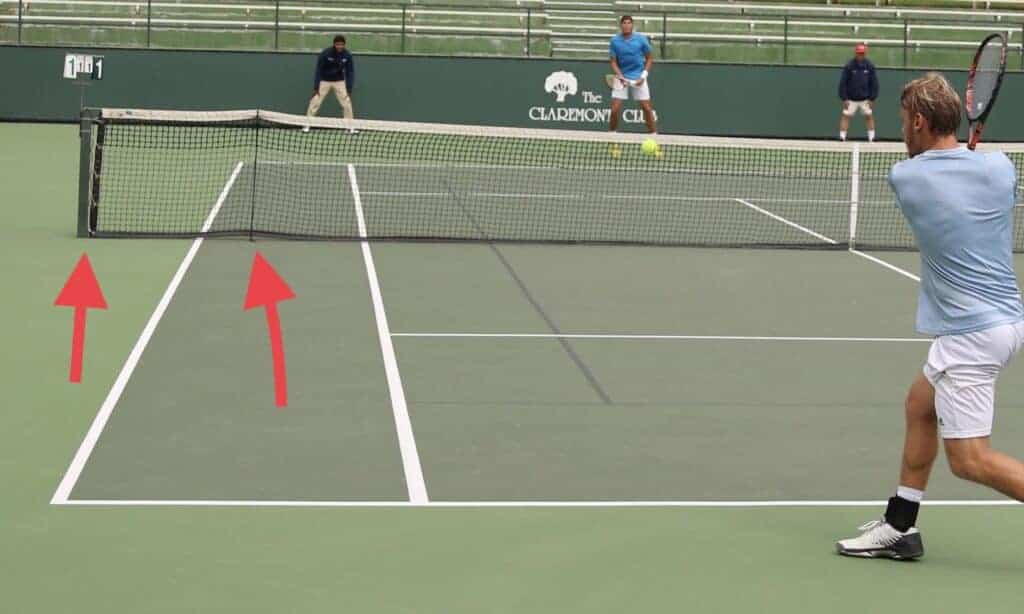
In amateur tennis, the net is typically positioned in the doubles position (outside the alley) and the single sticks are used in order to set up the net in a proper singles position.

Net Post Set Up Outside Doubles Alley + Singles Stick

If you are playing singles, it is pretty much impossible (at least I have never seen it) to hit a shot around the net if it is set up in a doubles position. 

Extra Rules To Keep In Mind

So far, we established that hitting a tennis ball around the net post is completely legal in tennis, but there are a few scenarios amateur players should know in case it happens during a match without officiating. 

The first scenario is if a player attempts to hit around the net post and the ball touches the net post or single stick and it somehow still hits the ground within the correct court, it counts as long as the ball travels through the outside of the net post. (ITF Rule #25c.) However, if the ball hits the net post and travels through the inside of the net post (if there is a gap between net post and net), the shot will not count. (ITF Rule #25a.) 

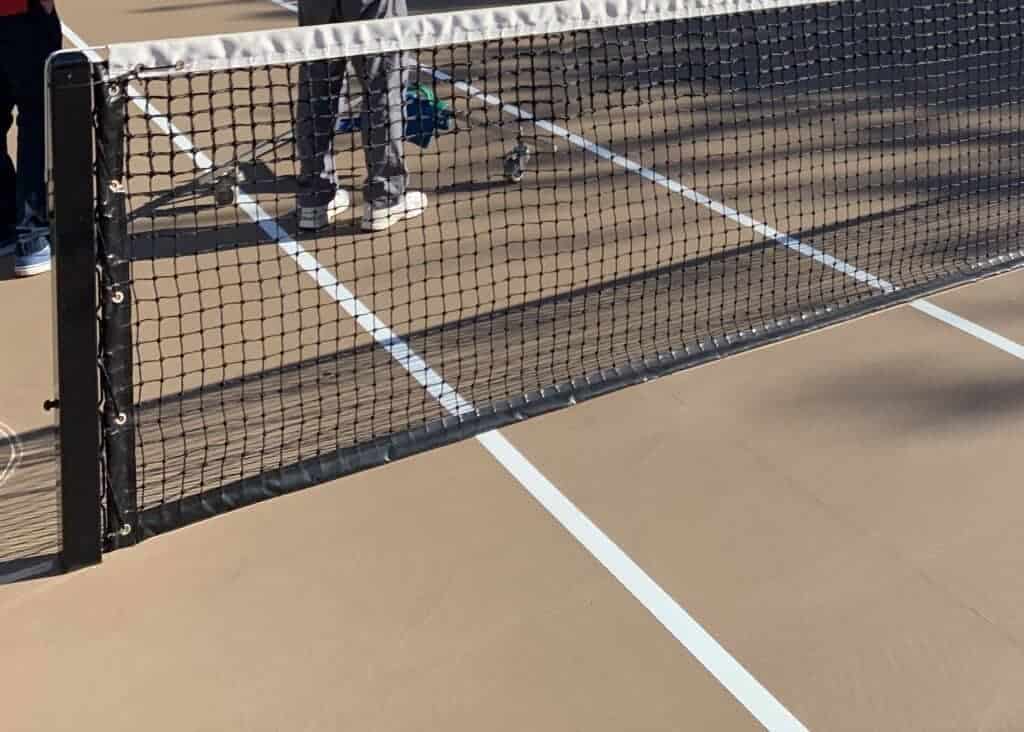
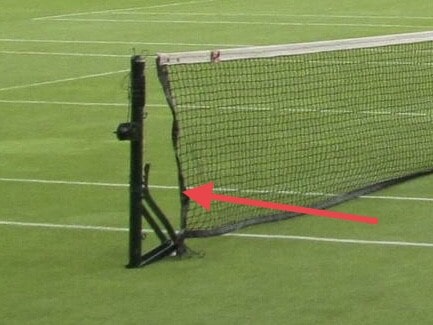
The second scenario is if, and this is more common in amateur levels, there is a gap between the net post and the net and you hit within said gap. In this case, the rule states that if “if the ball passes under the net cord, between the singles stick and the adjacent net post without touching either the net, net cord or net post and it hits the ground in the correct court”, the shot is considered a legal return. The reason why this is uncommon in professional tennis is because the nets are set tightly close to the net post so there is no gap for players to hit through. However, in some tennis clubs or public parks, nets can be old or not properly set up, living a gap between the net post and the net.

Net not properly set up.

Conclusion

So there you have it. Shots around the net post are rare and if you are an amateur playing without an umpire, you or your opponent risk not knowing the rules in this subject. Hopefully next time you step on the court you have the chance to hit one of these shots because they are incredibly satisfying. Have you ever hit a tennis shot around the post? Let us know in the comment section below.

Who Serves First In Tennis?


Tennis is a sport with a lot of rules, and those can be somewhat intimidating if you’re just learning how to play the game. There are rules related to the court dimensions, the scoring system, where you should hit the ball, and how the points work. And even if you learn all of the details, you can’t really start playing a match until you learn who should be serving first.

So how do you determine who serves first in a tennis match? In general, there are several ways to do so, including coin tosses, racket spins, and even rock-paper-scissors. The coin toss is the traditional method used in professional tournaments to determine who serves first, while the racket spin is the most popular among club players. Once the winner of the “game” is defined, he or she can choose whether to serve or return first. 

Below we will get a little more in-depth into how to go about the methods mentioned above and what are the advantages and disadvantages of serving or returning first. 

How To Decide Who Serves First

There is no such rule that establishes who serves first in a tennis match. In professional tournaments, the umpire performs a coin toss, and the winner of the coin toss decides if he or she wants to serve or receive first. However, in club matches or if you’re just playing with a buddy, there are several ways you can decide who serves first.

Racket Spin

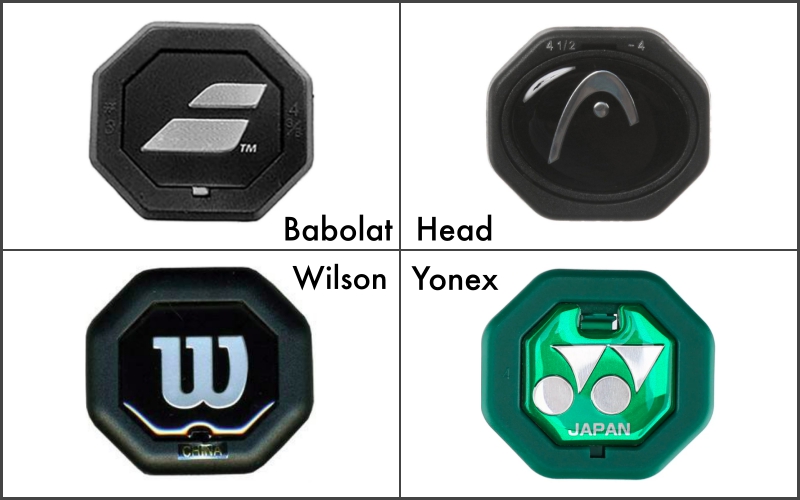
The most common way to determine who serves first is the racket spin. Each racket has some sort of logo, letter, or drawing in the bottom of its grip, which will be different depending on the racket’s brand. You can see the logos for the 4 most popular racket brands (Babolat, Head, Wilson, and Yonex) in the image below. 

The way the racket spin is done is player A covers the bottom of a racquet’s grip and begins spinning it. Player B chooses either “big line up” or “big line down” (if the racquet is a Babolat), or “M” or “W” (if the racquet is a Wilson). Player B then tells player A when to stop spinning, and the outcome of the spin will determine who wins it. 

Coin Toss

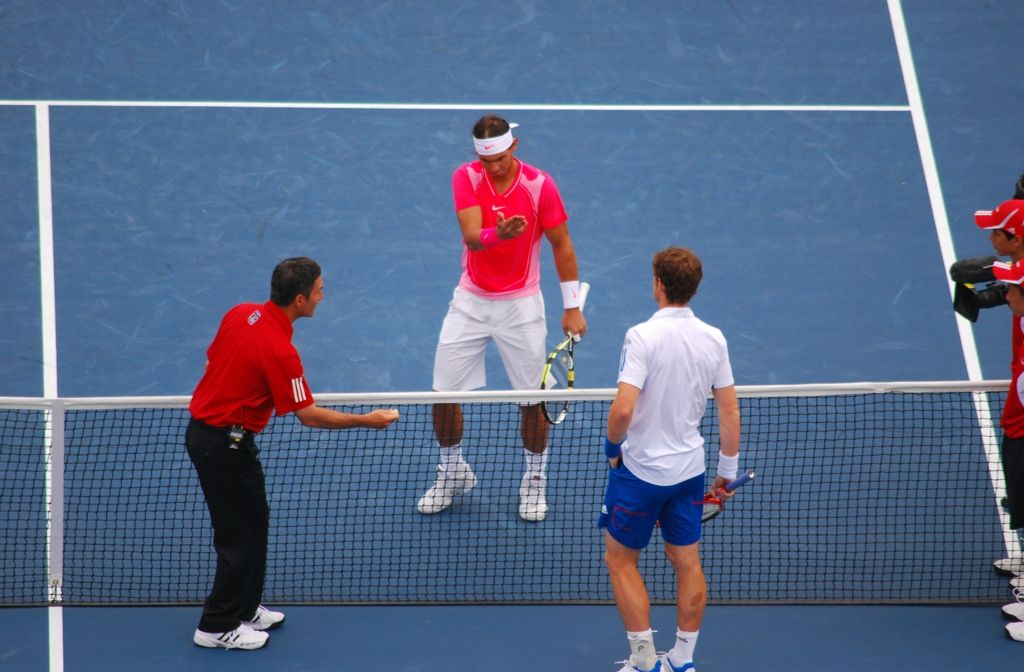
The most common method to decide who serves first in professional matches is the coin toss. Usually performed by the umpire, the coin toss is usually done with both players standing at the net. One of the players picks either heads or tails, and the winner of the coin toss decides whether he wants to serve, receive, or defer. 

Rocks-Paper-Scissor

The third method to choose who serves first is through a good old round of the rock-paper-scissors game. This would be done if the players don’t have a coin in hand and if by some chance their rackets don’t have a logo on the bottom of the grip. I think there’s no need to explain how rock-paper-scissors work, obviously. 

Oldest One Decides

Finally, the fourth and final way to decide who serves first is to let the oldest player decide. This is considered to be the least fair method of all of them, but it can be done if a player wishes to pay respect to an older player. 

Tennis Coin Toss Decision: Serve, Return, or Defer

After both players go through the coin toss, racquet spin, or rock-paper-scissor game, the winner of the “duel” needs to decide whether he or she wants to serve, receive, or defer to the other player. Players also have a fourth option, which is to choose the side of the court they want to start the match on. 

This ends up being a matter of personal preference: some players see an advantage on serving first, others prefer to return, and some others want to see what the other player will choose. We will discuss the advantage of each one later.

Once the winner of the “duel” makes the first choice, the opponent can make their own choice. So for instance, if Player A wins the coin toss and chooses to start serving, Player B can choose which side of the court he or she wants to start on. Alternatively, if Player A chooses a side, Player B can choose whether he or she wants to serve or receive. Once the match starts, players will take turns serving after each game ends. 

Who Serves First In A Tiebreak

If players end up tying at 6 games to 6, they need to play a tiebreak – which is a type of special game designed to break a tie. During a tiebreak, the serving rotation works differently than other games. One player serves for the first point, then players serve for two points each until the set is done.

Due to this different serving rotation, players can become confused as to who should serve first during a tiebreak. The rules are actually pretty straight forward though, as the turns should just continue their normal order. So if Player A served during the last game before the tiebreak, player B will serve for the first point of the tiebreak. 

Who Serves First In The Second Set

Similarly, it can be confusing to determine who serves first in the second set. If the previous set ended in any score other than 7×6, the players should just continue the normal order – so if player A served in the last game of the first set, player B should start the second set serving. 

If the previous set ended with a 7×6 score, however, things get a bit more tricky. The player who should start the second set serving should be the player who started receiving in the previous’ set tiebreak. 

What Are The Benefits Of Serving First?

While it may seem like a fairly trivial decision, choosing whether to serve or receive first may dictate the outcome of the match. Choosing to serve or receive is mostly a matter of personal preference, but players can make that decision based on their strategy against different opponents. 

Choosing to serve first in a tennis match has the benefit of establishing a larger advantage in case you can break your opponent’s serve. If you are able to hold your serve, break your opponent’s, and hold your serve, you will have a 3-game advantage – 3×0, 4×1, 5×2, or 6×3. If you choose to return first, on the other hand, you will only have a 2-game advantage. If you are playing a mentally weaker player or if you like the feeling of having a big perceptional advantage, choosing to serve first will help you get that. 

Choosing to return first, on the other hand, may be beneficial if you tend to start the game slow or if you think your opponent usually starts the game slowly. If you start the game slowly, returning first will give you the opportunity to play a whole game before getting to your service game, which will help you get into a nice rhythm. If you think your opponent starts the game off slow, returning first will give you a good opportunity to break their serve right off the bat. 

Finally, you may want to choose to defer, which will allow your opponent to decide what he or she wants to do first. You may find a benefit in doing that if one of the sides of the court has a lot of sun or wind against it. If you choose to defer, you can wait until your opponent decides whether he or she wants to serve or return, and then you can choose your side accordingly. By doing so, you can make sure you won’t start the match serving against the sun, which could otherwise result in you having your service broken right at the start. 

Tennis Down The Line Shots: 3 Key Tips


Pulling the trigger to go down the line is tricky, but knowing when and how to do it properly will change will make this simpler. Hitting the ball down the line is more difficult than hitting crosscourt because it is a lower percentage play; the court is shorter, the net is higher, and generally changing directions just complicates things with your stroke. I have come up with a few quick tips to help you understand when and how you should be going down the line. I try to keep this as simple as possible so you will be able to incorporate these things into your game with little adjustment period.

When you hit the ball down the line, you should focus on 3 things: your own position in the court, your opponent’s position in the court, and how the ball was hit to you.Going down the line is not “one size fits all.” That’s where you will have to make the decision in the moment.

In short, there are two main reasons to hit down the line. One is to be aggressive (put your opponent on defense) and the other is to get out of a pattern you don’t like. These factors work together in your decision to go down the line and it will help you to weigh the risk and reward.

In this article, I go into detail of the 3 factors to consider when going down the line. After that, I explain why you would go down the line to exit a pattern you do not want to be in. Let’s get into it.

1) Your own court positioning:

Changing down the line becomes less effective if you are further behind the baseline. This is because the earlier you can take the ball, the less time your opponent has to react.

Notice how in the diagrams below, the player changing directions inside the baseline (left) has less distance to cover with their ball. The player on the right has a further distance to cover, so they will have to be sure to create more margin (if not, better to play it crosscourt).

Your position on the left is in a better position to be aggressive,
while the player on the right is unable to really attack.

You should also be aware of your positioning side to side. Going down the line while further off the court lowers your margins and takes away reward, as you may be hurt on the following ball. Again, it’s not “one size fits all” but it is typically better to play high percentage tennis.

As you see above, your target gets smaller as you are further off the court.

You can also see that in the picture on the left, you will be able to get the ball moving away from your opponent. Obviously your margin is bigger as you are more towards the middle, but that doesn’t mean you should never change directions on the move.

As you see in the next diagram, your margin goes way down if you are pulled outside of the alley.

You can see that not only is your margin small, but you are also forced to hit back into your opponent. This is not a smart play because now your opponent is barely forced to move and they have the entire court open for the next ball.

If you do happen to change directions when behind the baseline or further off the court, it will most likely be to get out of a pattern you don’t like. You will need to give yourself more margin and height so that you are not hurt on the following shot. This will give you time to recover as well as less risk for error. Obviously the better position you are in, the more likely you will be to play your ball down the line effectively.

2) Your opponent’s court positioning:

The further your opponent is off the court, the easier it is to go down the line. Why? You will have a big target to be aggressive to, and you will be able to dictate with a ball you are still comfortable with.

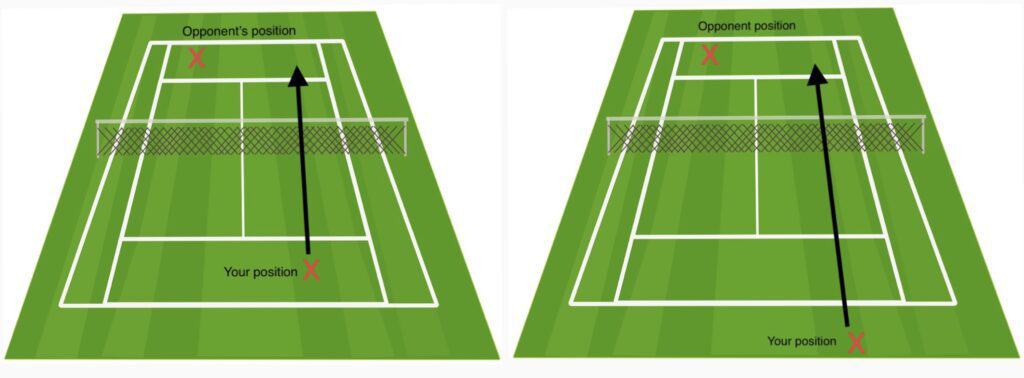
As you see in the graphic below, your position is the same in both the picture in the left and the right. However, your opponent is further off the court in the picture on the left. This gives you a bigger target and your opponent will have a tougher shot as he has to move further. Your opponents movement is shown by the red arrow.

While your position is the same in both photos, you have more of an upper hand in the picture on the left due to your opponents position.

The further your opponent has to go to track your ball down, the more offensive your ball will naturally be. 

3) The ball that came to you:

This factors into the other two. There is no set in stone rule of “if it’s a slow ball go down the line, if it’s fast go crosscourt.” Tennis is always different and relies on your ability to make quick decisions!

Generally, you will rarely be changing directions on a fast ball that you are running out wide to unless your opponent happens to be way off the court. However, if a ball comes fast down the middle of the court it can be a good opponent to redirect to the open court, as your opponent will have less time to retrieve it. This play is diagramed below.

As your opponent hits the ball quickly through the middle, you can simply redirect the ball to the open court using their pace.

For slow balls, you will generally have more options, but again you will need to use your best judgement based on the positioning of you and your opponent. An “ideal” play off of a short and weak ball is modeled below.

Notice that the arrow on your side indicates you moving forward and making contact inside the court. Avoid letting this ball drop below the net if possible.

On this ball, it is important to move forward quickly. A common mistake is to let this ball drop. This ball is ideally taken early because it is easier to hit the ball when it is higher, and it will give your opponent less time to recover and hit the next shot.

When to Go Down the Line

Now that you have a better idea of what to be looking for when you decide to change directions, you should know why you would go down the line at all. There are a few reasons. One is to simply to play aggressively and take charge in a point. I have given you many examples of this above, so look back on them if needed.

Another reason is to get out of a pattern that you do not like. To decide if you want to get out of a pattern, you must understand your strengths and weaknesses as well as your opponents strengths and weaknesses. I’ll highlight an example using my own game below.

Example of Getting Out of a Pattern

Personally, my backhand is my rock from the baseline and my forehand is my weaker side. Therefore, I try to structure points around that. Because many of my opponents pick up on that, they try to stay in forehand crosscourt rallies until they find a short ball or I make an error.

To counter that, I like to play my forehand up the line. However, it is important that I do not force this ball up the line because I am less comfortable on this side. This means I must go up the line with margin and to a big target. The diagram below explains what I mean by this. I am on the near side, my opponent is on the far side.

You can see that on the left, I play the ball high with lots of margin and a big target.

Here is what is happening step by step in the diagram above:

Step 1: I play the ball high and deep down the line with lots of margin. This is a ball I can be consistent on, and it gives me time to recover back to the middle.

Step 2: Opponent plays his backhand crosscourt because it is the high percentage play.

Step 3: I am now in a pattern of crosscourt backhands (my stronger side) rather than crosscourt forehands.

Final Thoughts

Here’s the deal: going down the line is not easy especially when you’re doing it on the wrong balls. I don’t care how cleanly you can strike the ball, the player who is making good decisions is generally going to win the match. Playing percentage tennis will lead to success.

I encourage aggressive play, but it should be done properly. This means changing directions on the right balls as explained above. I hope this helps your game!

I know that there is a lot of information in this article and it may seem complicated. If you have any questions about something that you saw in here, don’t hesitate to reach out to us in the comments below or on instagram at @mytennishq. We are always happy to talk tennis.

Futures Level Winners Should Be Awarded Challenger Wildcards: Here’s Why


By David Fox

May 13, 2020

Disclaimer: The following piece was written by a guest writer. This writer‘s views do not necessarily align with ours at MyTennisHQ.

Most active and former players would agree that tennis at the professional level is a ruthless sport. From the 48 week season to the lack of prize money distribution throughout the levels of the tour, one of the most challenging aspects of pro tennis is climbing through the rankings. It takes a combination of consistently high levels of performance, persistent travel, substantial periods of good health and a little luck thrown in the mix.

The current cut for Challenger Level tournaments on the men’s side is somewhere between #400-500 ATP (give or take depending on the week). In order to be within that ranking bracket you have to accumulate approximately 60-70 ATP points within the 12 month rolling calendar period. In order to reach that, you theoretically must win 6 $15k events (10 points for each), or at least 3 $25k events (20 points for each.) This is of course an extremely challenging feat that many players do not achieve, especially given all of the difficult aspects that the structure of the pro tour brings on.

For those of you unfamiliar with the ITF/ATP tour and the progressions through levels, the ITF Pro circuit is considered the entry level to professional tennis and is made up of two tiers: $15k and $25k. Most players begin their career at this level and spend a majority of their early career building their ranking by earning the limited ATP points that are on offer at this tier. By winning a $15k a player will bag themselves 10 ATP points, whereas a $25k will offer 20 Points for the winner. Once you have attained a high enough ranking, you can make the step into challengers where there are 80-125 points up for grabs to the winner.

On paper it would seem like these events are vastly different in terms of the level or quality of player. However due to the finite number of challengers on the schedule many “challenger” players end up having to drop back into the futures level in order to maintain their point total and maintain match experience. This is why it becomes extremely difficult for players to break into the challenger tour. They are essentially competing with challenger players at the futures level; in my past 3 futures tournaments I have lost to players ranked from #250 – 450 ATP. Considering the level is similar between these two rungs of the tour, I feel that it is important players are rewarded with an opportunity to compete at a higher level whenever they have earned it.

So what can be done to reward successful players and offer more opportunities to move up to the challenger level? My proposal is that all $15k and $25k winners and finalists earn themselves a Wild Card into an upcoming challenger event.

Those wildcards would be awarded by the following guidelines:

  • $25k Winner: Challenger 90 Main Draw WC
  • $25k Runner-up: Challenger 80 Main Draw WC
  • $15k Winner: Challenger 80 Main Draw WC
  • $15k Runner-up: Challenger 80 Qualifying WC

Guidelines for WildCard Use:

  • The wildcard can be used within 90 days (3 months) of the completion of the $15k or $25k from which they earned it from.
  • The Challenger Tournament is selected by the player (at the respective level earned) and they must notify the Tournament Director before the entry deadline with written confirmation from ITF Officials.

As we all know, tennis is a difficult sport to sustain extremely high levels for prolonged periods of time. That does not mean that players aren’t capable of a particular level on any given day. Therefore, rewarding players with direct access to the challenger level through their futures level success gives more opportunities to players to break through quicker. This will allow them to play for more prize money and more ATP points. It also gives players an opportunity to take a bite at the proverbial apple while riding the momentum and confidence that earned them their futures success, before either luck or health diminish or general levels of performance start to fluctuate.

If players happen to have one time success at a futures event and can’t sustain it during their challenger level opportunity, then they can return to futures with the experience and continue the grind. However, if the player happens to continue their success during their challenger experience, then one, their rise through the rankings will be somewhat streamlined and two, their opportunity to play challenger level is thus justified.

A potential addition to this system would be to remove direct acceptance into Challenger 80 Qualifying and have Challenger 80 Qualifying made up of 4 $15k Runner Up’s. This would alleviate the concern futures players may have about travelling to a challenger qualifying event without knowing if they will be accepted, while it would provide incentive for successful futures level players.

MyTennisHQ.com wants to hear your expert opinion on topics in the tennis world such as this one. Want to express your thoughts? Here is your platform. Send us a message on instagram @mytennishq and we will give you the details you need to start writing.

David Fox graduated from the University of Denver in 2016. After a 2 year full-time coaching stint, he began playing professionally in 2019. He is currently ranked #989 in singles and #620 in doubles in the ATP rankings. You can find David on instagram @fantasticmrfox94.