The 5 Best Tennis Rackets For Doubles

The 5 Best Tennis Rackets For Doubles

Recent Articles

MyTennisHQ Interviews: Tom Fawcett


Quick Facts

  • School: Stanford
  • Year Graduated: 2018
  • Current Job: Investment Banker

Bio

Tom Fawcett was born on October 18, 1995 in Skokie, Illinois. He was raised in Illinois and graduated from New Trier High School in 2014. After graduating high school, Fawcett enrolled at Stanford.

Tom had a very successful junior career. Before heading to Stanford in the fall of 2014, Tom was ranked #2 in his recruiting class. He had great success for his high school team as well, leading his school to a state title. He also reached the doubles final of the state championship while representing New Trier High School.

Tom Fawcett played at the #1 singles position throughout all four of his years at Stanford. One of the most impressive aspects of Tom’s college career was his consistency. His freshman year, Fawcett was named the Pac-12 Freshman of the Year and a member of the PAC-12 First Team, ending the year ranked #35 in the country. His sophomore year, Fawcett was named an ITA All-American in singles, finishing the year ranked #10 in singles and #16 in doubles. His junior year, Fawcett was named the PAC-12 Singles Player of the Year and was once again an All-American in singles. His senior year, Fawcett was named an All-American in singles for the third straight year, finishing at #13 in the country.

After graduating from Stanford, Fawcett began to play professionally. He reached a career high ranking of #440 in the world in January of 2019, winning one futures title. After playing over a year on tour, he realized that the tour was not for him. He took a job as an investment banker and is currently working back in Chicago.

Tom has always been a good tennis player and a great competitor. He is a well-rounded guy with a lot to offer, but you’ll read in his interview that he learned a lot outside of the classroom while he was in college. He provides great perspective on the “there is more to life than tennis” mentality, and that is important to understand. Ladies and gentlemen, Tom Fawcett!

7 Questions With Tom Fawcett

#1) What was your recruiting/school selection process like?

When I was in 6th grade, we were given an assignment to write a letter to ourselves to read once we turned 18. My letter started off “Ok, so you’re probably playing tennis at Stanford by now…”. I had always wanted to play tennis at Stanford. I worked hard pursuing this goal both athletically and academically starting at a young age.

By the time I was a junior in high school, I started to have some solid USTA results and, as a result, I had some good options when it came to my college decision. I visited and held conversations with several coaches at schools mostly in the Midwest, but ultimately when I was offered a spot on the Stanford team, the decision became quite easy for me.

#2) What was your favorite moment/story/aspect of college?

There are so many incredible memories from college that it is hard to condense it into a paragraph. One moment that comes to mind was my first 4-3 team win my freshmen year. Our team was ranked close to 40 at the time and we were playing USC, a team ranked inside the top 10. The match, tied at 3-3, came down to our captain, John Morrissey’s court. John ended up winning in a long back and forth match, and after storming the court with the team and celebrating properly that night, I realized how special this team was and what a remarkable experience I was a part of. This moment was when I fell in love with college tennis. There were many more amazing moments that followed.

#3) How did college tennis prepare you for the rest of your career/life?

For most people, college is the first time they are allowed freedom and leniency with their schedules. As an athlete, it’s a little different since class, practice, and fitness dictate most of the time during the day, but there is still more free time than ever before. As a result, college really helped me develop my time management and prioritization skills. In order to truly excel in the classroom and on the tennis court, I relied on these skills.

After school I played professional tennis for a year, and time management became even more vital. There is a lot of downtime on tour, and motivating to be productive with that time isn’t always easy. Now, I am in investment banking, and those skills are still extremely essential. Balancing long hours and a heavy workload becomes more manageable with these skills I learned from college and tennis.

#4) A lot of juniors and parents worry that tennis will suffer because of the academic demands of college. What advice would you give an 18-year old in terms of balancing academics and tennis?

I believe that a healthy balance in life produces the best athletes and people. As a result, demands outside of tennis really helped my tennis game. It forced me to be productive with the time I had in the gym or on the court, and gave me an outlet to mentally challenge myself. I would advise incoming college tennis players to embrace the challenges that come with being a student-athlete, since those challenges are unique and will only help in the long-run.

My tennis game actually began to suffer when I was on tour, and I struggled to find an outlet to get away from the game. My day was consumed with tennis. I found myself missing the balance that college allowed me, and I was provided with a new challenge in terms of figuring out a way to replicate the balance I had in college.

#5) Another thing we see parents worrying about is how the social component of college will affect their kids tennis. What would you tell an 18-year old going to college in regards to having fun without compromising their tennis/academics?

I am most grateful for the relationships I built in college. It is definitely achievable to have a fun and social experience without sacrificing grades or tennis performance. Choosing the right school with a good team dynamic and a coach who provides guidance on and off the court is a huge benefit. As a result, team culture should be one of the first things a recruit considers when looking at perspective colleges.

Fawcett during senior year with doubles parter Axel Geller.
Photo: gostanford.com

#6) Knowing what you know now, what would you do differently if you were starting college again today?

There is very little that I would change from my college experience. All four years were surreal and I have lifelong friends and memories because of it. One aspect of college, which is almost inevitable because of all of the demands, is that student-athletes sometimes try to just “get by” in some classes. If I could go back, I would try to take some classes that weren’t a part of my major and path towards graduation. College is a rare opportunity to learn about truly anything, but at times it was difficult for me to have that mindset since I was just trying to survive the demands of each day while striving for a good GPA.

#7) In your case, why did you think that college tennis was a good option as opposed to going directly to the pro tour?

For me, going pro in tennis was something I realized I wanted to do only after I started college. Therefore, I never thought about going directly to the pro tour (also because I wasn’t nearly good enough to consider it). That being said, my tennis greatly improved over my four years in school, and that time helped me gain the maturity to prepare for a life on tour.

Ultimately, I knew that as much as I loved tennis, it eventually would come to an end. And I knew college would help me prepare for a professional career outside of tennis. I do not believe my tennis career was cut short because of my time in college. In fact, it is because of Stanford tennis and my coaches Paul Goldstein and Brandon Coupe that I ended up playing professional tennis at all. I owe it all to my coaches, teammates and family for pushing my tennis career to the high levels I was able to reach.

Fawcett won the 2017 US Open American Collegiate Invitational.
Photo: usopen.org

MyTennisHQ Interview: Clay Thompson


Quick Facts

  • School: UCLA
  • Year Graduated: 2014
  • Current Job: Entrepreneur

Bio

Clarence Alley “Clay” Thompson IV was born May 4, 1992 in Venice, California. Clay is an absolute legend. The 6 foot 7 (2 meters) player joined the UCLA Bruins in 2010 as the #3 recruit in the nation. Clay was a key player for the bruins, amassing a phenomenal 108-35 singles record during his four years at UCLA.

His senior year was one of the best seasons in school history. Going 37-8 that year, Clay was nails all year long. During the fall, he won the backdraw at the ITA Men’s All-American Championships in Tulsa, which earned him a spot At the ITA National Indoor Intercollegiate Championships in Flushing, NY. He took home the prestigious title defeating Hiltzik in the finals. Clay also won the So Cal Intercollegiate Championships at UCLA, defeating teammate Mackenzie Mcdonald in the finals. His great form continued throughout the dual match season, finishing the year with a 15-5 singles record in the #1 position.

Clay’s senior year form earned him several accolades, including ITA National Senior Player of the Year, First-Team All PAC 12 selection and ITA Single All-American Status. He was the number 1 player in the nation from Jan 2nd until June 4th 2014, dropping to number 2 after teammate Marcos Giron won the NCAA Singles Championship.

After graduating with a degree in creative writing, Clay played professionally for a few years, where he reached a career high of #408 in the world. His playing style and on court charisma made him one of the most entertaining players to watch on the pro tour. Clay is an entertainer by nature and even though his career was shortened because of the financial burden of being on the tour, Clay built a cult-like following in the process.

I was lucky to be Clay’s teammate for 2 years at UCLA and he is one of the greatest guys I have ever met. He is unapologetic about who he is, which is a hard thing to find these days. His interview is fantastic and I hope you enjoy it as much as I did.

7 Questions With Clay Thompson

#1 What was your recruiting/school selection process like?


My recruiting process was pretty painless, I was fortunate enough to be the #3 recruit in the country according tennisrecruiting, in the pre-UTR days. A lot of people don’t know this but when I was a freshman in highschool I was actually verbally committed to Pepperdine with the intent of graduating high school early and joining the team in what would be the spring of my senior year. I decommitted from Pepperdine in 10th grade, citing my desire to look into other options as I felt like I was somewhat forced into that commitment by my coaching team.
Afterwards, I was looking at Virginia, Georgia, Duke, Harvard, Stanford. I took a visit to Duke and Ramsey Smith showed me an incredible time. Along with all my friends I had at that school I was very close to wanting to commit then and there.

Georgia was supposed to be my next visit, I completely forgot about my flight and had a voice message from coach Manny Diaz letting me know he would be picking me up at the airport in a couple hours. As I was sitting at my home in Los Angeles, that was a pretty difficult phone call to make. After this, my parents sat me down and basically said, you grew up in west Los Angeles and you are thinking of going to Athens, GA? Do you even know what that’s like? I didn’t. Soon after I called Billy Martin, who up until this point had not expressed any interest in recruiting me, and asked if there was a possibility to become a Bruin. I took an admittedly uneventful visit before deciding that it was probably in my best interest to stay close to my support team and familiarity of Los Angeles.


I think this comfort and familiarity is very underrated. By going to UCLA and not having to spend 1-2 years acclimating myself to a new environment, I was able to hit the ground running.

RANCHO MIRAGE, CA – MARCH 07: Professional tennis player Clay Thompson attends 13th Annual Desert Smash benefitting St. Jude Children’s Research Hospital on March 7, 2017 in Rancho Mirage, California. (Photo by Michael Bezjian/WireImage)

#2 What was your favorite moment/story/aspect of college?


Everything about it. I loved my college experience. I loved my classes, loved most of my teammates, loved the practices and singular mindset that we all had of chasing NCAA greatness. I loved being in LA still and establishing myself as a bigger part of the community. It’s very tough to pinpoint my favorite elements of what college meant to me so i’ll tell one of my favorite stories:
My sophomore year, I was slotted in at the #2 position in the beginning of the year. Nick Meister played #1 and we were very deep across the board. We had a shot of winning the title that year, but one major obstacle stood in our way, Steve Johnson and USC. Don’t think I need to go into detail about how good Stevie was, but to put it bluntly he was unbeatable in college tennis.

As USC was our biggest competition in pursuit of an NCAA and Pac-12 title, we had to figure out a way to beat them. Playing #2 for USC was Raymond Sarmiento, someone who has owned me for my entire life since playing in the 8 and unders. Raymond was unbeatable for me, he had such a mental advantage, probably having beaten me upwards of 15/16 times with me never getting a victory. I played him in our first match against USC and lost, Nick lost to Stevie and we lost the match. Billy Martin wanted to change something, so he put me at #1 and Nick at #2 for the next match, I lost to Stevie in ~40 minutes but Nick beat Raymond and we won the match. Furious, Peter Smith protested the lineup and stated that in no world am I the number 1 player for UCLA and we only did it to stack and give Nick the best chance to beat Raymond. The Pac-12 committee decided that Peter was right and moved me back to #2 for our Pac-12 championships. My pride had been wounded and as I took the court against Raymond in Ojai, CA in front of hundreds of fans, I felt something different that day. I beat Raymond in straight sets for the first time in my life and in Vitas Gerulaitis fashion said at the net “Noone beats Clay Thompson 17 times in a row”


I went back to playing #1 for the NCAA tournament and had a spring in my step everytime Coach Smith and I interacted from that point forward (we have a great relationship). I think this story relates how much college tennis can mean to someone, this match was one of the best experiences of my life to that date.

#3 How did college tennis prepare you for the rest of your career/life?


The best thing that tennis in general teaches you is how to lose every single day and still get up and strive to get better the next day. Once you achieve #1 player on your team then you are losing until you achieve #1 in the country, and then for a brief moment you are on top of the world until everyone comes gunning to take it away from you. This idea of day after day chasing a goal while getting knocked down pretty much every single day is one of the most important lessons that I have brought into my professional life as an entrepreneur. Let’s just say getting your idea torn apart by narcissistic venture capitalists is a lot easier after giving every ounce of effort you have only to get steam rolled by Steve Johnson and told you are worthless by USC fans.

Otherwise; time management, learning to work with a team towards a specific goal, communication (big for a tennis player) all were positive lessons I learned from college tennis.

#4 A lot of juniors and parents worry that tennis will suffer because of the academic demands of college. What advice would you give an 18-year old in terms of balancing academics and tennis?


My best advice on this matter is to communicate. Your professors understand that you are a student athlete and you have a job to do for the university outside the classroom. The thing those professors don’t like is the cocky athlete who takes advantage of them and expects a good grade. I was very open with my professors about my priorities, and let them know that even though tennis slightly outweighed their class in terms of my day-to-day priorities I still wanted to learn as much as I could from them. To this effect, I made an effort to go to as many office hours as I could, especially after I had to miss class. I think just this effort alone and willingness to communicate with them made my life a lot easier and is something that my highschool, Crossroads, really helped me understand.


So, to any incoming freshman my advice is, be open about your priorities and communicate with people. If there is a problem then at least you will deal with it immediately rather than waiting until you see a bad grade on your transcript.

#5 Another thing we see parents worrying about is how the social component of college will affect their kids tennis. What would you tell an 18-year old going to college in regards to having fun without compromising their tennis/academics?


​Again, I think understanding yourself and being open with yourself and those who support you is key. I told Billy Martin I was rushing a fraternity my freshman year, and he politely asked me to rescind my application as he thought it would be too much for me with my tennis and classes. I trusted in his wisdom and I think he appreciated that. The issue comes about when kids feel a need to hide their behavior from (parents, coaches, teachers) and usually when you have to hide your behavior you are not making the right choices. I felt, as I’m sure that many other freshmen do, the social component was very important for me. If you express your social life to be an important part of your life you must be willing to make time for it and I think that coaches are there to help you identify how to make time in your schedule for certain things. Any coach that completely shoots you down and says no you don’t need a social life or this priority is not important for you don’t do it, is not looking out for your best interest and I would recommend making a change. At the same time, if you completely disregard their advice and are not willing to meet at an equal ground then you are also being unfair.


I think anyone who knows me would say that I was brutally honest and open about my behavior for better or worse, but I think that this helped me understand myself and what worked for me. I always listened to other peoples opinions on what they thought, and then decided whether or not I actually wanted to follow those opinions.

#6 Knowing what you know now, what would you do differently if you were starting college again today?


Won the 2014 match against Guillermo Acorta (Oklahoma) so we could have made it to the NCAA finals to play USC. No, actually, I know Karue and Marcos know how I feel on this one. This is the only regret or real negative experience that I have looking back on my entire college career. 2014 was the year our entire team came together for the first time in my UCLA experience, everyone on that team had each other’s backs and did everything in their power to win the title. Losing that match, as the #1 player in the country and on the team, remembering how my teammates were cheering me on and how their heads fell as I lost. Man, that memory is harrowing for me and I will never ever forget it.


I wouldn’t change a thing about the rest of my college career, even the 2013 NCAA net touch. That’s an incredible story and honestly that team didn’t deserve it as much in my opinion.


The only advice I would give my freshman self which I think is extremely important for anyone at any point in their life is: Find what works for you, believe in it and own it. The sooner you can understand what system and behavior works best for you, share it with others openly and ask for their support. College schedules are meant to train good habits in you, but every person is different. Use the template of college schedules to figure out the best routine for you and don’t be afraid to tell your (coach, parent, girlfriend) that this is what works best. My most productive year in college (tennis and academics) came when I understood what worked for me and what didn’t. Luckily my coach, Billy Martin, was very supportive and I think most coaches will be if you can be open and honest with them.

Game vs. Stanford

#7 In your case, why did you think that college tennis was a good option as opposed to going directly to the pro tour?


The decision for me came down to, graduate high school a semester early and go pro vs finish high school and plan for 4 years of college. I always remember this being an extremely critical decision in my life. I had everything set up for me to leave Crossroads and set out on tour. On one hand I had a bunch of people that were incredibly successful in their respective fields telling me that college is an absolute necessity and on the other hand I had a group of coaches / trainers telling me I should go pro. Ultimately, I was having too much fun being in school and I thought for my development the best thing to do would be go to UCLA and pursue both tennis and academics with equal vigor. I often look back at this decision and think, what if I would have taken that deal and become a top 10 player in the world? I honestly think that choosing to go to UCLA closed the door on becoming a top 10 player in the world, which who knows if I even would have been able to achieve otherwise.

However, knowing myself I really don’t think I would have been fulfilled on that path. I have asked myself before: Okay, your life or Jack Sock? It takes me less than a second to answer that question. I would have loved to play professional tennis at the highest level, but honestly, unless your #1 in the world it’s not worth what it takes.


UCLA allowed me to focus on my personal development; mainly education, tennis and social. Playing professional tennis in this day and age requires the absolute neglect and stunting of any development besides your athletic ability and tennis specific strategy. While I believe that tennis is the absolute best sport for anyone’s personal development, I also believe that the current landscape of the sport shuns the characteristics that once made our sports great champions.

MyTennisHQ Interviews: Martin Joyce


Quick Facts

  • School: Ohio State
  • Year Graduated: 2019
  • Current Job: Accountant

Bio

Martin Joyce is from Hinsdale, Illinois and attended Hinsdale High School. Joyce graduated from high school in 2015 and was rated a 5-star recruit by Tennisrecruiting.net before heading to Ohio State University.

During Joyce’s junior career, he was one of the best high school tennis players in the country and was named the National Boys High School Player of the Year and the National High School Coaches Association Boy’s Tennis Athlete of the Year in 2015. He led Hinsdale High School to four straight state titles. He used this team experience to contribute at a high level for Ohio State.

During his time at Ohio State, Joyce was a major contributor to a strong Ohio State team all four years he attended. His freshman year he compiled a 21-0 singles dual match record playing mainly at the number 6 spot. He also contributed in doubles, where he was ranked as high as number 13 in the country with Ralf Steinbach. Joyce also contributed to singles and doubles success his sophomore year, going 13-9 in singles and 22-2 in doubles during dual matches. His junior year at Ohio State, Joyce compiled a 31-8 singles record and was 27-10 in doubles. He was named an All-American in doubles, as he and partner Mikael Torpegaard reached the finals of the NCAA Individual Doubles Tournament (they beat my partner and I in the semis 10-8 in the third, a heartbreaker!) During his senior year at Ohio State, Joyce clinched the victory for his team in the finals of the National Indoors Championship. Additionally, Joyce reached the top 25 in the doubles rankings with both JJ Wolf and Hunter Tubert.

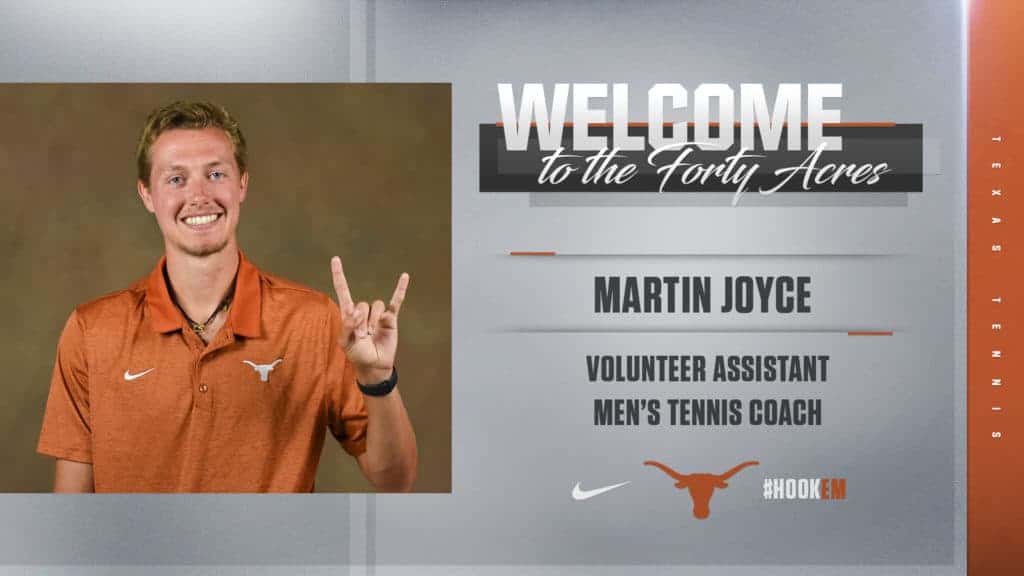
After his time at Ohio State, Joyce was accepted to University of Texas’ McCombs School of Business. He is close to completing a master’s degree in professional accounting. While going to school, he also served as the volunteer assistant coach for the Men’s tennis program, a team that was ranked #1 in the beginning of the year. Joyce has recently accepted a public accounting job in Chicago, Illinois. 

Though he ended my college career in the semifinals of the NCAA doubles tournament and in the team tournament the same year, Martin is really solid guy. He won a lot of matches for Ohio State and led his team by example. He worked hard and as he has accomplished a lot off the court in his time out of school, it is clear that he took a lot away from his experiences in college. Enjoy our interview with All-American Martin Joyce!

7 Questions With Martin Joyce

#1) What was your recruiting/school selection process like?

It seems like the trend in the recruiting process over the last few years is to commit earlier and earlier compared to years past. I was definitely on the earlier side when it came to verbally committing to Ohio State. I don’t remember the exact month when I called Coach Tucker and told him I wanted to be a part of his program, but it was well before I was even able to take any official visits.

Throughout my recruiting I had conversations with a lot of coaches throughout the country and it was definitely difficult to get it down to a final few that I was really interested in. I think something that helped me a lot was actually making “cuts” throughout the process. I would say, ok next week I am getting it down to 10 that I am still seriously considering. Then, a little while later, I am getting it to 5 and so on. This can help a lot because going through recruiting takes a ton of time and if you can cut out schools you know you won’t end up at early on you will end up being able to use that time to find out more about the ones you really might want to go to. This also helps the coaches a ton. They don’t want to be wasting tons of their own time and resources recruiting someone who knows they are no longer interested. One of the hardest things to do is tell a coach no, but they will definitely want to know sooner rather than later.

From the beginning I knew I wanted to try to go to one of the top programs in the country if they would have me. I wanted to give myself the chance to compete on the biggest stage possible and Ohio State was going to give me that every year. I wanted to play for someone that was going to make me work hard even when I didn’t want to push myself all the way and someone that had proven he was able to develop kids into better players. The first time I ever saw Coach Tucker was at the Midwest Closed when I was 16. He was standing in a corner with a Cincinnati Reds hat perched way up on his head, Ohio State Tennis shirt, army camouflage cargo shorts, and chewing on a pen cap. I had a feeling he might be my guy already at that point. A few months later I was in the Varsity Tennis Center for the first time on an unofficial visit watching practice. Balls were flying all over, people were yelling, and everyone was trying to peg each other in the doubles drills. I walked outside after that practice and told my parents this is where I was going to be.

Joyce took high school tennis more seriously than most highly recruited tennis players.
Photo: dailyherald.com

#2) What was your favorite moment/story/aspect of college?

It’s almost impossible to pick out a single moment from my four years in college. On the court it has to be clinching the National Indoors Championship in Chicago my senior year. That is an experience not many people get to have. It was also in the place where I grew up took it to another level. The whole week I had tons of friends, family and people from the clubs I used to practice at coming out to watch Ohio State play. I’ll never forget serving out that last game ever. Especially because the day before my teammate John McNally had jokingly asked me what I would do if I was trying to close out the match to clinch the championship and missed a sitting volley on top of the net. At 15-0 in that game I did just that and looked over at him feeling like I might throw up. But a few points later my first serve went in and my opponents return went straight up and hit the ceiling and I saw all the guys sprinting towards with hands raised and I don’t know if I’ll ever feel better than that again.

Honestly, there might be more great off the court memories with the team than on court from those four years. One year we played at Minnesota on a Friday night and after a good win the coaches wanted to be on the road so fast that we basically only had time for a quick rinse in the shower before heading to Madison, Wisconsin to play Sunday afternoon. We loaded up the minivans and climbed in. I was a freshman so I was in the back row hunched over with a tennis bag under my feet and my backpack on my lap. About 45 min into the drive one of the guys realized he’d forgotten his laptop in Minnesota’s locker room. We had to turn around to get it and then start that drive all over again. We got to the hotel at about 1:30am that night and I’ve never seen a group of guys more mad or more stiff from riding so long in a cramped van. It was an absolute battle, but now it’s one of the funniest stories to reminisce about with those guys and I could call any of them up and we’d still crack up laughing talking about it.

#3) How did college tennis prepare you for the rest of your career/life?

This year I was the Volunteer Assistant of the Texas Men’s Team and am getting a Masters in Accounting there. After I graduate, I’ll start working in Public Accounting back in Chicago in the fall. I think college tennis has prepared me in so many ways for this year and going forward. There are so many skills you develop being a college tennis player. One of the biggest is dealing with failure. If you want to succeed in college tennis you absolutely have to be able to get back up from failure right away and get better from it. You’re playing multiple matches basically every weekend. If you lose a match Friday night and can’t shake that off and come out stronger and hungrier for that next match on Saturday or Sunday then you’re going to have some big problems.

Another big one is time management. There is a lot going on and there really isn’t a break from when you start to when you finish your career. In order to be successful you have to balance everything out and really prioritize what you need to get done. That is something that is going to be huge for anyone to be able to do no matter what they are doing later on in their life.

#4) A lot of juniors and parents worry that tennis will suffer because of the academic demands of college. What advice would you give an 18-year old in terms of balancing academics and tennis?

The balance between school and tennis is definitely something I have seen a lot of parents be concerned about. The biggest thing is being proactive. People don’t realize the amount of amazing resources student athletes are given. You’re in an athletic department that is literally built around trying to help athletes succeed. You have counselors, tutors and other athletes/classmates that want you to achieve as much as you can on the court and in the classroom. It is really just up to the student athlete to take advantage of this. If you ask these people for help, they will give you everything you need to be successful. Of course it is going to be really hard at times, but it is totally manageable.

My freshman year, our captain was Chris Diaz and he had just about a 4.0 GPA in some crazy medical degree. He was also one of the best players in the country, winning almost all his matches at the top of our lineup. Not everybody can do that, but you can get pretty close if you are dedicated and responsible.

#5) Another thing we see parents worrying about is how the social component of college will affect their kids tennis. What would you tell an 18-year old going to college in regards to having fun without compromising their tennis/academics?

A lot of the same stuff can be said here as the question above. It really just comes down to being mature and understanding what you have to get done with school and tennis and doing that first. I have seen a lot of unbelievable college players totally drop off the map because their main priority becomes partying all the time. I have a hard time believing that any of them would say it was worth it to do that once they graduate and look back at their time in college.

I am not saying you should never have fun by any means. It should be the most fun 4 years of your life without a doubt. There is always going to be time to have fun with your friends and teammates. The important thing is just figuring out the right time for that. There are 16-18 hours a day when you’re not sleeping and that is a ton of time. If you can work hard and get what you need done for tennis and school it should leave plenty of time to do what you want outside of that. The hard part is making yourself get that done first. There are going to be days when you have a long practice or two and a lot of homework and there just isn’t time for the social stuff. A day like that you have to avoid the temptation to drop everything and go do the enjoyable stuff with friends. You have to understand there are so many opportunities for that and today just isn’t one of them.

#6) Knowing what you know now, what would you do differently if you were starting college again today?

That is a tough one. I really enjoyed my time at Ohio State and there isn’t much I could say that I would want to do differently. One thing I wish I had known more about is the scheduling of classes and what to take when. This is definitely something to really research and you want to plan out what you’re going to take and in what semester pretty early on. This makes it way easier and then you don’t get stuck where one semester you’re in a couple of the hardest classes in your degree at the same time. This happened to me once and it was a very long couple months.

I would also try to take more classes that I found really interesting. You obviously have to take the majority of your classes in the degree field you pick, but there are some classes that you can basically take whatever you want. My first couple years I just signed up for the ones that were supposed the be the easiest and with minimal work. I really regret that now especially at a huge school like Ohio State where they literally have classes for any topic. I would’ve gotten more out of it taking something where I learned a ton and could use rather than Yiddish Literature where my professor didn’t even show up some of the time!

On the tennis side of things I would’ve made myself do more individuals. Especially having the coaching staff I did where they worked so hard and would happily come out any hour of the day to feed me some balls. This one on one work is where you can make some huge jumps in your game and I definitely could have done more especially in my last couple of years. Of course, there are also the hour limitations on practice you have to factor in so you can’t be doing unlimited time with your coach. I think getting out the basket to crack some serves or wheeling out the ball machine are very underrated. I really only did this if I thought I was playing badly and wanted to get out of it as quick as I could. I wish I had made this more of a regular habit.

I would also highly recommend that sort of thing to anyone on the edge of the lineup. I saw guys on my team that were on the outside looking in, came early and stayed late doing the extra work and because of it they got their spot. If you’re neck and neck with a guy and you’re coming in early to hit forehands on the ball machine and staying late hitting serves out of the basket and the other guy isn’t I guarantee you are going to get the first look.

#7) In your case, why did you think that college tennis was a good option as opposed to going directly to the pro tour?

For me, going pro before college was never in the cards. I was always highly ranked for my age, but not at the level where it was really an option. I had always had dreams of trying to play after I graduated and almost tried to make it in doubles, but by the end of my career I felt like I was better off trying to do a little coaching and go back to school for another degree.

I think my path is very similar to the majority of players that go through 4 years of college tennis. I would say almost every single player should be going to college first. The percentage of players who should be skipping college and going pro has a decimal and at least a few 0’s behind it before a 1. It is absolutely possible and anyone can see this by turning on Tennis Channel and watching guys like Taylor Fritz, Frances Tiafoe, Reilly Opelka, and Tommy Paul. But those guys are the 1% of the 1%. For everyone else, going to college is going to give you the best chance to make it on the pro tour. You can get your level so much better on a college campus and for many people you get to do it for almost free. You have unbelievable coaching, practice partners, and facilities for four years at minimal cost compared to having loads of expenses and grinding virtually on your own every week for four years if you go straight to the tour.

MyTennisHQ Interviews: Dennis Mkrtchian


Quick Facts

  • School: UCLA
  • Year Graduated: 2015
  • Current Job: Associate Attorney for Gjerset & Lorenz, LLP

Bio

Born September 4th, 1993 in Los Angeles, California, Dennis “Dirk” Mkrtchian is a college tennis legend. Owner of a massive forehand, the American was the #6 overall recruit in the nation coming into UCLA. He won back-to-back singles titles at the Southern California Sectionals in 2010 and 2011 and represented the USA in the Junior Davis Cup Team.

At UCLA, Mkrtchian excelled on and off the tennis court. I was his teammate for three years and if there is one word I can use to describe him as a teammate it would be “winner”. We knew Dirk was going to win his matches and that is helped us raise our level. His overall singles record was 101-34. Dirk established himself as a key player for the Bruins despite fierce competition from incredibly talented teammates at the time (Giron, Thompson, Mcdonald, Novikov, Sell, Puget and so on).

To make his time at UCLA even more impressive, Mkrtchian was equally successful inside the classroom. He double-majored in Political Science and International Development Studies, graduating with Cum Laude honors. Because of that, he earned the prestigious PAC-12 Tom Hansen Conference Medal in 2015 for outstanding senior male student-athlete. He also won PAC-12 Men’s Tennis Scholar Athlete of the Year (2015) and First-Team PAC-12 All-Academic selection.

Following graduation, Mkrtchian did not pursue a professional career and focused on getting accepted to law school; and so he did. He attended Boston College Law School for one year before transferring back to UCLA, where he earned his Law Degree. Today, works as an Associate Attorney for Gjerset & Lorenz, LLP, in Austin, Texas.

Dirk is a close friend of mine and we shared many moments together. Your teammates are your friends for life and seeing them succeed and achieve their goals is inspiring. I hope you enjoy his interview.

7 Questions With Dennis Mkrtchian

#1 What was your recruiting/school selection process like?

Growing up twenty minutes from UCLA, I always saw myself wearing blue and gold. But I also wanted to make an informed decision and evaluate each university with an open mind. This was probably the most important decision of my young life, so I didn’t want rush into a decision. I spoke candidly with many coaches, and learned a lot about each program. During the summer before my senior year in high school, I narrowed my choices to UCLA, Michigan, Illinois, and Duke. But following my UCLA visit (it’s strange calling it a visit since my house was fourteen miles away) and speaking with Coach Billy Martin, I knew that I wanted to be a Bruin. I was well aware of UCLA’s academic prowess and was intimately familiar with the tennis program’s success under him. So, we mainly spoke about my game and my tennis and academic goals. Billy also mentioned that I probably wouldn’t play high in the lineup my first year. I actually appreciated the transparency, and was ready for the challenge (spoiler alert – I didn’t play high in the lineup my first year) Billy also recognized that each player is unique. In other words, something that works for one player might not work for another. This approach is what allowed me to succeed on and off the court (and likely true for most of the Bruins crushing it on the professional tour right now). You’ll hear during the recruiting process that having the right college head coach is the most critical factor for your tennis development and college experience. Take my unsolicited advice – it’s a 100% true. I was also excited to join a team of players that I’ve known most of my life. I was already good friends with freshmen Clay Thompson and Daniel Kosakowski. And one of my best friends, Marcos Giron, already committed to UCLA. I committed in September of my senior year in high school and knew that it was the right decision.

#2 What was your favorite moment/story/aspect of college?

This is a tough question. Similar to most former college players, I loved the team aspect of college tennis. Being a part of a team was so much fun – on and off the court. We had many unforgettable battles against our crosstown rivals USC. I played one Trojan – Roberto Quiroz – eight times throughout my college career! Or the nail-biters over the years against Pepperdine (some of the toughest competitors in college tennis at the time), Ohio State (I actually never won a match against a Buckeye), and Baylor (I once saved 11 match points in a match at Baylor). I could describe some of my favorite matches or individual accomplishments. But I’m feeling pretty nostalgic right now, so the story that sticks out to me at this particular time is our match against Berkeley during my freshman year. This was my first away-from-home dual match, and first match against a conference opponent. UCLA had lost to Berkeley twice in the previous year. We were ranked ninth in the county, but we felt we could be better. We were a relatively young team and ready to prove ourselves. The match against Berkeley would be our first true test.

We quickly lost the doubles point. A little over an hour and a half later, we had lost on Court 6 and five of the remaining six matches were in third sets, including mine. Behind my court, several guys were yelling at the top of their lungs “HIT TO THE BACKHAAAAND” in between points. I couldn’t even see them. I think they were hidden in the bushes or trees near the courts. I could only hear them. It was a hostile, but electric environment. Each court was locked in a close battle. But as would become a common theme throughout my time at UCLA, each player found a way to win through their distinctive playing style and on-court demeanor.

On Court 1, Nick Meister, the fifth-year senior who returned after a devastating hip injury, calmly and slowly wore his opponent down with his steady and physical brand of tennis. Clay Thompson was a little more animated on Court 2. I vividly recall his 6’6 arms flailing everywhere. Clay would serve and volley, rip a random backhand down the line, slice, drop shot, grind. He was a lot of fun to watch (but not to play against). Marcos displayed his typical focus and grit, patiently waiting for his opportunity to secure a late break in the third set. This match was just a preview of Marcos’ well-renowned “clutch-ness.” And in the meantime, I hit two backhands the entire third set. I was essentially recovering to the left doubles alley after each shot, refusing to let my opponent exploit my backhand. It was a wild scene that day. We ultimately defeated Berkeley 4-3 (with Nick Meister clinching), the first of many memorable classics during my time at UCLA.

21 MAY 2013: Dennis Mkrtchian of the University of California – Los Angeles celebrates his victory over mac Styslinger of the University of Virginia at the Division I Men’s Tennis Championship held at the Khan Outdoor Tennis Complex on the University of Illinois campus in Urbana, IL. Virginia defeated UCLA 4-3 to win the national title. Clark Brooks/NCAA Photos via Getty Images

#3 How did college tennis prepare you for the rest of your career/life?

College tennis improved my time management and prioritization skills. I know these are some of the more commonly-used answers, but that’s because it’s largely true. Additionally, succeeding on the tennis court and in the classroom requires a strong work ethic. These skills helped me succeed at UCLA School of Law and have been invaluable to my career as an attorney for a transactional law firm specializing in health care finance.

#4 A lot of juniors and parents worry that tennis will suffer because of the academic demands of college. What advice would you give an 18-year old in terms of balancing academics and tennis?

Academics provide an important mental break from the tennis grind. And nobody can train 24/7. If players are really worried about academics adversely impacting their tennis, then they can simply choose a less demanding major. More significantly, academics can provide players with alternative options to professional tennis.

#5 Another thing we see parents worrying about is how the social component of college will affect their kids tennis. What would you tell an 18-year old going to college in regards to having fun without compromising their tennis/academics?

The social component of college contributes to their personal growth and development. This is the best time to learn how to balance tennis with other important aspects of life. And professional tennis players also socialize and have fun. As long as the 18-year old is responsible, then the social components should be beneficial.

source: Daily Bruin

#6 Knowing what you know now, what would you do differently if you were starting college again today?

I would take advantage of the undergraduate resources provided by UCLA and the athletic administration. Athletic administrations at most institutions provide numerous resources designed to assist student athletes with making post-college decisions. It would have definitely reduced some of my post-college anxieties.

#7 In your case, why did you think that college tennis was a good option as opposed to going directly to the pro tour?

I know most junior players dream of playing professional tennis. There was a moment in my junior career when I also had professional aspirations. But I recognized that I was injury-prone. And that I had a pretty weak backhand. And I wasn’t particularly great at the net. I tried improving the holes in my game, but as most can relate, it’s not always that easy. So, I knew pretty early on, at least compared to some of my peers, that I wanted to attend college.

College was a blast. Some of my best memories are from college. And I’ve developed great relationships for life. I live in Austin, but I still talk to many of my teammates and college buddies regularly, including the co-founder of mytennishq.com!

MyTennisHQ Interviews: Bradley Klahn


Quick Facts

  • School: Stanford
  • Year Graduated: 2012
  • Current Job: Professional tennis player (ATP #126, career high #63)

Bio

Bradley Klahn was born on August 20, 1990 in Poway, California. He was raised there and picked up tennis at the age of 11. Klahn attended Poway High School before enrolling at Stanford in the fall of 2008.

Bradley was an accomplished junior tennis player. In his later years, he played mostly on the ITF Junior Tour, competing in tournaments all over the world. He built his ranking up enough to play each Junior Grand Slam multiple times, making the 3rd round in 3 of them. His highest ranking in the juniors was #14 in the world. Before going to college, he was the #1 recruit in the United States for his senior class. 

In Bradley’s career at Stanford, he became one of the best collegiate players in the country. He was acknowledged as the ITA National Rookie of the Year in 2009. Over the next few years, he became a 6-time All-American (singles and doubles 3 times each). Most notably, in 2010 he took home the NCAA Singles Individual title as a sophomore, giving him a wildcard into the main draw of the US Open. In his 4 years, he amassed an astonishing 130-34 singles record (70-22 in dual matches) and a 133-33 doubles record (68-17 in dual matches). Impressively, he played exclusively at the #1 and #2 singles positions. That’s a lot of wins against a lot of good players. For a full list of his achievements in college, see his profile at gostanford.com.

After graduating at Stanford in 2012, Bradley decided to take his talents to the professional tour. He reached a career high ranking in 2014 at ATP #63. Currently, he sits at #126. He has earned a spot to compete in each Grand Slam in the main draw, reaching the second round at Wimbledon and the US Open. One of his best “on paper” wins while on tour came in 2018, when he defeated David Ferrer in straight sets. 

While Klahn has established himself as a world class tennis player at every level throughout his career (juniors, college, and pro), he has also shown that he is a great character. Coming back to school after winning the NCAA singles title in 2010 will show you that to him, there is more to life than tennis. He puts 100% effort into everything he does. There is a lot to learn from this guy, so hopefully you’re able to take something away from the stories and advice that he shares. Give it up for Bradley Klahn!

7 Questions With Bradley Klahn

#1) What was your recruiting/school selection process like?

I committed to Stanford following my junior year of High School, before the July 1st contact period started. After visiting Stanford on an unofficial visit in the winter of my junior year, it quickly went to the top of my list due to its reputation for excellence in academics and athletics. I spoke with Stanford, USC, UCLA, UVA, Duke, and Notre Dame. As the process went along, I discovered that I didn’t want to leave California, before ultimately choosing Stanford.

I really started talking to schools at the start of my junior year. I only took 3 unofficial visits to Stanford, USC, and UCLA. I was looking for the best combination of academics and athletics, a place that could challenge me on and off the court and best set me up for a future with or without tennis. While I always had the goal to play professional tennis, I knew that professional tennis has a finite shelf life and it was important for me to earn a degree. Stanford has provided me a great network of friends who are successful in many different walks of life.

One thing that really stood out to me on my unofficial visit to Stanford was how much effort the coaches put into making sure I not only met the guys on the team but spent time getting to know them throughout the trip. These are the guys you are going to spend a large majority of your college career with and it’s crucial that you find a comfortable fit amongst your teammates. From day 1, the coaches and players made it known they were eager to have me as a part of the team, which made a huge impact on my selection. It also helps that I instantly fell in love with the campus and the area, as well as the culture of success at Stanford.

#2) What was your favorite moment/story/aspect of college?

My favorite aspect of college was playing a sport I love on a team with some of my best friends, surrounded by a great network of fraternity brothers, friends, and professors who pushed me to succeed off the court just as much as on court. Really- I loved the entire experience, and not to say there weren’t hardships, but I look back on those times and realize how much they shaped the man I am today.

I remember freshman year flying into Chicago for Team Indoors, and we were all dressed up in our khakis, a button down, and sport coat. First stop we make upon arrival? Walk right into McDonald’s looking sharp. It felt so goofy but so hilarious, and clearly still stands out. 

My favorite moment of college though: when we hosted NCAA’s my junior year. Winning under the lights against Texas A&M in front of a rowdy crowd, and then coming back two days later against UVA Saturday afternoon and having the support top the previous round, it’s an atmosphere that I’ll never forget.

I’ve been very fortunate to play on some big stages as a professional, but I’ll put those two matches up there with anything in the pros because we were representing more than ourselves- we were playing for our teammates, our school, and the community. I can still vividly see our buddies dressed up in costume- Ninja Turtles, Uncle Sam, and an elephant to name a few.

#3) How did college tennis prepare you for the rest of your career/life?

Playing four years of college tennis taught me the skill of working with others toward a common goal, continued to solidify the need for daily disciplined work toward that goal, and resiliency. There is no time to dwell on mistakes or losses, whether individually, because you need to make sure you’re still supporting your teammates in their matches, or as a team after a loss when the next opportunity to perform is the following day. Simply put, it builds character. How quickly can you accept and move on? How much are you willing to sacrifice for your goals? How do you treat those around you when things don’t go your way? These qualities are imperative to any growth.

#4) A lot of juniors and parents worry that tennis will suffer because of the academic demands of college. What advice would you give an 18-year old in terms of balancing academics and tennis?

What better way to learn life skills that will serve you well in the future than to start at a young age learning to balance separate tasks? College is the first time for many where you are on your own and begin to take serious responsibility for yourself. There is nobody telling you to wake up at a certain time, show up, or do anything. It’s up to you to find out what’s important to you and what you’re willing to sacrifice. The skills I learned of time management and how to prioritize and stay focused on the task at hand are imperative to success in the future. It wasn’t until college that I really decided I was going to give professional tennis my full attention and believe I could be successful.

#5) Another thing we see parents worrying about is how the social component of college will affect their kids tennis. What would you tell an 18-year old going to college in regards to having fun without compromising their tennis/academics?

Know that your actions have consequences. It’s important to have fun in college- these are some incredible memories and you make friendships that often last a lifetime, so 100% take advantage of those opportunities. However, you also can’t lose sight of your own goals, academically or athletically. There will be times you have to sacrifice one thing for another. This goes both ways. You may not be able to go to the event with your friends because of an exam or match the next day, but there may be days where you’re overwhelmed with the rigors of academics/tennis and just need to decompress with friends. As long as you know WHAT your responsibilities are and WHY you are making that sacrifice, you will have an easier time brushing off any feelings of guilt and be able to sleep well knowing you made the best decision for YOU. It comes down to intention.

#6) Knowing what you know now, what would you do differently if you were starting college again today?

I would have taken advantage of the opportunities outside of tennis that Stanford provided by going and listening to speakers, learning about other career paths, and spending more time with my professors. I worked hard in school to earn good grades, but also knew I wanted to play professional tennis. It was easy to get stuck in that one-track mind, but Stanford is a place where everyone excels in his or her own unique way and there is so much to learn from each person’s path.

When I arrived at Stanford, I was overwhelmed by how accomplished and intelligent everyone was. As I progressed, I realized that all that hard work intellectually growing up was still in me and found my academic confidence again amongst my peers, which also helped me feel more confident on court. This can really be summarized as: finding balance. Something we all strive for yet can seem unattainable at times.

#7) In your case, why did you think that college tennis was a good option as opposed to going directly to the pro tour?

I wasn’t physically or mentally mature enough to go straight to the pros. I also think college is an invaluable tool to develop many different sets of life skills, unless you are lighting up the professional tour before you would start college, which I wasn’t.

College presents it’s own set of personal responsibilities. There is nobody there to tell you what you can and can’t do. It can be really scary at first. I remember the first paper I wrote fall of freshman year, I procrastinated until the night before, up past 3 am writing absolute junk, and received the paper back with a note that said, “Please see me.” I walked into the professor’s office with my tail between my legs. Fast forward 3 years and I couldn’t wait to write papers, spending hours and hours doing research for my Economics Writing in the Major course and putting together a paper I was proud of. There are many other examples of this throughout my career, both on and off the court, but the biggest lesson I took from it was- life is going to keep punching you in the face. It’s your responsibility to find a way back on your feet with a determined smile on your face and take pride in your work, whatever that is.

You get to choose who you surround yourself with to support you- family, friends, professors, coaches, and mentors, but you and you alone have to create your own path.

MyTennisHQ Interviews: Simon Freund


Quick Facts

  • School: LSU/UCSB
  • Year Graduated: 2018
  • Current Job: Professional tennis player (ATP #686)

Bio

Simon Freund was born in Stockholm, Sweden. During high school, he attended Idrottsgymnasium and graduated in 2014. After graduating high school he attended LSU, before transferring to UCSB in 2016.

Freund’s career-high ITF Juniors ranking was No. 110 in the world in January of 2014. While playing on the ITF Juniors Circuit, Freund won two ITF Singles Titles and competed at the Junior Australian Open.

During Freund’s two seasons at LSU, he recorded 29 victories. During his freshman year he played at the #5 and #6 spots. HiS sophomore year, he played as high as #2 singles. After two seasons at LSU, Freund decided to transfer to UCSB.

During his junior season at UCSB, Freund compiled an 18-7 singles record playing primarily at the #3 position. Additionally, he and partner Morgan Mays competed in the NCAA Individuals doubles tournament. During his senior season he played primarily #2 singles and #1 doubles. He was ranked as high as #6 in the country in doubles with partner Morgan Mays.

Following his graduation at UCSB, Simon decided to give the pro tour a chance. He has had success in both singles and doubles, currently sitting at near career highs of #369 in doubles and #686 in singles. To this point he has won five futures doubles titles.

I have become quite close with Simon especially since competing against him on tour. He has some great advice to offer, especially because he is a foreigner that happened to transfer schools after 2 years. Enjoy our interview with Simon!

7 Questions With Simon Freund

#1) What was your recruiting/school selection process like?

I believe college coaches/recruiters started to find me as soon as I approached the top-100 on the ITF Junior Circuit. When that happened I started getting offers left and right. I believe it’s very easy to get overwhelmed in the process, so I tried to narrow the schools down to a top 3 as quickly as possible. Then I went on recruiting trips around August/September going into my senior year of high school. Then I finally committed to LSU around October 2015 (recruited for the fall of 2016).

#2) What was your favorite moment/story/aspect of college?

It is very tough to pick out a single moment. But for my time at LSU it would have to have been our road trip against the University of Tennessee and the University of Kentucky my sophomore year. We had a tough stretch of close losses before going on the round trip and our whole post-season (NCAA tournament) was on the line, since we were just on the cusp of getting in. We ended up beating both Tennessee and Kentucky in 2 crazy, come-from-behind 4-3 victories. It was just a crazy amazing atmosphere the whole road trip!

For my time at UCSB it was definitely clinching our conference championship my senior year! We had a great season, with everyone from freshmen’s to seniors stepping up, which helped us go 43-0 in the conference, a record that can’t be beaten! The fact that I was able clinch the last conference match was really a cherry on top for me!

#3) How did college tennis prepare you for the rest of your career/life?

Currently I’m playing full time on the professional tennis circuit. I feel like my college tennis experience really helped me grow and mature as a person.

One of the most important lessons I learned in college was discipline and structure. Like a lot of people growing up, I was “a master of procrastination”. But what I soon realized in college was that there are a lot of different parts that nee attention, and without any structure, it gets overwhelming and stressful very quickly. My first year I felt like I was always chasing from behind, running around on campus like a lost puppy. But with time I started to get better at prioritizing and structuring up my days. I began allocating certain time slots for certain subjects and assignments, and soon everything started to fall in place.

As I kept improving my structure, priorities, and discipline, I started to see big improvements especially on the tennis court. I felt like I was able to solely focus on tennis when I was there, and not the usual 2 projects and 3 homeworks due an hour after practice.

It’s safe to say that college tennis really taught me some great lessons of respect, structure, discipline, teamwork, toughness, and much more, that I will all take with me to whatever challenges I encounter.

#4) A lot of juniors and parents worry that tennis will suffer because of the academic demands of college. What advice would you give an 18-year old in terms of balancing academics and tennis?

I believe that is one of the best lessons you can learn during your time in college; how to structure your day in order to balance your multiple priorities and obligations. The best advice I can give to achieve that is learn how to prioritize, and don’t be afraid to ask your teammates, and especially your coaches and academic advisors for help to structure your days. Everyone is there for a common goal: to help you succeed.

Simon with doubles partner Morgan Mays after taking regional doubles title.
(They beat my partner and I 11-9 in the 3rd set. Still wish we could’ve won that one.)
Photo: Pepperdine University Athletics

#5) Another thing we see parents worrying about is how the social component of college will affect their kids tennis. What would you tell an 18-year old going to college in regards to having fun without compromising their tennis/academics?

My answer here will tie back to what I mentioned above, it’s all about priorities. You’re probably going to end up making some bad decisions here and there, but as long as you’re willing to learn from it and have good people around you, things will work out just fine.

#6) Knowing what you know now, what would you do differently if you were starting college again today?

I for sure should’ve asked for more help and guidance right from the start. I had some amazing role models and mentors around me who were trying to help me in any way they could. I started to learn my sophomore year that it really is a 2-way street, you need to show that you want to learn and improve, they can’t do it for you.

#7) In your case, why did you think that college tennis was a good option as opposed to going directly to the pro tour?

I believe I’ve always been relatively realistic about my abilities. When I was in my mid teenage years, I really felt that I needed to improve, mature, and grow a lot in order to have a chance of being competitive on the professional tennis circuit. So, 4 years of college tennis felt like the perfect match. I personally felt that one of the biggest lessons I learned in college tennis was understanding that you’re playing for something bigger than yourself. You’re competing for the whole program, your coaches, your teammates, the alumni and so many more that are a part of your particular college. The values of respect, unity, teamwork, and much more that you learn from that is invaluable. There’s no better teacher than college tennis.

Simon with his teammate and coaches during his senior day.
Photo: UCSB Twitter