If there’s one annoying thing in tennis it is players who bounce the ball dozens of times before each one of their serves. You play a great point and you’re ready to get into a groove, but there he goes again: bounce, bounce, bounce, bounce, bounce…. Sometimes it can be very frustrating to compete against such players, as it’s hard not to lose focus and cool down before each serve.
Why do tennis players bounce the ball before serving at all? In essence, bouncing the ball before serving gives tennis players an opportunity to develop a tactic for the point to follow, helps them to focus on their serve technique, and serves as a time to breathe and relax before the next point.
While beginners might just bounce the ball because they have seen a pro doing it on TV, there is a lot that goes behind those few (sometimes many) bounces. If used correctly, the second before a tennis point can be key to having a consistent game and winning more matches, and we’ll show you ways to do that below.
Developing A Tactic For The Point
One of the most important ways to use the time bouncing balls before serving is to develop a tactic (or strategy) for the point that is about to follow. In professional matches, those are the few seconds when the whole stadium is usually silent, which makes concentrating easier for the players.
Developing a tactic for the next point can be as simple as deciding where to aim your serve and where to hit the second shot, but usually there is a lot more to pay attention to. These are some of the things I personally pay attention to before developing a tactic for the next point (which happens in the few seconds I’m bouncing the ball before my serves):
The direction the wind is blowing
Whether my opponent or I are facing the sun
What happened in the previous point – winner or error
How tired I am
The overall score of the match
Whether my opponent is nervous, relaxed, or “hyped-up”
Where my opponent is positioned to return the serve
Whether my opponent has been more effective on the forehand or backhand side in the last few points
After analyzing all of these factors, I decide on a game plan for the next point. For instance, I might realize that my opponent is playing against the wind, that he might be feeling nervous – which is causing him to hit short balls – and that he has been missing a few backhands. If so, I’ll decide to hit a high kick serve to his backhand, which would most likely result in a short return, then I’d hit a forehand back to his backhand, approach the net, and hit a volley on the other side.
Focusing On The Serve Technique
Another benefit of bouncing the ball before the serve is that it helps players to focus on their serve technique. Needless to say, the serve is one of the (if not THE) most important shot of a player’s game, and therefore needs to be executed as perfectly as possible.
The difference between a tennis serve and the other shots is that the serve is the only shot in which the players have full control of the shot. In all other shots, the ball will be moving and the player will need to adjust to several factors like ball speed, height, distance, and spin. For the serve, the player has the ball in his or her hand and does not need to adjust, which translates into a lot more control over the shot.
When you’re hitting hundreds of serves every day, you learn how to optimize your serve and then build a habit on that certain technique. Usually this technique involves several “micro-steps” that can be easily repeated in order to hit a great serve every point.
Bouncing the ball before the serve allows players to kickstart their serving routine. I’ll bounce the ball between 4 to 6 times, then join both hands in front of my body, raise my right arm, toss the ball, and finally jump to make contact with the shot. This all becomes automated at a certain point, but bouncing the ball can be crucial to having a good routine.
Breathing and Relaxing Before The Next Point
Lastly, spending a few seconds bouncing the ball before the serve can give the player a great opportunity to breathe and relax before the point. In modern professional tennis, players only have a 25-second break between each point, and if they go over they get punished for it. Within those 25 seconds, they need to: use their towel to dry their hands, choose the balls they’re going to use for the next point, go back to the baseline, and get ready for the point. That’s a lot for 25 seconds, especially if you just ran side to side for over a minute.
The good thing about bouncing the ball is that it is considered to be part of your serve motion, which means that it does not count as part of those 25 seconds. So any time you spend breathing while bouncing the ball is ON TOP of the other 25 seconds. When you’re playing a difficult match and you’re having to run a lot, having a few extra seconds to breathe can be invaluable.
If you begin paying attention, professional players will usually spend more time bouncing the ball after they play a long, hard-fought point. This happens because they’re spending some extra time getting their breathing back to normal.
How Many Times Can You Bounce The Ball?
While there’s technically not a limit to the number of times tennis players can bounce the ball before serving, most players do so between 4 to 8 times before each serve. In the higher end of the spectrum are players like Novak Djokovic, who commonly bounces the ball over 15 times before important points. Doing so can be considered a little obnoxious by other players and fans.
If you watch the video above, you can see a fan yells at Djokovic to “STOP IT!” – referring to the ball bouncing. Personally I can relate to him – it can be frustrating to watch a match in which a player is bouncing the ball 15 times before each point. Life’s too short for that.
You always hear that in order to become truly better at something, you have to push yourself to the limit. In tennis, this is a very common thing to hear in clubs and academies. The thing is – have you ever accidentally pushed yourself beyond your limits?
I have. And doing so will actually set you back a few steps, as the only thing you’ll find beyond your limits are probably cramps, dehydration, and utter exhaustion. So how does one find the right balance between working hard but not overtraining? The answer lies in snacking. Proper nutrition is key to keeping your body from crashing, and since you can’t really have a 4-course meal on a tennis court, eating the right snacks during a tennis session is extremely important.
The best snacks for tennis matches or practices are ones with high simple carbohydrates, minerals, and vitamins, a small amount of protein, and low to no amounts of fat and fiber. These snacks will give the player energy quickly and will be digested quickly, not wasting unnecessary energy with complex digestion.
It is not only important to know what foods to eat, but at what point during a match you should do so, and how much you should actually eat. Below we’ll cover everything you should need to know about the optimal snacks for tennis players.
Why Should You Snack During A Match?
You must think of your body as a car – in order to go anywhere, it needs fuel. And the fuel your body needs comes in the form of food. It doesn’t matter if you have an incredible meal before the match: if the match starts going the distance (2, 3 hours), your body will run out of fuel.
Slowly your legs will not be moving as quickly as before, you’ll become more irritated and less patient during points, and you will start making more careless mistakes. And this is when your opponent will step up his or her game. Personally, this used to always happen to me after the end of the first set. My energy levels would be low which combined with the longer changeover (making me cooldown) would be the perfect recipe for disaster.
While you need energy from food, you can’t really eat big portions during a match. Have you ever tried playing tennis with a full stomach? Not fun. And this is where snacks come in handy – these bite-sized portions will give you just the right amount of energy to endure a long tennis battle.
What Makes A Snack Good For Tennis?
As mentioned earlier, a good snack for a tennis match or practice will be one filled with minerals, vitamins, and simple carbohydrates, with a small amount of protein, and very little to no fat and fiber.
There is a huge misconception these days that you should not eat carbohydrates and should focus mostly on proteins – but this is not true, especially during a tennis match. While this may be a decent strategy if you’re looking to build muscle and lose weight, it won’t take you too far as a tennis player.
High-protein foods cannot be easily transformed into energy, which means that you will not get that extra boost you need. High-fat foods can be more easily transformed into energy, but they are not recommended because they might give you an upset stomach and chances are that they will make you feel sluggish. Finally, high fiber foods are not recommended because… well, they might make you need to poop.
The answer lies in simple carbohydrate snacks. Simple carbohydrates will give you the fastest energy possible, and they are very easily digested. We’ll show you some examples of great snacks in a bit.
When Should You Snack During A Match or Practice?
Knowing when to snack during a tennis session is just as important as what to eat. As a general rule, considering you had a nice meal between 1-3 hours before the match, you should snack after every 40 to 50 minutes of physical activity. So if you play a 3-hour match, you should snack around the 45-minute mark, then 1:30, then 2:15.
10 Best Snacks For Tennis Players
If you follow the advice we’ve given you above, you can come up with dozens of great snacks for a tennis match or practice. However, in order to make your life easier, we’ve listed our 10 favorite snacks for tennis players:
#1 – Bananas
Bananas are one of the most common snacks chosen by tennis players. Besides being a fully natural snack, it provides very quick energy in the form of fructose and it helps to combat cramps, as it’s also full of potassium.
#2 – Pretzels
Pretzels are also a great option for snacks during a tennis match. They taste awesome (haters gonna hate), they will not upset your stomach, and they are a great source of energy.
#3 – Energy Bar
This is something you have to be a little careful with. Energy bars can be absolutely outstanding sources of energy, but you need to make sure you choose the right ones. If you don’t, you’ll end up with nothing more than a sugar rush and a sugar crash.
Some energy bars are pretty much just a candy bar with a fancy package. You should choose bars that have good ingredients and that don’t contain too much sugar. Personally I love the Cliff bars as they taste great and give me good energy, but there are several different good options out there.
#4 – Energy Chews
Energy chews are a good option for tennis players who get an upset stomach if they eat something on court. These are full of carbohydrates, but they also contain vitamins and minerals in them. However, they are mostly made out of sugar, so we recommend you use them as a last resort.
#5 – Protein Bars
Protein bars are similar to energy bars, except that they have a higher amount of protein in them. This means that they will make you feel more full, which can either be a good or a bad thing depending on who you are. If choosing a protein bar as a snack, make sure you choose one without too much sugar but with enough carbs.
#6 – Crackers
Crackers are very similar to pretzels in the sense that they are easily digested, are fairly light, and can give you great amounts of energy. I personally enjoy Goldfish crackers, but there are a huge number of good options out there.
#7 – PB & J Sandwich
The good old PB&J sandwich is also a nice alternative as a tennis snack. If choosing this option, choose white bread and steer away from adding too much peanut butter. Otherwise, your sandwich will have too much fat in it and might make you feel sluggish. I know that having a full-on sandwich on court might be a bit odd, so these little bite-sized PB&J snacks are a great alternative.
#8 – Trail Mix
A good trail mix is an awesome alternative for a mid-match snack. Make sure to choose one without too much chocolate and nuts (those have high-fat content), and focus on the ones with high carbohydrates like the one above.
#9 – Dry Cereal
Cereals are not just for breakfast – they can be a great source of energy during a match. You can find them in small packages like the one above, and eat a little every changeover. While this one is made with whole wheat grains, they should not be too heavy on your stomach. There are several options out there – just pick one without too much sugar.
#10 – Rice Cakes
Finally, the last snack option is rice cakes. Choosing a rice cake like the one above is a great decision if you’re looking for energy but still looking for an overall healthier choice. These are usually made with whole wheat (that means more fiber), so they can be a little harder to digest.
Final Thoughts
Choosing the right snack for a tennis match can give you the edge to finish the match strong and defeat your opponent. Remember that you should choose something with a high content of simple carbohydrates, minerals, and vitamins, low protein, and little to no fiber and fats. You should eat a little at a time, and make sure you’re eating something after every 45 minutes of play. By following this advice, you should never end up pushing yourself beyond your healthy limits!
If you have ever watched a doubles tennis match, chances are you’ve witnessed two partners approaching each other between points, getting really close, covering their mouths, and whispering something in each other’s years. While it may seem a bit strange, you should rest assured knowing that they’re not engaging in any sort of twisted pillow talk or gossiping about their opponents’ outfits.
What do tennis players whisper to their doubles partners? Between points, doubles players communicate to each other what their strategy for the next point is. Common things mentioned are where the serve or return will go, and where the net player should position himself after the first shot. The reason why they whisper is so the opponents won’t hear the strategy.
Doubles tennis matches require an incredible amount of coordination and strategy, even though not many people are aware of that. It takes great communication to work as a true doubles team on court – otherwise you’re just two singles players trying to share the same court space. Below we’ll go into more details about what exactly players whisper to each other.
Why Do Tennis Players Cover Their Mouths?
Doubles tennis players cover their mouths in order to keep their opponents from figuring out their strategy. Even though the opponents are on the other side of the court, they could possibly read lips – or a coach nearby could eavesdrop on the strategy and alert his or her player.
If I’m telling my partner that I’ll serve to our opponent’s forehand and somehow our opponent hears that, he will have a huge advantage when returning the serve. This is why doubles players cover their mouths when whispering. Even though this may be obvious for big tennis aficionados, it may not be that clear for new tennis fans.
What Doubles Players Usually Whisper
While doubles partners could technically be whispering anything to each other, there are 4 main topics that they usually address: where the serve/return will go, what the player at the net should do, what the baseline player will do, and the overall strategy for the point.
#1 – Where The Serve/Return Will Go
The first and probably most common topic whispered by tennis players is where the server will try to place his or her serve (when the team is serving) or return (when the team is receiving).
The player who is serving will usually say whether he is going to serve to the opponent’s forehand, backhand, or body, and in some cases he might include the type of spin he will add to the serve (slice, topspin or flat).
On the other hand, if the player is about to return a serve, he will mention whether he will try to hit the return at the opponent at the net, hit a lob, or hit the ball at the baseline opponent.
The reason why players communicate about this is so that their partner can be better prepared for the next shot. Once you play enough doubles, you realize that hitting the ball at specific places will generally result in similar subsequent shots. For instance, hitting serves more towards the center of the court will generally result in the next shot coming towards the middle of the court. So by communicating the location of the serve or return, players hope to give their partners an edge against their opponents.
#2 – Where The Net Player Will Go
The second most commonly whispered topic is where the net player should position himself and where he should go afterward the serve or return. This is part of the team’s strategy, and is one of the most important aspects of the doubles game.
There are several different ways a team can position itself when serving: one player on each side, both players at the baseline, the net player at the center of the court (“I” formation), and both players standing on the same side (Australian formation).
These formations are used to explore the team’s strengths and the opponents’ weaknesses. Needless to say, it’s very important that players communicate these strategies before the points begin – otherwise chances are that the players will end up bumping into each other.
“I” Formation in Doubles Tennis Match
#3 – Where The Baseline Player Will Go
The third topic whispered by players is where the baseline player will go after the first shot (serve or return) is hit. If the players choose a regular formation, the baseline player will need to decide whether he will remain at the baseline after the first shot or go to the net.
If the players choose a different formation (I or Australian), then the players will need to decide who will take each side of the court after the first shot is hit.
This is usually used by slightly more advanced players, as beginners are usually not as aware of the game in order to plan that far in advance.
#4 – Overall Strategy
The fourth and final topic discussed by tennis players through whispers is the overall strategy of the team. These are more high-level comments that address the overall moment of the game.
Maybe a player notices one of their opponents is struggling with a certain shot, and they whisper a new strategy to each other. Maybe they need to slow down the game and hit a few more lobs, so they communicate and change the strategy with the intent of taking control of the match.
Understanding doubles strategy is the key to becoming a great tennis player, and it is a huge differentiator. Players are extra secretive when discussing strategy, as accidentally “spilling the beans” to their opponents could cost them the match.
Final Thoughts
If you’re new to tennis and all the whispering that happens in a doubles match seems strange to you – I get it. It just seems like a whole lot of effort to do that before every point, and it would be much easier to just shout it out loud.
However, these few whispering seconds are the best opportunity players have to communicate with each other and change the course of the game. They’re the equivalent to a basketball or football timeout – when the coach wants to regroup and set the tone for the game moving forward.
Although it is played all year round across the world, a lot of us still see tennis as a summer sport. Wimbledon encapsulates this, with its grass courts and strawberries. When Federer or the Williams sisters step out into the glare on the almost permanently sunny Centre Court (or perhaps the fluorescent lighting, with the rain beating down on the roof!), they are always in pristine white outfits, presenting an extremely summery image. Roger somehow seems to look cleaner than humanly possible, even after he has played.
Nonetheless, it’s not just the champions who wear white at Wimbledon: anyone who does not will be quickly escorted off the court to change. There are a number of clubs around the world that operate a similar rule. So, where does the idea of wearing white clothes for tennis come from?
There are 3 main reasons for the white clothing rule: historic social trends, club traditions, and the way it reflects heat. Historically, white clothes were a symbol of wealth and class which is why some clubs only allow this color. Additionally, white clothes absorb less heat – which helps players stay cool throughout the match.
Let’s look at the logic behind the use of white clothing in general, and then focus on the place where it is most famously required.
Why Tennis Players Wear White in General
Scientists will tell you that white material reflects as much of the visible spectrum of light as possible, so it does not absorb much heat. This means that if you are going to play sport on a hot day, white clothing will keep you cool. So far, so logical, but that does not explain why players should not be given the choice of what color to wear.
In fact, the idea of white outfits for sport goes back to the 17th century, when the first mention is found of a tennis player wearing white. This may have been to stop them from getting too warm, but social pressure would soon become a major factor.
Gradually, all-white was adopted as the leisurewear of the wealthier classes on both sides of the Atlantic. This was partly a status symbol: the working classes could hardly wear white clothing in their daily lives, as any dirt was obvious. Those who did wear it were basically saying that they were upper class and did not need to work. White clothes also tended to be expensive, reinforcing their association with the social elite.
Nonetheless, gradually, the middle classes also adopted the trend, in order to present a successful image. By the early 20th century, participants in summer sports played by the wealthier classes, like tennis, cricket, bowls, and croquet, were expected to wear white.
Why Tennis Players Wear White at Wimbledon
Nicolas Jarry wearing the traditional all-white outfit at Wimbledon
Wimbledon is run by the All England Lawn Tennis and Croquet Club (AELTC), who see their job as putting on a great tennis tournament while maintaining the traditions of the club. With the trend towards white clothing for summer sports, it was no surprise when, in 1890, the club introduced a requirement for predominantly white clothing to be worn by all players.
During this era, such rules were common, but in recent years other major tournaments have decided that players can be allowed the freedom to dress in whatever colors they like. Wimbledon has emphatically not followed suit, with the AELTC making their requirements even stricter. They see the traditions of Wimbledon as part of what makes it unique and have no plans to change this rule.
Wimbledon Dress Code
The Wimbledon dress code for players currently extends to 10 paragraphs. In summary, players have to wear clothing that is ‘almost entirely white’. They need to be careful when doing their washing, as ‘off-white’ and ‘cream’ are excluded. Colored trim or small areas of color in a pattern are allowed if the colored part is no more than 1cm wide.
These same rules apply to everything from caps to tracksuits and medical supports. Even underwear that might become visible has to be white! Logos are outlawed, and shoes are subject to strict requirements. These rules have been tightened up by the AELTC in recent years so that some outfits which were acceptable a few years ago are no longer allowed.
The rules are a lot more relaxed for spectators, and as long as you are not expecting to be invited into a Members’ area or a hospitality suite you can more or less wear what you like. If you are watching the matches on Centre or Number One court, smart casual dress is preferred but will not be strictly enforced.
Ripped jeans, vests, sports shorts, and dirty trainers are discouraged, but the key thing to avoid is clothing with political slogans or large logos. The club expects to avoid ambush marketing and political protests, so the security staff will be on the lookout for this kind of thing. Apart from that, feel free to dress comfortably, and keep in mind that even in England it can get very hot sitting in the sun watching tennis.
Final Thoughts
The requirement to wear white clothing at Wimbledon, as well as some other clubs, can be looked at in two ways. Some will think that it makes players look smart and clean, and the rule should be retained in order to keep the old-school qualities that make the game what it is. Others would say that it comes from the days when only the wealthy or upper-class could play, and it emphasizes the fact that tennis is not an inclusive sport.
In my opinion, it is fine at Wimbledon, where the world’s top players are happy to dress up and pretend they are in the 19th century. If the club wants to retain its traditions for marketing or other reasons, they are not doing any harm. I worry more about other clubs that still apply this rule. If even one person is made to feel uncomfortable or unwelcome by the image or expense of all-white clothing, then the rule is not good for the game.
Best Rackets For Aggressive Players in 2020: Professional Recommendations
Choosing a racket that suits your game style is as important as anything else. Every player will have their own preferences, and you should keep this in mind when shopping around for the best racket for you. You should start by narrowing your search down to rackets that are good for the way you play. In this article we will focus on rackets that we think are most suitable for aggressive players.
There are different styles of aggressive play in tennis, and their ideal rackets will be different from each other. We will get into the different types of aggression a bit later, but remember that choosing a racket is personal. Make sure you are doing research that is best for you and your game.
Generally, aggressive players should look for rackets that reward big hitting. Aggressive baseliners will want a powerful, spin producing racket while players that finish most points at net will look for something more stable, creating more mass through contact. These rackets will look completely different from each other.
Here are the rackets that we recommend for aggressive game styles in 2020:
Remember: every player has different preferences. Articles like these are nothing more than general recommendations. They are not rule, they are simply our takes on what we prefer.
If you’d like to learn more about each racket and why they are best suited for aggressive play, continue reading.
Before we get started with the racket reviews, let’s make sure we are clear on the difference between aggressive baseliners and aggressive all-court players. It is your job to decide which category you fall into best before you start looking at rackets to play with.
The two main types of aggressive players are:
Aggressive Baseliners
Aggressive All-Court Players
In today’s game, I would classify the majority of top 100 players as aggressive baseliners. Players that fit the mold of this category are Juan Martin del Potro, Fabio Fognini, and Dominic Thiem. Though these 3 players all have a different style, they all try to work the point from the baseline taking massive cuts at the ball when they have the chance. This isn’t to say that they are afraid to come to the net when needed, but they all prefer to rip a forehand winner rather than force their opponent to pass them.
Aggressive all-court players, though becoming more rare, look to come to the net whenever possible. These players are somewhere in between the serve and volley style of Pete Sampras and an aggressive baseliner. Though there are several on tour, the textbook example is Roger Federer. While an all -court player is comfortable from the baseline, their ultimate goal is to finish points with a volley.
Choosing a Racket Suitable For Your Aggressive Style’s Needs
Now that you know the difference between the two main aggressive styles of play, you should know which category you best fall into.
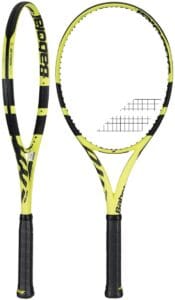
When choosing a racket, you have to ask yourself “what do I need my racket to do for me?” In my own game. I am an aggressive all-court player that tries to set up points with big groundstrokes to find my way to the net. Therefore, I need a racket that provides pop on the groundstrokes and serve, but also provides a stable and controlled feel at the net. My racket of choice is the Babolat Pure Strike because it gives me all of these things, but it won’t work for everyone.
Before you read our reviews, ask yourself:
What does my game require?
Do I hit with a lot of topspin, or do I hit flat?
Do I lack power on short balls?
Do I need help gaining power on my serve?
Do I make wild unforced errors?
Do I have any chronic injuries?
You know yourself better as a player than we do, but these are key things to think about when selecting a racket. Keep your strengths and limitations in mind.
The Rackets We Personally Recommend
Now that you have a better idea of what you’re looking for, we can give you our recommendations. We considered each racket on the market and found the ones below to be most suitable for aggressive players.
Each racket below is linked to our friends at Tennis Warehouse. Their website contains more in depth information of each racket, so make sure you browse their site before you buy!
4 Rackets For Aggressive Baseliners
The rackets below are ideal for big hitters from the baseline. The specs are tailored for power and spin, and most will give a bit of extra juice on your serve.
Since this racket was first used by Andy Roddick in his #1 days, it has continued to be a best seller for Babolat generations later. Currently used by Fabio Fognini, this racket will give you that extra pop you’re looking for.
The Pure Drive is popular among all levels. The racket specs that we look for in an aggressive baseliner’s racket are ideal in this one. It weighs 11.2 oz. (318g) strung, has a head size of 100 sq. in., and has a 16/19 string pattern. These things allow for a high swing speed, contributing to that modern aggressive style with big swings and lots of topspin.
Personally, I liked this racket because it gave me a bit more control than the other “powerful” rackets that I’ve tried. It was easy to swing, but had a bit more stability at contact than I expected. It also gave me an extra 5-10 mph on my serve, which is always a nice bonus for any player. The Babolat Pure Drive is a great option for the modern game, and definitely worth testing if you play with a lot of shape on your ball.
By choice of Rafael Nadal, this racket is top of the line in both power and spin. The Babolat Pure Aero is also popular among all levels of players because it is maneuverable (easy to swing). The Aero technology (aerodynamic beam at the throat of the racket) allows the racket to glide through the air as the player swings.
The general specs we look for in power and spin are identical to those of the Babolat Pure Drive (seen above). The frame’s head size is 100 sq. in., weighs 11.2 oz (318g) strung, and has a string pattern of 16/19. The combination of these specs with the Aero technology make this racket one of the most lively sticks on the market.
When I tested this racket, I was most impressed with how little effort I had to put into my swing to produce topspin. The response to spin was amazing, and this is coming from a guy who generally hits the ball flat. If you’re looking for easy spin and power from the baseline, this is a great option. Additionally, I found that the pop on the serve was similar to that of the Babolat Pure Drive. Putting this frame in my hand instantly gave me 5-10 mph on the serve.
A downside to this racket was the control. As my ball is flatter than most from the baseline, I had a bit of a hard time finding my range in extended points. This racket is made for players with tons of racket head speed and shape on their balls, so it isn’t for me. If you are interested in more in depth specs and information on this racket, click here.
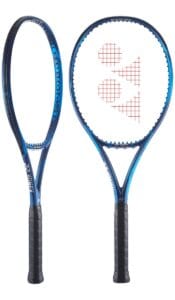
The EZONE 98 is the racket of choice of Naomi Osaka and Nick Kyrgios. This frame is perfect for players looking for easy access to power, increased topspin, a large sweetspot, and great feel. It is one of the most user friendly rackets in the Yonex lineup.
As for specs, the EZONE 98 has similar specs to the Babolats seen above. The main difference is the head size being 2 sq. in smaller at 98. This gives more control and a comfort in swinging away freely. The string pattern is 16/19 and the weight is 11.3 oz. (320g) strung.
If I were to personally switch to a Yonex frame, this would be the one. It has that same soft, powerful feel that many desire in the Babolat Pure Drive, but loads more control. I felt that the slightly smaller head size gave me the ability to hit the ball where I wanted to. The beam is thin, similarly shaped to the Aero technology of Babolat. However, the feeling off the strings is a bit more stable.
It makes sense why Nick Kyrgios chooses to play with this racket with the racket head speed that he is able to create. When you connect nicely with this stick, there isn’t a much better feeling out there. If you’re looking to find a racket that generates power, definitely consider giving the Yonex EZONE 98 a try. Click here to see more about this racket.
The Graphene is most notably endorsed by Taylor Fritz and Diego Schwartzman. Those two guys absolutely punish the ball from the baseline, so you shouldn’t need much convincing on this one.
The Radical MP has a weight of 11 oz. (312g) strung, with a head size of 98 sq. in. The string pattern is 16/19, giving it a similar combination of power and spin to that of the EZONE.
When I hit with this racket I could tell why it is the choice of several big hitters on tour. I felt that this racket had a lot of control and responded to spin nicely when warranted. This frame will not produce spin as easily as either of the Babolats listed above, but that is not necessarily a bad thing.
Personally, I would add some weight to it to give it more mass through the ball at contact. However, the lighter stock weight is great for intermediate players, or advanced players that lack strength. The low stock weight is also great because it gives you the ability to add lead tape where you feel you need it most. Click here to see more about the Radical.
4 Rackets For Aggressive All-Court Players
The 4 rackets below are perfect for players that are eager to finish points at the net. They differ from the frames that you see above, mainly in weight, string pattern, and head size. These will produce more stability and control while maintaining enough power to bully your opponents around the court.
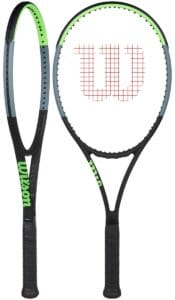
Starting off our lineup is the widely used Wilson Blade 98. This frame is extremely popular among touring professionals because of its all-around quality.
The Blade weighs 11.4 oz. (323g) strung, had a head size of 98sq. in., and an 18/20 string pattern. The nice thing about the Blade is its variety; Wilson sells variations of this racket that differ in weight, head size and string pattern as well, so you are bound to find a version that you like. The specs of this frame shines in touch/feel, so you are sure to be confident in your accuracy around the net.
Along with being great at the net, this racket is ideal for groundstrokes because it allows the player to take full cuts, making it easier to earn their way to the net.
The Wilson Blade is simply a favorite for players that have fairly polished technique. We also recommend it for players less advanced on their tennis journey because of its all around playability. I can’t guarantee that you will be serving like Milos Raonic, but there is a reason he uses this racket. For more info on the Wilson Blade, click here.
This frame is a great modern twist on Pete Sampras’s original Wilson Pro Staff. Roger Federer is arguably the best server and volleyer in tennis today and his racket is one of the best out there for the job.
This is a heavy frame, weighing at 12.6oz. (357g) strung. However, it is extremely head light (9 points) so its weight does not sacrifice maneuverability. The racket is extremely well balanced because it provides incredible feel, touch and control while still rewarding big cuts.
Playing with this frame, I could not get over how much feel it has. Precision is consistent on slices, volleys, and serves. We think that this is a serious contender for best serve and volleying racket on the market.
While this is a great “player’s racket,” the weight is not for everybody. You need to be strong enough to swing the racket. Don’t allow your ego to get in the way here; if it feels too heavy, it probably is. Luckily, Wilson makes a lighter version so you can try that one out. For more on the Wilson Pro Staff 97RF Autograph, click here.
Babolat is known for making the most powerful rackets because of the Pure Drive and Pure Aero (shown above). However, the Pure Strike added a much needed control aimed frame to their brand. As my own racket of choice, the Strike is a bit friendlier than the Pro Staff and Blade we saw above. It is definitely aimed at solid baseline players who want spin and control.
Along with its pure baseline play, this racket also performs on serves and volleys. It weighs in at 11.4 oz. (323g) strung, has a head size of 98 sq. in., and a 16×19 string pattern. While a bit lighter, it is balanced so the swingweight is higher. This gives great stability and mass through contact without a lack in rewarding aggression.
This a great all around racket made for modern tennis. It is solid from the baseline but if you want to be more offensive and serve and volley, it feels crisp yet comfortable”.
This racket is user friendly and a great choice for players of all levels. For more info on this racket, click here.
Rounding out our recommendations is the Head Graphene 360+ Prestige Midplus. While the name is a mouthful, this racket will do the talking for you on the court.
Prestige rackets have always aimed at providing an old-school feel to a modern frame, and the 2020 version does just that. This model excels in control and feel, perfect for an all-court player.
The updated Prestige weighs 11.9 oz. (337g) strung, has a 98 sq. in. head size, and an 18×20 string pattern. Though the string pattern is dense, the 2020 version has a larger sweet spot than the previous model. Head’s Graphene 360+ technology was crafted for more comfort and forgiveness in mind.
Fellow MyTennisHQ player used this racket on the tour using the previous generation Prestige and loved it. He says that when he tried this version, he immediately liked that it was more user friendly without sacrificing the Prestige feel.
This is a fantastic option for aggressive all-court players in this modern era of tennis. For more information on the Head Graphene 360+ Prestige Midplus, click here.
Key Takeaways
Hopefully this article was helpful in finding you a racket that suits your aggressive gamestyle! Depending on whether you’re an aggressive baseliner or aggressive all-court player, pay attention to the racket specs that will fit your game.
In summary, remember these few things:
Know your game’s strengths and limitations, and find a racket that will help you.
Know what specs to look for in a racket that will highlight your strengths.
Always try a racket before you switch to it. Rackets are personal and comes down to how it feels in your hand, not what the reviews say.
Click any of the links in our articles to buy straight from Tennis Warehouse!
If this article helped you, let us know in the comments below!
Best Tennis Rackets For Doubles in 2020: Pro Doubles Reviews
Every player should seek for the racket that is going to suit them best. Seems like a pretty simple concept, right? The “problem” becomes the infinite options to choose from. It can get complicated and overwhelming, so this article should help you find something you will like.
If you play more doubles than singles, you will want to look for rackets that are specific to this. This article is going to focus on rackets that suit a conventional doubles player. Obviously not everyone plays doubles the same way, so make sure to choose a racket that will work well with how you play.
The key components to a good doubles racket are touch/feel, maneuverability, stability, and power. Because good doubles players typically win on serve or finish points at the net, good doubles rackets compliment these things. Small head sizes and thin beams lead to most of these things, but you’ll see below that there are exceptions.
The rackets that we recommend for doubles as of July 2020 are:
For more details on each of these rackets, keep scrolling! We have a review for each of them with specific specs, explaining why each of them makes a great racket for doubles.
Doubles Rackets: What to Look For
Before we get into the details of each of these rackets, we will go through what exactly we looked for in picking them. With so many rackets on the market, its importnt to narrow down the options. Here are the things we looked for most:
Touch/feel
Maneuverability
Stability (Control)
Power
Each of the rackets we recommend as exceptional doubles rackets were chosen based on our research and knowledge of the rackets on the market. Those 4 metrics were the ones we found most important for the traditional style of doubles. Additionally, we have play tested each of the rackets on our own that we recommend, as we believe the only way to truly know what a racket plays like is to hit balls with it.
Now that you know what went into selecting these rackets, lets get into it:
Roger Federer’s style of play would translate phenomenally to doubles, so it only makes sense that the racket he endorses is at the top of our list. The Wilson Pro Staff RF 97 Autograph has everything we look for in a classic doubles racket.
This racket is heavy. At 12.6 oz (357g) strung, there’s no way around that. However, the frame is 9 points head light. This combination allows for great stability at net for absorbing pace without lacking maneuverability. Quick reactions are key in doubles, hence the reason we stress maneuverability in a racket.
When I played with this frame, I was obsessed. I love how the ball feels off the strings when good contact is made. Compared to other rackets, the sweet spot is small. It will reward players with more compact swings, especially on returns and volleys. If you have large strokes or hitches in your technique, this one may not be for you.
We recommend this racket more for advanced ball strikers. If you are a beginner-intermediate player, we think that this frame may be a bit too heavy, as it could just make the game more difficult than it ought to be.
Because it rewards smaller strokes, it’s perfect for doubles. Doubles is fast, so it requires a stable hand and good placement. The control you will gain with this racket is off the charts, and it is definitely worth trying.
As Dominic Thiem’s racket of choice, this continues to be one of the most popular rackets on the market. It just so happens that it is the perfect fit for doubles as well.
So what makes this racket suitable for doubles play? It is a great mix between the heavy, old school racket style and a modern powerful racket. It is lighter than the Wilson Pro Staff, at 11.4 oz. (323g) strung. However, the balance is 4 points head light, giving it a good heavy feel through the ball.
Overall, the playability of this racket is quite high. Players of all levels can benefit from using this racket as it rewards aggression, but also plays with nice feel. The mid-range weight attributes to good maneuverability at net, and it is powerful enough to find great pop on the serve.
Personally, I use this racket. As I found more success in my career on the doubles court, I can say that it maintains enough stability at net, but also allows for enough power on the serve. This one gets a high recommendation from everyone on our team at MyTennisHQ.
Originally used by Andy Roddick back in his world #1 days, this racket has remained a best seller for Babolat even after his retirement. You may be surprised that this racket made our list for doubles, as it seems a bit out of place, but we can explain.
The Babolat Pure Drive is one of the most powerful rackets that you can find. With a 100 sq. in. head size and only weighing 11.2 oz (318g) strung, this frame has a large sweet spot and allows tremendous racket head speed. Using this racket, you are sure to find that extra pop you’re looking for on the serve and forehand. Because it is so light and maneuverable, those quick reflect volleys will become effortless.
The game has changed, even in doubles. While many top doubles players still serve and volley, some no longer do. The game has transitioned to emphasize the serve more than volleys. Therefore, some players such as the Bryan Brothers have made the switch to this stick.
The Prestige lineup is one of the most popular on the market. The goal of the Prestige has always been to give a modern feel to an old school racket. The 2020 version does just that. The stability and control of this stick are as good as any you’ll find.
The updated Prestige weighs 11.9 oz. (337g) strung, has a 98 sq. in. head size and is 7 points head light. The 2020 version comes with an increased sweet spot and Head’s Graphene 360+ technology for more comfort and forgiveness. The new model is better for the modern style of doubles, as it has a bit more feel around the net and more pop on serves and returns.
This is a fantastic option for serving and volleying in this modern era of tennis. If you are looking for a traditional racket that has adapted over the years to a more lively feel, look no further.
The Yonex VCORE Pro 97 310 is gaining steam among competitive players. It is becoming known for its stability, control, and feel around the net; 3 things that make this the ideal doubles racket.
The VCORE Pro 97 310 weighs 11.5 oz. (326G) strung, has a 97 sq. in. head size and is 7 points head light. These specs maximize control and feel around the net, but allow for great maneuverability on groundstrokes and serve. The combination of maneuverability and mass allow for a solid feel on every ball. Of the rackets on this list, the VCORE Pro 97 310 has the highest rating for touch/feel.
When I hit with this racket for the first time, I loved it because of how it rewards clean contact. There’s no better feeling racket out there when you hit the ball cleanly on groundstrokes, slices, and volleys. I can‘t recommend this frame enough, especially for advanced and old school players.
Key Takeaways
If you are primarily a doubles player, you should consider that when choosing the right racket for you. Depending on your game style, strengths, and weaknesses, we advise that you consider rackets that are well rated on touch/feel, maneuverability, stability, and power. These things should help your serve, return and volleys, which are most important on the doubles court.
Remember not to choose a racket just because your friend likes it. It’s more important to do your own research on what you think will help your game. If you like to play a fairly traditional style of doubles, we think the 5 rackets listed above can be a great fit for you. Click on the links to shop through Tennis Warehouse, and don’t forget to try before you buy if possible.
Like what you saw in this article? Let us know in the comments below!