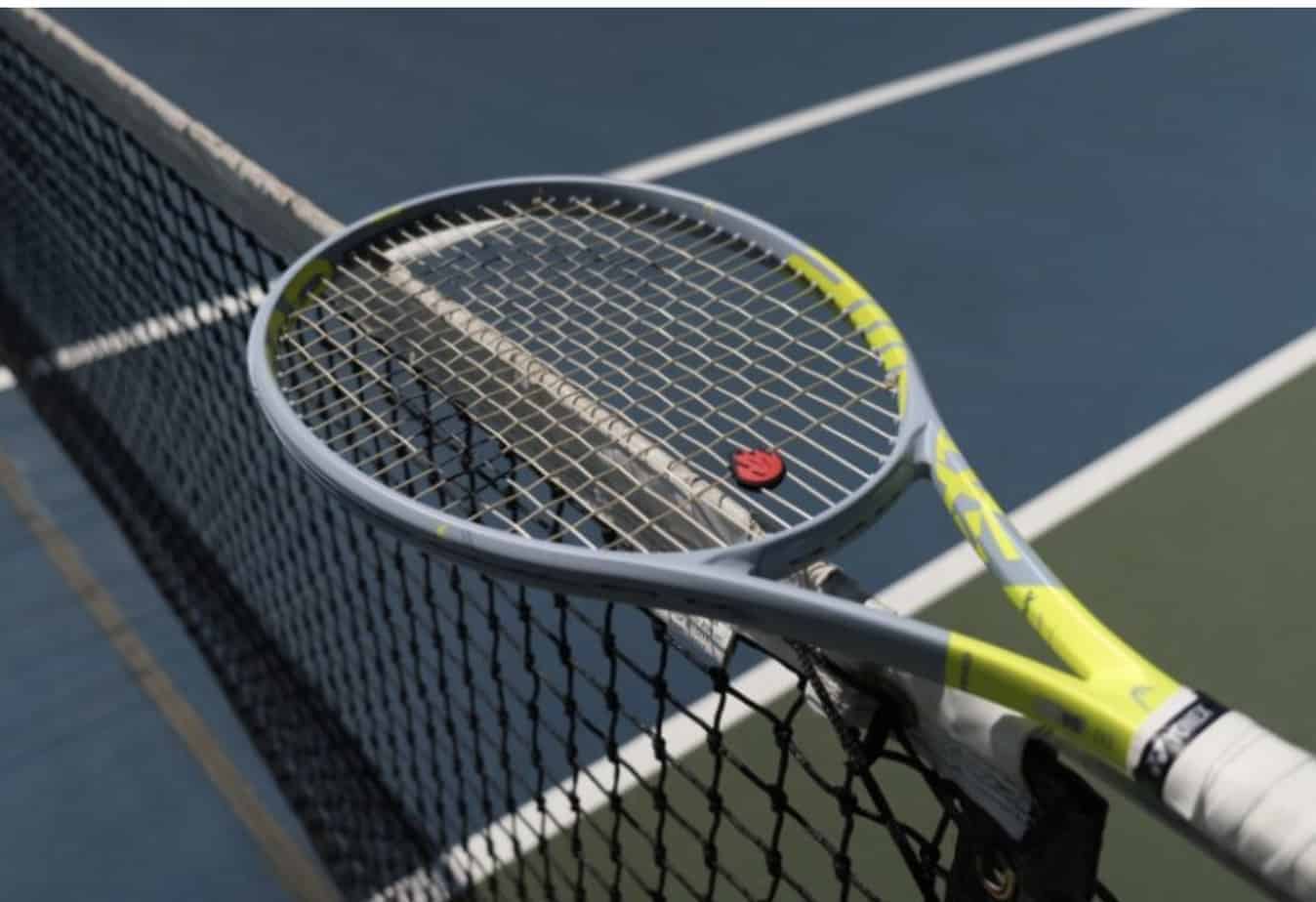
The 5 Best Tennis Rackets For Doubles

The 5 Best Tennis Rackets For Doubles

Recent Articles

Tennis Rackets: Power vs. Control


There are rackets out there for everybody. Rackets are designed and produced with an ideal user in mind, so you want to make sure that you’re playing with the best racket to suit your game. However, with so many numbers, ratings, and specs you’ve never heard of, it can be hard to understand what you should be looking for. That’s where we come in. 

We define control in tennis by how well you are able to move the ball where you want on command. How precise are you able to be, or in this case, how precise is your racket allowing you to be? Power, on the other hand, is how big the ball comes off of your strings. A powerful racket will allow the ball to come off the strings big with little effort. 

Those are the basics, but if you continue reading we will go into more detail. This article will look at what certain types of players should be looking for, what specs give a racket it’s characteristics, and our recommendations for the best power and control rackets on the market. Let’s dive right in. 

What does control mean?

As we touched on above, control relates to how precise you are able to be with your shots. It has a lot to do with not only your shot placement, but also how well you can place the ball on command. The “command” part is important, and it’s going to vary from player to player.

Control becomes an aspect on all shots: groundstrokes, volleys, slices, serves, and returns. Your ability to place the ball where you intended to is not only important for winning from point to point, but also for your confidence in your shots. If you are playing with a racket that doesn’t produce enough control, your confidence in each shot can dip drastically. 

What does power mean?

Power is, as mentioned previously, how big the ball is coming off your strings. Further, it will relate to how aggressively you are able to play. No matter how well you place the ball, you won’t really be able to “bully” your opponent on his back foot without a little extra pace on your ball.

Finding Which Racket is Best For Your Style

Now that you know the difference between power and control, you can better apply it to your game. You should be thinking about what style of player you are. Are you offensive? Defensive? Counterpuncher? Serve and volleyer? It’s important to know your on-court identity before you figure out which racket is the best fit for you. 

Knowing your own strengths and weaknesses in your game is going to help you select a racket. For example, players that lack easy power may want to find a racket that helps to fill that hole. 

It is important to remember that choosing a racket is personal. You can’t choose the best racket for you simply by reading an article, because it may just not feel right in your hand. That is why we recommend demoing the racket before you fully commit to switching to it.

What players need control rackets?

We think that players who love to move forward and finish points at the net benefit greatly from control rackets. The extra stability on volleys contributes to better precision. Many players who like to serve and volley use control rackets.

Other players that benefit from control rackets like to slice, especially on their backhand side. Again, this is a shot that requires precision. Powerful rackets tend to be a bit more sporadic, so control rackets are best for players who like to play with a lot of touch. 

If you feel that your groundstrokes are flying all over the place, a more controlled racket may be a good fit for you. That extra stability in all parts of your game can really help to build your confidence, and it can help you find the consistency you may be lacking.

Remember, you’ll want to look for a racket that can fill the holes in your game and highlight your strengths if possible. 

What racket specs will lead to control?

When shopping around for a controlled racket, the main specs you should be looking for are head size, swing weight, string pattern, and stiffness. 

Every racket is different, but a racket with a smaller head size, higher swing weight, dense string pattern, and low stiffness will contribute to a controlled racket. Some controlled rackets will stray off from this trend, but those are the most important specs to watch out for. 

Best Control Rackets on the Market

Here are a few recommendations for control rackets out there. You’ll notice that the specs of these rackets match the info that we provided above.

Wilson Blade 98 18×20 v7

Wilson Pro Staff RF97 Autograph

Babolat Pure Strike 3rd Gen

Head Graphene 360+ Speed Pro

Yonex Vcore Pro 97HD 18×20

What players need powerful rackets?

Generally, players that benefit from powerful rackets will spend most of their time playing from the baseline. The players that like to bang the ball heavy from the baseline will find powerful rackets to highlight their strengths. Additionally, because powerful rackets are generally less precise, being on the baseline allows more room for error. 

Additionally, powerful rackets will often create 5-10 extra MPH on a player’s serve. That is obviously a trade off for the lack of control, but everyone could benefit from a little extra juice on their serve. Keep that in mind as you are searching for a good racket to suit your game. 

If you feel that the effort you put into your shots isn’t paying off, it is best to look at powerful rackets. It will make your life a whole lot easier, especially if consistency isn’t an issue in your game. 

What racket specs lead to power?

When shopping for a powerful racket, you’ll want to pay attention to head size, swing weight, string pattern, and stiffness. 

Yes, these are the same specs as a control racket, but you’ll want to look for the opposite numbers. So, powerful rackets will generally have large head sizes, lower swing weights, more open string patterns, and higher stiffness. Again, some powerful rackets will deviate from this trend, this is meant to guide you in the right direction.

Best Power Rackets on the Market

Here are a few of the best powerful rackets that we have tried. You’ll notice that they all align with the specs above.

Babolat Pure Aero

Babolat Pure Drive

Prince O3 Legacy 105

Wilson Ultra 100 v3

Head Graphene 360+ Extreme MP

Final Thoughts

Now you know the basic difference between power and control rackets. Hopefully this article helped you to understand what type of racket is best for you. If you click any of the products above, you will be sent to our friends at Tennis Warehoouse. Their website has everything you need to know if you want more details about each racket.

Did we miss something? Let us know if you have any questions in the comments below!
Tennis String Types: The Beginner’s Guide


When choosing the equipment to use, it is important to be well informed about what you’re looking at in order to know what will work best for you. Whether it’s strings, rackets, shoes, grips, or even clothing, everyone has different preferences. 

With so many different brands and types of strings on the market, it can be difficult to decide what is best for you. With our experience playing and testing gear over the years, we are here to provide our insight so that you can make a good choice to help your game. 

The types of string that you will want to consider are Polyester, natural gut, synthetic gut, multifilament, and hybrid. These types of string will all contribute to different factors in the way the string plays. The main factors that you will want to consider are power, spin, comfort, control, touch, string movement, playability duration, and durability. Based on your gamestyle, injury proneness, and budget, these things will help you to find a string that brings you success on the court. 

There are clearly a lot of things to consider when selecting a string. Keep reading below for more of an explanation of the different types of strings, details of what each factor means, professional recommendations, and more. 

If you see a string you’d like to check out for yourself along the way, click any picture to be sent to our friends at Tennis Warehouse. There you will be able to select from a wide range of options.

What are the different types of tennis strings?

As we touched on above, the types of strings on the market are polyester, natural gut, synthetic gut, multifilament, and hybrid. Below is an overview of each of these types of string, and what you can expect out of each of them in general.

Polyester:

This type of string is made of polyester. Many of the strings on the market are considered “poly” strings, but have a slightly differing composition. Many will be called “co-polyester monofilament” or something like that. Don’t let it confuse you, this is just a more specific detailing of what the poly string is composed of.

Polyester strings are most well known for their durability over time, and ease in generating power and spin. Polyester strings will generally be less comfortable on joints over time, so this should be kept in mind if a player has chronic pain in their shoulder, elbow, or wrist. 

Natural Gut:

Natural gut string is actually made of… drumroll please… cow intestine. The material used is found at the outermost layer of the cow intestine called the serosa. The food industry provides this material to string makers, as this part of the cow is not consumed.

As far as the string itself, tennis players love it. While natural gut is far more expensive than the other types of string, the comfort and control that it provides is unmatched. Because it is so expensive, most players that use it pair it with another string so that they only use half a set per racket. Natural gut string is also low rated in durability, so the pairing of another string gives it a bit more life in the racket before it breaks.

The general consensus among most high level players is that if they can afford to use it, they will. However, this string is so expensive that even string companies have a hard time affording to give it to sponsored players for free. If it is in the budget, it is definitely worth a shot!

Synthetic Gut:

As it is obvious by the name, synthetic gut is not made from cow intestines. This string was produced to mimic the feel and comfort of natural gut, but at a more affordable price. This is a great option for players looking for more feel, touch, and control in their game at about a quarter of the price of natural gut. This string is great when paired with another type of string such as a polyester because their qualities balance each other out nicely.

Multifilament:

This type of string is made by twisting different types of strings together to, in theory, create a combination of all of them. These strings are known to have a solid, all-around feel that produces a combination of spin, power, control, and durability. Of all of the types of string, multifilaments best combine playability and durability, making it the best option for your average tennis player. 

Hybrid:

We touched on this a bit above, but a hybrid is when 2 strings are combined separately in the string bed of one racket. It is most common to mix polyesters with natural gut, synthetic gut, or multifilament strings to combine the characteristics of each. For example, Roger Federer uses natural gut in the main strings, and a polyester in the cross strings. 

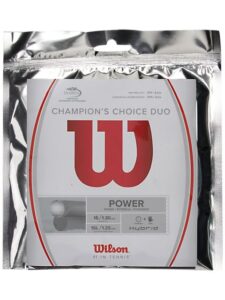
Because this is such a common thing to do, string companies such as Wilson sell “sets” of string in pairs that compliment each other well. This makes it convenient for consumers to find exactly what they are looking for.

String Factors Explained

Now that you better understand the types of string out there, you can better assess what you should be looking for. We mentioned that the main factors to consider in strings are power, spin, comfort, control, touch, string movement, playability duration, and durability. Because you now know which types of strings will warrant these characteristics, here is an in depth look at what the characteristics mean. 

Power:

This is simply how “big” your ball comes off the strings with little effort. Power is the amount of pop are you getting, mostly on serves and groundstrokes.

Spin:

This rating tells you how much spin a string provides. The shape of a string often has the biggest effect on this rating, and we explain this further later in the article. 

Comfort:

This characteristic reflects how the string makes your body feel, especially over longer periods of time. Natural gut, for example, will be much more comfortable than polyester.

Control:

This will indicate how easily it is to control the ball when contact is made. Elements such as power and spin do affect this rating, so this number shouldn’t come as a surprise when you see it compared to the other string ratings.

Touch:

This rating is most applicable to volleys, drop shots, and slices. This rating is often similar to the rating of control from string to string. 

String Movement:

This rating is based on how much the strings move while hitting. Some strings move quite a bit during play and require adjustments after each point, while other stay secure. This is more of an issue of preference, but it affects how often the strings break and how quickly they lose tension.

Playability Duration:

This rating will tell you how long the string will perform well. As strings are used, they lose their freshness at different rates. Strings with a low playability duration will end up with a “mushy” feeling over time, and will require restringing before they break. This rating is different from durability for that reason.

Durability:

This is based on how long the strings last before they break. This is different from “playability duration” because this rating is solely based on how long the string takes to break, not how the string feels right before it does. 

What strings do pros use?

If it works for them, it should work for you too. Right? Well, not always. While it is fun to use the same gear as the pros, make sure you test it out for yourself too.

Just like your preferences will be different than your peers’, the pros have different preferences from each other as well. Professional players are picky about what they use and most of them don’t tinker with gear often, as they have generally found success by using the same equipment for years.

Polyester strings are most popular among professional players ranked inside the top 500. This is because most players inside of this ranking get their string for free from sponsors, and the sponsors are willing to give polyester string for free. This also has to do with the fact that most professional players are young and healthy, so they are able to handle the fact that it isn’t so soft on the arm.

Many of the top 100 pros use a hybrid setup of polyester and natural gut. This is because it is widely known to be the best feeling combination of string. However, this setup is not for everyone. That is why players such as Federer use a hybrid combo, and Nadal uses a full polyester string. Every player has different preferences, and it is important for the player to use what is best for them.

Below are a few of the strings that are endorsed by top professional players.

Roger Federer

Rafael Nadal

Andy Murray

Dominic Thiem

Stan Wawrinka

Nick Kyrgios

What tension should you use?

Again, this comes down to preference. If you are unsure, you should start by knowing how different tensions will effect your game.

Most rackets are strung between 45 lbs and 60 lbs. The looser you string your rackets (less pounds) the more power you will gain. The tighter you string (more pounds) the more control you will gain. Looser tensions are also easier on joints, so that is something to consider.

The type of string you choose to use will also be a factor in what you tension you decide to string your racket at. Polyesters should be strung looser, as a polyester string that is too tight can cause pain. Because polyester strings generate more spin, you won’t have a problem controlling the looser tension. As a general rule, synthetic and natural gut strings should be strung at least 2-5 lbs tighter than your polyester string. Most microfilaments should be strung with tension somewhere in between that of polyester and gut.

Your string tension should also be determined by the racket that you are using. On Tennis Warehouse, each racket has a recommended tension guide. We highly recommend checking that out if you are unsure what tension is best for the racket you use.

If you are completely unfamiliar with string tension, start with a tension around 52 lbs and work up or down from there. Remember that the longer you play with a racket, the looser the strings will get.

Tennis String Gauge Meaning

The gauge of a string is the thickness. For example, Babolat’s RPM Blast is sold in 17g and a 16g. It’s the same exact string by it‘s property, but the 17 gauge will produce more power. Because it is thinner, it will break much quicker.

From my experience, thinner strings are much more comfortable and have a higher playability rating. However, it can be annoying and expensive to break strings frequently. Because synthetic and natural gut breaks faster, you should be looking for a lower gauge (thicker) in those types of string.

There are a couple of different numbers that relate to thickness: gauge and MM. They refer to the same thing, string thickness. MM refers to the diameter of the string. For some odd reason, manufacturers have slightly varying numbers when it comes to this. Here’s a quick table showing what each number means so you don’t get confused:

Tennis String Shapes

As string technology has advanced, manufacturers have found that different string shapes provide different shot feedback. This is most common in polyester strings.

The shape of a string is mostly determined by the strings edges. The idea is that the more edges (and therefore corners) a string has, the more it will grab onto the ball, producing spin. Most strings will specify a string’s shape on it‘s packaging or online.

Tennis Strings Recommendations

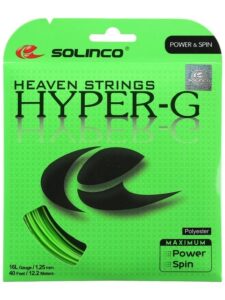
Alright, now that you better understand what strings you should be looking for, here are a few of our favorites. We’ve given a few from each of our favorite brands. We recommend deciding on a type of string before you decide on a brand.

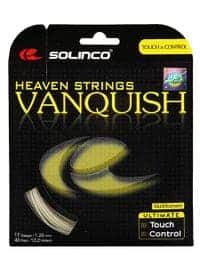
Solinco

Diadem

Wilson

Head

Babolat

Best Tennis Strings for Beginners

When beginners ask me what types of strings I recommend that they use, I like to point them in the direction of multifilaments and synthetic guts. Here is why…

Beginner players are not experienced enough to be able to really tell a difference between a really expensive string (natural gut) and a cheap multifilament. But price aside, I think that it is important for players to begin with a string that will be easy on their arm. Beginners are not used to the impact of the ball on the strings, and soft strings will prevent injury.

Additionally, beginners usually do not break strings frequently at all, so durability is a nonissue. Here are a few strings we highly recommend for players just beginning their tennis journey:

Final Thoughts

After reading this article, you will probably know more than you thought you ever would about tennis strings. Now you can be better informed before you choose a string. We recommend that when switching strings, you buy a couple of different sets. They are reasonably priced and it won’t be the end of the world if you don’t like one. It is better to experiment with a couple of types of strings before you make your choice, so that you can be confident going forward.

Did you find this article helpful? Anything we missed? Either way, let us know in the comments below, or reach out to us on our instagram at @MyTennisHQ.

Why Do Tennis Players Break Their Rackets?


Why Do Tennis Players Break Rackets?

Tennis is considered to be a sport of gentlemen: class, tradition, and sportsmanship are considered essential traits of successful tennis players. Roger Federer and Rafael Nadal embody the essence of tennis – they’re absolute class-acts, and serve as role-models for kids everywhere across the world. 

This is why tennis players are always shocked when they see Roger Federer breaking a racket (which happens roughly once every 15 years). Breaking rackets is one of those big “no-no’s” in tennis, as it is considered to go against what the sport stands for. As a tennis player you’re not supposed to do it; as tennis fans, you’re supposed to frown upon it – and yet, most of us secretly enjoy watching a nice racket smashing.

Why do tennis players, at the end of the day, break their rackets? During a tennis match, players can get increasingly frustrated after making easy mistakes and losing points. They cannot request a time-out, they cannot be subbed out, and they cannot scream – so their rackets end up being the only outlet to unleash their accumulated anger. 

Tennis rules establish that players should get punished for breaking rackets, so this is another incentive not to do so. And still, some players are known to be big racket-smashers on the tour. The reason? We’ll cover that below. 

Frustration and Anger

Tennis is a very frustrating sport. While it’s very satisfying to hit winners (a good shot in which your opponent can’t reach the ball), it is just as frustrating to make errors – and even professional players make more errors than they hit winners. 

As mentioned earlier, tennis players are expected to keep their composure throughout long matches – even after making mistakes. For the most part, players do a good job keeping it cool – until they don’t. When that happens, the natural reaction is to let the anger out on whatever you have on your hands – most times it ends up being either the racket or the ball. 

This is somewhat of a “natural” reaction, and you can see it in other sports in which players have equipment in their hands. It is fairly common to see golfers breaking their clubs on their knees or throwing them away like a boomerang, and baseball players frequently break their bats on their knees. 

Why Is Breaking Rackets Not Allowed?

In tennis, breaking rackets is considered to be unsportsmanlike conduct. This means that it is a behavior that goes against the set of rules established by the tennis association organizing the event. 

These rules cover every area of a tournament, including the role of umpires, the prize money distributed to players, and participant conduct. Breaking a racket is a violation of these rules (called racket abuse), and as such is usually punished with a loss of points and a fine.

There are several other on-court violations that tennis players can commit, including ball abuse, audible abuse, visual abuse, lack of effort, and coaching violations. Each one of these has a different, pre-established punishment. 

What Happens When You Break a Racket?

The biggest incentive not to break rackets is to avoid the financial punishment that comes along with it. We have written a full article that breaks down all the fines associated with it (you can check it out in here), but in essence ATP players can be fined up to $500 per occurrence while WTA players can be fined up to $2,500 per racket they break. 

Players don’t need to actually break the racket in order to be fined. The rulebook says that “players shall not violently, dangerously or with anger hit, kick or throw a racquet or other equipment within the precincts of the tournament site. For purposes of this rule, abuse of racquets or equipment is defined as intentionally, dangerously and violently destroying or damaging racquets or equipment or intentionally and violently hitting the net, court, umpire’s chair or other fixture during a match out of anger or frustration.”

On top of the financial punishment, players also get punished with the loss of a point, game, or even set during the match. The first racket breaking generally results in a warning (no points lost), and the subsequent occurrences result in a point loss, game loss, set loss, and finally disqualification. 

After a player breaks the racket, the racket becomes unusable. After the frame of the racket becomes damaged, the tension of the string becomes unstable and players lose control of the shots. 

Finally, some players will argue that they play better after breaking rackets. They say that sometimes releasing all the pent up anger can finally allow the player to relax and start playing better. 

Worst Racket Breakers 

Tennis has seen some notorious racket-smashers throughout history. These racket breakers were condemned at first, but then people started enjoying their matches in hopes that they would see a great racket smash. The list below has some of the most famous racket breakers in history.

John McEnroe

John McEnroe is known to be one of the most eccentric players in the history of tennis, so naturally he’s also earned his spot in this list. Even at old age you see McEnroe going after it.

Marat Safin

The absolute king of breaking rackets, Marat Safin has broken an estimated +700 rackets throughout his career. Quite an impressive accomplishment.

Serena Williams

On the women’s side, Serena is at the top of the list. Not only one of the best players in history, Serena has also given us one of the best racket smashes ever.

Fernando Gonzalez

Gonzalez can be considered one of the most creative racket breakers of all time. In one occurrence, he started being booed when breaking the racket, and continued breaking it until people were clapping for him. Talk about charisma. 

Marcos Baghdatis

Marcos Baghdatis will forever be remembered as “the one dude who broke 4 rackets in a row”. Some of the rackets were still inside the bag. 

Goran Ivanisevic

Goran had a strong personality while on tour, and he once had to default on a match because he broke all of his rackets and did not have another one to play with. 

Nick Kyrgios

Kyrgios still needs to do some work in order to catch up to the people above, but he’s definitely shown some potential when it comes to racket smashing. And with his attitude, chances are he might make it to the top of the ranking. 

Tennis Doubles Rules: Everything You Need to Know


In tennis, there are two main events that you can play: singles and doubles. Singles in played 1 on 1, while doubles is played 2 on 2. For the sake of this article, we are going to assume that you already understand the basic rules of tennis in general. If you aren’t familiar with those, be sure to check out our article “Tennis Rules: Everything You Need to Know.” This way we will better be able to walk you through the similarities and differences between the two events. 

So what are the main differences between singles and doubles? The scoring is generally the same (we will get into details later in the article) but the main differences come in serving order and where each person is allowed to stand. You serve so that each player has their own service game where they serve for the entirety of the game. In the next game that your team serves (two games later), the other player will serve. 

We will go into full details of doubles rules, scoring, serving order, and tiebreak order below. Let’s get right into it:

Tennis Doubles Scoring Rules

The scoring rules in doubles are similar to those of singles. When your team wins a point, you are awarded “15, 30, 40, and game.” In most tournaments including on the professional tour, doubles is usually played with no-ad scoring. This means that the point at deuce is sudden death, and the receiving team gets to choose the side they want to play it on. You will want to be sure to discuss whether you and your friends are playing “no-ad scoring” or “regular scoring” before you start playing. 

Besides that small difference, the set is played the same way in doubles and singles. Teams play up to 6 games. If the score reaches 5-all, teams will play 2 more games. If the score is 6-all, you will play a tiebreaker. If the score reaches 7-5, the set is complete. 

Photo: Regina Cortina Photography

How Many Sets In A Doubles Tennis Match?

If you are playing recreationally, this again is something that you should discuss with the other players before you start. Usually you will either play 1 set or 2 out of 3 sets with a 10 point tiebreaker instead of a full third set. However, it comes down to the preferences of the group and how much time you all have to play.

On the professional tour and in amateur tournaments, it is most common that 2 out of 3 sets are played with a 10 point tiebreaker in lieu of the third set. There are some tournaments that play differently, like some Grand Slams that play 3 out of 5 sets, but this is the typical format.

Third Set Rules

Again, the third set rules for doubles vary on the tournament. Each tournament will specify their rules prior to matches starting. It is rare that doubles tournaments play a full third set. Most tournaments will shorten it to a 10 point tiebreaker if the first two sets are split 1-1. 

A 10 point tiebreaker is played exactly the same way as a 7 point tiebreaker, but it is played to 10. One team serves the first point, then teams alternate every 2 points until the tiebreaker is completed. In tiebreakers, teams must win by 2 points (scores may end 11-9, 15-13, 20-18, if necessary).

Tennis Doubles Serving Rules

The serving rules for doubles commonly throw people off, so don’t worry if it seems confusing at first. Each game has only one server for the entirety of the game. Just as in singles, opposing teams will switch off serving to each other. 

Where it gets more complicated is which teammate serves what game? Are you able to have the better server serve every game? The answer is no. In doubles, the team must alternate which teammate serves from game to game. So, if I serve the first game at 0-0, my partner will serve the game at 1-1 or 2-0.

Who Serves First?

The only time that you are allowed to choose which doubles partner serves first is at the beginning of the set. It is up to you as a team to decide who will serve for you in your team’s first service game. 

So how should you decide? Typically, you will want to start with the stronger server because as the set goes on, there is a chance that the person who served first will end up serving more games in total. However, there are other things to consider such as:

  • Who serves better in the sun?
  • Who serves better in the wind?
  • Who is better at the net?
  • Who usually has an easier time starting a match (nerves, warm up, etc.)?

Who Serves First In Second Set?

For the second set, you can choose again which of you serves first. Even if you served last to end the first set, you can serve first in the second set. Many think that you must continue your order into the following set, but that is not true. As a team, you are allowed to choose who starts serving the set. 

So how should you decide who starts serving the second set? Again, it is better to have the stronger server start the team off. By this time, you and your partner have both served at least once, so you know who has been having more success in their service games. Use that information to make your decision. If things are going relatively well in your team’s service games, I find it more important to keep players on the same sides of the court so that nothing changes in the conditions. 

How Serves Work In A Tiebreak?

Photo: Regina Cortina Photography

Tiebreakers are confusing, there’s no getting around it. Hopefully we can clear up any questions you have. In doubles, things become even more complicated because there are more people. 

First, you need to know how a tiebreaker works. Here are the basics:

  • Play up to 7 to end a set, or 10 if in lieu of a 3rd set
  • Team must win by 2 points
  • Switch ends of the court every 6 points (at 4-2, for example)
  • Even points (3-1, 5-5, etc) are played on the deuce side
  • Odd points (3-2, 4-5, etc) are played on the ad side

Those are the basics, now how do serves work? Team A will serve the first point if it is their turn to serve (their team served at 5-5). After the first point, teams will switch off serving 2 points at a time. So, it’s 1-2-2-2-2 etc. until the tiebreaker is completed. 

This gets a bit more complicated in doubles. In doubles, teammates must alternate who serves each set of two points.

Example of Tiebreak Serving Order

Team AB versus Team CD:

Player A serves 1st point.

Player C serves 2nd and 3rd points.

Player B serves 4th and 5th points

Player D serves 6th point 

*Teams switch ends of the court*

Player D serves 7th point

Player A serves 8th and 9th point.

Player C serves 10th and 11th point.

And so on……

Unlike starting a new set, the order from the set must be followed heading into a tiebreaker. However, if a 10 point tiebreaker is played in lieu of a third set, teams can choose who they want to serve first, as it counts as a new set. 

Tennis Doubles Positioning Rules

This section will tell you everything you need to know about where to stand in doubles. There are two factors to this: where you should stand and where you are allowed to stand.

Where to Stand When Serving

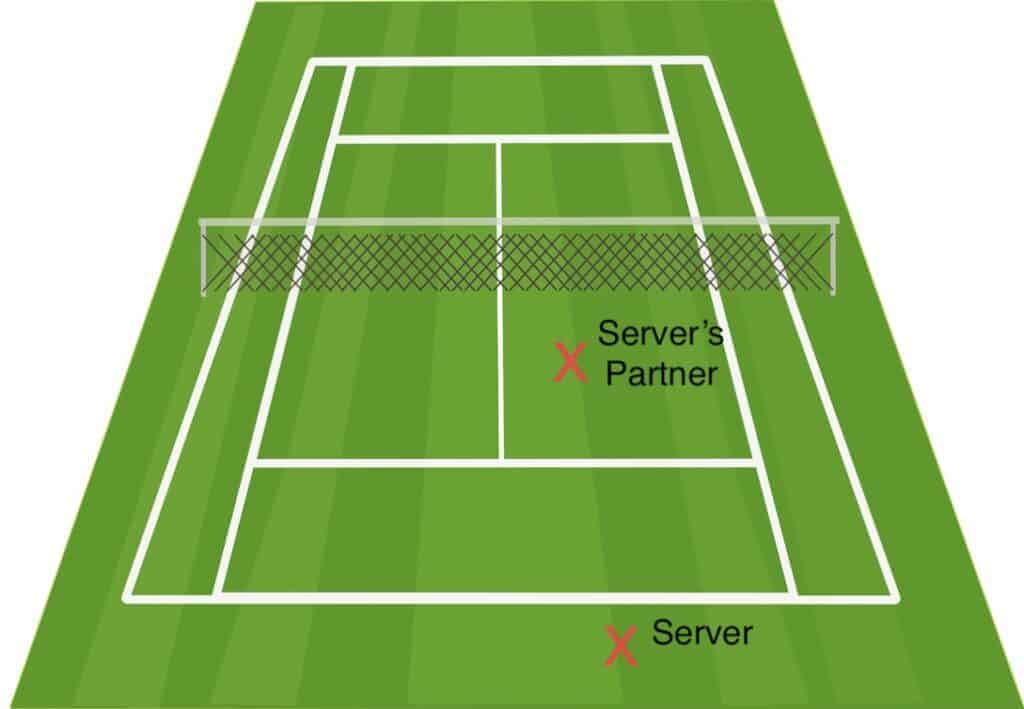
In general, the serving team in doubles has an advantage. Therefore, the server’s partner will almost always stand at the net, ready to put away an easy volley earned from the serve. They will be standing on the opposite side of the court from their serving partner. You can see this below:

Typical Serving Formation

Technically, the server’s partner can really stand anywhere. Although it is uncommon, the rules allow for them to stand on the baseline with their partner if they want.

The servers partner can also, by the rules, stand on the same side as their partner. This is called “Aussie Formation.” This strategy is shown below and is used as a way to lure the returning opponent to hit the ball down the line.

“Aussie Formation”

Where to Stand When Returning

When returning, there is really no “right” or wrong place to stand as far as where you should stand strategically. Some teams prefer the returner’s partner to stand at net, while other teams play with both players on the baseline. Both of these options are highlighted below:

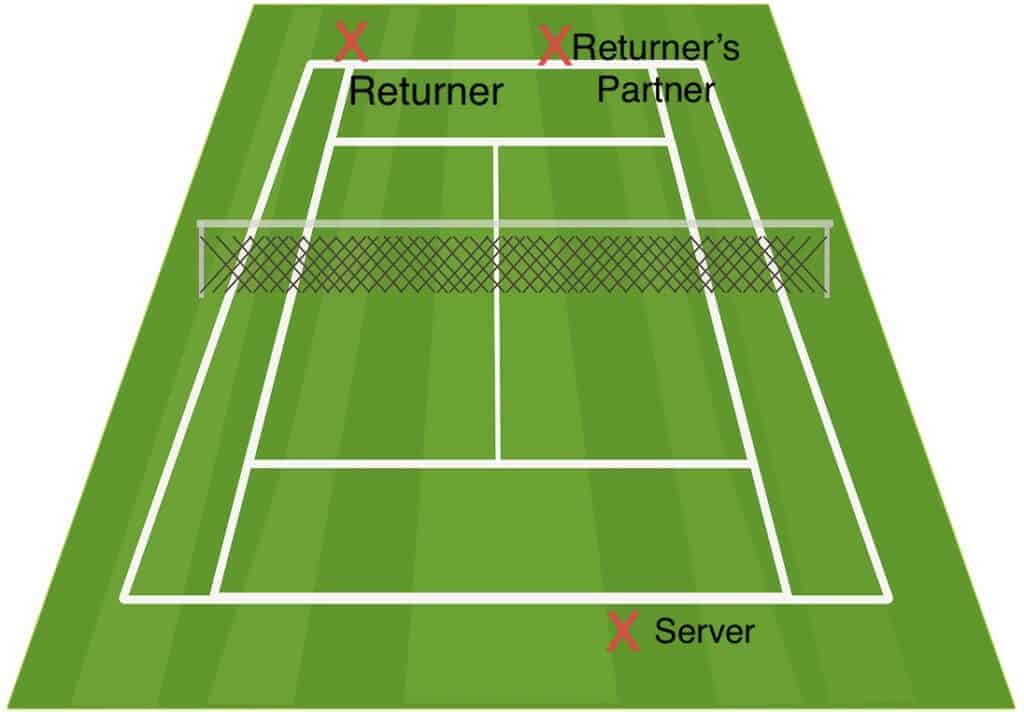
There are, however, a couple of rules on where you are allowed to stand when returning serve in doubles. When returning, you must stand in the court that you are receiving serve from. Your partner must stand in the opposite court. In other words, the receiver‘s partner cannot stand on the side with their partner. This is seen as an obstruction and is against the rules. This rule is shown in the image below.

The highlight shows the boundary of the returning team’s sides of the court.

After the return is hit, teams can do whatever they want. They can switch sides as they please, as long as it is during a point. This typically only happens when it is necessary by defense.

Can You Switch Sides In Doubles?

This question comes up a lot. Let’s say your partner is having a hard time returning on the deuce side on a particular day. Are you allowed to switch with him? Yes, you can, but it has to be in between sets. The rules state that you must stay on the same side that you start on from the first point for the entirety of a set.

This rule is put into effect because it prevents partners from switching sides every point. Think of it this way. If my partner was Roger Federer, I would want him returning on every point. This rule assures both players each return on roughly half of the points in a set.

As I mentioned above, you can switch sides during a point. Once the return is struck, players are allowed to move freely however they please.

Final Thoughts

And there you have it: all of the basic rules of doubles. Hopefully this article gave you everything you need to know to get out there and enjoy a competitive (or hit and giggle) match with your friends. As always, if you have any questions about more doubles rules, feel free to reach out and let us know!
Why Do Tennis Players Eat Bananas During Matches?


Tennis players are very interesting creatures – they all have very, very particular rituals. If you have ever watched one of Rafael Nadal’s matches, you might have witnessed some of his very interesting habits: picking a wedgie before every point, fixing his hair in a very particular way, and making sure his water bottles are ALWAYS aligned. Or maybe you might have witnessed Sharapova facing the wall before every point

The point is: each tennis player develops a set of rituals they perform on the court during matches and practices, and most of the times these rituals will be different from player to player. However, there is one ritual you will see among a very large number of tennis players: eating bananas during tennis matches. And why is that?

The 4 reasons why tennis players eat bananas during matches are: 1) they are a good source of carbohydrates, giving the players the energy they need; 2) they are full of potassium, which helps to prevent cramps during long matches; 3) they are natural and filled with vitamins; and 4) they are a quick and easy snack, perfect for changeovers. 

While it may seem strange that most players end up choosing the same food to eat on court, we’ll cover the reasons behind it below. And if you think you might want to add bananas to your own on-court diet, this will hopefully help you make up your mind. 

It’s A Good Source Of Carbohydrates

During a tennis match, tennis players use a LOT of energy running side to side, and they need to replenish that energy somehow. The easiest way to do so is by eating full of carbohydrates – which our bodies can easily transform into energy. Foods filled with protein, on the other hand, cannot be easily transformed into energy, while foods filled with fat can take a long time to be turned into energy, also taking a long time to digest, and possibly causing indigestion. 

Within the category of carbohydrate-filled foods, there is an important distinction between low glycemic and high glycemic foods. The score a food receives in the Glycemic Index reflects how quickly the food can be absorbed into the body and transformed into energy. The GI is measured between 0 – 100, and foods ranking above 60 are considered high (very quick energy), while foods with lower scores are considered to provide longer, more steady energy.

Bananas are not only full of carbohydrates, but they score a 51 in the Glycemic Index, which means that they have a good balance between the quick absorption and the long-lasting energy.

Eating high GI foods might give you a burst of energy very quickly, yet you will likely crash early. Foods that rank too low on the index, on the other hand, might take too long to give you energy and at that point the match might as well be over. Bananas are a very well balanced food, and this is one of the main reasons why tennis players choose them as part of their diets. 

It’s Also Full Of Potassium

One of the distinctive qualities of bananas is that they are full of potassium. The reason why potassium is a very important mineral for tennis players is that it helps to combat cramps during long and exhaustive matches.

During long matches, tennis players lose a very large amount of water and electrolytes (through sweat), which can lead to dehydration and – if the player is pushed far enough – muscle cramps. These are extremely painful and severely hurt your game as you’re not able to run at full speed and begin losing control of your movements.

I’ve personally gone through a full-body cramp during a match once in Colombia and had to get carried out of the court. Not fun.

There are other foods that contain a large amount of potassium (coconut water, avocados, watermelons, and pomegranates), but bananas are usually preferred over them as they are more practical.

It’s Natural And Full Of Vitamins

The third reason why bananas are a preferred snack by tennis players is that it is natural and contains a lot of vitamins. When you are a professional athlete, you need to really treat your body as a temple, and it is significantly better to eat foods that are natural rather than processed. 

Bananas contain not only vitamins (B6 and C), but several different minerals, which include potassium, copper, magnesium, and manganese. While these vitamins and minerals can technically be obtained from supplements, it is much better to get them from natural sources. 

It’s A Quick And Easy Snack

Finally, one of the most appealing qualities of bananas for tennis players is that they are a quick and easy snack. They require no preparation whatsoever, they are extremely cheap, and the peel is a natural “package”. This makes bananas a perfect snack to eat during changeovers, since players can take a bite or two out of it then just “close it” and save it for the next changeover. 

At the end of the day, changeovers only last 90 seconds, which needs to be enough time for players to drink something, rest, and maybe eat something. It’s obvious that they don’t have time to spare, so bananas end up being a very handy snack. 

Are Bananas The Best Snack For Tennis Players?

In the past, bananas were the preferred snack for essentially every single pro tennis player out there. However, recently players have begun to use special supplements that provide them all the required nutrients they need. So which one is best?

When playing at the ultra-high level at the ATP and WTA, players need to get an edge any way they can. With nutrition being so incredibly important for athletes, it makes sense that these top pros would rely on something more advanced than bananas and that tailors to their own nutritional requirements. 

However, these supplements can cost a lot of money – while bananas usually cost less than a dollar. For recreational and lower level professional tennis players, bananas are still considered the top snack for matches and practices, especially when those go the distance. If you’re interested in what are some other great snacks for tennis matches, you can check out our Top 10 Best Snacks for Tennis Matches guide here. 

The Banana Controversy

Just as a side note: during the 2020 Australian Open, French tennis player Elliot Benchetrit asked a ballgirl to peel his banana. The umpire interjected and told him that peeling bananas was not part of her duties, and that he should peel his own banana. 

Benchetrit got a lot of backlash for doing this – but he claims that the reason behind his request is that he had cream on his hands and couldn’t peel it himself. 

Final Thoughts

Nutrition is incredibly important for tennis players. At the end of the day, how far your body can go will depend on the type of fuel you consume. Making smarter choices when it comes to food can be one of the best (and easiest) ways to improve your game. And eating bananas on court can be a great start!

The Top 10 Best Tennis Academies in California


Along with Texas and Florida, California has long been known for producing the highest level of tennis in the USA throughout the years. A big reason for that? There are countless California academies that function year-round due to immaculate weather.

Growing up and going to college in California myself, I have had personal experience with many of the academies we list below. My promise is that from my knowledge, I would send my own child to any of the academies listed below. And trust me, there are many that I had to leave out. There are many more great ones in the area, but these are the ones that we can vouch for most confidently.

Junior academies are a great option if you’re looking for something where your child can develop as a player and a person. It can be difficult to find all the information you need in one place, so we’ve made this article to lay it all out for you. Let’s face it, looking at Yelp reviews for tennis academies just isn’t going to cut it. This is an important decision, and you are much better off asking the experts. Luckily, we have experience with many of them and are here to tell you which ones are best.

Because California is such a large state, we felt it necessary to differentiate between Southern California and Northern California. We include information such as location, price, academy goals, and schedule.

The tennis academies featured in this article have proven to be successful by their track records. Each has a resume showing their production of high level players throughout the years. Most of them have been a training hub for future division 1 college players, as well as highly successful professionals. Whatever your child’s goals may be, these 10 academies can help to achieve them.

Search programs on tennis-academies.com

Top 5 Academies in Southern California

#5 – Weil Tennis Academy

One of the best tennis academies in California, Weil Tennis Academy is a hotspot for young tennis talent across the world. Located in Ojai, California, facilities include 22 courts, a pool, jacuzzi, a nice gym, restaurants, dorms, and classrooms.

Weil Tennis Academy emphasizes a path that leads students to the best universities in the United States. Their website mentions that the academy has the #1 rated college placement program in the world. Students that have graduated went on to play at schools such as Stanford and UCLA. 

The cost for a full-year of tennis, school, and boarding is about $48,550.00 per year.

Weekly Schedule at Weil

For more information about Weil Tennis Academy, visit their website at weiltennis.com

#4 – Jackson-Bridge Tennis Academy

Los Caballeros Sports Village

Jackson-Bridge Tennis academy is located in Orange County, California. Specifically, it is based out of the Los Caballeros Sports Village. This facility was rated the #1 sports club in Orange County because of its 23 great tennis courts, 2 gyms, 3 pools, and beautiful racket ball facility.

The academy has options ranging from weekly private lessons to full time boarding. Their main goal is to examine the level and goals of each player, then create a path to achieve those goals.

According to their website, “The Jackson-Bridge full-time academy is for local, and international, boarding and non-boarding players who are looking for college placement or pro career development. Custom training plans are put together after a thorough player evaluation.”

Full Time Academy Includes…

  • Small Group Training
  • Private Lessons
  • Custom Training
  • Match Play (UTR ladders, team based points, situational points)
  • Fitness (agility, strength, speed, and balance work)
  • Academics (program coordination, individual instruction, accountability)
  • Tournaments (traveling)
  • Boarding (on-site)

For more information about the Jackson-Bridge Tennis Academy, see their website at jacksonbridgetennis.com

#3 – Advantage Tennis Academy

Advantage Tennis Academy is located in Irvine, California. It is widely known to produce top notch players at the collegiate and professional level. Advantage is based out of The Racquet Club of Irvine which includes 22 hard courts, 6 clay courts, a spacious gym, and a large swimming pool.

Founder and Director Jimmy Johnson has a track record of over 25 years of coaching experience. His hands-on involvement in daily training is one of the biggest reasons for the academy’s success.

Advantage offers versatile training packages so that you will be able to find the perfect one for your needs. They offer individual lessons, after school camps, and full time training for both boarding and non-boarding students.

Advantage Sample Daily Schedule

Schedule via Advantage Tennis Academy Website

For full time training, Advantage Tennis Academy costs about $42,000/year including boarding. Lower cost packages are also available.

For more information, visit the Advantage website at advantagetennisacademy.com.

#2 – Tennis Mechanix (TMX) Academy

The Tennis Mechanix Academy (TMX as it is referred to in Southern California) has produced many collegiate level players over its existence. It was founded in Burbank, California by Cecil Mamiit and Joel Dacay. Mamiit is a former world no. 72 professional player and has a long track record of juniors he coached that have excelled through to the college and pro level.

TMX offers both after school and homeschool programs for players between the ages of 7 and 18. Their training lies on 3 simple but essential pillars for success: hitting drills, point play, and fitness.

  • Hitting drills to improve all around skills, placement, patterns, timing, recognition, and weapons.
  • Point play to incorporate the technique, skills, and footwork learned in drilling into a live-ball situation.
  • Fitness to improve hand-eye coordination, tennis specific conditioning, speed, injury prevention, and longevity.

For more information, please visit their website at TMXacademy.com.

#1 – TennisPower Academy

TennisPower Academy is a world-class training facility located at Peninsula Racquet Club in Southern California. Overlooking the Pacific Ocean and majestic Catalina Island, the Academy prominently sits on the cliffs of the beautiful Palos Verdes Peninsula. It boasts 12 fully lit courts with an amazing ocean view clubhouse and terrace, locker room and pro shop.

TennisPower Academy is owned and managed by Oliver Messerli, a WTA and ATP touring coach with 25 years of developmental experience. He has been the traveling coach of names such as Mary Pierce, Lisa Raymond and Jason Jung. The Academy is home to several current touring professionals that work closely with TennisPower coaches on and off the court.

Aside from tennis, training includes tennis-specific outdoor gym conditioning and fitness training. A physiotherapist is available to the athletes as needed.

TennisPower Academy is smaller than most boarding academies, which allows more individual attention for players to receive from their coaches. The academy prides itself on being able to tailor specific goals and objectives with the needs and personalities of each unique athlete in different stages of their development.

Attentive coaches guide professionals and ITF players on and off the court from technical development to physical and mental conditioning to tournament and travel planning. They also structure serious junior players toward their ultimate goals; whether it’s following a path to play college tennis or pursuing the ITF platform. Players are able to leverage on TennisPower Academy relationships with many college coaches and countless years of travel on the junior circuit.

The Academy offers a full training schedule year round for traveling professionals, home-schooled players and all juniors looking to attend an after-school program. Full-time programs account for 15 to 20 hours of training on court and 5 hours of conditioning and mobility/flexibility work weekly.

TennisPower Academy Weekly Schedule

For more information, visit peninsularacquetclub.com or @tennispoweracademy on Instagram.

Top 5 Academies in Northern California

#5 – NorCal Tennis Academy

NorCal Tennis Academy was first started in 2003. It has now grown to be one of the largest and most successful tennis academies in all of California. They have 5 locations: 3 in the South San Jose area, one in Morgan Hill, and one in the Fremont-Newark area.

Headed by coach Thomas Le, this academy has produced Northern California standouts year after year, sending them off to prestigious colleges throughout the country. Coach Le’s impressive resume, seen here, has played a large part in that.

Academy highlights via norcaltennisacademy.com

Their coaching philosophy is fairly simple. It starts with giving young players a solid foundation that will allow them to improve tremendously as they grow and gain experience. Their website claims that “Together our 10U and 12U players have been winning an impressive 28 consecutive team sectional championship wins and close to a dozen individual sectional titles (the highest level in each age group).” Their academy offers private lessons, group training, strength and conditioning, and team competition and tournaments for any player between the ages of 10 and 18.

Because they are not a boarding academy, their rates vary depending on how long your sessions are, and how individualized they are. Their system consists of a “credits” system, where lessons are paid for in packages. Visit their site at norcaltennisacademy.com.

#4 – Eagle Fustar Tennis Academy

Photo via eaglefustar.com

Eagle Fustar Tennis Academy runs out of 5 separate locations all across Northern California. They have clinics run by experienced coaches in Sunnyvale, Cupertino, Saratoga, Fremont, and Santa Clara.

This academy was founded in 2003 by Brian Eagle and Nick Fustar. They both have lengthy playing and coaching resumes. Additionally, they pride themselves on catering to each player’s individual needs. Not every player has the same goals, but they make it their mission to achieve whatever they might be. They have clinics for every level, as seen below.

While they do have a full time program, they also have an flexible drop in system that allows players to drop into the academy at a per clinic rate. This way there is no long term commitment if your child decides it isn’t the best fit for them.

Their programs consist of:

  • Specialized fitness
  • Mental training
  • Academic support and college guidance
  • Expert coaching
  • Physio access

Cost of Eagle Fustar Tennis Academy

Pricing at Eagle Fustar depends on the level of the clinic and how many you purchase at once. For the High Performance Clinics, you can pay $90 dollars per clinic as a drop in rate. For more specific pricing, click here.

#3 – Sylvano Tennis Academy

Photo via sylvanotennisacademy.com

Sylvano Tennis Academy is located in Santa Clara, California and was created by Coach Sylvano Simone. Sylvano began coaching in 1997. He has made it a priority to make junior players better through hard work, intensive training, and dedication to hours of training.

Sylvano Tennis Academy offers group and individual lessons for juniors of all levels and ages. His most advanced group focuses on the following key aspects to development:

  • Direction and planning to become a top ranked player
  • Intensive high energy work outs to improve concentration and fitness
  • Mental and fitness training
  • Reinforce proper techniques and skills
  • Train with players similar age and skill levels

Prices are not listed for Sylvano Tennis Academy, but you can obtain this information through contacting them directly. You can also learn more on their website at sylvanotennisacademy.com.

#2 – JMG Tennis Academy

Photo via JMGtennis.com

The JMG Tennis Academy is located in Sacramento, California. Joseph Morris Gilbert, the man who founded the academy in 2011, is a widely respected coach across the country.

JMG tennis academy has produced several high achieving college and professional players. Among them are Jenson Brooksby, Collin Altamirano, and Katie Volynets. The list goes on to include many Blue Chip Recruits, including players that went on to play at Stanford, University of Texas, and so on.

Training at JMG consists of creating an individualized program for each player depending on their needs. Their website claims, “Most junior tennis academies focus on the quantity of group hours, JMG Tennis focuses on creating a specific individual custom program which is tailored to the players needs so he/she has the best opportunity to succeed.”

The scheduling of this academy depends on the individual needs of the junior, so their schedule is not spelled out on their website. However, each player can expect the following:

  • Private attention
  • Group training
  • Physical training
  • Tournament consulting
  • Sports psychology
  • Academics

If you want your child to improve as a tennis player, this academy stands out. I have competed against several of their players in tournaments and they are all tough as nails. You can contact them at JMGtennis.com for pricing and details.

#1 – Gorin Tennis Academy

Rounding out our list at #1 for Northern California tennis academies is Gorin Tennis Academy.

With several locations across California, Gorin Tennis Academy is known to be one of the best academies in the United States. The main location is in Granite Bay, where the academy started. The head coach is Vitaly Gorin, who has coached top players such as Nikoloz Basilashvilli, Dimitry Tursunov, and Yaroslava Shvedova. All of them have reached the top 30 in the world. 

There are only 7 courts at this academy, meaning you can expect more individualized attention from coaches. They offer both boarding and non-boarding programs depending on your needs.

Typical Daily Schedule at Gorin Tennis Academy

Their website claims that 85% of their players receive scholarship offers or go professional. This is an astounding number.

For full-time boarding, you should expect to pay about $33,175 per year. However, individual non-boarding classes come out to be much cheaper. For more information, visit their website at gorintennis.com.

Final Thoughts

While we have researched all of these academies, ultimately it is up to you to decide which is the best fit for your child. Each of these academies is a bit different with their strengths and weaknesses, so be sure to find a good fit rather than throwing your child to the “big name academy.”

Hopefully this list is helpful in finding the right academy for you in California! If you have any questions, be sure to reach out directly to them, as they will be happy to give you details further than what we could provide. Happy training!