The 5 Best Tennis Rackets For Doubles

The 5 Best Tennis Rackets For Doubles

Recent Articles

Do Tennis Strings Go Bad? Know When You Need Fresh Strings


If you just picked up your racket for the first time in a while, the strings may look a bit goofy. Maybe you just got the tennis itch again and you’re playing much more than you used to, so you’re not sure when you should be changing your strings. Finally, maybe you’re a frequent player but you’re not sure if you should change your strings or wait for them to break. If you’re asking yourself whether or not your strings are still good to use, you’re not alone. This is a common question asked by both occasional and regular players, and we will be sure to answer all your questions.

I’m glad you stumbled upon this article, because tennis strings do in fact go bad as they sit in a strung racket, whether they are being used or not. One reason for this is that strings lose tension over time, so strings that sit in a racket for a while go dead.

There are a lot of things to go into this. The biggest question that you should ask yourself is whether or not it will affect you. Conditioned players will notice more of a difference in old strings than players that decide to play a couple of times per year.

There are many factors that will affect the lifespan of a strung racket, and we will do our best to go through them thoughtout this article. Keep reading for everything you need to know regarding string life.

What happens when tennis strings go “bad”?

When tennis strings go bad, it is because they sit in a racket for too long. When a tennis racket is strung, the strings are pulled by the machine to create tension. The longer strings sit around, the more tension will be lost and they become dead over time. This affect is similar to that of a rubber band; as time goes on, it looses its pop and becomes mushy.

This dead feeling will promote a lack of feel, especially for experienced players. When playing with dead strings, you may find that your shots just don’t have the same “pop” or “bite.” This sensation is difficult to describe, but experienced players will feel that they are lacking a crisp contact.

All in all, strings that have gone bad will not give you everything that the string usually has to offer your game. You’ll find that your shots have less spin, power, and control. This is why if you are trying to get into tennis more consistently, it is important to be aware of when your strings are too dead to play effectively.

How long does it take for strings to go bad?

The short answer to this is that it depends on a variety of factors. Durability ratings are typically a good indicator of how long different strings will last before breaking. You can find this rating on tenniswarehouse.com if you click on any string product.

Remember that when you’re researching and see the durability rating, that refers to how long a string will last before it breaks. Therefore, it doesn’t apply to how long they will last in a racket without being used. That difference is important.

If you do not break strings, there is a general rule of thumb for club players. This rule says that you should be stringing your racket the amount of times you play per week. So, if you play 4 times per week, you should be restringing your racket 4 times per year. This rule is good enough for recreational players, but there are too many factors that go into it to put an accurate rule on it.

When deciding how often you should be restringing your racket, you should be taking the following factors into account:

  • How hard you are hitting the ball?
  • How much spin you typically have on your shots?
  • What type of string you are using?
  • Are you playing doubles or singles?

Do What Feels Right

If you are a fairly conditioned player, you will be able to feel when your strings begin to feel “off.” Many players will find that their rackets are ready to be restrung before the strings break. Don’t be shy to get your racket restrung before the strings break, or your game will suffer.

Signs That Your Racket Should Be Restrung

It’s better to know the signs that your racket should be restrung rather than follow some “rule of thumb” that you see online. Here are the signs that you need to know:

  • Strings are “fraying” significantly
  • Strings are moving; much more crooked than normal after points
  • Strings make a “thud” sound at contact
  • You feel that your ball has far less control than normal
  • Strings make a screeching sound when you move them with your fingers; they should glide on each other without a lot of friction

When in doubt, ask a trusted coach or experienced player for their advice.

Strings Can Go Bad Without Being Used

As we mentioned before, strings can go bad without even being used. That being said, the standard of when strings go “bad” comes down to player preference. Professionals will be able to tell the differerence in a racket that was strung the day prior and a racket that was strung a week prior. However, most amateurs won’t be able to tell the difference between a freshly strung racket or one that was strung 6 months prior.

You can tell if your strings are dead by the signs below. You’ll notice that many of them are similar to the list above, but strings that haven’t seen much use will not fray.

  • Strings are moving; much more crooked than normal after points
  • Strings make a “thud” sound at contact
  • You feel that your ball has far less control than normal
  • Strings make a screeching sound when you move them with your fingers; they should glide on each other without a lot of friction

Final Thoughts

The bottom line is tennis strings do go bad over time. They become dead and lose their pop, so it is important to know when it’s time to replace them. The tips above should give you a good idea of when that will be. When in doubt, ask a trusted coach for advice. Generally, it is better to restring if there is a doubt. You will benefit from using fresher strings.

If you have any more specific questions about this, feel free to reach out to us in the comments below or on Instagram @mytennishq. Best of luck!


TopCourt Review – Is The Tennis Tool Worth Your Money?

One of the reasons why people love tennis is because it’s a game full of traditions, like only wearing white at Wimbledon. While some people appreciate this, there is an argument to be made that tennis has been lagging behind other sports in terms of innovation – like basketball or football. 

Every now and then, a new tennis platform comes out with the goal of modernizing the sport and making it more exciting. Some work, some don’t. The most recent platform to come out is TopCourt, an online platform that contains well-produced videos with top players (Fernando Verdasco, the Bryan Brothers, Sloane Stephens, and more), in which the players talk about things like their backgrounds, their favorite drills, and some of their favorite stories. People are still a little skeptical about TopCourt’s proposition, so today we’ll shine a little light on it. 

After conducting our review of TopCourt, it is clear that TopCourt is a very unique platform that provides a specific value to tennis fans. TopCourt should be purchased as an entertainment tool for fans wanting to learn more about their favorite players rather than as an online coaching tool. 

That is not to say that people won’t be able to learn valuable tips from it – we just want to be clear that this tool is not going to be a great fit for everyone, and we want you to be informed before you make such a purchase. We’ll cover everything in detail below, and if by any chance you want to take a “test-drive” of the platform before buying it, you can use our link at the end of the post for a 14-day free trial. 

TopCourt History

TopCourt was created by 3 former collegiate tennis players at UNC-Chapel Hill: Zach Hunter, Taylor Meyer, Alex Rafiee. They realized that there was a large “bridge” between professional tennis players and their fans, and that there were not platforms out there attempting to shorten that bridge. 

After founding TopCourt, they secured $1.25M in venture capital from a few investors, which allowed them to launch the platform in June of 2020. Since launching, TopCourt has released videos from several top players, and has also partnered with several brand ambassadors across the world. 

According to TopCourt, the brand is “the first digital platform offering tennis fans an authentic look into the life, mind, and performance of the game’s best players.

TopCourt’s mission is “to share the lives of tennis pros with the world to inspire and grow the tennis community.” 

What Type Of Content Does TopCourt Have? 

One of TopCourt’s pros is that their video quality is unmatched. They only have professionally produced videos, similar to something you would find on Netflix. They have a professional camera crew with them every time a player comes in for a shooting at one of TopCourt’s two venues. 

Some people may find these videos hard to relate to, as they might seem too “produced” and don’t seem applicable to the average tennis player. This is one of the reasons why we believe this is more of an entertainment platform rather than a teaching tool. 

TopCourt’s platform is very user-friendly and simple to use. There aren’t that many functionalities in their website, so it’s hard to feel lost. The videos are tagged as either Stories, Drills, Instruction, or Behind The Scenes, (as you can see in the image above) so you can choose which category you’d want to see. 

When it comes to the player’s story, the videos are structured in a mini-season way – with short episodes that highlight a specific aspect of the story. 

When it comes to drills and instructions, the videos are somewhat random. Each player talks a bit about their own favorite drill and instruction, but there’s not much structure to it. This is done with the professional athlete in mind rather than the average club player, which is why we think there are better online tennis coaching tools out there. 

You do have the ability to select the videos based on specific shots (forehand, backhand, serve, etc), but they don’t follow any specific progression.

Athletes On TopCourt

TopCourt releases videos with one new player every month, so you know exactly how much new content you will be getting. While this list will keep increasing (you can check the current list here), these are some of the athletes that you will find on TopCourt:

  • Genie Bouchard
  • Fernando Verdasco
  • Lindsay Davenport
  • Bryan Brothers
  • Taylor Fritz
  • Belinda Bencic
  • Sloane Stephens
  • Monica Puig
  • Alja Tomljanovic
  • Brad Gilbert
  • Paul Annacone

Players With Videos Coming Up:

  • Mackenzie McDonald
  • Petra Kvitova
  • Andrey Rublev
  • Sofia Kenin
  • Elina Svitolina
  • Reilly Opelka
  • Aryna Sabalenka
  • Casper Ruud
  • Sam Querrey
  • Jelena Ostapenko
  • Tommy Paul
  • Corentin Moutet
  • Iga Swiatek
  • Caty McNally
  • Katie Boultier

TopCourt Gold Courts

TopCourt also has a “rewards” program which they call gold courts. These gold court points are earned every time a user completes a milestone – like creating a profile, referring another user, or selecting a favorite player. Gold court points can also be purchased – 1 gold court costs $1.99 while 135 cold courts cost $69.99. 

These gold court points can be redeemed in exchange for different prizes. Currently, the only ways to use gold courts are to purchase a tennis ball signed by a player (75 gold courts per ball) and to enter a contest to visit a TopCourt shooting (1 gold court per entry, with a maximum of 10 per user).

TopCourt Pricing

TopCourt sells memberships for two different tiers – basic and gold. The Basic version costs $180 per year (billed annually) and has access to all of the videos, allows users to redeem gold court points, and allows users to ask questions to players. The gold version costs $600 per year (also billed annually) and gives users the following additional perks: 

  • Access to video content earlier 
  • Opportunities to win trips to our filming shoots and hit with the players
  • Opportunities to win trips to Grand Slams and other wta/atp tournaments 
  • Opportunities to ask pros questions directly 
FeatureBasic VersionGold Version
Price$180 / year$600 / year
Access to All VideosYesYes
Redeem Gold Court PointsYesYes
Ask Questions To ProsYesYes
Early Access to VideosNoYes
Opportunities to Win Trips to Filming Shoots and Hit With PlayersNoYes
Opportunities To Win Trips To TournamentsNoYes
Opportunities To Ask Questions To Pros DirectlyNoYes

TopCourt Pros & Cons

ProsCons
– Unmatched video quality
– Access to behind-the-scenes stories and content that is not otherwise accessible
– Deeper understanding of how tennis players think
– Basic membership cost is reasonable
– Small perks that can be “purchased” with gold courts
– Chances of visiting a video shoot
– Gold membership is very expensive
– Limited amount of content
– Lack of structure when it comes to instructions
– Instructions are more applicable to advanced players, while beginners will most likely not relate much
– Limited ways to redeem gold courts

Who Is TopCourt For?

TopCourt is a great platform for tennis “superfans.” If you’re interested in getting to know your favorite player on a deeper level, this can be a great tool for you. Tennis players live very private lives, and it’s hard to learn about them in a deeper way than just watching them on court.

TopCourt is not for the beginner tennis player who is looking for a way to fast-track their progress. The instructional content (even though it’s nice) lacks in structure and can be overwhelming for someone who is just starting out. 

TopCourt Promo Code (14-Day Free Trial)

If you’re interested in trying TopCourt but still don’t feel ready to pay for it, you can use this link to get a 14-day free trial with full access. You’ll be prompted to give your credit card information, but you will be able to cancel it at any time during those 14 days without being charged. (Full disclosure: if you do use our link and end up purchasing it, we’ll get a portion of it – with no additional cost to you.)

What Do Pro Tennis Players Drink During a Match? Why You Should Be Drinking it Too


We hear it all the time: hydration is everything. Anyone with the most basic workout experience will agree with this, but many don’t realize that only water during their intense workout isn’t enough. The same is true when it comes to tennis. 

This is something that should be copied from the pros. The best players in the world have access to great nutritionists that tell them what exactly they need to perform at their highest level. Therefore, it’s a no-brainer to steal their methods to stay hydrated on court.

Professional tennis players all drink different things on court, but the drinks are essentially made up of the same nutrients. The ideal sports drink will replace electrolytes, provide an energy bump, boost vitamin levels, and keep a player focused. 

Keep reading this article to learn more about specifically what the pros are drinking during matches. We will give you all the tips you need to stay hydrated and replenish what is lost in sweat during intense workouts. 

Water

While every player pairs their water with another drink, water is still essential in almost all cases. Why? It sits more easily on the stomach than any other drink. Therefore, your body will be able to stand more of it as opposed to flavored drinks.

As we will go over later on in the article, the more electrolyte-replenishing fluids that you can stand without upsetting your stomach, the better. However, it is uncommon for someone to be able to put down the recommended amount of liquid through sports drinks alone, so most athletes pair their electrolyte supplement with plain water.

Assuming the athlete is hydrated before playing, the general recommendation is that athletes should be drinking about 7-10 ounces of fluids every 10-20 minutes of exercise. For perspective, the average water bottle is almost 17 ounces. Remember that these numbers are nothing more than an estimate for an average workout in average conditions. Additionally, everyone sweats different amounts, so some people will need far more than others.

Energy Drinks

As a general rule of thumb, energy drinks on the court are a big no-no. You will rarely see any professional player sipping on energy drinks in general, let alone during competition or training.

There are several players that love a good RedBull, presumably to their nutritionist’s dismay. Energy drinks such as Monster or RedBull are unhealthy in general life because of the many chemicals that are added. You can find these on the ingredients list (if you can even read them.) 

However, there has been a surge in “healthy” energy drinks over the past year. These are a great alternative to the unhealthy ones in everyday life, but we recommend avoiding them before and during matches. This is because the amounts of caffeine in these drinks lead to poor hydration. A highly caffeinated athlete is likely to cramp if they are not careful about how well they are hydrating.

So, what can you do to get the energy rush you need? Athletes usually rely on the right balance of vitamins in their drink concoctions for an energy boost. If you drink the right things and you’re doing things properly off the court, you shouldn’t need a traditional energy drink to find the boost you’re looking for.

What do the pros drink besides water?

Now that you have the basics down, we will go into what you’re seeing on TV. We mentioned above that many of the top pros work with nutritionists to make them a concoction unique to them. This depends on what exactly they are losing in sweat. Most of these drinks are low in sugar because the taste is less important than what they are actually putting in their bodies. 

What’s in their drinks?

As a first note, it is best to find sports drinks with natural ingredients. Over time, you will be putting a lot of this stuff into your body, so be sure that it’s the right stuff to stay healthy over time. That being said, let’s get into the key components. 

Your electrolyte-replenishing drink will help you to replace water, electrolytes, and energy that you lose during a workout. Your drink should include some sort of energy-boosting carb, potassium, sodium, magnesium, and calcium. These things are most commonly lost in sweat, so they must be replaced to optimize performance. You will inevitably get tired throughout the course of your workout, but the proper amount of this drink will prolong that fatigue. 

If you are picky (and you should be) about what you can get at the store, you can make your own electrolyte drink at home that will be just as effective! I like this one because it gives me everything I need, but sits on my stomach lightly. Here’s the recipe below:

  • ¼ cup sugar
  • ¼ tsp salt
  • ¼ cup orange juice
  • 2 tbsp lemon juice
  • 4 cups cold water

“Cloudy Water” and The Pink Drink

If you watch tennis on TV, it is likely that your favorite player seems to be drinking “cloudy water” or a pink drink. These are just their forms of electrolyte replenishing drinks. Those men and women have the resources for custom drinks for matches, so you’ll rarely see a top player sipping on a Gatorade. Some of the drinks get cloudy because of all of the vitamins and minerals that are added to them.

We have an article all about the pink drink that many of the athletes use. It is a bit repetitive of what you’ve read in this article, but feel free to check it out: What is the Pink Drink Tennis Players Drink?

Recommendations

Like I said, I am quite particular with what I drink on the court. I always make sure that I am putting good fuel into my body. Over the years, these are the electrolyte supplements that I have had the best luck with.

Vitalyte

Nuun Electrolyte Tabs

NOOMA Organic Electrolyte Drink

Ultima

Final Thoughts

Well, now we’ve been through everything you need to know about hydration for your time on the tennis court. We hope this was all clear and you are able to take these tips with you to improve your game. Remember that this is personal and you will need to do some experimenting to find what exactly your body needs on the court.

If you have any questions about hydration, feel free to reach out to us. We are always checking our messages, especially on instagram @mytennishq. Keep following us for more content that you can use to improve!

Best Energy Bars For Tennis Players


Whether you’re a serious daily tennis player or just a weekend warrior, it is essential to fuel your body properly while on the court. Eating quality meals before and after sessions will help, but it is simply impossible to perform at the same level for more than an hour without replenishing nutrients while on the court. You should be eating something during both training and competition.

Energy bars are the most convenient snack to have handy on changeovers every time you are on the court. In my experience playing, I have won or lost matches simply because of what I put (or didn’t put) into my body. After all the training sessions and hard work, there is nothing more frustrating than losing a match because of something fully in my control. So what should you be looking for in an energy bar?

When choosing a bar, be picky. Most bars you will find on the shelves are unhealthy and have negative effects. These unhealthy bars will end up causing a crash instead of a pick-me-up. In my experience, bars with simple and whole ingredients work the best. My favorites have ingredients such as nuts or fruit, some sort of natural sweetener like honey, and some salt.

The most important thing to look for in an energy bar is carbohydrates. Carbohydrates will give you quick access to healthy energy, which is perfect when you start to feel a bit sluggish. 

What should you look for in your bars?

As we mentioned above, carbohydrates are the most important thing to look for in a bar. The proper balance of sugar and carbs will give you the boost you need without weighing you down.

Further, pay attention to the ingredients. It is always a good rule of thumb to keep your bars around 7 ingredients or less. This will help to ensure that the ingredients you’re consuming are purposeful. Food is most effective if when it comes from natural sources.

Where do carbs come from?

Carbohydrates are found naturally in nuts, oats, and fruits. Therefore, it makes sense that the bars recommended at the end of this article include these things as their base. Carbs are commonly thought to sit heavy in your stomach, but that isn’t true especially during workouts.

As a player with a high metabolism, I actually struggled to replenish my carbs quickly enough. I tend to feel heavy if I eat too much during matches, so I saw a nutritionist to discuss my options. The nutritionist helped me find bars with dried fruit and nuts as their base. The most important part is to find bars with carbs as the base. This ensures that everything you are consuming will be used by your body and there is no wasted space. These were easier to eat more of, so I was able to continuously eat them throughout matches without feeling heavy.

Everyone is Different

It is important to remember that everyone’s body is different. We all burn calories, carbs, fats, etc. in different ways, so nutrition is never one-size-fits-all. That being said, the best place to start is at the simplest forms of food. Processed food just complicates things, so when you’re trying to figure out what works for you, stick to the basics. The best energy bars that I have tried are recommended below. 

Bar Recommendations You Can Find Anywhere

Bulletproof Bar

GoMacro Bar

Larabar

Luna Bar

Tennis Racket Swing Weight Explained


When choosing a racket, it is important to understand the specs that are associated with it. This will give you a better idea of how the racket will feel before you even play with it. One of these specs is swing weight, not to be confused with static weight. 

The swing weight of a racket is affected by the combination of a racket’s static weight and balance. A racket that is more head heavy will have a higher swing weight than that of a head light racket. Even though these two rackets may weigh the same on the scale, the head heavy racket will feel heavier during play, hence the higher swing weight. 

A key to remember is that swing weight is not measured in grams, but rather by a number called RDC (Racket Diagnostic Centre). This can get confused with the measurement of grams that static weight is typically taken in. A lot of times swing weight RDC and static weight in grams can be similar, so make sure to know the difference.

There is a lot more to consider about swing weight besides the basic definition above. In this article we will go into a deeper meaning of what swing weight really means, how it will affect the performance of a racket, what swing weight is best for you, the formula used to calculate it, how to change yours.

Tennis Racket Swing Weight Meaning

Before we get into more specifics, we will cover the basics of what swing weight really means. As mentioned above, the swing weight of a racket is the measurement correlated to a combination of balance and static weight. In this measurement, the distribution of the weight has more of an affect on swing weight than the static weight does. A head heavy racket will have a higher swing weight than a head light racket, assuming that the static weights are the same. 

The reason for this is basic physics. If the majority of a racket’s weight is located further from your hand, it will have a heavier effect when swung. Think of your hand as the axis. If the weight is closer to the access, it will have a lighter affect. 

How does a racket’s swing weight affect the performance?

Now that you understand the basics of what swing weight is, we can get into the fun part: performance. This is the part that matters most to the typical player because everyone wants to know what different rackets will give them, right? The two basic things that swing weight will affect are power and stability. 

Power

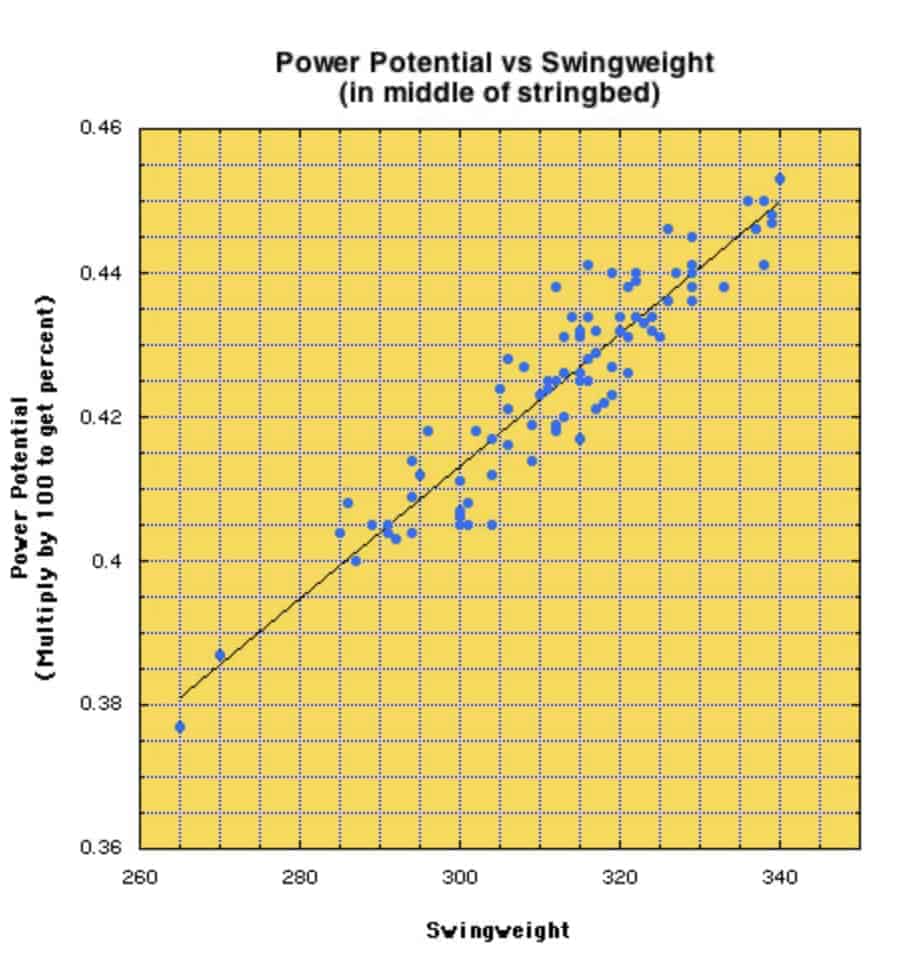
The trend among rackets is that as swing weight increases, power increases. This is because a high swing weight allows the racket to plow through the ball at contact. Less swing weight behind the ball at contact causes the racket to move more on impact, taking less energy out of the ball. 

Remember that when it comes to swing weight, the distribution of weight is more important. So a racket that is head heavy will provide more power, as the weight is further from your hand.

Below is a chart showing the correlation of swing weight to potential power. You can see that as swing weight increases, potential power increases as well. The chart is courtesy of Tennis Warehouse.

Photo courtesy of Tennis Warehouse

Stability vs. Maneuverability

As swing weight increases, stability increases as well. Further, lower swing weights contribute to less stability and more maneuverability. Stability corresponds to how little the racket moves at contact. This relates to power because of the reasons explained above. Lower swing weights contribute to more maneuverability because as the weight will be centered towards your hand, it will be easier to whip the racket around at will. 

Maneuverability will be an advantage for quick reflex volleys at the net, but a disadvantage for power on groundstrokes. This is because as the racket moves more at contact, you will lose power. Stability will be an advantage for power and control, but will be a disadvantage for producing racket head speed. Racket head speed is a key factor in creating top spin. 

What swing weight fits your game style?

In my experience I have found that players with short, compact strokes benefit from rackets with a higher swing weight. Long strokes benefit from rackets with a lower swing weight. 

Players with loopy strokes that produce a heavy ball will generally prefer a racket with a lower swing weight because maneuverability is so essential for their game. The racket head speed that they rely on for their groundstrokes is hard to come by with rackets that are high in swing weight. On the flip side, players that play flat and through the court generally prefer rackets with high swing weights because it gives them more power as the racket ploughs through the ball at contact.

It is important to remember that your preference on whether you are seeking maneuverability or stability is personal. Different players will benefit from different things, and it is important to know what you should be looking for. 

Photo: Regina Cortina Photography

Tennis racket swing weight range

Online you will be able to find racket swing weights ranging from 280-420 RDC. RDC stands for Racket Diagnostic Centre, the machine used to calculate swing weight. When you see that a racket has a swing weight of 330 RDC, this means that this is the number that the machine determined for the particular racket’s swing weight. This is not to be confused with grams. Grams are commonly used to measure the static weight of a racket, and these numbers can be very close to each other. 

How can I measure a rackets swing weight?

While you can measure swing weight on your own, it will have imperfections due to human error, especially if you are not experienced with the process. We highly recommend that you find a Racket Diagnostic Centre (RDC) machine to measure a racket’s swing weight for the most accurate results. These machines are fairly uncommon, and you’ll most likely have to find one through a local pro shop or a store that practices racket customization. 

Because it can be hard to find an RDC machine, there is a way that you can get a close estimate of swing weight using items found around the house. This process is highlighted by Tennis Warehouse, and you can see the step by step guide here.

How can you change the swing weight of a stock racket?

There is really only one simple way to tinker with the swing weight of a stock racket: using lead tape. Lead tape is material used by many advanced tennis players to get their rackets customized to their liking. Lead tape can be added anywhere on the frame to add weight, and the location of the lead tape will affect the swing weight of the racket.

Lead tape that is placed under the grip will increase the static weight without affecting the swing weight much. However, lead tape added to the top of the frame will affect the swing weight of the racket tremendously.  

We have an article on everything you need to know about changing the weight of your racket. Click here to check it out: Adding Weight to Your Tennis Racket: A Beginner’s Guide.

Final Thoughts

Hopefully this article cleared up some of your questions about swing weight. It can be aa bit complicated because there is a lot of science involved, but if you stick to the basics in this article you will be just fine.

Our friends at Tennis Warehouse have a great selection of rackets and they make it easy to find exactly what you’re looking for. Click this link to be sent to their racket finder to find the best frame for you!

Tennis Racket Stiffness Explained


If you’re busy browsing the tennis racket market, you are likely trying to make sense of all of the numbers you’re seeing. The racket’s “specs” show everything you really need to know about each racket, and they will give you the best idea of what a racket will play like before you even hit a ball. One of the most telling specs is racket stiffness, and it’s important to understand what that number means before you consider buying a particular racket.

A racket’s stiffness is defined by how much the frame bends when it makes contact with the ball. The number you see is correlated directly to how much the racket is distorted as the ball is struck. So, a higher rating of stiffness relates to less bend in the racket at contact. A lower rating, therefore, means that a racket will bend more at contact. 

Rackets on the market have a stiffness of anywhere from 40-80. However, the most popular rackets typically fall between 60 and 70. The difference between a racket with a rating of 60 and a racket with a rating of 70 quite substantial.

This article will go through the details of what stiffness means, how stiffness affects a racket’s feel, how stiffness affects potential injuries, and examples of rackets with both high and low stiffness ratings. Let’s get to it.

What does stiffness mean in a tennis racket?

We touched on it above, but stiffness is defined by how much the frame bends when it makes contact with the ball. “Stiff” rackets are less distorted at impact than “flexible frames, assuming that all of the other specs are the same. 

The stiffness in a racket is one of the most important specs because it considerably affects how a racket will feel to a player upon contact. This number tends to confuse people and to be honest, it confused me as well earlier in my career.

When we say that a racket is distorted at impact, this isn’t something apparent to the naked eye. Flexible rackets aren’t going to be bending to the point where you’ll see it when hitting a ball, but players will definitely feel a difference in how the ball comes off the strings. 

How is stiffness determined?

So if you can’t see the racket bend, how can people tell how stiff a frame is? You can’t bend even the most flexible frames on your knee and expect to see anything. If you try this, you may be looking like Stan Wawrinka below. 

There are machines that determine a racket’s stiffness. These machines are used by racket companies to put a number on the rating so that their consumers have a better idea of how the racket will play. 

How does stiffness affect a racket?

Now it’s time for the important part: Why does stiffness matter? The stiffness determines how much control and feel the racket has. This is why this spec should be such a key factor when deciding which racket you should be using.

The reason that this rating is confusing to many is because the wording is slightly contradictory. Some players jump to the conclusion that the higher stiffness rating will cause the racket itself to feel stiff, like a board (i.e more control, less power). The truth is actually the opposite. Remember, stiffer rackets actually allow for more power, not less. 

Sounds weird, but once it is explained it will make some more sense. Stiff frames allow the energy to bounce back quickly and explosively off of the strings at impact. The stiffer the frame, the less energy is transferred to the racket (and therefore there is more energy in the ball). Frames that are less stiff absorb more energy from the ball, and therefore the racket will provide less power when the ball is transferred off of the strings. 

Does stiffness increase the risk of tennis elbow?

This is a common question. The answer is yes, definitely, but it is not the only spec that can contribute to injury. The combination of a stiff and light weight racket can cause injury because of the way the joints are whipped around, especially with hitches in technique. Less stiff rackets can also lead to injury, mainly if they are heavy, because the joints end up taking a lot of the blow at contact when the racket does not bend.

The stiffness of your racket could be leading to injury, but it isn’t always as simple as just using a racket that has a different stiffness. It is important to look at the whole picture rather than just one spec of the racket. 

For more information about tennis elbow, see our article: Tennis Elbow – The Full Guide For Tennis Players.

Recommendations and Examples

Now that you have a better understanding of what stiffness is all about and what it can provide to your game, you are ready for a couple of our recommendations. Remember that stiffness is just one of the many factors that makes a racket more based in power or control, so stiffness is not the ultimate determiner. Below are our highly recommended rackets for both low and high stiffness. 

Stiff Rackets

Wilson Ultra 100 v3

Stiffness of 73

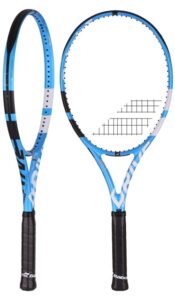
Babolat Pure Aero

Stiffness of 67

Babolat Pure Drive

Stiffness of 71

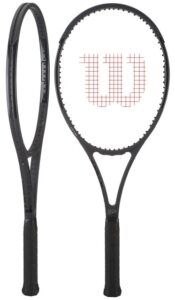
Wilson Pro Staff 97 RF Autograph Black

Stiffness of 68

Flexible Rackets

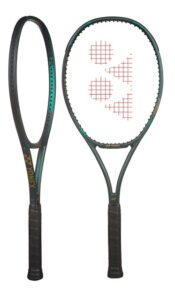
Yonex VCORE PRO 97HD 18×20

Stiffness of 59

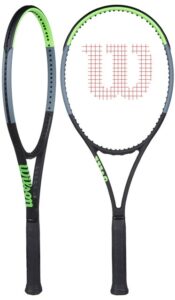
Wilson Blade 98 18×20 v7

Stiffness of 62

Head Gravity Tour Graphene 360+

Stiffness of 61

Head Graphene 360+ Prestige Midplus

Stiffness of 61

Final Thoughts

When choosing a racket, it is important to understand the specs that the racket provides. The combination of all these specs is what makes a racket unique, and they will give you an idea of what a racket will play like before you even hit a ball.

Stiffness is one of the specs that generally has a large effect on how a racket feels, so hopefully this article answered some of your questions about it. If you have more detailed questions that we may have missed the answer to, feel free to reach out to us. You can reach us either in the comments below this article, or on our instagram at @MyTennisHQ.