The 5 Best Tennis Rackets For Doubles

The 5 Best Tennis Rackets For Doubles

Recent Articles

At What Age Do Tennis Players Retire?


What Age Do Tennis Players Retire?

Tennis is a sport in which people begin to specialize at a young age, and in which many matches and a lot of training take place on hard, concrete-based surfaces. This takes a considerable toll on players’ bodies, causing injuries and sometimes leading to forced retirement. In recent years, however, improvements in medical support and racket technology, plus input from biomechanists, have helped players to extend their careers beyond what might have originally been possible. There is now a clear trend towards players being able to continue playing until their mid-30s if they remain motivated.

On average, professional tennis players typically retire at around age 27. For the top players, the average retirement age is significantly higher. The retirement age is, on average, higher for men than women, and less successful players of either gender are likely to be forced to retire earlier, either for financial reasons or due to a lack of medical support.

After they retire, tennis players usually remain involved with tennis in one way or another. We have written an awesome article on the paths tennis players follow after retiring, and you can check it out here.

The Average Retirement Age

It was calculated recently that the average tennis player retires at the age of 27 with around $300,000 in career earnings. There are several reasons, however, why this is misleading. The stated career earnings offer a big clue. Any player who has spent a significant amount of time ranked in the top 100 will have earned considerably more than $300,000. This means that many of the players included in this calculation have been playing primarily ITF tournaments and Challengers.

For these players, life is tough. They barely earn a living and require sponsorship or funding from a governing body to keep touring. They will also lack the top-class medical and biomechanical advice which top players can rely on. Players in this position will often retire in their early 20s, when either their motivation diminishes, they run out of money, or they suffer from chronic injuries. This large group will skew the retirement age calculation downward.

A second reason why the average retirement age might give a false impression is the fact that it is likely to include both genders. Female players tend, on average, to retire earlier (sometimes temporarily) in order to start a family, whereas male players can keep playing in similar circumstances. It is also possible for female players to be competitive at a high level at an earlier age than males, which, if not managed carefully, can lead to injuries and burnout. Famous names of the past like Tracy Austin and Andrea Jaeger are examples of players who enjoyed early success and retired at a very young age.

If they avoid serious injury, the trend among the leading male players is now to continue playing into their mid-thirties and sometimes longer. The leading female players are also playing longer, although the average age of the top players is lower than for the men.

The Average Age Players Peak

One factor which will be crucial for a player deciding whether to retire will be how close they are to their peak level of performance. A player who peaks at 29 will not be thinking of retiring at 30, for example. Recent research published on www.sbnation.com suggests that male players typically peak somewhere between the ages of 23 and 24, whilst females peak earlier, between 20 and 21.

The latter is certainly borne out by the recent performances of Kenin, Andreescu, Swiatek, et al. The former, if true, does not bode well for the likes of Sascha Zverev, who is forced to look on as the vast majority of Grand Slam events are won by players aged well over 30. On the other hand, there are plenty of exceptions to these ‘rules’, with a variety of late starters and late developers peaking in their late 20s and 30s. Game style is probably also a factor, with efficient players like Federer, or big servers like Karlovic, peaking later than many.

How The Retirement Age Has Increased Over Time

Whilst retirement age data for different years is hard to come by, a 2017 study by Tennishead magazine gives a clue as to the trends. They found that in 1987 the average ages of the top 100 male and female players were 23.74 and 22.56 respectively, but by 2017 these had increased to 28.26 and 25.8. They calculated that even since 2007 both average ages had increased by 2-3 years. These figures reflect the fact that many players are retiring later, although female players tend to retire earlier than males. Tennishead noted that 42 top-100 players were over the age of 30 by 2017. These trends look set to continue into the 2020s.

Who Is The Oldest Player To Play On The Tour?

There have been some remarkable feats of longevity, although some of the statistics represent former top players accepting a wild card into a local or favorite event when semi-retired, just to see if they could still perform at that level. At present, 41 year-old Ivo Karlovic is still battling away, just outside the top 100, on the main ATP tour, and clearly still enjoying every minute. On the WTA tour, Venus Williams shows no sign of retiring at the age of 40.

In past years, one of the most astonishing stories was that of Kimiko Date, who retired when highly ranked in 1996, aged 25, and returned to play, successfully, in 2008 following a lay-off of almost 12 years. She finally retired due to injury at the age of 47. The oldest player to enjoy success was the great Martina Navratilova, who eventually retired just before her 50th birthday after winning her final US Open mixed doubles crown. On the men’s side, Younes El Aynaoui continued making sporadic wild card appearances on the ATP Tour until he was 47, and John McEnroe played doubles at 46.

Final Thoughts

Modern technology and sports medicine enable tennis players to play for longer than ever now. It may not be long before we see a 40-year-old win a grand slam singles title.

How Do Tennis Players Train? (By A Former Pro)


How Do Tennis Players Train?

Malcolm Gladwell once suggested that to reach an elite level in any activity, around 10,000 hours of practice is required. This gives an indication of the level of dedication needed to reach the top in tennis. From a fairly young age, aspiring tennis players will be taking part in frequent, highly-focused hitting sessions, supplemented by regular strength and conditioning work. They will also be carefully monitoring their nutrition and recovery, and learning the mental skills they will need to compete at the highest level.

Top professionals spend 3-4 hours on court for at least four days per week, with less intense sessions on two other days. They will fit strength and conditioning sessions, incorporating speed, agility, and weights, in between on-court sessions. They will generally train at big academies or national training centers, and will work with coaches, fitness trainers, and sport psychologists.

How Often And How Many Hours Do Tennis Players Train?

If a player is on the main ATP or WTA tour, their year will normally (although not in 2020) consist primarily of traveling from place to place playing tournaments. Their training during these periods will depend on the number and intensity of the matches they are playing. If they are enjoying a successful spell, with 2 hours or more of match play each day, plus possibly doubles, there will not be a great need for on-court practice.

Instead, they will focus on recovery, rehabilitation of any injuries, and maintaining their overall fitness with core work and stretching. They will probably practice on court for 30-45 minutes on the morning of their match, just to ensure that everything is working as it should, and will have a regular pre-match physical warm-up routine to ready their muscles and ligaments for the battle ahead.

Recovery is an extremely important aspect of the routine of a tennis player. We have written a thorough guide with the most common recovery strategies players use, and you can incorporate those methods into your recovery as well.

During the off-season, or a period when the player is not winning and hence has fewer matches, a more intense training program will be instigated. These periods enable players to spend more time in the gym, to improve their strength and flexibility, as well as to build speed endurance and agility. Physical training sessions will last perhaps 1-2 hours each, and will take place on most days during a high intensity training block.

The other key element will be on-court work. Players will typically hit for 3-4 hours per day, probably in two or three highly focused sessions. This will enable them to build solidity and consistency, as well as to improve their game in any areas they and their coach consider necessary. It would be usual for players to follow two intense days with a lighter one, making the seventh day a rest day, but there are many different ways of structuring a training program. Around all of this, the crucial mental skills work will be done in association with a sport psychologist.

Where Do The Pros Train?

Top players will have to do a lot of their training ‘on the road’ due to the amount of time they spend playing tournaments. They will use the facilities at or around the tournament venue, and will take advantage of the presence of their peers to find practice partners.

During a training block, the players will tend to base themselves at large academies, like Sanchez Casal or Mouratoglou. Although this is not a cheap option, they know that by doing this they can assure themselves of a ready supply of practice partners, good courts, and high-class fitness facilities.

Some will use centers owned by their governing body, such as the UK’s National Tennis Centre at Roehampton. In theory, players can train anywhere there are courts and a gym, but they need access to fitness trainers, a physiotherapist, a nutritionist, a psychologist and a coach, plus hitting partners of an appropriate standard, so it is generally easier to train at the same site as a number of other players.

On Court Training

During their on-court sessions, players will perform several different types of practice. The solid base will be instilled by tough, physical sessions of doing drills, perhaps from a basket feed to enable the coach to maintain a high intensity. The drills might be aimed at consistency and repetition, or they may be intended to ingrain patterns of play which are likely to be effective in matches.

When two players are hitting together, there are likely to be structured drills which force certain combinations of shots, and others which allow more generic rallying. Many sessions will conclude with some competitive points being played, partly for enjoyment and partly because the effective playing of points is the ultimate objective. Sometimes a session may consist almost entirely of competitive matchplay, and a good coach will be able to assist by offering new tactical ideas to practice.

Fitness and Workouts

The most important point here is to remember what the player is training for. Speed endurance and agility are vital to support the playing of numerous high-intensity rallies. Flexibility is crucial for avoidance of injuries, as is strength to prevent undue stress on ligaments and joints. The daily fitness sessions described earlier will be designed to improve all of these elements, with the type of training being rotated to avoid boredom and overuse injuries.

Mental Training

If you want to get to the top, your mind must be at least as strong as your body. Mental toughness is largely a product of proficiency in a wide range of mental skills. Examples include effective inter-point routines, mastery of relaxation techniques, control of self-talk, positive thinking, and effective use of visualization. Ambitious players will work on these skills several times per week, regularly consulting a sport psychologist, whether in a tournament or training block. The psychologist will help them to analyze their psychological performance in matches in order to help them improve.

Final Thoughts

To become a top player, a huge amount of work is needed, and this can never stop if you hope to remain successful. The best players retain a hunger for training because they recognize its importance.

How do Tennis Tournaments Work?


How Do Tennis Tournaments Work?

Thousands of tennis tournaments take place across the world every year, at many different levels. Most of these will have common features like knockout draws, qualifying events, an entry fee and/or prize money. Any tournament requires a substantial amount of organization. Beforehand, players must be accepted on an agreed basis, placed in an appropriate slot in the draw, and given all of the information they need.

During the event, officials must be provided, and clear communication needs to continue. At higher levels, accommodation must be organized and prize money paid promptly. In 2020, the coronavirus pandemic has forced tournament organizers to instigate many additional protocols to ensure the safety of everyone involved.

In essence, tennis tournaments work by accepting as many of the highest-ranked players as possible, given the maximum draw size they accommodate. There may be a qualifying draw to allow lower-ranked players a chance to play. Events normally run on a knockout basis, culminating in a final. Prize money and ranking points, if applicable, are awarded according to the stage reached.

How Players Qualify for Tournaments

There are many different levels of event but, whatever the standard, it is usual for the highest-ranked or rated players to be admitted first. If there are more entrants than spaces, there will be a cut-off below which players are added to a reserve list. In more prestigious tournaments there will often be a qualifying draw, in which the highest-ranked players who were not automatically admitted to the main draw play off to earn a small number of spots specifically allocated to qualifiers.

The other common way of gaining admittance to a tournament is via a ‘wild card’ issued by the organizers. There will be a few wild card spaces in the main draw and the qualifying event to allow the organizers to admit any players they wish. These slots are intended to be filled by local players, or perhaps a former champion who no longer qualifies for direct acceptance. In the past, at the lower levels of professional tennis, some unscrupulous tournament organizers have accepted money to give players wild cards, but fortunately, this rarely occurs today.

At professional level, entries will be determined primarily by ATP or WTA world rankings. The ITF World Tennis Tour is the level at which players must work hard to gain a world ranking, but even these events are not always easy to get into without one. This is where wild cards can be a great help to up and coming players.

On the men’s side, ATP Challenger events are the next step up, whereas for the women there are higher tiers of ITF events. To get into these, a reasonable world ranking must have been earned through the lower level ITF tournaments.

Finally, when a player reaches somewhere close to the top 100 in the world, they will have a chance of playing regularly on the main ATP or WTA Tour, and will be able to enter the most prestigious and lucrative events.

We have written a full guide on how tennis players qualify for Grand Slam, and you can check it out here.

Do Players Pay to Enter Tournaments?

In general, the answer is yes: the vast majority of tournaments incur expenses such as court hire, ball purchase, and payments to officials, and players are expected to pay an entry fee to help cover these. At the amateur level, there will virtually always be a significant fee to be paid. As players move further up the ladder, prize money becomes more significant, and tournament expenses will be covered by sponsorship income or television fees.

This means that on the main ATP and WTA tours, and at the Challenger level, there is no entry fee. Instead, players are normally provided with free accommodation, and often food as well, and will receive prize money according to the stage they reach.

On the ITF World Tennis Tour, tournaments are less well funded, and prize money is only really significant if a player reaches the latter stages. In the majority of events, players will be responsible for their own accommodation costs, and they will normally be expected to pay an entry fee. This fee can be up to $40.

The Draw and Match Play

There are many different ways of structuring a tennis tournament: one or two prestigious ones like the ATP World Tour Finals operate on a round-robin basis. The majority of events will, however, be run on a knockout basis. The draw size will typically be 16, 32, 64, or 128, allowing for the numbers to be gradually reduced to a final two without awarding any byes.

Some spaces in the draw will be kept for players who win through the qualifying event, which will be structured in a similar way. The highest-ranked players will be seeded to keep them apart until later in the tournament. The matches themselves will generally be played over the best of three sets, although some events will replace the third set with a tie-break, and men’s Grand Slam events use a ‘best of five sets’ format.

The Prize Money and Ranking Points

On the main tours, prize money comes from television and sponsorship income, and can be very generous. On the ITF tour, tournaments rely more on funding from governing bodies, along with limited sponsorship. Prize money in these events is normally far from generous, and for the majority of players it will not cover their expenses.

In all cases, the prize money will be allocated by sharing out a predetermined prize fund, with larger amounts going to the most successful players. Most tournaments at all levels provide ranking points, although the basis of these can differ wildly. They are most critical at the professional level, where they determine admission to later events.

Final Thoughts

Running tennis tournaments is a complex business, and many rules must be followed to ensure fairness, especially where players’ livelihoods are at stake. Nonetheless, the basic structure is fairly consistent, allowing amateur players to play in events that resemble those played by their heroes.

Do Tennis Rackets Matter? (Yes, They Do)


Do Tennis Rackets Matter?

There have been massive changes in tennis racket technology over the last 50 years. In the 1970s, wooden rackets generally held sway. Metal frames became popular for a time, but the next big development was the move to graphite frames in the 1980s. Since then, a wide variety of composite materials has been used in racket manufacture, with substances ranging from titanium to graphene being employed. Compared to their wooden ancestors, modern rackets can be made longer, with larger heads, while being significantly lighter and stiffer. These characteristics mean that it is much easier to hit the ball hard and impart spin with modern equipment.

In the same way that modern rackets are easier to use and more effective than their predecessors, there are many differences between the rackets you can buy today. They will have different balance or stiffness, as well as being fitted with various types of string – and all of these elements will affect the way you play the game.

Choosing the right tennis racket is an important matter for a player’s overall game. Depending on the player’s physique and playing style, some rackets will optimize the player’s strengths while others will accentuate weaknesses. In addition, choosing the wrong racket can eventually lead to injuries.

How Rackets Impact Your Game

Head size is probably the most important factor here. A racket may be described as having a ‘mid-sized’, ‘mid-plus’ or ‘oversized’ head. A mid-sized racket will have a head size in the range 80-94 square inches. Mid-plus rackets are roughly 95-105 square inches, and oversized rackets will be over 105 square inches.

Typically, the larger the head, the faster the ball will rebound from the racket and the larger the ‘sweet spot’ will be. The sweet spot is the area of the racket face where the ball bounces off most quickly and precisely, so inexperienced players benefit greatly from this area being as large as possible. In addition, a larger head means that a racket is less likely to twist if you do make an off-center contact with the ball.

On the face of it, you might think that all players should use the largest head size possible, in order to maximize the benefits described above. In practice, top players tend to prefer rackets with modestly-sized heads. This is due to the fact that they can already generate plenty of power, and what they are looking for is control and maneuverability, which they will get from rackets with smaller heads.

Frame thickness is another characteristic that will impact your game. Wider frames are stiffer, and will result in the ball rebounding more quickly, offering increased power. The downside is that a stiffer frame transmits more vibration to your arm. Grip size is also significant, with a smaller grip increasing maneuverability but requiring the muscles in the hand and forearm to work harder.

The string used is particularly critical, as this will influence how it feels to strike the ball, plus how much spin and power can be imparted. Soft strings offer good ‘feel’, but only modest power and control, and will tend to break frequently. Thicker, tougher strings will be stiffer, meaning that they can provide power, and, at higher tensions, control, but they offer reduced feel and transmit more vibration to your arm.

Issues Caused by Playing With the Wrong Racket

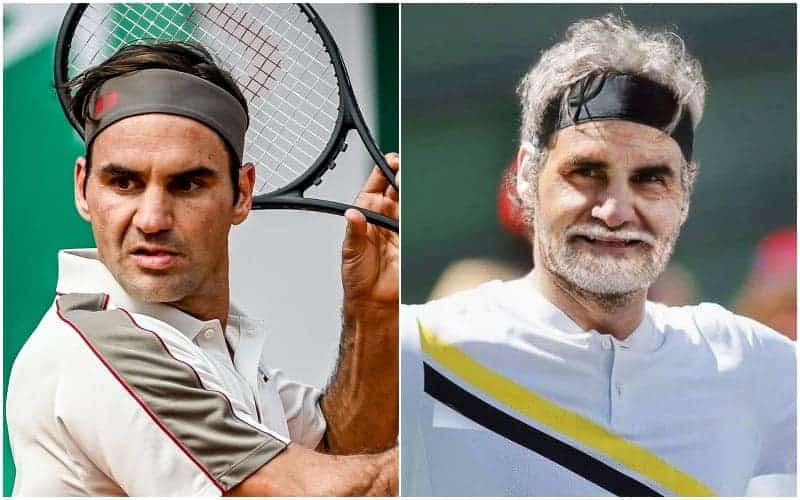
If a big hitter tries to use an oversized racket with a large sweet spot, they will almost certainly find that they lose accuracy and control, as the powerful, but not especially maneuverable, frame will not suit them. Similarly, if a player with little power begins to believe that they are Federer, and switches to one of the rackets he has popularized, they will soon realize that he plays a different game to them. These rackets offer great control and accuracy for players with attacking shots who seek precision, but offer little margin of error or additional power for lesser players.

There are potential physical issues that can arise from using the wrong racket. Stiff frames and tough, thick strings can transmit a lot of vibration through a player’s arm. Excessively light rackets can cause similar problems. This type of vibration is believed to be a primary cause of tennis elbow, which can be very painful and difficult to get rid of. Using too small a grip can also aggravate tennis elbow.

Are Heavier Tennis Rackets Better?

The trend in recent years has been for tennis rackets to become lighter. Wooden rackets were substantially heavier than graphite ones, and the latest rackets are, on average, lighter than many of their predecessors. Nonetheless, heavier rackets do have advantages. If everything else, including swing speed, stays the same, a heavier racket will produce more power. It will also transmit less shock through a player’s arm, protecting against tennis elbow, and due to its solidity will offer better control.

Lighter rackets make it easier to produce faster swing speeds but will normally transmit more vibration. Another aspect of racket weight is the balance of the frame. Some rackets are designed in such a way that more of the weight is in the head (‘head-heavy’), whereas others are weighted more towards the grip. A head-heavy racquet does not need to be heavy overall, but it will feel heavier to swing, and will produce more power than a more balanced frame. On the other hand, a less head-heavy frame will allow better control.

Are Expensive Rackets Better?

The very cheapest rackets are made from inferior materials and are not suited to better players, although they are ideal for beginners. The most expensive and latest models will doubtless be advertised with various dubious pseudo-scientific claims. Ignore the latter unless you are a wealthy and very serious player, and look for deals on the models that were cutting-edge a year or two ago, keeping in mind the important characteristics described earlier. These rackets will be just as good, and considerably more affordable.

Final Thoughts

Choose the right racket and you will play the game better and minimize injuries. Find a racket with the right weight, head size, grip, stiffness, and balance, and avoid the overpriced current models if possible.

How Much do Tennis Lessons Cost?


How Much Do Tennis Lessons Cost?

Whatever the standard of your tennis, there is always room for improvement. If you are looking for advice on how to hit the ball better and more consistently (technical), or using your shots in a smarter way (tactical), you will want to arrange a few lessons with a coach. There are many different levels of tennis coaches, and most will specialize in working with certain types of players.

For example, if you play at a high level you will be looking to work with a highly qualified coach who has a track record of success with top players. Such a coach will not come cheap. On the other hand, if you are a beginner, or are looking to offer your children a start in the game via group lessons, you will want a coach with a sound understanding of the basics, who is very patient, and who understands how to make learning the game fun. This is a very different skillset to that required by the advanced coach, but, due to the lower level of qualification required, such coaching tends to be available more cheaply.

The average cost of an hour’s tennis tuition in the USA is currently around $60. Costs vary according to the level of the coach and player. If a coach with few qualifications is running a session for a small group in a park, that is likely to cost just a few dollars per head, whereas an hour with a leading coach at an elite venue might cost you between $200 and $300.

There are different factors that influence the cost of a tennis lesson, and we will cover them below so you can make a sound and informed decision to fit your own needs.

Cost of Individual vs Group Tennis Lessons

Coaches will, naturally, be looking to make as much money as possible from the hours they work, so they will charge as much as they believe the market will bear, keeping in mind the number of competitors for their business.

The cost of an hour’s coaching will reflect any court fee set by the venue, some allowance for equipment costs (e.g. balls), and the coach’s basic hourly rate. Group coaching may require more than one court to be booked, and there will be more wear and tear on equipment, but in principle the cost of an hour of the coach’s time should be unchanged.

On this basis, it would be usual for the cost per head of a group lesson to be markedly less than that of an individual one, although equally the coach will look to make more money per court by increasing either the rate per head or the number of players per court.

Another important factor affecting the cost of any tennis lesson is the experience and level of qualification of the coach. A coach who has spent years learning their trade, as well as undertaking qualifications, and who takes professional development seriously will quite rightly expect to earn more per hour than an eager but unqualified novice coach.

If you attend an individual lesson on a public court, run by a coach with no, or basic, qualifications, you should expect to pay around $20-25. For a group session, the cost would be shared, so perhaps $5-10 per hour.

At a Country Club, you are more likely to encounter a certified coach, perhaps a Certified Tennis Instructor or a Certified Professional Tennis Instructor. With the additional overheads at a Country Club, you might be asked to pay $50-80 for an hour of individual tuition, converting to perhaps $10-20 per head for a group session.

Finally, at a resort or hotel, coaches will normally be highly qualified Certified Professional Tennis Instructors, and the venue will look to maximize income, so a range of fees from $90-150 per hour is to be expected. Group rates might go as high as $30 per head.

Are Private Tennis Lessons Worth It?

The fact that private tennis lessons are significantly more expensive than joining a group might lead some people to question whether they are worthwhile. After all, you can learn the basics in a group setting, and then go and enjoy playing the game with friends and family. There are, however, several reasons why you might want to invest in some individual lessons.

First of all, there is the possibility that you hope to become really good. To reach the kind of standard that the best players attain takes years of work on your technique, fitness and mindset, and this is almost impossible without a significant amount of individual attention from a good coach.

A second possibility is that you may be nervous or shy, and would prefer to work on a one to one basis rather than exposing your faults in a group environment. Thirdly, you may wish to use individual lessons to expand upon points which you have picked up during your group lessons, in order to ensure that you really understand and improve. For any of these reasons, individual lessons can be thoroughly worth investing in.

How Often Should You Have Lessons?

This probably depends on the player, as some prefer to think more deeply and frequently about their technique than others. At most levels, however, one individual technical session per week should be sufficient, as it is vital to make time outside of your lesson to practice what you have learned. Once you become more advanced and there is less room for improvement, you might consider increasing the frequency of private lessons to 2-3 times a week.

Why Are Tennis Lessons Expensive?

As indicated above, qualified professional coaches need to make a living. In addition, court fees must be paid, tennis balls have to be purchased, and any other equipment used will eventually need to be replaced. It is also true that some lessons are more expensive than others: if you do not care about where you play you can save money on court fees, and an inexperienced coach can be hired for much less than one at the top of their profession.

Final Thoughts

Tennis lessons can be expensive, although there are ways of economizing. Group lessons are helpful, particularly for novices, but, if you can afford them, individual lessons, tailored to you, are the best way to ensure that you improve as quickly as possible.

How to Read Tennis Scores (Easy Guide)


How To Read Tennis Scores

For someone who is not familiar with the game, the scoring system used in tennis must seem very strange. In almost every other sport there is a consistent number of points awarded for a particular method of scoring. In most racquet sports, one point is awarded when a rally is won. In tennis, whilst all points are in truth worth the same, they are not represented by the addition of a consistent number to the scoreboard.

There is a lot of debate as to the origin of the tennis scoring system. Some have suggested that the scores represent positions on a clock face, whilst others believe that they represent how far you were allowed to move forward into the court when serving in a precursor of the modern game. Whatever the real reason is, the quirky and archaic scoring system seems to be here to stay. So how do we read the scores in a tennis match?

In brief, within each game scores increase from 0 to 15 to 30 to 40 as points are won. If a player wins the next point when they are on 40, they score 1 game – but only if their opponent is not on 40 too. In that case, they would need to win two successive points to win the game. 6 games give them a set, but they must have a 2-game lead.

A ‘tie-break’ game is played at 6-6. Two or three sets wins the match, depending upon the format.

Reading A Tennis Score On TV

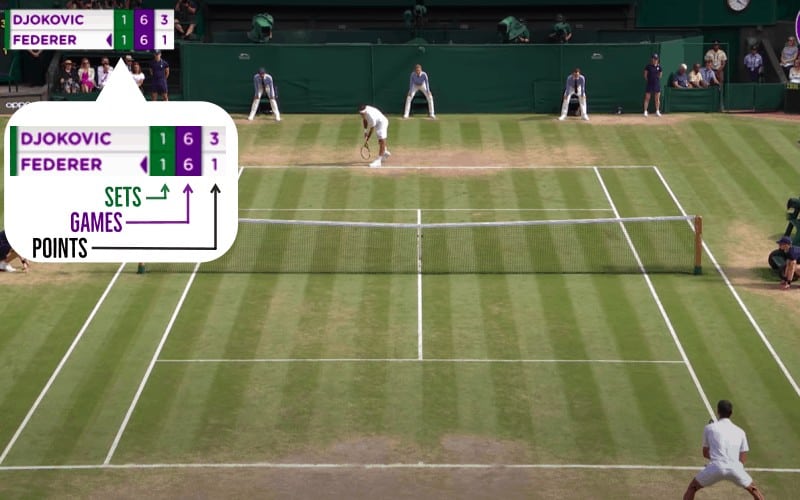
When reading a tennis score on TV, you will have the score right next to the players’ names. You will usually have one column for the set score, one for the game score, and one for the point score. You can see the scoreboard above and what each column represents. Below you will find some context behind the meaning of each of the terms above.

The Points

When a match starts, one player begins the points by serving for a whole game. Every time a rally is won, a winning serve is struck, or a double-fault (two successive serves which fail to land in the required area) is served, one of the players scores a point. As briefly explained above, this does not normally add just one to the player’s score. Instead, the first point scores 15. The second point won by a player increases their score to 30, and the next brings them to 40.

The score will be announced with the score of the player serving given first, so it might be 15-0, or 30-15. If a player has not won a point in the game, their zero score is described as ‘love’ in English. It is believed that this might derive from the French word ‘l’oeuf’, meaning ‘egg’. If the score is even at one or two points each, it is announced as ‘fifteen all’ or ’30 all’. If the score reaches 40-40, this is described as ‘deuce’.

If a player whose score is 40 wins the next point, they generally win the game, adding one to their game score. If, however, the score is deuce, the winner of the next point does not win the game. Instead, they are described as having ‘advantage’. If a player who has an advantage wins the next point, they win the game. If they lose that next point, the score reverts to deuce.

This process continues until one player wins two successive points following a score of deuce. This means that games can continue for some time. When the game is eventually won, one is added to the winner’s game score, and the player who had not been serving does so for the next game.

The Games

The game score within a set is much simpler to interpret than the point score. Essentially, each player takes it in turns to serve for a game, as described above, and each time a game is won, the winning player adds one to their game score.

It is normally the case, especially in men’s tennis where the players are physically bigger and tend to serve harder, that it is easier to win a game when serving than when receiving the serve. For this reason, if a player wins a game during which their opponent was serving, this is described by commentators as a ‘break’ of serve, and is considered to represent a significant advantage.

The Sets

A set is normally won when a player accrues six games, as long as they lead by at least two. Thus, a set can be won 6-0, 6-1, 6-2, 6-3 or 6-4, but not 6-5. Normally a set can be extended to allow a player to gain the necessary two-game lead, so a set can also be won 7-5. A limit has been set in recent times to prevent sets from taking an excessive time, so if the set reaches six games all it is decided by a special tie-break game, and the winner of this is awarded the set 7-6.

Matches are generally played over the best of three sets, in which case the first player to win two sets wins the match. Men’s matches at Grand Slam tournaments are played over the best of five sets, meaning that three sets are needed to win these.

Reading a Tie-Break Score

If a set reaches 6 games all, it is decided by a tie-break. In this special game, the first player to serve does so for just one point, and thereafter each player serves for two points in succession. The scoring is much simpler than in a standard game, in that each point won simply adds one point to the player’s tie-break score.

To win the tie-break, and hence the set, a player must be the first to accrue 7 points, but as usual they must be two points ahead. If the tie-break score reaches 6-6, the game continues indefinitely until one player gains a two-point lead. In some formats, particularly at club level and in some professional doubles, the final set of a three-set match is replaced by a longer tie-break, in which 10 points are required to win. These ‘Championship’ tie breaks otherwise work identically to normal ‘set’ tie-breaks.

Final Thoughts

The scoring system used in tennis is unusual, but it is one of the things which gives the game its special character. When you have played or watched enough tennis, following it will become second nature.