The 5 Best Tennis Rackets For Doubles

The 5 Best Tennis Rackets For Doubles

Recent Articles

Is Tennis A Hard Sport? (By A Former Pro)


Is Tennis Hard?

When you watch great players like Roger Federer in action, the sport of tennis can look deceptively easy. Roger seems to almost glide around the court, hitting powerful strokes without obvious effort. Take to the court yourself, however, and it will seem a good deal less straightforward. If you are a beginner, you may well find it difficult to consistently make contact with the ball, never mind hitting with the power and accuracy of Federer.

Many people consider tennis one of the hardest sports to learn, due to the need for hand-eye coordination, flexibility, agility, strength, and speed. Players must master different shots and learn the mental side of the game, which is considered the hardest part.

While learning tennis can be challenging, it becomes significantly easier when you have a game-plan. We have written a full guide on how to start playing tennis, with insights on how to choose gear and how to plan your lessons, and you can check it out here.

Is Tennis Hard To Learn?

If your ambition is simply to walk onto a park court and hit a few balls over the net with a friend, tennis is not that hard. Swing the racket, and you will gradually start to make contact with the ball more often. Occasionally, something resembling a rally may break out. If, however, you want to play the game properly, with a view to joining a club or playing competitions, there is considerably more to it.

Using an effective technique in tennis will give you the best chance of directing the ball where you want it to go, and will protect you against injury. It is very easy to hurt your arm, wrist, or elbow by repeatedly hitting a tennis ball with poor technique. Coaches are trained to help find the best technique for you, so it is generally helpful to sign up for a few lessons. In the long term, this will help you to improve more quickly and play better.

You will need good hand-eye coordination, which can be improved through playing tennis or other sports, and will need to learn techniques for forehands, backhands, serves, returns, volleys, and smashes. As you improve, you will learn to use different spins to make life harder for your opponents. All of this will take a substantial amount of time, but each small improvement can bring great satisfaction.

Is Tennis Physically Demanding?

This is heavily dependent upon how you play the game. If you want a gentle game of doubles with friends, none of whom hit the ball very hard, the physical demands are about the same as taking a brisk walk. If, however, you aim to play at a high level, the demands are considerable. To produce powerful shots you will involve many different parts of your body, pushing with your legs, flexing your torso, rotating your shoulder and accelerating and bending your arm and wrist. Repeatedly hitting the ball hard will stress all of these elements, potentially resulting in a variety of strains and creating a risk of tendinitis.

Another demanding aspect of playing tennis at a high level is the way players have to frequently sprint, jump, and lunge on hard court surfaces. Many tournaments are played on hard courts, and a lot of American players train on them.

Playing tennis frequently on such an unforgiving surface can cause stress fractures and a variety of inflammations and strains, as well as being notoriously hard on the knees. Surfaces such as clay and grass are less demanding, but players’ bodies are still tested to extremes in the biggest tournaments.

What Is The Most Difficult Thing In Tennis?

From a technical viewpoint, the serve is probably the most challenging shot to become good at, as you must put the ball in position yourself whilst instigating a complex chain of movements. Nonetheless, with practice most players can become at least competent servers. When playing competitively, there are other aspects which provide a challenge every time you take to the court, however good your technique is.

Firstly, you will need to find the right tactics to defeat your opponent, taking account of their strengths and weaknesses, as well as the conditions in which the match will be played. This is complex enough, but it is made more difficult by the fact that they will be trying to do the same to you.

Secondly, you will need to remain calm and appropriately relaxed, energized when necessary, and focused. All of these mental skills will help you to remain positive and confident, allowing you to perform close to your best. It is vital not to worry about who might be watching, to fear losing, or indulge in any other negative thoughts. A substantial amount of training and practice is needed to develop the necessary mental toughness.

How Long Will It Take To Learn Tennis?

This will vary according to what other sports you have played and your general fitness. As a beginner, you can expect to play a reasonable social game within a few months. However, it will require several years of physical, mental, and technical training before you can compete at a standard anywhere near that of the professionals. For this reason, most top players started playing at a young age.

Is Tennis Harder Than Other Sports?

Not long ago, ESPN assessed the demands of 60 different sports, and found tennis to be the seventh most challenging, harder than baseball and soccer and a long way clear of less physically demanding sports like golf.

It could be argued that even this underestimates the challenges tennis offers. Matches can last five or six hours in potentially intense heat, and players are generally out there on their own with no-one to advise them and everyone judging them. They have no teammates to pick up the slack if they are having an off day, and their opponent will have prepared specifically to beat them. Minor injuries are common, and players must try to overcome these and maintain a high level of play.

Final Thoughts

Tennis is fairly easy to play badly, but incredibly difficult to play well. There are few other sports which offer a comparable mental and physical challenge.


Why Do Tennis Balls Have Numbers On Them?


Why Do Tennis Balls Have Numbers On Them?

Next time you open a tube of tennis balls, have a close look at what is printed on those gleaming fluorescent spheres. There will be the manufacturer’s name, the model of the ball, possibly a logo, and a number between one and four. The reason for the presence of the first three features is clear, but the purpose of the number is less obvious. Each ball in a given tube will be printed with the same number, so it is not to distinguish the balls within the set.

Some players believe that the number reflects the bounciness of the balls, but they are confused. It is true that the International Tennis Federation (ITF) require tennis balls to conform with one of three sets of specifications. Type 1 balls are ‘fast’, type 2 are ‘medium’, and type 3 are ‘slow’. However, while tennis balls are categorized in this way to give people an idea which type they might want to buy, these numbers do not appear on the balls themselves. So what, then, are those numbers for?

Tennis balls have numbers printed on them so players can distinguish their balls from balls coming from another court. Most people play tennis in an area where people are playing on adjacent courts, and it is very possible that more than one court might be using the same brand and type of ball. The numbers allow for a simple and easy distinction.

The Reason Why Tennis Balls Have Numbers

You will have noticed that when professionals play matches, the balls are changed for new ones every few games. The reason for this is the fact that new tennis balls are harder and bouncier than used ones, and the pros like to play with balls of a consistent quality. As soon as a new set of balls is removed from its pressurised tube it begins to get slightly softer, and hitting the balls hard, as the pros do, just accelerates the loss of pressure.

Club players do not hit the ball as hard as professionals, but, nonetheless, their tennis balls get softer with every hour of use. If you are playing with new balls on the next court to some players whose balls have been used before, you will notice the difference in playing characteristics if the balls get mixed up, even if they look similar. If you are using the same brand and type of ball, this can be a real issue, especially if the people on the next court are quite happy to ‘borrow’ your new balls. The numbers on the balls provide an easy solution. If you are using balls printed with number 3, and the next court is using number 4, it is easy to make sure the right ones are returned to you if they should roll onto the adjacent court.

Are Balls Different If They Have A Different Number?

If tennis balls are identical in terms of manufacturer and model, the number on the ball does not indicate any difference at all. It is purely a means of separating one set of balls from another. However, if faced with the scenario in the previous paragraph, where balls of the same type are being used on adjacent courts but one set is older, then the two sets of balls will perform differently. So in this sense the different numbers will indicate a difference in performance.

Do All Brands Print Numbers On Their Tennis Balls?

The addition of a number to the balls is such a simple and obvious thing to do, incurring minimal extra cost and offering a real benefit, that it is now difficult to find balls without numbers. There are, however, certain specific situations where numbers are not useful and where the manufacturer may choose not to include them.

For example, some companies make monogrammed balls, featuring your own name or that of your company. In this case, it is unlikely that another court will be using something similar, so numbers are superfluous. Equally, companies making practice balls recognize that coaches will normally use large batches of balls, and numbering them from 1 to 4 is not helpful. Finally, if balls are made specifically for elite tournaments, they are unlikely to get mixed up, and numbers are not needed.

Other Differences Between Tennis Balls

The main differences between tennis balls are their size and bounciness. While the ITF will not allow large variations if balls are to meet with their approval, slower balls are slightly larger than faster ones and, being a little softer, may not bounce as high.

Balls vary according to the amount of felt on them, which can affect their weight (especially in the wet) and durability. If you play on hard courts, for example, you will probably want a slow, durable ball with plenty of felt, as the surface will wear the covering off the ball quickly.

In general, you will want to try out various types of ball to establish what works best on the type of courts you use, but there will always be a strong element of personal preference.

Tennis balls are generally a bright yellow colour these days, but other colours are available. The felt should be bright and easy to see, but apart from that it is really a matter of personal choice. Tournaments are virtually always played with yellow balls for adults.

For children and novices, colored low-compression balls are used according to the players’ stage of development. Red is the softest, for beginners, then orange, and finally green.

Final Thoughts

Tennis balls can vary in many ways, but the numbers are simply there to help you to avoid mixing yours up with those from the next court. They are very useful, but manufacturers could consider increasing the range of numbers beyond 1-4 to avoid clashes.

What Is An Ace in Tennis? – The True Definition


What Is An Ace In Tennis?

Tennis is unusual among racket sports in that the serve can be a major attacking weapon. Players serve by tossing the ball above their head and striking it with their racket. They use a throwing action to make the racket move very quickly and can produce considerable pace and spin. The fastest serves have been measured at over 150 miles per hour.

Tall players are often particularly adept at serving, as their height allows them a better angle to hit the ball over the net, at speed, into various parts of the target area, known as the ‘service box’. With modern rackets, the best servers can win a lot of points simply by hitting a good serve, which some purists, who prefer long rallies, dislike. Others of us admire the skill that goes into top-class serving, and find a great serving performance just as entertaining as a player running around the baseline hitting winners.

If a serve lands in the service box and the returner is unable to touch it with their racket, it is called an ‘ace’. This wins the point for the server. An ace does not have to be fast: spin and deception can also defeat the returner. Nonetheless, harder serves are more likely to produce aces, as the opponent has less time to react.

The Definition Of An Ace In Tennis

A serve must be struck from behind the baseline and must land in the service box diagonally opposite without touching the net. If the ball bounces for a second time without the receiver touching it with their racket, the server wins the point and the serve is called an ace.

Why Is It Called An Ace?

As ever with words that have been in use for a long time, the root of the term ‘ace’ is not entirely clear. The most likely explanation is the fact that the ace is the most valuable and powerful card in a deck of playing cards, and it hence carries an implication of excellence.

It has also been suggested that there is a link to the terminology used in World War I. Fighter Pilots were categorized as ‘aces’ if they were successful in shooting down a number of enemy planes, and there could be argued to be a link to the firing in of winning serves. The playing card analogy sounds the most plausible.

How Do Players Hit Aces?

The players who hit the most aces tend to be those who can hit the ball hard at a wide range of angles. If they can disguise the direction in which they plan to hit the ball, many of their serves will be very difficult to return.

Spin can also be a big factor in producing aces, as a serve that is hit to the side of the box can be made to move further away from the receiver using slice, rendering it very difficult to reach.

Pure deception can occasionally work too. If a receiver is expecting a powerful, high-bouncing serve, they might stand a long way back in preparation. A clever server might occasionally play a disguised underarm serve, in the form of a drop-shot, instead. If this bounces twice before the unsuspecting returner can reach it, this too will be categorized as an ace.

Can You Hit An Ace With A Second Serve?

Traditionally, players tend to be a little more cautious with their second serve, as, if they miss it, they lose the point. Nonetheless, champions of the past like Ivanisevic and Becker tended to hit their second serve in a fairly similar manner to their first, earning a lot of aces (as well as a few double faults!).

In general, today’s players tend to try to hit a solid second serve that is difficult to attack rather than going for a winner. Despite this, from time to time, many will go for more pace and different placement in the hope of hitting an ace. Although he is not renowned as a great server, Novak Djokovic put this tactic to good use in 2019, earning 58 second serve aces, more than anyone else in the top 10.

Tennis Ace Records

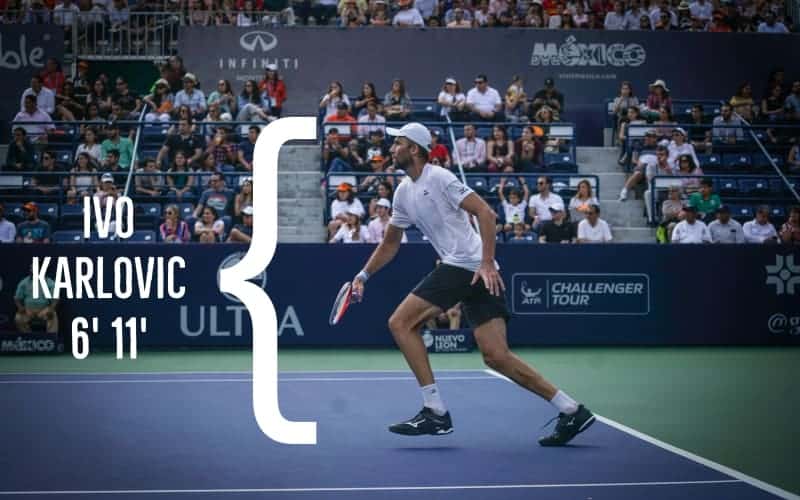
The great servers are often very tall, which means that men have an advantage over women in this area. Most serving records are held by men who are well over six feet in height. The greatest server of all time is the colossal Croatian Ivo Karlovic. At the time of writing, Ivo has served more than 13,600 aces in his career. In second place is almost equally tall American John Isner, with in excess of 12,300. The legendary Roger Federer sits in third place with over 11,300, although his total comes from more than twice as many matches as the two giants ahead of him.

Aces are most commonly served on the fastest courts, which are normally grass. Isner has recorded the highest number of aces in a tournament with 214 at Wimbledon 2018. He has also achieved the greatest number of aces in a single match with 113 in his incredible contest with Nicolas Mahut at Wimbledon 2010, which ended 70-68 in the fifth set. This latter achievement will probably never be equalled, as Wimbledon’s rules have since been changed to prevent matches of this length.

Goran Ivanisevic served 1,477 aces in 1996, which remains the highest total for a season. Goran was at the very top of the game then, so he was helped by playing a large number of matches, but it is still an impressive score. Sam Querrey, another very tall man, holds the record for the most consecutive aces with 10 at Indianapolis in 2007.

Final Thoughts

The serve in tennis is an underrated part of the game. It can be smooth and elegant, or fierce and brutal. The great servers deserve as much credit as those with stylish forehands or beautiful backhands. The aces they serve are a statistical reminder of the skill they bring to the sport.

Do Tennis Shoes Need To Be White?


Do Tennis Shoes Need To Be White?

If you are going to play at the All England Lawn Tennis and Racquet Club Championships, then you might need to wear white tennis shoes. But, for the rest of us who can only aspire to wear garments endorsed by current champions, our choices are thankfully a little more diverse. No longer do corseted ladies’ volley with grace and gentlemen have long ago disposed of jackets and long trousers on the court.

Modern tennis rules allow players to choose whichever color of tennis shoes they want, as long as the shoe does not damage the surface of the court. Only players competing at Wimbledon are required to wear white shoes.

Since the days of Stan Smith endorsing Adidas tennis shoes the trend has nibbled away at the dominant white color and today the most popular tennis shoe of the top fifty players is available in a variety of vibrant colors. White is one of them, but so is an almost luminous green as well as black. Your choices are as vibrant as your imagination and until you get to the center court at Wimbledon you are free to choose any color you want.

Do Tennis Shoes Need To Have White Soles?

Fading away in some obscure corner of many tennis clubs will be a sign regarding the prohibition of black soled shoes or shoes that would leave marks on the court. Today, brand marketing gurus have utilised the space under the feet of tennis stars to print their logos in a variety of colors.

Just like the upper portion of modern tennis shoes, so to the soles have embraced color and the only requirement of soles is that they leave no marks on the court. The color is irrelevant.

What Type of Shoes Do You Wear For Tennis?

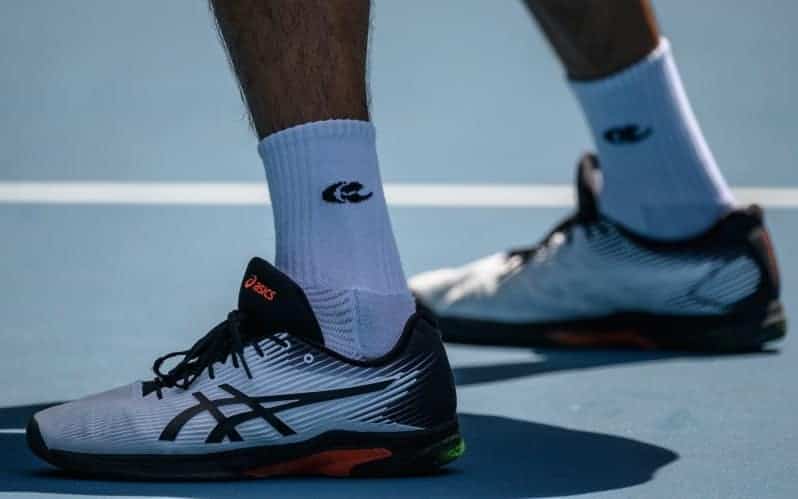
The simple answer is of course, ‘tennis shoes’ but the reasons are more important. The distinction between tennis shoes and sneakers has become blurred – and that creates a problem. Proper tennis shoes are designed to provide comfort and support for the specific conditions of the court.

They are made to protect your feet and ensure your safe movement around the court. So, no matter at what level you are playing, make sure that the shoes you wear have been designed and manufactured specifically for the surface on which you are going to be spending your time, whether that is clay, hard, carpet, or grass.

Tennis Shoe Sole Pattern

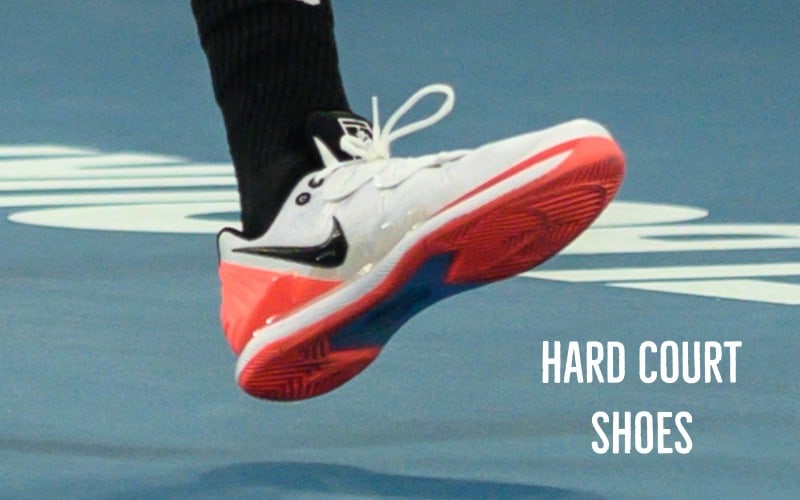
Just like running shoe soles are designed for forward movement, tennis shoe soles are designed for a variety of movements as well as for specific surfaces. The pattern of soles for hard courts recognizes the potential for wear on the most abrasive of the three surfaces. Typically, they will have a modified herringbone type structure that is designed to provide a combination of stability and grip. They will also have additional cushioning to provide comfort on the harder and more abrasive surface.

On the softer and more slippery clay court, the sole pattern is a full herringbone which provides the necessary traction but also allows a degree of slide. In addition, the grooves are specifically designed to combat clay lodging in them.

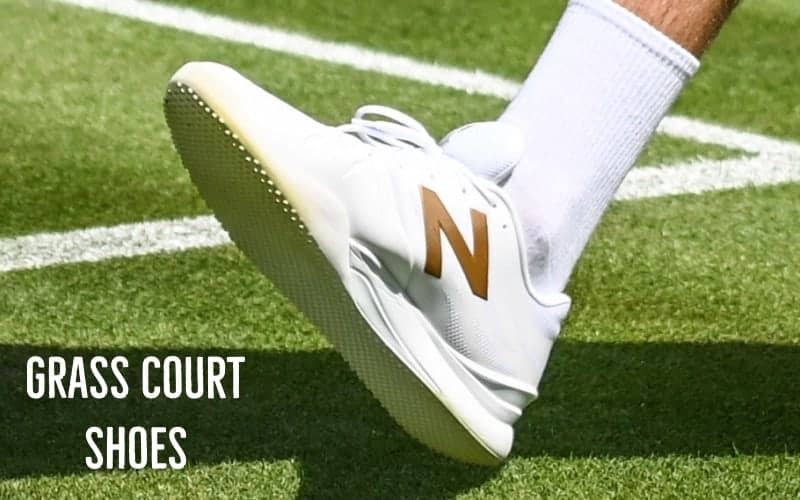
Those fortunate enough to play primarily on grass courts will need soles specifically for this surface that is the fastest and softest of the three types. Here the herringbone gives way to a flat sole covered with small bumps or ‘pimples.’ Soles for hard courts will also suffice for the occasional game on clay or grass for everyone bar the serious league player, but you do need to check the local club rules before playing.

How to Choose Tennis Shoes

The range of tennis shoes is huge. To guide you along in the selection process, identify your style of play. Are you going to be dashing to the net at every opportunity, or are you going to hug the baseline and power your way from there? 

Next, have a look at your old tennis shoes and pay attention to the area of wear. This will guide you in the type of shoe you need to buy. The easiest of the three issues is your choice of surface you are going to spend most of your time on.

The advances in technology will accommodate your specific requirements and spending time making an informed decision will reward you with hours of comfort on the court.

Final Thoughts

Tennis is hard on the feet and anything that comes between them and the court so spend time choosing shoes that not only suit your style of play but also provide you with adequate comfort and support. Next to your racket, shoes will be your biggest equipment expense.

Young players can escape from a fall on the court with just a couple of scratches and scrapes but as players get older falls on the court get to be treated a little more seriously and a firm footing becomes ever more important. Technology has advanced immensely from the days of the plimsole shoe so embrace the improvements in design and material and utilize the opportunity to let your foot ware make your fashion statement with vibrant color on the court.  

How Do Tennis Tiebreakers Work?


How Do Tennis Tiebreakers Work?

Over the past decade, there have been many great matches and moments that have caught the attention of tennis fans. One of the most remarkable ones took place at Wimbledon in 2010. One first-round matchup was the American John Isner against the Frenchmen Nicolas Mahut. On paper, it should have been an easy win for Isner who was ranked 19th in the world back then. What followed however was the longest match in tennis history. It took over eleven hours until the American finally won with a score of 70:68 in the fifth set.

In order to avoid these marathon-matches in every tournament, the American Jimmy van Allen invented the first form of the Tiebreak in 1954. It wasn’t, however, until 1971 that the Tiebreak we know it today was devised by Peter Johns and officially made it into the tennis rule book.

A tiebreak works as a special game to decide the winner of a tie between two tennis players. Once a set is tied at 6 games to 6, players start the tiebreak and the first player to score seven points wins the tiebreak and the set. If players tie at 6-points-to-6, the first one with a 2-point margin wins.

What Does Tiebreaker Mean In Tennis?

A tiebreaker is the crucial part of each set where every point matters much more than during the games. Essentially, it is a special game developed to break a tie in a tennis match. It’s a quicker way to decide sets and matches to avoid matches like the Isner-Mahut match in Wimbledon in 2010.

Tennis Tie Break Rules

The rules are simple. The player who gets to seven points first (or if it’s still tied 6-6, leads by two points) wins the Tiebreak and the set.

The player who returned serve in the last game of the set has the right to start the tiebreak serving from the right-hand side of the court. After the first point, the serve changes and the other player has two serves with his first one coming from his left-hand side of the court. There is always a change of serve when the sum of the points is an uneven number. After one point, three points, and so forth. The reason for that is so the winner must win at least one point when the opponent is serving. It’s a so-called “mini-break”.

After every six points, players need to switch sides. During this switch however they are not allowed to sit down. They are only supposed to walk to the other side and only quickly get a sip of water if needed.

Tennis Tie Break Doubles Rules

The same principle as in singles applies – the pairing which returned serve in the last game before the Tiebreak starts serving. The following two points shall be served by the player of the opposing team due to serve next. After that starting with the first team, each team’s player whose turn it is to serve next, serves alternately for two consecutive points until the end of the tie-break. In order to make doubles matches more enjoyable for the viewers, the tennis governing bodies decided a few years ago to replace the deciding set in with a ten-point Tiebreak. This rule is in place for all tournaments except at the Grand Slams.

The 10-Point Tiebreak

The rules for the 10-Point Tiebreak are almost identical as for the regular one, with the main difference being that the player who reaches 10 point with a two-point margin wins. If the score is 10:10 it continues until one player has a two-point lead. There is also a change of sides after the first sixth point and subsequently after every sixth point.

Nowadays all double competitions are playing a 10-Point Tiebreak instead of a deciding set. On the singles tour it is played at the Australian Open to decide a 6:6 tie in the deciding set.

The Longest Tennis Tiebreak Ever

The longest Tiebreak ever happened in 2013 at a Challenger Tournament in Plantation Florida. Benjamin Balleret defeated Guillaume Couillard in a 70-Point Tiebreak 7:6 (36:34), 6:1. Even though the match was played without line judges or a chair umpire the match score was verified by the ITF and ATP.

The score for the longest men’s singles Tiebreaker in an ATP main draw was 20:18, which happened numerous times. One of which was between Roger Federer and Marat Safin in the Semi-finals at the 2004 Tennis Masters Cup in Houston. The Tiebreaker which Federer won with a score of 20:18 lasted 26 minutes.

Final Thoughts

Tiebreaks have been a great invention in many ways. They add more excitement as every single point counts. It can also lead to surprising results and upsets if for example one of the top players has a few bad moments and commits too many unforced errors. In addition to that it favours players with a great serve as it is crucial to get “mini-breaks” to win a Tiebreak.

They are also essential to keep the games shorter. This can be vital for players in a Grand Slam, as they have little rest between the games and nobody wants to be on the court for eleven hours. The invention of the 10-Point Tiebreak also helped save the popularity of doubles matches. It made them shorter and more entertaining to watch.  

Why Do Tennis Players Change Rackets?


Why Do Tennis Players Change Rackets?

A typical club or recreational tennis player will rarely change the string or grip of their racket. They tend to get used to the way it feels, and as any changes to string tension or the condition of the grip are likely to be very gradual, they will just keep going until the string breaks or the grip begins to visibly deteriorate. They will not want to incur the expense of a restring or a new grip unnecessarily.

Top professionals, on the other hand, look at things very differently. They will want their rackets to be in optimal condition every time they take to the court, either for a match or for practice. They will therefore go on court with a batch of freshly strung rackets with new grips, and will change rackets whenever they consider it necessary. The pros will also use different string tensions for different atmospheric conditions or court surfaces.

The reason behind the frequent racket changes made during matches by top professionals is primarily to ensure that the racket performs exactly as they wish, with no variation and little chance of string breakage. They will have rackets strung at a range of tensions, in case conditions alter, and also to allow for the effect of new balls being introduced.

Broken Strings

The racket head speed and power that professionals can bring to bear put their strings at risk of breakage. Although they will commonly use tough polyester strings, these may still only last a few hours. There is also a trade-off between the thickness of the strings and their playability. A top player would prefer to play with strings that felt good rather than ones that might last longer. To compensate for the increased chance of breakage, the top players will simply get a whole batch of rackets strung to their specifications every time they practice or play a match.

As Serena Williams has pointed out, if a racket string breaks it will probably cost the player a point, and that point could be an extremely critical one, so why take the risk? Of course, less wealthy players will not be able to afford to take such an extravagant approach, so this puts them at a slight disadvantage. The top players are meticulous and take no chances.

Tension Loss

It is difficult to measure the actual tension in your strings once they are tied off in your racket. However, it is thought that they may lose about 5-10% of the tension they were originally strung at within 24 hours. This emphasises another reason why the top professionals want their rackets restrung every day. If they use rackets which were restrung a few days earlier, some tension loss will have already taken place, and the exact amount of this will be unknown.

Tension is also lost during play, to an extent depending upon the aggression of the player and the composition of the string. Top players’ wish for certainty means that they do not want to allow time for further deterioration to take place, so they will make frequent changes of racket.

New Grip

New rackets tend to be fitted with grips which have a moderate amount of tackiness, but when in contact with the natural oils and sweat from a player’s hand this will rapidly diminish. It is possible to replace the entire original grip with a tacky, cushioned, absorbent replacement, purchased for a few dollars. It is relatively straightforward to replace the grip, with a little practice, and for a club player this can be the best solution.

Professionals will expect to have a ‘new’ grip every time they play, to avoid any risk of the racket slipping in their hand. They are most likely to do this by using ‘overgrips’. These are thin, tacky strips which, as their name suggests, are wrapped around the original grip to provide a new surface. They can be bought in bulk and are quick to replace- much more so than a full grip. Some professionals take things to extremes: Richard Gasquet will generally be seen putting a new overgrip on his racket at each change of ends in his matches. Others will just wait until they change their racket.

Why Do Players Change Rackets With New Balls?

During matches on the main tours, new tennis balls are provided every 7-9 games. These will be harder and quicker than the used balls, so professionals will want to allow for this. The most thorough players will change to a racket with a higher string tension when the new balls are brought out. The fear is that the new balls are more likely to fly long or wide due to their extra speed, and the tighter strings will help the players to feel more in control, at least psychologically.

Final Thoughts

Professional tennis players change their rackets very frequently. It could be argued that an enormous amount of time and effort is wasted in putting strings into rackets and cutting them out again, but the top players can afford it and the stringers are pleased to have a continuous flow of work.

The players are aware that at the highest level the margins are very fine, and they do not want to risk losing a match due to being less well prepared than their rivals. Nonetheless, the difference these frequent changes make is fairly minimal, and the standard of play would barely be affected if they did not take place, except perhaps where atmospheric conditions altered dramatically.