
The 5 Best Tennis Rackets For Doubles

The 5 Best Tennis Rackets For Doubles

Recent Articles

Can You Learn Tennis By Yourself? (Easy Guide)


Can You Learn Tennis By Yourself?

The value of being taught by a qualified coach is widely recognized. They will be able to see the inefficiencies in your game and help you to improve them. Most leading players will have received a large amount of coaching to develop their strengths and minimize their weaknesses. What if, however, you don’t want coaching, perhaps considering it too expensive or preferring to learn in a different way? Is it possible to learn to play tennis to a good standard without any help?

Whether you can teach yourself tennis will depend on your preferred learning style. If you enjoy having someone explain things to you and guiding the learning process, you will benefit most from lessons. If, instead, you like to seek information out for yourself and like to learn by imitating others, teaching yourself is a great option.

Learning Tennis By Yourself vs. Private Lessons

Private lessons have the advantages of being easy to arrange and personalized. You need to show up on time, and you can receive targeted technical and tactical advice while being given the opportunity to practice with someone whose aim is to provide the ideal feed for you.

If your motivation wanes slightly, a booked lesson can represent the difference between practicing and ‘giving it a miss for a week’. On the downside, such lessons might typically cost $60 per hour, and you might not spend enough additional time practicing to master any technical changes.

Learning by yourself has the advantage that you can go at your own pace. If you need to spend a two-hour block working on your topspin forehand, you can do so. You can look at videos of any player online so that you can model your shots on anyone- you will not feel any pressure to do things in a set way.

On the downside, if your motivation wanes, you will stop improving. You might find it hard to get practice partners prepared to feed the balls you want, and in general, you will need to be extremely patient and dedicated to reaching a good standard this way.

In general, taking private tennis lessons will offer more structure and accountability. Learning tennis by yourself, on the other hand, offers more control, flexibility, and costs a lot less than private lessons.

The Key To Learning Tennis By Yourself

There are many steps that will need to be taken to learn to play well. Firstly, you need to have a plan. If your practice is random and haphazard, your tennis will be erratic and unreliable. Decide when you will practice, and make a note of what you intend to work on each week. Arrange your practice partner in advance.

If you belong to a club, there will normally be another member who is keen to practice. If you are not paying them, you will probably need to agree that you will work on something for their benefit for part of the session, and the other part will be for you.

When learning tennis by yourself, make sure to set yourself goals, and make sure that they are measurable, achievable, and time-bounded. Well-chosen objectives are vital for maintaining motivation.

When you have decided on the stroke or tactical area you want to work on, decide which source of information you will use to learn from. Most of the useful information will be found online.

For example, YouTube features an enormous number of videos of professionals and coaches playing or demonstrating shots, often in slow-motion. Study as many of these as necessary to decide which aspect you want to incorporate into your game. Practice shadowing the relevant shots until you are comfortable with the movements.

Finally, go out and practice on the court. If at all possible, fix up a camera or phone to video the session. This will enable you to subsequently compare your efforts with what you were aiming for. If your shot isn’t quite matching Federer’s, analyze the differences and begin the process again.

Perhaps most importantly, once you have some reasonable basic shots, find some people of a similar standard, and play some tennis. You will learn far more from playing than from any practice session. You mustn’t lose heart if you do not progress as rapidly as you had hoped.

There are examples of primarily self-taught players achieving great success. Former top 20 player Ivo Karlovic has always struggled to find practice partners, but he improved by hitting a lot of serves and watching the style of the great serve-volleyers.

Mexican-American Richard Gonzales came from a poor background and could not afford coaching, but he still won two US National Championships in the late 1940s, as well as being part of a winning Davis Cup team.

How Often You Should Practice Tennis

When deciding how often to practice your tennis game, you must consider your age and fitness level, as well as the surface you are playing on. Younger players will often be capable of practicing longer and more often, while older players will need to watch out for injuries and burn-outs.

An enthusiastic 16-year-old playing on clay courts could easily practice for an hour or two every day, as long as they spent enough time in the gym to protect themselves against injury. A 75-year-old playing on concrete courts should probably limit themselves to 2-3 sessions per week at most in order to reduce wear and tear on their body.

The mental aspect is also crucial: you need to maintain your enthusiasm for playing and learning. If you try to play too much, you may begin to feel burnt out, resulting in a loss of motivation.

Therefore, the answer to the question is probably: ‘as much as you are physically and mentally able to’. As a minimum, one technical session each week and one free play session will help you progress.

Final Thoughts

It is tough to learn tennis without coaching, but it can be done if you are determined enough. You will need great patience and attention to detail, and it is vital to maintain general fitness to protect against injuries.

Tennis Forehand Grip – The Ultimate Guide


Tennis Forehand Grip - Continental, Eastern, Western

For many players, their forehand is their favorite shot. It is the one they try to hit as much as possible, and the one they employ when they are aiming to strike a winner. Fans of the game love to watch the smooth, powerful forehand of Federer or the brutally topspun stroke of Nadal. Considering those two legends emphasizes the fact that there are many different ways to hit a forehand well, and many of these require you to hold the racket grip at a different angle.

It is vital to adopt a grip that is appropriate for the way you want to hit the ball, and, with the emphasis on the spin in today’s game, more players than ever are using what might be described as an ‘extreme’ grip. So what kind of grip is best for your way of playing?

The range of forehand grips runs from the continental, via the eastern and the semi-western, to the full western. The continental is for hitting flat shots, whereas the western is for the heaviest spin. If you are a beginner, you will probably start with an eastern or semi-western grip, and many players will continue with one of these.

We will cover everything you need to know in order to choose the right grip for your game. If you are interested in learning more about other aspects of a good tennis forehand (like footwork, backswing, follow-through) you can check out our awesome Tennis Forehand Step By Step Guide.

How Do You Hold A Forehand Grip In Tennis?

The handle of a tennis racket has eight sides, and a grip is most easily described by how these ‘bevels’, as they are known, sit in your hand. The diagrams below shows the bevels, along with numbers to make them easier to describe.

You will notice that the bevels are numbered differently for left and right-handers, as they strike the ball with opposite sides of the racket. In general, a player will hold the racket moderately firmly in their dominant hand, with the thumb and index finger making a ‘V’. The index finger will sit in a kind of ‘trigger’ position, with the rest of the fingers remaining close together as they wrap around the handle.

Forehand Grip Types

The key difference between the various types of grip is how the knuckle below your index finger and the heel of the hand (on the opposite side to the thumb at the base of your hand) are positioned. Due to the angle at which your hand holds the racket, these two areas will sit on the same bevel. The position of the bevel on which they rest determines whether the racket is in a good position for flat hitting or extreme topspin.

Continental Grip

In the days of wooden rackets and serve-volley tennis, this grip was common. In the above diagram, the index knuckle and heel of the hand sit on bevel 2 for a continental grip. Today, virtually nobody uses this grip to hit a forehand, as it makes it very difficult to hit topspin. Nonetheless, the grip is excellent for hitting serves and volleys, so it is still commonly used for those.

Eastern Grip

Move your hand around the handle so that your heel and index knuckle are on bevel 3 and you will be demonstrating an eastern forehand grip. This was used by the legendary Pete Sampras, and Roger Federer also employs something similar, although he may actually be part way between bevels 3 and 4.

The person who made this grip fashionable in the late 1970s was multiple grand slam champion, Bjorn Borg. Borg was the first player to demonstrate that, even with wooden rackets, it was possible to win matches from the baseline by hitting consistent heavy topspin. His forehand incorporated a steep, upward racket path that enabled him to produce this spin.

A small number of players still use an eastern grip today, but they are primarily those who like to hit the ball hard and flat, with a modest amount of topspin.

The grip has advantages for more attacking players because it lends itself to aggressive groundstrokes, and it is quick and easy to change to a continental grip if the player moves forward to volley. Its disadvantage is that it is more difficult than some others to use for higher balls, and it does not lend itself to control.

Semi-Western Grip

This is the grip which is most commonly taught to juniors at present. The index knuckle and heel will be on bevel 4, although young players are sometimes taught, instead of worrying about bevels, to lay the racket on the floor and then pick it up to help them find the correct grip.

Many people consider the semi-western to be the ideal grip for the way tennis is played today, and it is used by numerous professionals including Serena Williams and Novak Djokovic. The racket angle that this grip produces allows considerable topspin to be put on the ball, as well as lending itself to powerful shots. It works well for medium and high balls and is most effective if the ball is contacted in front of you.

On the downside, a significant adjustment is required to change to the continental grip for volleying, which is not helpful to players who like to move to the net, and the grip does not make it easy to play very low balls.

Western Grip

For a western grip, the index knuckle and heel will be on or near bevel 5. This means that the racket is being held at almost 180 degrees to the position it is in when the continental grip is used. This grip lends itself to extreme topspin and is best when the ball is bouncing high. It is often favored by players who developed their game on clay courts.

Karen Khachanov and Kyle Edmund are examples of leading players who favor this grip, and Rafael Nadal also uses something similar. The advantage of a western grip is the ease with which it can be used to generate heavy spin, but it is not as easy to switch to other grips quickly due to the extreme position in which the racket is being held.

It is considerably more difficult to deal with the low-bouncing balls that might be encountered on quicker courts using this type of grip. Young players are often discouraged from using a western grip, as it is believed that it increases the risk of arm and shoulder injuries in juniors.

The Best Forehand Grip For Beginners

Beginners will not be taught the continental grip, because it is not used for forehands in the modern game, and the western grip is too difficult for beginners. Coaches might teach very young children an eastern grip to make it easy for them to hit flat shots, and then encourage them to shift to a semi-western position as they become more adept. For an adult beginner, the semi-western might be taught from the outset.

Grips For Topspin vs Flat Shots

Semi-western and western grips make it much easier to accelerate the racket across the ball and still strike it cleanly, so either of these is best for generating topspin. Topspin can be produced using an eastern grip, as Borg demonstrated, but it is easier to generate the necessary racket-head speed using a more extreme grip. For flat shots, an eastern grip is the best option. It is in fact extremely difficult to hit shots without spin if your grip is close to the western position.

Pressure: Loose vs Firm Grip

There is an ongoing debate about how tightly you should grip the racket. Some coaches teach that the racket should be held fairly tightly, at least until you hit the ball, whereas others favor a relatively relaxed grip.

The advantage of a tight grip is that it keeps the racket under control, enhances consistency, and reduces errors. The disadvantages are a probable reduction in racket-head speed, and an increased risk of tennis elbow, caused by the tense muscles putting a strain on the tendons in your arm.

Once players have understood and practiced the racket path they aim to use, many coaches will teach them to relax while hitting the ball, and this will encourage them to have a fairly loose grip, although it still needs to be tight enough to prevent the racket from moving in their hand.

The advantages of this are the ability to produce greater speed and the reduced risk of injury. On the downside, more errors may result, and there is a small danger of inadvertently releasing the racket, but overall a relaxed grip is generally a good idea for everyone except beginners.

Final Thoughts

The forehand grip has evolved a lot over the last 50 years. Most players now use grips which are designed to help them apply a combination of power and extreme spin from the back of the court, and less thought is given to what will be beneficial if they approach the net. Over the next 50 years fashions will no doubt continue to change, perhaps to even more extreme grips, or perhaps back towards the eastern and continental. Only time will tell.

Do Tennis Players Get Tested For Drugs?


Do Tennis Players Get Drug Tested?

There are sports like cycling where almost every fan knows that there are drugs involved and sometimes someone gets busted. Then there are sports where you would never expect anyone to cheat – like tennis. People see tennis as a clean sport. For the most part, it is. Very few players ever test positive for banned substances, but the authorities can make players’ lives pretty tough.

Every top professional tennis player gets tested for drugs. It started in the 1980s when they tested mainly for drugs such as cocaine, methamphetamine, and marijuana. It wasn’t until the 1990s however that players began to get tested for performance-enhancing drugs.

But even now experts regard the testing methods as highly questionable as the sport doesn’t chase with any determination after EPO and synthetic testosterone, the two substances with the biggest benefits.

How Often Do Tennis Players Get Drug Tested?

This is an extremely controversial and much-discussed topic within the sport of tennis. This is because there is no set number of tests that each player must take. It is different for each one.

Any athlete is subject to testing by three organizations – the international federation of tennis, the anti-doping agency of the country the athlete is from, and the world anti-doping agency. So, for example, in 2017, almost every top 20 player on the men’s side had 14 tests a year from the ITF and WADA plus additional ones from their national anti-doping agencies.

And last year you can look at the numbers of tests and see big discrepancies. Rafael Nadal and Roger Federer were both tested, by the ITF, 29 times. Novak Djokovic on the other hand only 24 times. At the top of the list was South Koreans Chung Hyeon with 34 and Jan-Lennard Struff with 31.

On the women’s side, Ashleigh Barty and Elina Switolina were the most tested with 29 tests administered by the ITF. In total which means in- and out-of-competition tests including urine and blood there were 7773 tests, 1359 for men, and 1278 for women administered by the ITF.

Tennis Drug Testing Procedures

The testing procedure is the same for every player on the ATP and WTA tour, as well as on the ITF Pro Circuit tournaments and ITF Junior events. The procedure is:

A doping control officer will notify you that you have been selected, then you must be in full view of that office until you provide a sample. You’re not allowed to urinate before going to the Doping Control Station. Furthermore, you must report there immediately unless you participate in a victory ceremony, attend a media interview, take a shower, obtaining urgent medical treatment, or you are looking for your ID or an interpreter who must accompany you.

In that case, the player can delay reporting to the doping control officer for a brief period. After the player has reported he delivers the sample and should declare all medications, substances or supplements they are taking or have taken over the last seven days. Lastly the player needs to sign the doping control form as a definitive record of the rest. The procedure for blood testing is very similar.

Prohibited Substances

  • Anabolic steroids – Perhaps the most famous performance-enhancing drugs, anabolic steroids allow athletes to both build muscle more quickly and train harder.
  • Stimulants – While you naturally produce a stimulant (adrenaline), other drugs such as amphetamines, ephedrine, cocaine and caffeine can be used for an unnatural energy boost.
  • Human growth hormone (HGH) – Used to build muscle, this PED has a history in tennis.
  • Narcotic analgesics – These drugs affect the central nervous system, masking pain, and even producing a feeling of euphoria. Consequently, they allow athletes to train harder and ignore injuries that would otherwise put them out of action.

Tennis Players Banned After Drug Tests

Richard Gasquet

In 2009 Gasquet had tested positive for cocaine at the Miami Open and was handed a provisional 12-month ban. However, an ITF panel overturned the ban a few months later, accepting Gasquet’s claim that the substance was only in his system due to him kissing a woman who had taken cocaine at a nightclub.

Andre Agassi

Agassi tested positive for crystal meth back in 1997. He however got away with just a 3- month ban as he claimed that the drug was taken unknowingly and blamed the positive test on a spiked drink.

Marin Cilic

Cilic was tested positive for nikethamide, a stimulant at the BMW Munich open in May 2013. He was banned for a total of 9 months for this drug abuse by WADA. Cilic claimed that he was in no knowledge of taking the banned substance and unsuccessfully appealed the decision at the court of arbitration for sports.

Viktor Troicki

Troicki refused a mandatory blood test in 2013. He said, that he did not agree to the blood test because he was sick when the test was ordered by the ITF. However, he did provide a mandatory urine sample. He also suffers from a fear of needles that makes a blood test difficult. The ITF however refused Troicki’s claim and banned him for 18 months due to the failure to comply with the organization’s anti-doping regulations.   

Maria Sharapova

Sharapova failed a drug test at the 2016 Australian Open. She had tested positive for meldonium, a substance normally used in heart medication that increases the oxygen supply to the blood. It is also used to treat heart disease and the Russian maintained there was no wrongdoing on her behalf as she admitted using the prescription drug for over ten years. Her initial ban of two years was reduced to 15 months after a court found there was no intention to cheat and no significant fault on her behalf.

Final Thoughts

Drugs in tennis remains a difficult and delicate subject. Do I believe that the sport is as clean as everyone wants to believe? Yes, but could there be some players that do cheat, and we just might never found out? Yes.

The testing system is confusing not just for the fans or the media but also for the players. It seems random and it doesn’t help that each player basically has a different number of tests each year. If the ITF doesn’t properly regulate its testing procedures nothing will change but maybe they don’t want it to, as they would love to keep the image as the clean sport. 

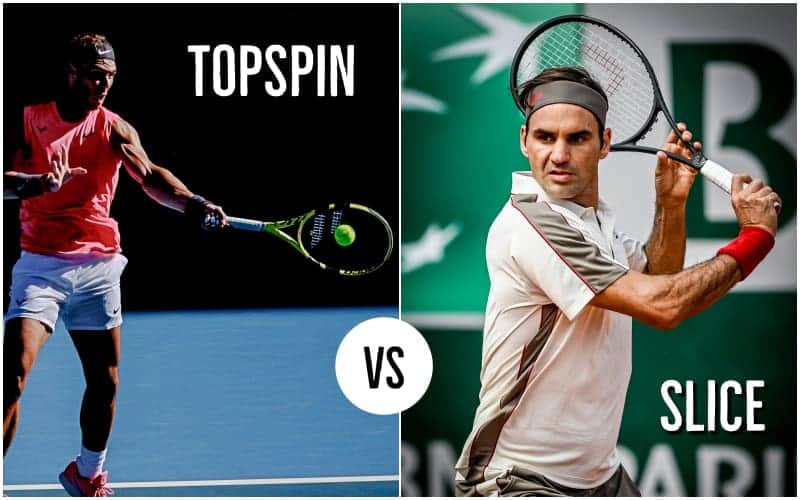
Tennis Slice vs Topspin – What’s The Difference?


Tennis slice vs topspin

When you are playing tennis it’s all about getting the ball over the net and trying to hit a shot your opponent can’t return. At the start, you’re content with just hitting the ball flat but as your skill level progresses you need to add variation to your game. For that reason, it’s vital to add different types of shots to your repertoire. The most common variations are the slice and the topspin. But what is the difference between these two groundstrokes?

Basically, a slice causes the ball to rotate backward (toward the person who hit the ball). A topspin shot, on the other hand, rotates forward toward the opponent as it travels through the air. A player can add slice or topspin to shots by hitting the ball in different places.

What Is Topspin In Tennis?

Modern-day tennis players utilize topspin frequently, as it can appear that the ball will sail over the net and out of bounds before dropping well within the lines of play.

Topspin has changed how tennis is played due to the fact that you can generate much more power behind your shot with a proper topspin forehand. Many of tennis’ greats, such as Roger Federer and Rafael Nadal, have relied on their vicious topspin forehand to win world championships and countless titles.

There are many variations of the topspin forehand where players will choose a desired Western or Eastern grip depending on their style of play. Generally, when practicing a topspin forehand, players will implement a semi-Western grip, as you are able to apply a greater amount of spin to the tennis ball using far less effort.

A player can add topspin to a shot by hitting the ball in a “down-up” movement, which causes the ball to rotate towards the opponent.

What Does Slice Mean In Tennis?

Backspin is most commonly achieved when using a slice shot technique. During a slice shot, the racket travels in a downward motion, before slicing underneath the tennis ball.

Using this technique, you can make it very difficult for your opponent to return your shot with topspin, making the slice a great defensive shot. Since many modern tennis players rely on their topspin forehand to dictate the pace of the match, the slice is most commonly seen as a defensive shot that can be used as a last-ditch effort.

When To Hit Topspin vs Slices

Topspin shots are used by most tennis players as their general groundstroke because it forces opponents to go backward. Good topspin shots will land just in front of the line and bounce towards the opponent so he has a tough time generating power and needs to have good footwork to cope with it.

Topspin shots are also used to come towards the net as previously mentioned it pushes the opponent back, which gives you time to advance to the net.

A slice is often used when you return a serve and then come straight to the net (known as “Chip and Charge”) because it gives you time to do so. The same can be set for other net approaches. When you’re moving forward toward the net and you want to drive a low-bouncing ball into the corner of your opponent’s court. This leaves it tough for the opponent to hit it back with much pace.

Another instance when you are using a slice is if you want to surprise your opponent with a drop shot. It is also the most commonly used shot when you are in a defensive position. When you’re scrambling to retrieve a good, angled shot by your opponent you can swipe the ball back with a slice and buy yourself a little time to get back into position.

The Importance of Variation In Tennis

Implementing finesse into your shots when competing against other tennis players is a great way to throw off your opponent by forcing them to change their game plan on the fly.

Nuanced shots can effectively deceive your opponent, causing them to approach the ball incorrectly while increasing the likelihood that they will not be able to return your shot. By using the proper topspin or backspin techniques during your next competitive match, you will be able to easily keep your opponent on their toes, making it much more difficult for them to adjust to your techniques throughout the entirety of your match.

Final Thoughts

To be a complete tennis player and to be competitive you need to master every shot and you need to know when to use them. If you look at the top players in the world they know exactly how to use topspin and slice shots to their advantages.

Rafael Nadal for example knows that with his extreme spin on the forehand he can make it difficult for a player like Roger Federer with his one-handed backhand to generate power. With the topspin, he forces Federer and other opponents to either be pushed too far backward or to take a risk and hit the ball extremely early.

The same can be said about Federer’s use of the backhand slice. He knows like no other how to disrupt the opponent’s rhythm by using the slice in almost every rally or how to completely catch them off guard with a drop shot.

Topspin and slice shots are a necessity in tennis. They are something you should work on and get better at but in the end, are extremely fun to use.

Can You Learn Tennis At Any Age? (And What To Expect)


Can You Learn Tennis At Any Age?

One of the great things about the game of tennis is that it can be played by everyone, from very young children all the way through to people in their 80s and 90s. Go down to any club on a summer weekend and you are likely to see groups of youngsters enjoying a coaching session, as well as some fairly elderly people taking part in their regular game of doubles. Some might wonder whether, if they did not start at an early age, they will find the sport too difficult to pick up. After all, many leading players were on court by the age of 5.

In fact, setting realistic goals is the key. If you begin playing at age 35, you are unlikely to ever play to the standard of Federer, as, although he is a little older, he has been training his physique and technique for decades. This does not, however, mean that you cannot learn to play the game to a good standard, or will not be able to compete at an appropriate level.

There is nothing to prevent you from taking up the game of tennis at any age. A good coach will recognize your physical capabilities and teach you techniques that are appropriate for your strength and flexibility. There’s an advantage to learn the game as a kid, but if you work hard you can still become a good player in your age group.

Is It Ever Too Late To Learn Tennis?

Absolutely not. There may be some shots, such as those requiring high racket-head speed and/or extreme spin, that a woman taking up the game at 75 should probably avoid, but as long as she is fit and healthy she can still learn to play a solid game and to enjoy tennis for the rest of her life.

Good coaching is important here. The coach needs to understand what the player is capable of and to teach the kind of technique that will be effective without creating an undue risk of injury.

The other crucial element is physical conditioning. If you are considering taking up a new sport late in life, you need to ensure that your body can handle the stress. If you already spend a lot of time in the gym and play other racket sports there will be no problem, but, if not, a few sessions with a personal trainer will be advisable before you start, to prepare you for the new movements.

Playing Tennis At 30, 40, 50 and 60 – The Difference

Many leading professionals are aged over 30, and there is no reason why a player should not be able to play the best tennis of their life at that age. A well-trained 30-year-old is still quite close to their athletic prime, and with good technique and tactical understanding, they need not put a ceiling on their ambitions.

By the time a player reaches the age of 40, their physical capabilities will be starting to decline. Speed, flexibility, and strength will all have reduced a little, although strength and conditioning work can minimize this.

It is still possible to play great tennis at 40: Federer is almost that age now, and can still compete with the very best on his day. The great server, Ivo Karlovic, is well over 40 and still playing professionally, and many leading doubles players are close to entering their fifth decade.

40-year-old players may have to use their experience to substitute for some of the physicality they once had, but they can still play at a very high level.

At 50, there will be a distinct loss of speed, and strength continues to decline. This is probably the kind of age at which players will no longer want to regularly play singles with players in their twenties, preferring to stick to their own age group. Nonetheless, a high level of doubles is still possible.

By the time a player reaches 60, the physical weakening and stiffening will be very clear, although there are some very fit players in this age bracket who still play at a good standard on the ITF Seniors Circuit. With the lack of power and possible deterioration in eyesight, it is hard to even play doubles with the best young players at this age. When playing with their peers, accuracy and touch become more important than ever for 60-year-olds.

Learning Tennis As A Kid vs As An Adult

Most players who reach a high level in the game will have started playing before the age of 10. Many will have been on court playing games designed to boost their coordination, and swinging a racket, sometime between the ages of 3 and 5. This early start means that the movements required to play top-level tennis become second nature to them, and their technique is highly trained and unlikely to break down under pressure.

A player who starts as an adult will generally find it more difficult to develop the instinctive footwork around the ball required to play at a high level, and their technique will be less ‘grooved’, meaning that their shots will not always be reliable.

Learning Tennis As An Adult – Tips

  • To learn effectively and quickly, you will need to get lessons from a coach with experience of teaching adult beginners.
  • Do not rely on playing tennis to get you fit  if you are out of shape: you will need physical training to make sure that you can play safely.
  • Set realistic goals. Concentrate on your own performance and improvement. Understand that you must initially compare yourself with players of similar experience to yourself.
  • If you want to compete, choose events of an appropriate standard and age group.

Final Thoughts

Tennis is a game for life, and you can start at any age. Look after your body and you will be able to play for many years. You may surprise yourself by how good you get!

5 Ways How to Find a Tennis Partner


How To Find A Tennis Partner

It doesn’t matter if you are an amateur or a professional tennis player. Someone who just started playing or a Grand Slam champion. Everyone needs a partner of some form to actually play tennis. Practice is necessary to improve and for that, you need someone to train with. But how do you find the perfect partner? Is it going to be a friend, a ball machine, a sparring partner, a coach, or just a wall?

There are various ways to find the right tennis partner. You can play with a friend, get a coach, hire a professional hitting partner, buy a ball machine, or play against a wall. Just like with almost everything else, nowadays there are also apps where you can find someone to play with.

Why Is It Important to Have a Hitting Partner?

For starters, you need a hitting partner to practice as without practice there is no chance you will ever improve your game. With a hitting partner, no matter what type of partner it is, it’s all just about hitting the ball and getting some rhythm. You can train exactly what you need to work on without the pressure of losing points or a match. The setting is much more relaxing and you can get instant feedback without any repercussions.

Joining a Tennis Club or a League

Joining a local tennis club is one of the best ways to find a hitting partner, whether you hire a pro or just let them know you are available to hit with another club member.

Even if you choose not to join the club, many times, they will let you post your information on an internal board to let others know you are looking and maybe you can join as a guest.

If it’s within your budget you can also take a few lessons or hitting sessions with a local pro, who can then set you up with other players. Maybe you’ll even meet friends with whom you can split semi-private lessons going forward.

Joining a league, team or even contacting them will ensure you find partners and teammates at your same level. They offer tournaments, lessons, clubs, clinics, camps, trips and travel and so much more for tennis players, as their job is to grow the sport. Joining your local league is a great way to find tennis partners.

Using Tennis Apps

Using tennis apps is a very convenient way to find a tennis partner. Nowadays there are various options to choose from. One example is Tennis Buddy, where users can connect with fellow tennis players in the nearby area who are looking for hitting partners or match opponents at any given moment.

It’s a location-based app and is established in more than ten cities. It has features like the ability to filter by different criteria such as distance, age, gender, and skill level. Users can also check out all local player profiles and view feedback ratings they have received from other Tennis Buddy players. You can also just post a broadcast that will be instantly received by all tennis players in the area.

Other app options are also TennisPAL, Play Your Court, or Swing Vision.

Hiring a Tennis Partner

This is a great way to train and play exactly what you want to work on. It will improve your endurance and footwork because the rallies will be much longer than in a regular match. Because of this, players will realize how important good footwork is and that it’s the basis of any tennis success.

Without the pressure of winning, players can stay more relaxed and can even smile during the rallies. They can even celebrate the partners’ shots as well as their own. Players can realize their true potential because they feel much looser in a hitting session.

The point of rallies isn’t to win the point but about how both players focus on each shot that they hit and each rally that they are playing. Because there aren’t any rewards or consequences players learn to deal with their misses before they start the next rally.

This option can be quite pricey depending on where you are, but it might still be cheaper than joining a country club or league. We have written a guide on the cost of tennis lessons, and you can check it out here – How Much Do Tennis Lessons Cost?

The Best Partners: Walls and Ball Machines

If you happen to not have a training partner but are still interested in getting as much practice in as possible, then there are several options you can choose from. The two most common ways to practice alone are against a wall and with a tennis ball machine. 

Both the tennis ball machine and the wall are excellent ways to practice tennis alone. You can work on your footing, placement, and technique on both. However, a tennis ball machine is better in offering a more realistic ball movement and feel for the tennis court compared to a wall. A ball machine can be used to make the same shot over and over again.

With a wall, you lack the depth of the court. This is an important part of tennis as depth control and placement are some of the most fundamental skills you need to work on.

Final Thoughts

Finding the right training partner can be difficult and is unique to each person. It depends on how much time, or money someone has. If you are just an amateur or a player that is serious about becoming a pro player. But with all the hitting partners mentioned above, it’s about hitting the ball moving around, not keeping score, and just playing tennis for the fun of it or to improve certain aspects of your game.

It is about keeping a healthy perspective on tennis and to enjoy the sport even more. The technical and strategic elements of tennis are imperative, but they are useless when a player can’t fully relax and doesn’t completely trust their body when out on the court. So, make time sometimes to forget about all the pressures of what you can be in tennis, and just go out a have a good time for a few hours!