The 5 Best Tennis Rackets For Doubles

The 5 Best Tennis Rackets For Doubles

Recent Articles

How To Stop Your Tennis Racket From Slipping


When you are playing tennis, your racket’s angle and the direction in which it moves determines what the ball really does after you hit it. If the racket slips in your hand, you will no longer be in control of the movement of the racket face, and the ball could go almost anywhere. As control and accuracy are very important in tennis, you will want to do everything you can to stop your racket from slipping. So what might cause this problem, and how can you fix it?

Racket slipping may happen due to a weak grip, an old overgrip, or sweaty hands. Players can stop the earlier by holding the racket with the appropriate strength. Replacing an old overgrip with a tacky new grip can help stop slipping. Lastly, special products are available to help players with sweaty hands.

How Hard Should You Hold The Racket?

There are many theories about how tightly you should grip your tennis racket. Some players and coaches advise maintaining quite a firm grip to enhance control. However, the more common view is that some shots (like serves or volleys) require a firmer grip than others.

For example, when playing shots like service returns and volleys, the ball arrives at speed, and it requires a solid grip to keep the racket stable and control the ball.

However, in a rally situation, the ball’s impact on a racket is likely to be less fierce, and there should be no loss of control if you adopt a looser, more relaxed grip.

This relaxation will help you to develop more racket-head speed and potentially more spin and pace. If there is one shot for which a loose grip is likely to be most beneficial, it is the service for which the ball is barely moving at the point of contact.

A relaxed grip will help with pronation and produce an efficient and effective action. Also, gripping the racket tightly can contribute to problems like tennis elbow and rotator cuff injuries.

Therefore, the logical thing to do is hold the racket as loosely as you can for serves and groundstrokes. Unfortunately, this will increase the risk of the racket slipping in your hand or even falling to the ground.

Some of the other solutions below might help with this, but essentially if your racket is slipping in your hand, you may have to practice playing with a tighter grip until you find the lightest pressure needed for this to stop happening.

Do You Need A New Grip?

Professionals will have new grips put on their rackets every time they use one, as they do not want to risk losing even just one point due to a slippery grip. Many club players take the opposite approach, using grips that have obviously seen better days.

If your racket grip is no longer as tacky as it once was and shows clear signs of wear and tear, you should change it. Replacement grips only cost a few dollars and are relatively easy to fit with practice. A new grip will make your connection to the racket more secure and cut the risk of errors due to slipping.

Some players like to use overgrips, which are thin pieces of tape that wrap around the racket handle on top of the existing grip. These are quicker to change than the main grip, but they also need to be changed more frequently.

Leading French player Richard Gasquet appears to put on a new overgrip at each change of ends! Certainly, no overgrip should be expected to last more than a few weeks.

Some players prefer to replace the main grip regularly, and others favor overgrips, but the key point is that neither should be allowed to deteriorate significantly before being changed.

Slippery vs. Tacky Tennis Grips

Some overgrips, in particular, are designed to be very tacky. While they are new, this allows you to keep a firm grip on the racket very easily. On the other hand, some players find that this limits their ability to make quick grip changes, as the racket almost sticks to their hand.

These players are likely to prefer the dry-feeling overgrips, which are also available. The latter are designed to absorb sweat, and when they do, they become more grippy. Tacky overgrips will need to be replaced more frequently than the dry, absorbent ones, as once they become dirty and lose their tackiness, they are simply smooth and slippery.

Best Tennis Grips For Sweaty Hands

In terms of overgrips, players who are prone to sweaty hands will prefer absorbent grips like Tourna Grip, as these will become grippier as they sweat, while those with dry hands will tend to favor the tacky ones.

However, there is another option in that some types of replacement grip are also very good at absorbing sweat. These will tend to be slightly thicker grips with perforations to allow the sweat to be absorbed. If you have this issue, try both options to find out which works best for you.

Problems Caused By Slippery Rackets

If the racket slips in your hand as you are playing a shot, you are likely to lose control of the ball and will probably lose the point as well. There is one other potential issue, which can become expensive. If you serve or hit groundstrokes with a loose grip, the racket can fly out of your hand. When it slips out like this, it can travel quite fast, and on a hard court, a costly breakage can result.

Final Thoughts

Always ensure you are using the right grip and that it is in good condition, and your racket should stop slipping. If not, you may have to hold it a little tighter!

The Top 10 Best Tennis Academies In Florida


Top 10 Best Tennis Academies in Florida

Florida boasts warm weather all year round, which makes it an ideal location for tennis. As a result, it boasts a number of excellent academies. There are 11 key features that the best academies should have:

  1. Top coaches with a record of developing young players.
  2. Lots of good players to practice with.
  3. Plenty of courts, with a good quality surface.
  4. A range of surfaces.
  5. Time and support freely given for academic work and established links to expert tutors.
  6. Clean and comfortable accommodation.
  7. Excellent physical training facilities and expert trainers.
  8. Sport psychology support from a qualified psychologist.
  9. Atmosphere of positivity and support for all players, but plenty of friendly competition.
  10. Not too high a financial cost.
  11. Mild climate, allowing all-year-round play.

In this article, I will describe 10 of the leading academies in Florida. All of them satisfy number 11, but do they meet the other criteria that might mark the ‘ideal academy’?

I will be looking at the Bill Clark Tennis Academy, Rick Macci Academy and Tennis Center, ClubMed Tennis Academy, Proworld Tennis Academy, Extreme Tennis Academy, Evert Tennis Academy, Saviano Tennis Academy, Academia Sanchez Casal, Saddlebrook Tennis Academy, and IMG Tennis Academy. This list undoubtedly includes some of the finest tennis academies in the world.

Search programs on tennis-academies.com

Bill Clark Tennis Academy

Bill Clark describes himself as a two time Florida coach of the year with 35 years of coaching experience. His academy is located in Hollywood and is fairly basic, with 8 hard courts, but it offers everything players need to develop and improve. It is not competing with the likes of IMG and would not be the first choice if you aim to be world number one, but on a lower budget, it offers an opportunity to train regularly with good players and experienced coaches. At the high-performance part of the academy, players can attend between 2 and 5 sessions per week in the afternoons, each lasting 2-3 hours. In terms of the ‘ideal academy’, it does not meet criteria 4 to 8, but it is certainly worth considering if your aim is to play tennis in college.

Rick Macci Academy And Tennis Center

The promotional material for Rick Macci’s academy is far more bold and brash, emphasizing his status as a coach to 8 Grand Slam champions. His academy sells itself very much on the quality of the coaching and the low coach-pupil ratios. The academy is based at the Rick Macci Tennis Center in Boca Raton, which boasts 19 hard courts, including three indoors, and remains available for use by the public. With characteristic hyperbole, the website describes it as ‘Disneyland and Candyland wrapped into one’.

In terms of cost, the Macci Academy does not come cheap. Although not stated on the website, it is likely to cost around $2,000 per week to train there. Individual lessons from the maestro himself cost a remarkable $600 per hour and are booked months in advance. The fact is, people are prepared to pay for something that has been proven to succeed. This academy does not seem to offer academic education, and the only criteria on the list it is guaranteed to satisfy are 1, 2, 3, 9, and 11- but if Rick can make you a star, many would say ‘who cares’?

ClubMed Tennis Academy

The ClubMed Academy is based at Club Med Sandpiper Bay in Port St. Lucie. There are excellent facilities for several sports there, some of which have their own academies on site. For tennis, there are 14 hard courts and 6 clay courts. The ClubMed Academy is run by head coach Gabe Jaramillo, who has coached 27 top 10 players during his career, and fellow Director Scott Del Mastro, who holds a Master’s degree in Sport Psychology.

The full-time program at Club med is residential, and academic work is scheduled at specific times. From Monday to Friday, the way players spend their time is tightly organized from 7 am until 9 pm, with lights out at 10:30 pm. A typical day will incorporate 3-4 hours of tennis training, along with an hour of conditioning and around 6 hours of schooling. On Saturday, there might be 4 hours of competitive play in the morning, with the afternoon and Sunday being free. They use a ‘farm’ system, in which players are encouraged to compete with each other for status within the group. The program is clearly tough, but they have a record of producing good players. As expected, this is not cheap, currently costing around $68,000 for a ‘year’, running from August to June. Nonetheless, apart from number 10, it satisfies the majority of the ‘ideal academy’ criteria, as long as you are happy with the ‘farm’ system.

Proworld Tennis Academy

The Proworld Tennis Academy is based in Delray Beach, on a site with 15 hard courts and 3 clay courts. They offer an established team of coaches from around the world, working under Managing Director Lorenzo Cava. They emphasize the importance of the range of backgrounds they come from in creating a diverse and multicultural environment in which any athlete can thrive. The team aims to provide the skills and mindset needed for players to achieve their potential.

The full-time training program at Proworld consists of 3.5 hours of tennis per day, plus an hour of fitness work, 6 days per week. In addition, an hour of mental skills training is provided weekly. This currently costs $3,200 per month or $38,400 per year. Criteria 5, 6, and 8 are not satisfied, partly due to the lack of a residential program or academic support. Nonetheless, training at Proworld is a lot cheaper than some other options, and it could well be worth checking out.

Extreme Tennis Academy

The Extreme Tennis Academy is run by experienced coaches Freddy Azucey and Carlos Maehama, and both have a record of producing successful junior players. The academy is located at a private club, the Michael-Ann Russell Soffer Family Tennis Center in Aventura, which offers 12 floodlit courts, including 9 hard courts and 3 clay.

The full-time program at Extreme is aimed at advanced players looking to excel and aiming for a place on the professional tour. They claim to offer ‘innovation, ingenuity, and an unparalleled reputation for excellence’. Accommodation is available, and the full-time program, for a boarder, is priced at $42,000 per year. They also offer a more limited and cheaper after-school program for players who aim to play at the college level. They probably do not satisfy criteria 5 and 8, but otherwise, extreme sounds like a viable option for ambitious players.

Evert Tennis Academy

The Evert Tennis Academy was established in Boca Raton in 1996 by tennis legend Chris Evert along with her father and brother. The campus offers 12 hard courts and 11 clay courts, with a further 25 nearby courts available when needed. There is a strength and conditioning room, and accommodation is available. The academy aims to develop collegiate and professional tennis players through ’embracing daily challenges’. They focus on instilling four core values: excellence, resilience, integrity, and leadership.

A typical day for students in the full-time academy program includes 4 hours of tennis, an hour of conditioning, and 3.5 hours of school, supplemented by 90 minutes of private study at the end of the day. This keeps them busy between 7 am and 8:45 pm on weekdays. The Evert Academy clearly takes schooling seriously, and several study options are available. Their ‘year’ runs from mid-August until late May and currently costs $45,500. They fulfill most of the ‘ideal academy’ criteria, although 8 is questionable as they offer little information on mental training, and 10 depends on what you can afford.

Saviano Tennis Academy

Following a successful playing career, Nick Saviano has coached many leading players, including, in recent times, US Open champion Sloane Stephens and Wimbledon finalist Eugenie Bouchard. He has developed what he calls the ‘Saviano Method’, by which he enables players to unleash their ‘creative genius’. The academy is located at the David Posnack Jewish Day School in Davie, where there are 4 clay courts and 4 hard courts.

The full-time program at the Saviano Academy is very much focused on tennis. A typical day includes 4 hours of tennis and an hour of conditioning, with ongoing mental skills work. A 9-month ‘year’ currently costs $30,550. Criteria 5, 6, and 8 are not satisfied, as this is not a boarding program with educational support. Criterion 3 is also doubtful with just 8 courts, but this academy’s attraction is the track record of its founder.

Academia Sanchez Casal

Part of the world-famous Sanchez Casal Academy, founded in 1998 by former leading players Emilio Sanchez and Sergio Casal, Academia Sanchez Casal is located in Naples on a site featuring 33 clay courts and 5 hard courts. This balance reflects the belief of the Spanish founders that clay is the best surface for young players to train on.

Sanchez Casal has a worldwide reputation, earned from working with many leading players. They base their training on their ASC Developmental Pyramid model, focusing on technical, tactical, physical, and mental skills. It is clear as well that a lot of thought has gone into their educational program. A typical week for an under-16 player at Sanchez Casal would include 10-17 hours of tennis, 4 hours of conditioning, plus an hour of group mental skills work. On top of this, there would be 30 hours of schooling. Fees are not stated on the website, but they are likely to be $60,000 plus for a 9-10 month ‘year’.

Academia Sanchez Casal will satisfy most of the ‘ideal academy’ criteria, although the cost will be high, putting criterion 10 in doubt.

Saddlebrook Tennis Academy

The Saddlebrook Tennis Academy in Tampa was originally set up by Harry Hopman and boasted 45 courts, including all 4 Grand Slam surfaces. It runs in conjunction with Saddlebrook Preparatory School, enabling it to provide a full ‘academy’ experience for boarders. The coaching team, under Director of Coaching Rick Crockett, ensures that players are given a weekly theme, get plenty of competition, and are well versed in the importance of goal-setting and accountability.

A typical day for a full-time player at Saddlebrook will incorporate around 4.5 hours of school and 4 hours of tennis, plus fitness work as necessary. Mental skills training is delivered by qualified professionals. Fees are currently $63,560 per year for full-time boarders.

Saddlebrook will satisfy most of the ‘ideal academy’ criteria, although it is far from cheap. It lacks the high profile coaches of some of its rivals but is associated with a school and has an impressive range of courts.

IMG Tennis Academy

The IMG Tennis Academy was established in 1978 by Nick Bollettieri and is now famous around the globe. It is based on a 600-acre campus at Bradenton, featuring 34 hard courts, 17 clay, and 4 indoor, with even more under construction. The key difference between IMG and most of the other academies described here is its sheer scale. There are large numbers of talented players competing with each other on a daily basis, striving to stand out.

At Bradenton, there are academies for several sports, and education, character development, and social responsibility are all taken seriously. Usually, the morning will be taken up with school, with the afternoon featuring tennis and physical and mental conditioning, but this can vary. The cost for an academic year is currently around $83-86,000.

The IMG Academy will satisfy most of the ‘ideal academy’ criteria, except 10, as it is expensive by any measure. Criterion 9 could also be questioned, as the academy has traditionally required players to fight their way to the top. Nonetheless, it offers everything a player needs to succeed.

Final Thoughts

Any of these academies will benefit your tennis: if you are interested, visit a couple you can afford and test out the atmosphere.

The Top 5 Best Tennis Academies In Texas


The Top Tennis Academies in Texas

If you are a young tennis player with ambitions of getting to the top or the parent of a promising junior, you are probably looking for a tennis academy that can help move you or your child to the next level. The ideal academy for someone who wants to commit to the game full-time will offer the following features:

  1. Top coaches with a record of developing young players.
  2. Lots of good players to practice with.
  3. Plenty of courts, with a good quality surface, so that you can practice at a time to suit you.
  4. A range of surfaces so that you do not simply become a specialist in one.
  5. Time and support freely given for academic work and established links to expert tutors.
  6. Clean and comfortable accommodation for players staying on site.
  7. Excellent physical training facilities and expert trainers.
  8. Sport psychology support from a qualified psychologist.
  9. Atmosphere of positivity and support for all players, but plenty of friendly competition.
  10. Not too high a financial cost.
  11. Mild climate, allowing all-year-round play.

Texas is a state in the US with a climate that certainly fits with playing outside all year, although the winter can be a bit cold, and summers are pretty hot, so any academy there will satisfy point 11. This is one of the various reasons why you will find a range of excellent academies in Texas. In this article, I will check at five of the best and compare them to the ‘ideal’ template above.

The San Antonio Tennis Academy aims to develop players to college standards through three intensive sessions per week. The Houston Tennis Academy offers a four-session program, whereas Brookhaven offers a much wider choice of session times in summer. The John Newcombe Tennis Ranch and the Austin Tennis Academy offer full-time programs, but the former may be more suitable for those aiming for the very top.

Search programs on tennis-academies.com

San Antonio Tennis Academy

At San Antonio, the ethos is very much to encourage young players to reach the best standard they can, to raise them to college standard or above. For their year-round academy, they run three sessions per week, Tuesday to Thursday, 5 pm until 7:30 pm, at the Alamo Heights Tennis Center. There are 12 hard courts available at Alamo Heights, so a substantial number of players can be accommodated. To attend all three sessions currently costs $72 per week or $3,744 per year. You can only attend if you are at least a ‘Champ’ level junior, and the highest level of players there are likely to be college standard.

At the academy, they claim to use innovative training methods and focus on all of the important characteristics needed to improve, including mental toughness and ‘tennis IQ’. It seems that San Antonio Tennis Academy would be a great choice if you are looking to develop your tennis alongside your normal school commitments, to play to a good standard at college. In terms of the ‘ideal academy’ criteria, numbers 4 to 8 are either not relevant or not satisfied, but they do a pretty good job with the rest, especially keeping to a low budget.

Houston Tennis Academy

At Houston Tennis Academy, the program benefits from being located at Club Westside, which boasts 30 tennis courts, including four indoor, as well as a fitness center. Most are hard courts, but there are nine clay courts. Over the summer, they offer five sessions per week, running from 4:30 to 6:30 pm, for Champ and Super Champ players. This program costs $425 per week, which is almost six times the training cost for three days per week at San Antonio. The question here is, what do you get for the extra money?

The most significant benefit of playing at the Houston Tennis Academy is the opportunity to train at Club Westside. With its swimming and fitness facilities, it offers more of the feeling of a resort than a tennis club, and there are plenty of courts to train on. The coaches who run the academy emphasize their role as mentors and focus on three key areas: discipline, accountability, and effort. They aim to offer intense training combined with camaraderie and fun. The academy also claims to help players balance their sporting, academic, and other commitments, so this is a ‘holistic’ approach, looking at pupils as complete people and not just tennis players.

In comparison to the ideal academy, Houston ticks most of the boxes. However, it is non-residential, without an academic program, and does not appear to employ a sport psychologist, meaning that it falls short on 5, 6, and 8. Point 10, the cost element, maybe a bit high for some. Nonetheless, it will certainly give promising players a chance to improve their game in a pleasant environment.

Academy of Tennis Training at Brookhaven

The Brookhaven Academy is based at Brookhaven Country Club, located at Farmers Branch, northwest of Dallas. The club offers a variety of memberships, but for those who are focused on tennis, and do not wish to pay for a golf membership, the adult joining fee is approximately $300, with ongoing membership fees of around $360 per year, although there is normally a waiting list. The club features 39 tennis courts, primarily hard courts, with 16 being indoor or covered and 5 being floodlit outdoor clay.

The Academy includes a high-performance section for players who are Champ or Super Champ level or above. At Brookhaven, during the summer, players can book training sessions at various stages during the day. If they are part of the high-performance academy, the expectation is that they will take part in two 2 hour sessions per day. These sessions will be designed to cover technical, tactical, mental, and physical aspects. The academy appears to be very much aimed at preparing players for collegiate tennis. In terms of cost, a sliding scale is used. One session is $50 for a Brookhaven member, whereas 28 or more sessions in the summer are $760. Non-members typically pay $30 extra, reflecting the monthly cost of a Brookhaven membership. These costs are relatively reasonable: a comparison shows that 10 sessions at Brookhaven will cost less than 5 at Houston.

Comparing the Brookhaven Academy with the ideal, it certainly does the job in terms of facilities, court surfaces, and availability. A player could enjoy a really intensive training block at Brookhaven without breaking the bank. The club has a lot of covered courts, so the weather cannot stop training, although the academy is likely to offer far fewer training options in the winter. As a non-residential program with no evidence of a sport psychologist, it falls short on points 5, 6, and 8. However, it still offers a great opportunity for young players to work hard on their game, especially over the summer.

John Newcombe Tennis Ranch

Set in Texas Hill Country, between San Antonio and Austin, the John Newcombe Tennis Ranch styles itself as one of the premier tennis facilities in the world. Founded by the legendary former world number one whose name it bears, the Ranch offers 27 hard courts, 4 clay courts, excellent fitness facilities, and what their website describes as ‘camper style accommodations’. On top of this, there is a soccer field, a basketball court, and a swimming pool.

The academy is generally known as the ‘Newks’ Tennis Academy, honoring its founder’s nickname. It offers a full-time residential academy, although it does accept local players who commute. Prices for the full-time academy are not stated on their website, and there are scholarships available for the ablest, but as a guide to the cost, they currently charge just over $3,000 plus tax for a three-week block of training in their summer camp. They emphasize their concept of ‘team-family-team’, which sums up the atmosphere they aim to generate as they nurture and develop players. The academy operates on a holistic basis and works alongside the local high school to ensure that both academic and sporting goals are met. They put a high value on fitness work and take sport psychology seriously. Unlike the other academies described so far, Newks Academy is set up to give players the opportunity to reach the top of the game, rather than collegiate level. This is illustrated by the fact that alumni include former Grand Slam Champions Lleyton Hewitt and Li Na.

In terms of the ‘ideal academy’, Newks satisfies every requirement apart, possibly from being cheap. However, with scholarships available, even that might not be an obstacle.

Austin Tennis Academy

Also set in Texas Hill Country, around 25 minutes west of downtown Austin, the Austin Tennis Academy aims to help young people achieve their potential ‘as tennis players and human beings’. They want to develop ‘citizens of significance’. The Academy boasts 12 hard courts and two red clay, along with a fitness center.

The Austin Academy emphasizes the quality of coaching offered, along with the support they can provide at tournaments. Their all-year-round, non-residential program typically includes four sessions per week, starting at 5 pm and running for 2 to 2.5 hours, plus a monthly Saturday morning session. In the summer, these are supplemented by sessions from 1 pm to 4 pm every weekday. The focus appears to be on obtaining a college scholarship, and they seem to have a good track record in this area. They clearly care about developing their students’ character and respect their need to have other priorities outside tennis, particularly academic ones. There are classrooms on-site where academic work can be done. The cost of a year at the academy is not stated on their website, but a year’s training, excluding individual tuition, is believed to cost around $15,000, which is relatively cheap.

In relation to the ‘ideal academy’, Austin lacks in 5, 6, and 8 as it is non-residential and does not appear to employ a sport psychologist. Still, it appears to offer a cost-effective way to give yourself a good chance of a college scholarship.

Final Thoughts

No academy is truly ideal, but the criteria at the start of this article should help you judge which of the Texan academies is most suited to you or your child. If you are ambitious to reach the very top of the game, only the John Newcombe Tennis Ranch is set up for this. Its full-time residential program and record of producing champions tell you all you need to know. It is a pleasant but functional location, which is ideal for focusing on your sport. If you are aiming for a college scholarship, the other academies are very much worth considering. Here, the choice is between the excellent value offered by the modest program at San Antonio, the fuller program at Austin, or the luxurious settings of the Brookhaven and Houston Academies. Budget will undoubtedly be a factor for many, but I recommend trying out the various options. If it feels right in terms of atmosphere, you will probably thrive there.

The Top 6 US Tennis Tournaments


There are many great tennis tournaments scheduled to take place around the world in 2021. No country, however, will host more top tier events than the USA. The best American tournaments carry a lot of prestige, making sure that most of the world’s best players will participate. The locations offer impressive stadia and, usually, great weather. So, what are the six events not to be missed?

The US hosts several of the top tennis tournaments in the world, but the best and most popular ones are the Hall of Fame Open, Cincinnati Open, Miami Open, Indian Wells, US Open, and in some years the Laver Cup.

The Hall of Fame Open has a charm derived from its extensive history, whilst Cincinnati and Miami are prestigious hard court events. Indian Wells has sometimes been referred to as the ‘fifth major’ due to its scale. However, nothing compares to the mighty US Open, although the Laver Cup gives an opportunity to see the top players playing as a team.

Hall of Fame Open

Although the tournament has only been in existence since 1976, it is played at the International Hall of Fame Club in Newport, Rhode Island, the original site of the US National Tennis Championships.

The tournament, therefore, offers a glimpse into the history of the game. The event takes place on the historic grass courts, and the atmosphere is a throwback to the events of the past, a world away from today’s bustling, raucous, US Open. It marks the end of the grass-court season each year, and the start of the North American swing, taking place as it does in the week following Wimbledon.

The Hall of Fame Open is an ATP World Tour 250 event for men and offers around $600,000 of total prize money. This places it in the third tier of ATP Tour events.

This, along with its scheduling directly after the only grass-court Grand Slam event, means that only players with a fondness for grass courts and who did not reach the final at Wimbledon directly beforehand are likely to attend.

The last winner of the event, in 2019, was big-serving John Isner, and other mighty servers like Ivo Karlovic and Greg Rusedski also feature on the roll of honor. One of the quirks of the tournament, until Isner broke the hoodoo in 2011, was that the top seed had never won it until that time.

Although the Hall of Fame Open does not carry the same kudos as the other events in this list, it is very much worth watching. The opportunity to see some of the best grass-court players in the world plying their trade on American soil is a rare one these days and should not be missed.

Cincinnati

The Cincinnati Masters, currently named the Western & Southern Open after its sponsors, is the oldest tennis tournament in the US, which is still played at its original venue, having started in 1899. It hosts both men’s and women’s events and is a prestigious tournament for both.

The men’s event is a top tier Masters 1000 event, and the women’s version has now been a second-tier Premier 5 tournament. In the future, it will be a Premier 1000 event for women, possibly enhancing its stature. There has so far been a significant imbalance in prize money since it has not been a top tier event for women, with the men sharing over $6.7 million in 2019 while the women’s prize fund was just under $3 million.

Until 1978, the competition was played on clay, primarily at the Cincinnati Tennis Club. From 1979 it moved to Mason, Ohio, and from then on, it has been played on hard courts. It is played at the impressive Lindner Family Tennis Centre, which has 17 courts, including four stadia.

In 2020, as (hopefully) a one-off, the event was moved to New York to minimize player travel in the midst of the coronavirus global pandemic. Although the event is likely to attract the majority of the world’s leading players, it is renowned for having a slightly more intimate atmosphere than the US Open, with fans being more likely to see players close up.

The honor roll includes virtually every top player, with Federer, Nadal, Djokovic, and Murray all featuring prominently in the men’s event in recent years. On the women’s side, winners have included Serena Williams, Muguruza, Clijsters, and Azarenka.

Miami Tennis Open

The Miami Open is another highly prestigious men’s and women’s event that takes place in the run-up to the US Open. It was first played in 1985, and by 1987 it had moved to Crandon Park in Key Biscayne, where it would remain until 2018. The hard courts at Crandon Park were renowned for being slow, resulting in long rallies in what could be extremely hot conditions.

The organizers tried to upgrade it and build some new stadia, but the conditions under which the land had been donated to them ultimately prevented this. Hence, they instead moved the event to the Hard Rock Stadium in Miami Gardens from 2019. This offers a large main stadium, along with more freedom to develop the rest of the complex. There are currently 12 match courts, including 4 stadium courts and 18 practice courts.

The said tournament is a huge event, with a 96-player singles draw for both men and women and 32-draws for doubles. It is a Masters 1000 event for men and has been a top tier Premier Mandatory tournament for women (changing to a Premier 1000 event for the future).

The Miami Open offers equal prize money for men and women, with a total prize fund of over $9 million for each, reflecting its stature. It can normally boast a very strong entry, and past champions include Federer, Djokovic, Murray, Agassi, and Sampras on the men’s side.

The women’s honor roll is equally star-studded, featuring names like Barty, the Williams sisters, Azarenka, Hingis, and Graf. Heat is a big factor in Miami, so players who cannot handle high temperatures will struggle there.

The Miami Open is a great event where spectators can watch the world’s best players competing for valuable ranking points and big money at a newly developed venue. If you get the opportunity to go, it will certainly be worthwhile- just don’t forget your sunhat!

Indian Wells

If Miami is a big tournament, Indian Wells is possibly just that little bit bigger. It is played at the Indian Wells Tennis Garden, which was completed in 2000, and which features 12 match courts, including two stadia and six practice courts.

The stadia are particularly impressive, with Stadium 1 being the second-largest tennis-specific venue in the world, boasting a capacity of 16,100, and Stadium 2 offering a still-substantial capacity of 8,000. The tournament was initially held in 1974, and by 1987 it was established as a top-tier event. Today it is a Masters 1000 event for the men and will be a Premier 1000 event for the women, having been a Premier Mandatory event. The total prize fund was planned to be over $9.7 million for both men and women when the event was scheduled in 2020.

The tournament at Indian Wells lasts almost two weeks, marking it out as a bigger event than most on the professional tours. Once again, it features a 96 player singles draw for men and women, with doubles events running alongside.

Indian Wells is the best-attended tennis event outside of the four Grand Slams, with a record of over 450,000 spectators attending during the tournament. Although the matches are played over the best of three sets, you can see why some people regard Indian Wells as the ‘fifth major.’

The entry is always strong, and virtually every player who has risen to the top of the game has featured there. Federer and Djokovic have each won the event five times. Interestingly, no woman has won the tournament more than twice. However, the group who have achieved this includes Serena Williams, who, along with Venus, boycotted the event for 13 years due to how the crowd treated them in 2001.

Indian Wells is not a Grand Slam event, but it as close as a tournament can get to this without actually being one. Any keen tennis fan should try to get there to watch it at least once.

US Open

Quite simply one of the world’s greatest tennis events, the US Open is one of the four ‘Grand Slam’ events, offering the most prestige, ranking points, and prize money. It first began in 1881 as the US National Championship played on grass at Newport, Rhode Island.

For many years the event was held at Forest Hills, also on grass, with a brief switch to clay courts in the 1970s. Finally, in 1977, it was switched to its current venue at Flushing Meadows, New York, today popularly recognized as the USTA Billie Jean King National Tennis Center.

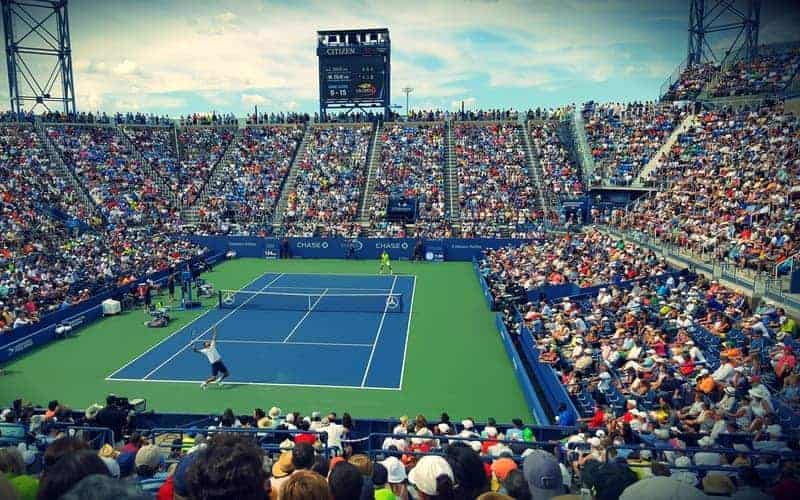
The venue has four stadium courts, plus 13 other match courts, with five practice courts (plus 12 others available nearby). All are hard courts. The main court is the colossal Arthur Ashe Stadium, with its retractable roof and 23,771 capacity.

The other three stadium courts are also impressive on a smaller scale, and the event is renowned worldwide for its lively atmosphere and big crowds- in 2019, the total attendance was just under 738,000.

In relation to the other Grand Slam events, the singles event draws at the US Open feature 128 players and is played out over two weeks. Alongside these, there are men’s and women’s doubles, mixed doubles, wheelchair events, juniors, and seniors. In every event, the world’s best players will be trying their utmost to win each match.

The men’s singles draw features matches played over the best of five sets, which can become real tests of endurance. For historical reasons, the women still play over the best of three sets. The total prize fund for the event in 2020 was $53.4 million.

If you want to see sporting drama in an electric atmosphere, try to get a ticket for one of the famous night sessions at the US Open. The organizers tend to schedule the big names to play in these slots, and the packed crowds add massively to the experience.

Laver Cup 2021 (Boston)

The 2021 Laver Cup will take place in Boston in September. This will be the fourth edition of the relatively new event. It is an indoor hard court tournament, pitting a team of Europe’s highest-ranked men against the best from the rest of the world, under the captaincy of legends Bjorn Borg and John McEnroe.

Named after Australian great Rod Laver, the event aims to mimic the success of golf’s Ryder Cup, putting players who normally compete as individuals together in a team environment.

Players compete in singles and doubles, with each match being played over two sets and deciding 10 point tie-break if necessary. The format is designed to keep the event alive until the final day, with matches counting for more points as the event progresses.

This was necessary, as there was a fear that Europe, who had most of the highly ranked players, would win too quickly. Although Europe has always won, the format worked well in 2019 as the score was quite close.

All of the players are paid to appear at the Laver Cup, although a bonus is paid to the winning team. On paper, it is just a sanctioned exhibition tournament, but it is fascinating to watch how much the top players start to care about the result when they play with a team of their peers. It is certainly worth watching if you get the chance.

Final Thoughts

The US has an array of fantastic tennis tournaments featuring the best players in the world. They are great to watch on TV, but there is nothing to compare with being part of the crowd. If you afford it, try to get some tickets for 2021.

What Do Tennis Players Need In Order To Be Good?


What Do Tennis Players Need?

When you watch the leading players battling for supremacy at a big tournament, it is easy to marvel at their athleticism and technique. They can appear almost superhuman at times. Highly trained techniques and excellent mental skills are vital at that level, but in this article, we will cover the physical aspects that players need to develop in order to reach the top.

It is important to remember that, while there is some element of genetics involved, the top players have got where they are by working relentlessly to improve their physical ability over a long period, and most of them travel with a physical trainer. So, if you are a young, aspiring tennis player, what physical qualities should you be working on?

A successful tennis player needs to be well-coordinated to adjust quickly to different shots. To last through long matches, they need good endurance, and flexibility helps them play awkward balls. A high level of agility and sharp reflexes allows them to volley well, whilst physical power helps them dominate.

Coordination

Sports scientist John Kiely has defined this as follows: ‘Coordination is when the central nervous system organizes the body to satisfactorily solve a movement problem for the least uptake of resources.’

Many subsidiary skills contribute to good footwork, but in essence, an elite tennis player needs coordination to get themselves into position quickly and hit the ball using an efficient technique.

Roger Federer is an example of a player with outstanding coordination, which explains why he generally looks so elegant on the court.

Although coordination can be worked on at any age, it is generally believed that substantial improvements are most easily obtained if you do coordination exercises when you are young. For this reason, if you watch tennis coaching groups for young children, you will nearly always see many coordination games being played.

Tennis is, therefore, a sport where you benefit from starting at an early age, but there is no need to despair if you did not. Just arrange a few sessions with a strength and conditioning coach and ask them to work on your coordination.

Endurance (Muscular and Cardiovascular)

Tennis matches in the men’s draw at a Grand Slam can last five or six hours in what might be hot conditions. A player whose endurance is suspect will have little chance in such a match, however good they are.

An elite player needs cardiovascular endurance (of the heart and lungs) to sustain them through the longer rallies. This can be trained by running and, in particular, interval training.

Possibly more important in tennis, particularly for attacking players, is muscular endurance. Specifically, players need to repeat sets of fast, explosive movements hundreds of times during a long match without a significant decline in performance.

Strength training is precious for developing muscular endurance, but ideally, a weight below your maximum should be used, incorporating a higher number of reps instead.

Flexibility

There is a lot of stretching and lunging involved in tennis. Simply watching Novak Djokovic play for a few minutes should be enough to convince you of the importance of flexibility.

However, many of the movements required in tennis can, rather counter-intuitively, result in players developing a lack of flexibility in some joints. This, in turn, means that fitness trainers typically spend quite a lot of time helping players restore this flexibility.

For example, the typical low ready-position can result in hamstring tightness, and serving can result in a limited range of external shoulder motion.

Therefore, it is vital to work on the range of motion in your shoulder along with hamstring stretching to avoid shoulder, hamstring, and lower back injuries.

Agility & Reflexes

Although top players read the game well, a tennis match will always bring many situations where a player has to react to unexpected changes of pace, spin, and placement.

In order to deal with difficult shots, tennis players need excellent agility and reflexes to respond quickly. Just being a fast runner is not enough: players need to move rapidly forwards, backward, or sideways.

Therefore, it is vital for aspiring players to train all of these movements, and there are many exercises designed for this purpose. One specific point to bear in mind is the benefit of training over the kind of distances you might move in a rally, so a series of 20m sprints can be especially beneficial.

Power

Aided by modern racket technology, today’s tennis players hit the ball harder than ever before. A player who lacks power is unlikely to succeed.

It is important to realize that powerful tennis shots are produced due to a chain of motion that includes both the upper and lower body. Strength training should therefore focus on legs and glutes just as much as arms and shoulders.

A well designed, gym-based strength training program using appropriate weights will protect a tennis player against injury and give them the power to hit the ball hard consistently.

Final Thoughts

Elite tennis players are superb athletes, and they train extremely hard to maintain this and minimize injuries. Anyone who aspires to play at a high level should consider hiring a fitness trainer to improve all of the areas mentioned in this article.

What Are The Tennis Levels? (NTRP, UTR, ATP, ITF)


What Are The Tennis Levels?

In the game’s upper echelons, the equation is pretty simple: the best players play in the Grand Slams and the other big-money events, which also carry the most ranking points. At the amateur level, things are less clear. For most adult players entering a tournament or league, the main aim will be to enjoy competing with players of a similar level. The question is, how can players find their level without playing a lot of one-sided matches first? Luckily, there are various rating systems that can help with this.

The 4 main tennis levels are the NTRP, UTR, ITF, and ATP. The NTRP is used to place players in appropriate leagues. The UTR system uses an algorithm to rate players based on recent results and is used by college coaches. The ITF and ATP rankings are based on tournament points and are for professionals.

What Are The Levels In Tennis?

The NTRP system uses a series of ratings to describe the players’ standards, and these are reassessed at the end of each season. Players can initially estimate their own rating, but if they choose too low a figure in the hope of winning a lot of matches, the USTA will retrospectively annul their results. Adult NTRP ratings go up in jumps of 0.5. The meaning of the various numbers is set out below:

  • 1.0: Just starting to play tennis.
  • 1.5: Player working primarily on getting the ball into play.
  • 2.0: Player needs on-court experience, with an emphasis on play.
  • 2.5: Player is ready to play league matches and low-level tournaments.
  • 3.0: The player is fairly consistent, hitting medium-paced shots, but struggles in other situations.
  • 3.5: Player has dependable strokes but lacks variety.
  • 4.0: Similar to 3.5, but more variety.
  • 4.5: Player can vary pace and spin and has a solid serve.
  • 5.0: Player reads the game well, has good variety, plus at least one significant ‘weapon.’
  • 5.5: Player can use pace and/or consistency as a major weapon. Plays well under pressure.
  • 6.0: Player is highly trained: possibly top college player.
  • 6.5/7.0: World-class player.

The NTRP ratings for juniors are similar, but they start at 2.0 and go up in increments of 0.1.

How To Know Your Tennis Level

The previous section’s descriptions should help anyone new to competitive tennis in the US to determine where they fit in. However, if you are really relatively new to the game, or the country, it can be difficult to judge your own standard without seeing the level of play in the different divisions.

The most effective way to know your tennis level is to get someone else’s opinion. You can do this by arranging a couple of games with people who play in the league or hitting with an experienced coach. Either way, the people you hit with should be able to give you an idea of what your rating should be.

Once your league career is underway, your rating’s regular reviews will make sure it continues to give a reasonable indication of your standard.

The ITF & ATP Rankings

For professional players, ratings are irrelevant, as they are all pretty good! Instead, it is about winning matches in professional tournaments and earning ranking points.

The first level of men’s and women’s professional tennis is the ITF World Tennis Tour. This entity has its own ranking system, which awards points more freely than the main ATP or WTA systems, and the ITF rankings are therefore useful to determine which players gain entry to tournaments at the lower levels.

The ATP and WTA ranking points are what players covet, as these ultimately lead to the main tours and big money. Making good progress in ITF events results in ATP or WTA points being earned (as well as ITF points), and accruing these enables players to climb the ladder and play in bigger events.

The UTR System

The UTR, or Universal Tennis Rating, is a system where an algorithm is used to calculate your rating based on a weighted average of your most recent results. College recruiters tend to like using the UTR to assess prospective players, so it has become a priority for some young players to improve their UTR above tournament success. For this reason, a number of events have grown up, which are specifically designed to pit people with similar UTRs against one another- the ‘Progress Tour’ is a prominent example. A typical UTR-based event will be mixed, as the algorithm assesses males and females on the same scale. Ratings vary between 1 and 16, with Rafael Nadal currently top of the pile with a UTR of 15.94.

How To Improve Your Tennis Level

The only real way to improve your tennis level is to work hard on your game, practice, and learn to win more matches. However, each of the measurement systems described above allows scope for people to ‘game the system’ a little.

Getting a higher NTRP rating than your standard justifies seems pretty futile, but some might try to win more matches by putting themselves in on too low a rating. Improving your UTR is most easily done by entering ‘Progress Tour’-style events where you will definitely play opponents with similar UTRs to yours. If you play people with wildly different UTRs, yours will not change as you might in a traditional tournament.

At the ITF World Tour level, players with money who want to enhance their ranking can travel to obscure and difficult to access events in Africa and Asia, where entries will be weaker and ranking points easier to come by. This can gain them access to the next level of the tournament.

Final Thoughts

There are many ways of measuring standards in tennis, and some are more efficient than others. If you keep working on your game, you will improve, and the ratings and rankings will eventually reflect this. Try to avoid becoming too focused on ratings.