The 5 Best Tennis Rackets For Doubles

The 5 Best Tennis Rackets For Doubles

Recent Articles

How Can I Book A Tennis Court?


How To Book A Tennis Court

If you are not a regular player but would like a game of tennis, the first thing you need to work out is where you are going to play. You may want somewhere cheap and easy to get to, or you might prefer somewhere classy, as a treat. Whatever you decide, you can guarantee that there are plenty of options. But how do you go about reserving a court at your preferred venue?

Common places to book tennis courts are clubs and parks. For a club, courts are usually booked through the phone. For a park court, players might be able to just turn up and play for free, although many venues now use an app for reservations. There are rules about how long players can play for and when turns start and end (to avoid disputes).

Reach Out To Local Tennis Clubs & Parks

Some clubs may not be keen to let non-members use their facilities, although this kind of attitude is perhaps more common at the most upmarket venues. In many cases, clubs will be delighted to showcase their courts to what they will see as potential new members. Either way, if you really know someone who is already a member, this will make things much easier, as they will be able to book a court and sign you in as their guest.

There will often be a guest fee to pay, but you can rest assured that your court will be available at the time you book it and is likely to be in good condition. If you do not know each club member, contact the club and tell them that you are considering joining. They will almost certainly be very pleased to offer you the chance to try out the facilities for free in the hope that you will soon join.

Park courts are generally easier to access. The rules for booking courts differ across the country, but in some areas, you can simply turn up and play for free if you are prepared to wait your turn. There is often an option to reserve a court online or using a booking app.

Use Tennis Court Booking Apps

In many areas, booking apps are used to find available courts. Some clubs make courts available to the public this way, although the fees can be significant, and many park courts can be reserved for a modest cost. One example of a court booking app is ‘Kourts’. This will search through the courts offered by the organizations that have signed up for it and will show you what is available at the time and location you have selected. All you need to do is choose a time and place, pay your money, and your game will be instantly confirmed. In general, booking apps can save you a lot of research and phone calls.

Visit Public Courts

Public courts are often in parks and are generally the easiest and cheapest places to have a casual game. If it is booked online or with an app, your court will be available during specified times. Often, however, you might want to take advantage of the opportunity to play for free, and in some areas, this will be possible if you just turn up and wait by the court. Some cities, like New York, operate a permit system, where for $100, you can play as often as you like.

Either way, there will be rules about how long you can play if someone is waiting- perhaps 30-45 minutes- so you will need to be prepared to limit your game if you are playing at a busy time. As you might expect, rules like this lead to disputes, as inquiries about how long people have been playing are traditionally met with claims to have arrived just before you got there! You will also probably need to select a court to wait for and stand by it, or else you are likely to lose your place.

How Long Are Court Bookings For?

At a club, you will probably book a court for either one or two hours, giving you ample time to enjoy your game. If you pay to reserve a court in a park, you will similarly get plenty of time. Problems might arise if you rely on a ‘turn up and wait’ system in a park. You will probably be notionally allowed an hour, but the rules often provide that you are only allowed to play for up to something like 30 minutes if someone is waiting. If you play at an off-peak time, you will probably be able to play for as long as you like, but you must be prepared for a shorter game if you choose a busy time.

Final Thoughts

Finding a tennis court to play on is far easier than it used to be, thanks to booking apps. The only downside of it is the need to pay. Park courts are generally cheap or free, but your time might be limited. If you enjoy tennis and definitely want to play more, you will probably find that joining a club is the best option, as it will be easy to book courts as well as to find people to play with.

How Can I Be A Tennis Ball Person?


How To Become A Tennis Ball Boy or Girl?

When watching any big tennis tournament on TV, one of the biggest differences you’ll notice from club matches and local events will be the presence of ball persons. Traditionally, these on-court helpers were called ‘ball boys’ or ‘ball girls’, or, more recently, ‘ball kids’. Today, some tournaments will accept people of any age, so they are now ‘ball persons’. Prior to the coronavirus pandemic, ball persons did everything from collecting and distributing tennis balls to dealing with the players’ towels. Their role is slightly more limited now, but they still make the game a lot quicker and easier for the players. So, how do you really go about becoming a ball person?

There are various ways to become a ball boy or girl, depending upon the event. There are extensive training and trials for big tournaments, but for smaller events, it is easier to get involved. Any salary will be modest, and your key role in the progress of the match is to ensure that the players have what they need to play without delay.

How To Become A Tennis Ball Person

Your chances of being chosen for this important role differ from event to event. Some smaller tournaments will take volunteers from local schools or tennis programs. If you are associated with one of these, your chances of getting selected are good- simply volunteering might be enough to get you some time on the court.

The bigger tournaments, like the Grand Slams and the World Tour Finals, each have their own system for selecting ball persons, and none of them make it easy to get chosen.

At Wimbledon, you need to attend a local school. If you are in the right age category, around 30% of applicants are successful.

At the US Open, approximately 300 ball persons are selected in total, with half coming from the previous year’s group and the other half being chosen from a series of try-outs. Around 500 people normally apply to the try-outs, so once again, the chance of being selected is about 30%.

At the Australian Open, around 360 ball persons are chosen from roughly 2,500 applicants, who are sifted during an extensive program of trials and training, suggesting that you have just under a 15% chance of getting picked.

If you want to be a ball person at the French Open, you will need to be one of around 4,000 applicants for a year-long training program. These are eventually cut to 220, which gives you just over a 5% chance of success.

The ATP World Tour Finals are similarly selective, with a series of trials offering those who apply via the ATP website around a 10% chance of making it to the final 30.

The Average Tennis Ball Person Salary

Historically, ball persons were just unpaid volunteers who could hope for little more than some free food and a few autographs. In recent times, the trend has really been for greater professionalism in tennis officiating, and to a limited degree, this has extended to the ball persons. While the bulk of ball persons are still likely to be unpaid, the big events usually offer some form of payment.

At Wimbledon, ball persons will be paid the equivalent of a couple of hundred dollars for the fortnight, with meals provided. At the US Open, there is a modest salary, typically $7-11 per hour. In Australia, they get what is almost certainly a better deal. Although the ball persons are not paid, they get free tickets for family and friends as well as a gift such as a racket or a pair of headphones at the end. French Open ball persons are not paid but do the job for the prestige and experience.

How Old Do You Have To Be?

Each event will have its own age requirements. For example, at the Madrid Masters ATP event, for a number of years, they used 19-28 years old female models to perform the ball person role. This might be viewed as adding glamour or disappointingly sexist, depending on your perspective.

Ball persons are still most commonly schoolchildren. At Wimbledon, they need to be around 14-16. The US Open has no age limits. The Australian Open invites applications from 12-15-year-olds, whereas for the French Open, the range is 12-16.

Tennis Ball Person Responsibilities

The primary job of the ball persons is to collect the balls after a rally has finished and ensured that there is an ample supply of balls for the server when they are ready to begin the next point. Traditionally they would also have the unpleasant job of dealing with the player’s sweaty towel, as well as providing drinks and running errands. They might even have to deal with an errant moth! Some of the less appealing responsibilities have been eliminated during the COVID pandemic, with players having to deal with their own towels.

Do Tennis Ball Persons Have Training?

If the ball persons are doing their job well, they will barely be noticed. They need to be fast, quiet, and efficient, with any fumbles minimized. They also need to be well-drilled, with a clear idea of when and where to pass the balls around to get them to where they are needed. Even people with natural athletic talent will need some training to carry out the role efficiently.

The Grand Slams offer extensive training to potential ball persons, with the French Open topping the charts with its year-long training program. For the US Open, the try-outs incorporate extensive training and instruction. In Australia, there are two trial stages followed by a four-month training program. At Wimbledon, the training also takes four months.

Final Thoughts

For any tennis fan, being a ball person at a major tournament would be a fantastic experience, giving them the chance to be on the court with the great champions. If you are fit enough, why not apply?

Do Tennis Rackets Wear Out? (& When To Change Them)


Do Tennis Rackets Wear Out?

Most serious tennis players will change to a new set of rackets roughly every year. Top professionals will change their rackets more frequently than this, as they don’t want to leave anything to chance. However, some club players will keep using the same frames for decades, relying on the maxim: ‘if it ain’t broke, don’t fix it.’ So, is there a good reason for changing your rackets frequently, or do those club players with their trusty old Dunlops have the right idea?

For a club player, a racket frame can last a decade or more, but in the hands of a full-time player with powerful shots, it can wear out after a few months. Some players and their stringers are much rougher with frames than others, and their rackets will deteriorate faster. Once rackets wear out, they will feel different and need to be replaced.

Keeping two to four rackets should prevent crises, although once they are too cracked or scraped, you will need to change them anyway.

How Long Do Tennis Rackets Last?

Rackets are typically made up of fiber and resin of some kind. Frames are put under a lot of stress by the forces applied during play, especially when physically strong players hit big serves or aggressive groundstrokes. Eventually, the fiber and resin will begin to break down, and the racket will lose some of its stiffness. Since this happens very gradually, players might not notice the change.

Nonetheless, a reduction in stiffness will affect the power and spin that can be produced with a frame and limiting control. An expensive machine known as a ‘Racket Diagnostic Center’ (RDC) can check for any deterioration by measuring frame stiffness. Still, without this, you will probably need to rely on general guidelines to determine how long your rackets will last.

For a big hitter, training regularly and playing tournaments, rackets last about 1 year and tend to lose stiffness after that. A club player who does not hit the ball particularly hard and looks after their rackets can have rackets last for 10 years or perhaps more without problems.

Variables That Affect Racket Life Expectancy

Your racket’s lifespan will be affected by several factors. How often you play will clearly be one of these and how hard you hit the ball. Some others might be less obvious. Racket frames need to be stored appropriately: they could be damaged by excessive heat or cold.

The stringing process is also critical. The string is usually in fairly high tension and needs to be removed carefully, and the clamps holding the racket in place during stringing must not be too tight. If the stringer is careless, or their clamps have seen better days, the damage could ensue. Every time the racket is restrung, there is a risk of damage, so frequent restringing may also shorten frame life.

Of course, a racket can also be damaged during play, either through scraping on a hard court or through the player deliberately hitting it on the ground in anger. Professionals can afford to throw their rackets around, but this can become an expensive habit for amateurs: as soon as a frame cracks, it becomes useless.

How Many Tennis Rackets Should You Have?

If you are a club player, two rackets should be enough. If you break a string or even a frame, having a spare one in your bag will get you through. Just ensure that you only use one of the rackets until its string breaks so that your spare is unused. Carrying two rackets with worn string brings the risk that you might break both during one match and be left with none.

For a tournament player, you will want to have enough rackets to get you through a two-week tournament trip without having to use a possibly expensive and dubious local stringing service, so four or five should be adequate. Full-time pros might have ten or more with them, restringing them in batches for each event.

Signs It Can Be The Right Time To Get A New Racket

Unless you have an RDC, you are unlikely to detect the gradual deterioration of your racket frames. Nonetheless, other things can indicate that they are due to be replaced. If you play on hard courts, the outer part of the frame will gradually wear away, as it gets scraped on the court every time you retrieve a low ball.

This is easy to see, and when the wear and tear look significant, it is likely that the weight, balance, and stiffness of your racket will have changed, and it will be more likely to break. Even worse than this is the dreaded crack. If you discover a crack in your frame, it will not perform in the same way as it once did, and you will need to change it immediately.

Should You Change Rackets Even If They Are Still Good?

If you are young and becoming taller and stronger, you may need to change to a heavier racket even if your existing one is in good condition. Serious adult players need to change rackets regularly to avoid the effect of the gradual loss of frame stiffness, even though the rackets might still look good. For club players, your racket should last for several years: if it suits you, there is little point in incurring the expense of changing it frequently.

Final Thoughts

Look after your rackets, find a good stringer, and you’ll get good use out of them. Beware of gradual deterioration, but you will not benefit from changing your racket just to get the latest syle.

Do Tennis Players Lift Weights?


Do Tennis Players Lift Weights?

To play tennis at the elite and highest level, you must be able to play rallies of high physical intensity for three hours or more, with only modest breaks. You need to be able to hit the ball hard and accurately, and you must be able to continue to do this throughout the match, not just in patches. With physical demands like this, a well-designed and challenging physical training program is essential.

This will consist of running, jumping, agility, core, and strength work. Although not all tennis players appear overtly muscular, they will all be lifting weights to develop the kind of strength they need.

Weightlifting is an essential part of tennis training. Weights can be used to help build an appropriate degree of strength in several key muscle groups. Periodization of training is important: weight training should be carried out at the right time to support tournament performance.

Although the aim is not to build prominent muscles, under-16s should avoid excessive weight training to reduce injury risk.

The Importance Of Weightlifting For Tennis

You do not need to be massively bulky and muscular to be a good tennis player. Nonetheless, you need to be strong in many areas to prevent injuries resulting from the stress that the game puts on your body. Tennis players will do a substantial amount of weight training to build up the kind of durability they need.

One particular area where weight training is crucial is in the evening up imbalances. Tennis is a very one-sided sport, especially for players who use a single-handed backhand. This will lead to them becoming much stronger on one side than the other, and this unevenness can lead to injury. Gym work can redress the balance by strengthening the weaker side.

Weight training can strengthen the muscles around the joints which are subjected to the most stress in tennis, such as the shoulder and knees, significantly reducing the likelihood of injury. Weightlifting can build leg strength in general, which will help hit powerful serves (to which the leg drive makes a big contribution).

In addition, weights can be used in improving core strength and muscle endurance, which play a crucial part in performing well and avoiding injury.

What Exercises Are Good For Tennis Players?

Tennis players will benefit from a well-designed program that incorporates explosive and speed-strength, as well as starting strength and maximal strength. If they want to be quick off the mark, they need to train by moving mid-range loads quickly.

If, on the other hand, they really want to absorb the kind of force that they will experience when decelerating after running down a challenging wide ball, they need to do eccentric strength exercises, which include controlling a heavy load. More dynamic exercises like plyometrics can be very useful in helping players to develop on-court power and speed.

The exercises which are best for any specific player will depend upon their playing style and injury history. Four exercises that are commonly used, some of which are relatively static and some dynamic, are squats, deadlifts, medicine ball throws, and plyometric step jumps. These will all be likely to feature in a well-designed training program. Still, you should consult a physical trainer to get a personalized routine if you are serious about making improvements.

When Should Players Lift Weights?

Periodization is crucial for tennis players, as, when they are competing, they will not be able to undertake their full strength training program. They will need to set aside training blocks in which they can make physical improvements. The bulk of their strength training needs to be done at the beginning of their pre-season training block when they will be doing little or no on-court training.

Towards the end of pre-season training and in the early part of the season, they need to focus on the more dynamic ‘power’ exercises, where they move a modest load quickly. During the season, they should try to fit in one strength session and one power session most weeks to maintain conditioning.

In general, it is definitely not a good idea to do strength training and play tennis on the same day, as your muscles need to recover. Similarly, just before a tournament, you should let your training taper off a little to ensure that you are fresh.

At What Age Should Tennis Players Start Lifting?

There is plenty of strength training that can be done by junior tennis players, but their growing bodies are at risk of injury if they lift heavy weights. Players under the age of 16 should focus on bodyweight exercises and use resistance bands and medicine balls. From 16 onwards, they should be ready to gradually increase the weights they train with.

Why Are Players Not Muscular?

This is, of course, a matter of perception. Players like Novak Djokovic are highly trained and muscular, but not bulky. John Isner is often used as an example of a player with little obvious muscle, but he has sufficient strength to avoid injury and uses his long levers well.

Players do not benefit from being bulky, as the key in tennis is to be quick and flexible. If you can move the racket quickly, you will generate power- you do not need the physique of a bodybuilder. Lower body strength is important, as there is a lot of stretching and lunging involved, and the legs are crucial in generating speed and power, so players will generally have strong, muscular legs.

A lighter upper body will lend itself to the flexibility needed and put less stress on joints like the knees. In essence, tennis players need to be light, strong, and flexible, and bulking up and becoming too muscular would not be helpful.

Final Thoughts

Weight training is an important and crucial part of keeping players healthy and helping them perform at their best. If you are serious about your tennis, ask a physical trainer to devise a program for you.

Do Pro Tennis Players Pay Entry Fees?


When you see the top players picking up vast cheques at the major tournaments, the question of entry fees probably doesn’t even occur to you. At that level, it probably doesn’t occur to the players either: if Djokovic expects to pick up $500,000 at the end of the week, whether or not he is asked to pay a minimal fee to enter the event makes no difference to him. Lower down the rankings, however, any entry fees that players are asked to pay will make a significant dent in their meager earnings, meaning that they will be very well aware of what they are being charged. So, which events actually charge entry fees?

At the top level, tennis players do not need to pay entry fees. As entry fees are designed to cover the costs of the event, there is no need for them at the big tournaments as these generate revenue from sponsors and ticket sales. However, at lower levels, prize funds are very small and costs are covered by charging players an entry fee.

How Pro Tennis Entry Fees Work

On the main ATP Tour and the secondary ATP Challenger Tour, there are no entry fees. Even the least lucrative Challenger events, with their modest prize funds of around $55,000, cover their costs without the need to ask players to pay.

In truth, it would be completely pointless asking for entry fees, as even first-round losers receive more in prize money than they would realistically be asked to pay to enter: they would be giving the money to the tournament only to receive it back a few days later.

There is actually one rare exception to this rule. If a player plays (perhaps by means of a wild card) in an ATP Tour 250 event or above, and that player is not a member of the ATP Tour (for which a subscription is required), then a service fee of between $100 and $400 must be paid.

This is normally deducted from their prize money and maybe offset the cost of joining the ATP for that year. The situation is similar for female players on the WTA Tour, except that if a non-member plays in one of their tournaments, an administration fee of $250 must be paid.

Do Tennis Players Pay To Enter Grand Slams?

The ITF rulebook states that there should be no entry fees for Grand Slam events. For many players, even getting into qualifying for a Grand Slam is a major achievement and gives them an opportunity of earning important ranking points and prize money. Any entry fee would be swamped by the prize money, so charging one would be pointlessly bureaucratic and time-consuming.

Does The Tennis US Open Have An Entry Fee?

Since the tournament is organized by the ITF, the US Open comes under the same heading as the other Grand Slam events, which means no entry fee can be charged.

Entry Fees At Lower Levels

Professional tennis players whose ranking is not high enough to earn them entry to ATP Tour, ATP Challenger, or WTA Tour events will need to pay entry fees for the tournaments they play. This mainly applies to the ITF World Tennis Tour events, which are the lowest level of international professional tournaments.

These will offer prize funds of $15,000 or $25,000 for men, and $15,000 to $100,000 for women. The discrepancy between men and women is explained by the fact that the WTA does not run an equivalent of the Challenger Tour, so there are more lucrative ITF events to fill the gap.

The ITF rules specify maximum entry fees of $40 for players involved in singles and doubles and $20 for those playing doubles only. It is likely that tournaments will charge the maximum fee to maximize their income, and there will be no reduction in the ‘singles and doubles’ entry fee if a player cannot gain entry to the doubles.

The fees outlined above may seem trivial, but most ‘professional’ players on the ITF World Tennis Tour are essentially paying to play, as their weekly expenses will vastly outweigh their prize money earnings, even if they are doing well. They are hoping to earn enough ranking points to gain entry into more lucrative tournaments. These entry fees are just another cost they must bear, and it does seem slightly ironic that the only players asked to pay entry fees are those who can least afford it.

At the amateur level, it will be expected that players play an entry fee, or league fee, to cover the costs of any competition they play in. Still, these players generally will not mind, as they realize that there is a cost involved in pursuing their hobby.

However, aspiring professionals would certainly benefit from reducing or eliminating such entry fees, as they are usually struggling to make ends meet.

Final Thoughts

Top pros do not have to pay entry fees, despite the fact that they probably spend more on their laundry each week than they would have to spend on fees. At lower levels, players who are financially stretched do have to pay entry fees. Perhaps if the ATP and WTA charged some levy on prize money and/or tournament sanctioning fees, this could be transferred to the ITF to cover entry fees for up and coming players? As things stand, the situation seems unfair.

Tennis Backhand Grip: The Easy Guide


Tennis Backhand Grip Guide

The backhand is a vital shot in any tennis player’s armory. It is played whenever they are faced with a ball on their non-dominant side and is normally struck with the opposite side of the racket to the forehand. For many players, the backhand will be their weaker stroke, and they will work hard to make it solid and difficult to attack, whereas, for others, it will be a strength with which they can produce a range of spins and angles of considerable power. Either way, there are a variety of different grips which can be used.

The backhand grip chosen will depend upon whether you hold the racket with one hand or two and whether you intend to hit topspin or slice. The racket’s angle in your hand will be adjusted to make the kind of shot you want to hit easier, although a few players even manage to hit the ball with the same grip for both forehands and backhands.

How Do You Really Hold A Backhand Grip In Tennis?

There are two main ways of playing a backhand. Firstly, two hands can be used to hold the racket, with only a modest grip change from the forehand for the dominant hand. Secondly, the racket can be held in one hand, most likely in conjunction with a more significant grip change.

Backhand Grip Types

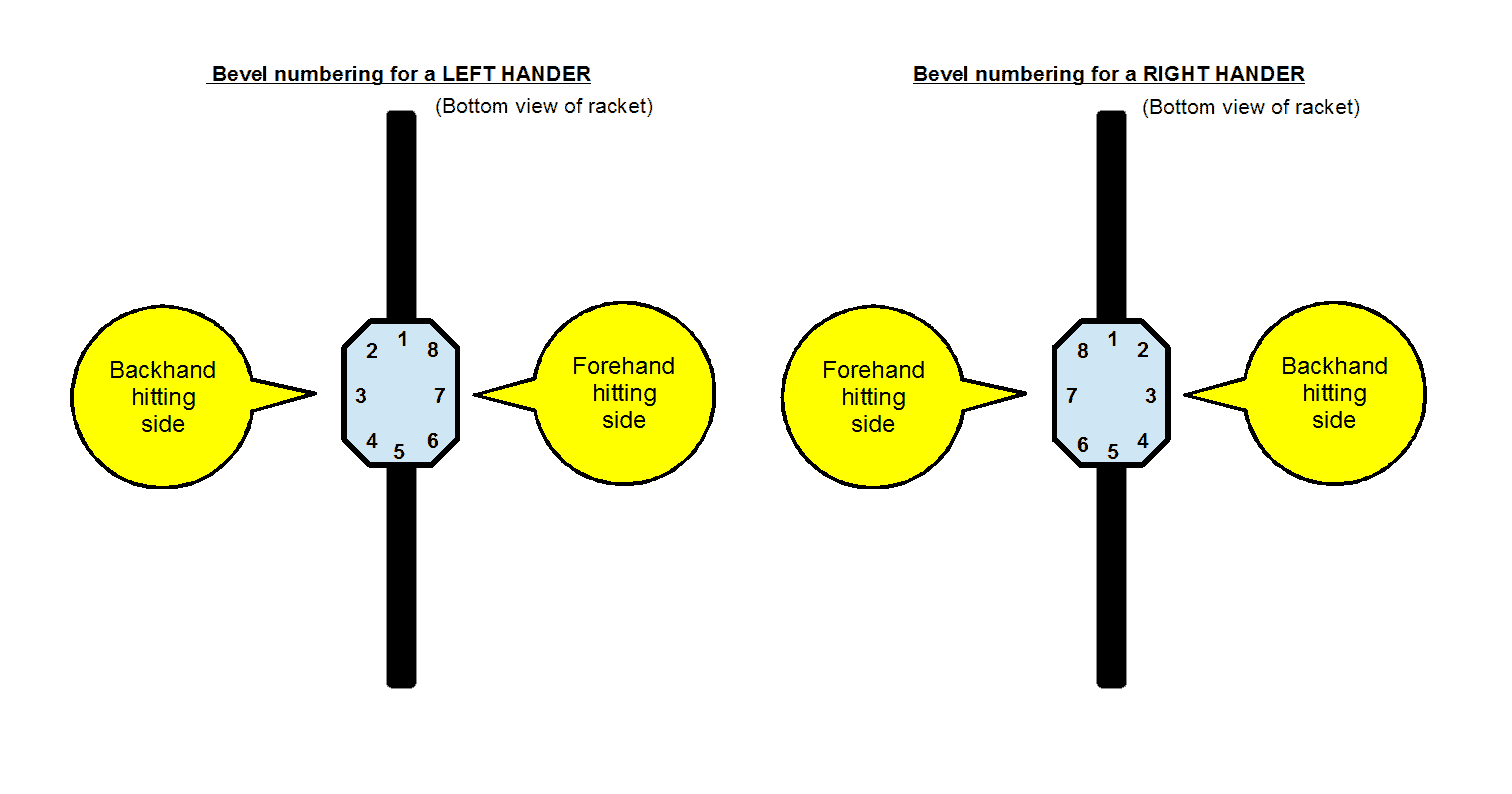
Image created by Tavernsenses, licensed under the Creative Commons Attribution-Share Alike 3.0 Unported license.

The above diagram shows the ‘bevels,’ which are the sides of a standard octagonal tennis grip. The ‘index knuckle’ is the joint on the palm of your hand, just below the index finger, and the ‘heel’ of the hand is at the base of the palm, on the opposite side to the thumb. The position of these in relation to the numbered bevels allows us to describe the differences between the various grips.

The majority of players, especially in women’s tennis, hold the racket with two hands when playing a backhand. A right-handed player will place their right hand at the base of the grip, with their left hand further up. The index knuckle of the right hand will typically be on bevel 2, while the heel of the right hand will be on bevel 1. The index knuckle and heel of the left hand will sit on bevel 7. This pattern will, of course, be reversed for a left-handed player. A double-handed backhand has the advantage of aiding power and control and being helpful for returning powerful serves. On the other hand, it restricts reach and limits the amount of spin you can put on the ball.

Traditionally, backhands were played with just the dominant hand on the racket. This gave players greater reach. A substantial minority of top players, such as Federer and Thiem, still use a single-handed backhand. The principal advantages for them are the spins that can be applied and the ease with which angles are created. A range of different grips is possible for the single-hander.

When a player wishes to slice the ball with their backhand, which is often the case if they are defending or wish to approach the net, they need to use a continental grip. For this, both index knuckle and heel of the hand rest on bevel 2, and a V-shape is formed between the thumb and index finger.

If a player aims to produce power and a modest amount of topspin with their backhand, they will probably favor what is known as an eastern grip. Here, both index knuckle and heel are placed on bevel 1. It is important to note that the fingers’ position is slightly different for a single-handed backhand compared to a forehand. The racket’s handle runs parallel to your knuckles, and the index finger wraps around the racket rather than extending forward as it might for a forehand.

Finally, for players who wish to apply more topspin, there is the extreme, or semi-western, backhand grip. Here, both index knuckle and heel sit on bevel 8. This type of grip has been famously used by former world number one Justine Henin, amongst others.

The Best Backhand Grip For Beginners

If a player does not actually have a strong preference, most coaches will teach beginners to use a double-handed backhand (right hand in bevel #1 or #2 and left hand on bevel #7 or #8). They will do this because it is simpler to execute.

Keeping both hands on the racket makes it easier for players who do not have a great deal of physical strength to control the path when hitting the ball. The shot itself is also less complex, as there is little need to apply a significant amount of spin to the ball.

However, there will be some beginners who will have seen Federer on TV and who are adamant that they want to hit the ball one-handed like him. After the coach has attempted to manage their expectations a little, they will probably suggest that the player uses an eastern backhand grip and start with a simple action that does not apply too much spin.

Backhand Grips For Topspin vs. Slice Shots

A player who uses a double-handed backhand will normally create a modest amount of topspin, but not a great deal. On occasion, when faced with a low, spinning ball, they might want to hit a slice. Hitting a slice with two hands on the racket is a rather awkward maneuver and not recommended. Instead, the player will probably remove their non-dominant hand from the racket and switch to a continental grip to hit the shot one-handed. The difference between the position of the right hand for a two-handed backhand and a standard continental grip is small, so this is fairly straightforward to execute with practice.

A player with a single-handed backhand will also use a continental grip to hit a slice. The eastern grip allows a modest amount of topspin to be produced, but if they want to make the ball spin, they will use a semi-western grip.

Can You Have The Same Grip For Forehand And Backhand?

In the days of wooden rackets, this was not uncommon, as shots would tend to be hit flat or with slice, and volleying was an important part of the game. A grip like the continental could be used for everything if a player wished.

Today, players hit a lot more spin, and they generally want to apply topspin to both forehand and backhand, which, even for players with single-handed backhands, requires the angle of the racket in their hand to be significantly different.

Nonetheless, it is not impossible to use the same grip on both sides, as Alberto Berasategui demonstrated during his successful career a few years ago. Berasategui used a particularly extreme western forehand grip, applying huge amounts of topspin, and this enabled him to hit backhands with the same side of the racket without changing his grip. This style was far more effective on high-bouncing clay courts than on faster, lower surfaces, but it demonstrates what can be done.

Final Thoughts

There are many different ways of hitting a backhand. Take a look at Federer, Nadal, Gasquet, Serena Williams, and so on, and you will see many different styles, techniques, and grips. If you are starting in the game, don’t be afraid to experiment with different grips, but if you and your coach find one that works for you and doesn’t injure you, stick with it. Your backhand and the associated grip are entirely your own and don’t have to be like anyone else’s.