The 5 Best Tennis Rackets For Doubles

The 5 Best Tennis Rackets For Doubles

Recent Articles

What Are Tennis Strings Made Of?


What are tennis strings made of?

In France in the 1870s, Pierre Babolat had established a business making strings for musical instruments. In 1875, he turned his attention to the newly established game of lawn tennis and began making racket strings from sheep intestines. These were the first ‘natural gut’ tennis strings, and some leading players still use a modern equivalent of these.

Natural gut dominated until the 1950s, when synthetic strings became a more budget-friendly option. Around this time, natural gut strings were given more durability by a switch to the use of cow intestines. The spectacular successes of Gustavo Kuerten in the late 1990s changed the landscape substantially, popularising the use of polyester strings. In this article, we will look in more detail at the most popular categories of string available today.

Most tennis strings are made of natural gut, synthetic gut, or multifilament. Natural gut strings are the traditional option, ideal for good atmospheric conditions. Synthetic gut strings are a cheap, nylon-based option that is ideal for beginners. Multifilament consists of a combination of fibers and provides an excellent feel and cushioning.

While the basic option is to use the same strings for the whole racket, many players use hybrids, putting different strings in as mains and crosses.

Natural Gut Strings

From the time M. Babolat first put them into a racket, these were the string of choice for virtually every keen player. Even when synthetic strings initially became available, the latter were considered an inferior, cheap, alternative until polyester strings became fashionable.

Natural gut offers great feel, comfort and power, and for this reason is still used by leading players such as Federer and Djokovic as part of their string set. Away from the main professional tours, it is now very rare to encounter anyone who plays with natural gut strings due to its many disadvantages.

Firstly, it does not perform well in cold or damp conditions. It is prone to fraying as it wears, and in any event it is not particularly durable. Not only this, but natural gut is extremely expensive, with a set costing $40 or more even before you pay your stringer.

As the pros play almost exclusively in good conditions, and get their rackets restrung every time they play, with cost being no object, they can reap the benefits of natural gut. For the rest of us, other options are likely to be better.

Synthetic Gut Strings

Although they sound similar, synthetic gut is very much at the opposite end of the scale to natural gut. It is a nylon string, normally featuring some kind of outer coating to improve its playing characteristics. Synthetic gut can be very cheap, with some manufacturers offering reels at a price equating to less than $2 per set.

It is generally regarded as an ideal string for beginners, as it offers reasonable all-round playing characteristics at a low price. More experienced players, who hit the ball harder, or wish to generate more spin, are likely to find synthetic gut less satisfactory. In particular, its lack of durability is likely to be a problem for bigger hitters.

Multifilament Tennis Strings

This multifilament tennis strings category covers a wide range of strings which are constructed by weaving together numerous fibres in an attempt to produce something superior to synthetic gut. A well-designed multifilament string offers a good level of power, control and feel.

Using a multifilament can be particularly beneficial for players who have suffered from tennis elbow, as it tends to be softer than most other types of synthetic string. These strings do have two significant disadvantages. Firstly, they are relatively expensive, and secondly they are not usually sufficiently durable for use by powerful players who hit a lot of spin. For stronger players, their main use might be as part of a hybrid string set.

Hybrid Tennis Strings

Most top players tend to use a combination of two different string types in their racket, in the hope that this will enable them to benefit from the best qualities of each. Polyester strings, which are durable, and enable players with the right technique to produce a large amount of spin, are likely to feature in these sets.

Although Nadal, for example, uses a polyester string in both mains and crosses, others will prefer to partly string their racket with something offering greater feel. Federer and Djokovic both use natural gut in their main strings and a polyester cross string. They do this because the main string has the greatest influence on feel, and they want the feel of natural gut.

This kind of arrangement would not be suitable for most amateurs, however, as the main strings are the most prone to breakage, and using natural gut there would require frequent and expensive restrings. The best compromise is normally to use a tough polyester main string with a softer cross string, such as a multifilament, to add feel.

How To Choose The Right Strings For Your Game

The way your tennis strings are made, and the materials used, will have a big influence on the way your racket feels when you hit the ball, how quickly the ball leaves the racket, and how much spin you apply. There are many options to consider, but, if you are a big hitter without an unlimited budget, you will have little option but to incorporate at least some polyester in your string set.

To find the best string for you, you will want to experiment with various types of hybrid set, probably using polyester mains. In essence, you will need to counterbalance how good a string set feels against how long it lasts. If you are a light hitter, a multifilament may be a good choice, while a beginner will find synthetic gut more than adequate.

Final Thoughts

There are many good strings available, with new ones coming on to the market all the time, so do not be afraid to try out new options. A better string choice could give you the edge you have been looking for.


The Top 14 Best Tennis Apps [Updated]


The Top 14 Best Tennis Apps

The levels of technology and connectivity which are now available to us mean that tennis fans can keep up to date with match scores, review and improve their shots, find people to play with, or even play electronic versions of the game at any time. To enable us to make the most of these possibilities, a wide range of tennis apps is available for use with smartphone or tablet. Of course, we don’t want to clutter our devices with mediocre apps that we will never bother using, so in this article we will look at which apps are worth downloading.

We will talk about four popular apps which will enable you to follow tennis scores at almost any level of the game, four different types of apps aimed at game improvement and analysis, three which can help you to find partners and courts, and finally three apps which can offer hours of enjoyment playing tennis games.

Currently, the top tennis apps available are:

  • To follow tennis scores: ATP, ITF, TNNS, and Resultina
  • To improve your tennis game: APEAK, Swingvision, Head Tennis Sensor, and Hudl Technique
  • To find partners and courts: TennisPal, Kourts, and TennisGroups
  • For tennis games: Tennis Clash, Tennis Open 2021, and Australian Open Game

Best Apps To Follow Tennis Scores

The ATP app is the successor to the extremely popular ATP/WTA app which was withdrawn in early 2021. Incidentally, this means that there is currently (March 2021) no official app covering the main women’s professional circuit.

The ATP app provides live scores, results, and news from the main men’s tour, offering notifications when anything involving your favorite players is taking place. Early reviews are not promising, but there is some hostility to overcome as the previous app was so popular.

The ITF app allows you to check point-by-point progress in all of the matches taking place in the various ITF events around the globe. In addition to live scores, it offers a results service and detailed statistics. In principle, it also provides notifications relating to specific players or events, although some users have experienced difficulty with this function.

The TNNS app claims to have been developed ‘by the fans, for the fans’, and many consider it a worthy successor to the much-missed ATP/WTA app. As well as covering ATP and WTA events, it gives information from ITFs and Challengers. TNNS can give live scores, statistics, schedules of play, etc, and most users seem to like it. The small number of negative reviews suggest that it can be a little slow.

The Resultina app is in direct competition with TNNS, and is also fairly well-liked. Again, it offers ATP and WTA scores and statistics, plus rankings and notifications. It also covers ITF events, both at the senior and junior levels. Users praise the amount of information the app provides, although one or two have had issues when purchasing the paid version.

Best Apps To Improve Your Game

APEAK is a mental skill training app. After completing an initial assessment you will be given a training plan. You are then able to regularly review your progress, and learn how to develop your skills in your weaker areas. Regular reviews can be carried out, particularly after competing. The aim is for it to be ‘like a sport psychologist in your pocket’, and reviews are generally positive.

In contrast, Swingvision looks at your shots and match statistics. It appears to only be compatible with Apple devices, and is perhaps best used in conjunction with an Apple Watch.  It offers real-time shot tracking and video analysis, enabling you to track shot type, spin type and speed. Users seem to be largely happy with it, although there have been issues with bugs.

The Head Tennis Sensor requires a physical sensor to be purchased for around $100 and attached to your racket. This produces detailed statistics about the shot types, spins and speed, as well as telling you how close a given shot was to the ‘sweetspot’. Connecting to the associated app lets you analyse the details on any bluetooth-enabled device. You can even use it to develop your technique by practicing specific skills and monitoring the feedback. The device seems to be well-liked, but is more costly than most.

Hudl Technique is a free app which enables you to review and develop your technique using video analysis. It is designed to allow you to view your shot alongside that of a professional or coach in slow motion in order to allow detailed comparison. It can also be used for other sports such as golf. You will need someone to video you, and it has few features, but it does its job well.

Best Apps To Find Partners And Courts

TennisPAL is a fairly simple app which connects you with practice partners or coaches, and can find an available tennis court. You can even submit videos for a coach to analyse. Some users have had difficulty with the functionality, but the developers seem keen to assist.

The Kourts app allows you to locate available courts and coaching groups, book and pay. It is well liked by users, although one or two have had issues with the accuracy of the live database.

TennisGroups (formerly RCTA) is designed to help you to run a tennis community, and allows you to post updates, organise events, etc. It seems to be popular with users.

Best Apps For Tennis Games

Tennis Clash offers a good basic tennis game, and it is free. However, several users have complained about the number of mismatches it sets up, and the methods it employs to encourage in-app purchases.

Tennis Open 2021 is another popular tennis game. Some users have observed that it can be finished within a week, and may not offer enough challenge for the longer term.

The Australian Open Game is the official game of the tournament. It is generally popular with users. You can play against any player from the real event, and either play the whole tournament or a quick match. If you find that you are winning too easily, turning on ‘manual movement’ may provide the challenge you need.

Final Thoughts

There are some great apps out there. Download a well-chosen selection of the apps listed here and you will not go far wrong.

Tennis Grip Guide (Eastern vs Western vs Continental)


Tennis Grip Guide - Eastern vs Western vs Continental

When you start playing tennis, you are most likely to take a racket and hold it anyway it feels comfortable to play the ball over the net. If you never take any tennis lessons, you might never know that there are actually multiple different ways for you to grip a racket and that this has an impact on your shots. 

There are essentially three different types of grips – the continental, the eastern, and the western. But what is the difference and which tennis player should use which grip?

The Eastern grip allows players to hit flatter shots and to transition faster to volleys. The Western grip allows players to hit shots with more topspin, which gives players a bigger margin of error. The Continental grip is only used for slices, volleys, serves, and overheads, as it is difficult to add topspin to shots.

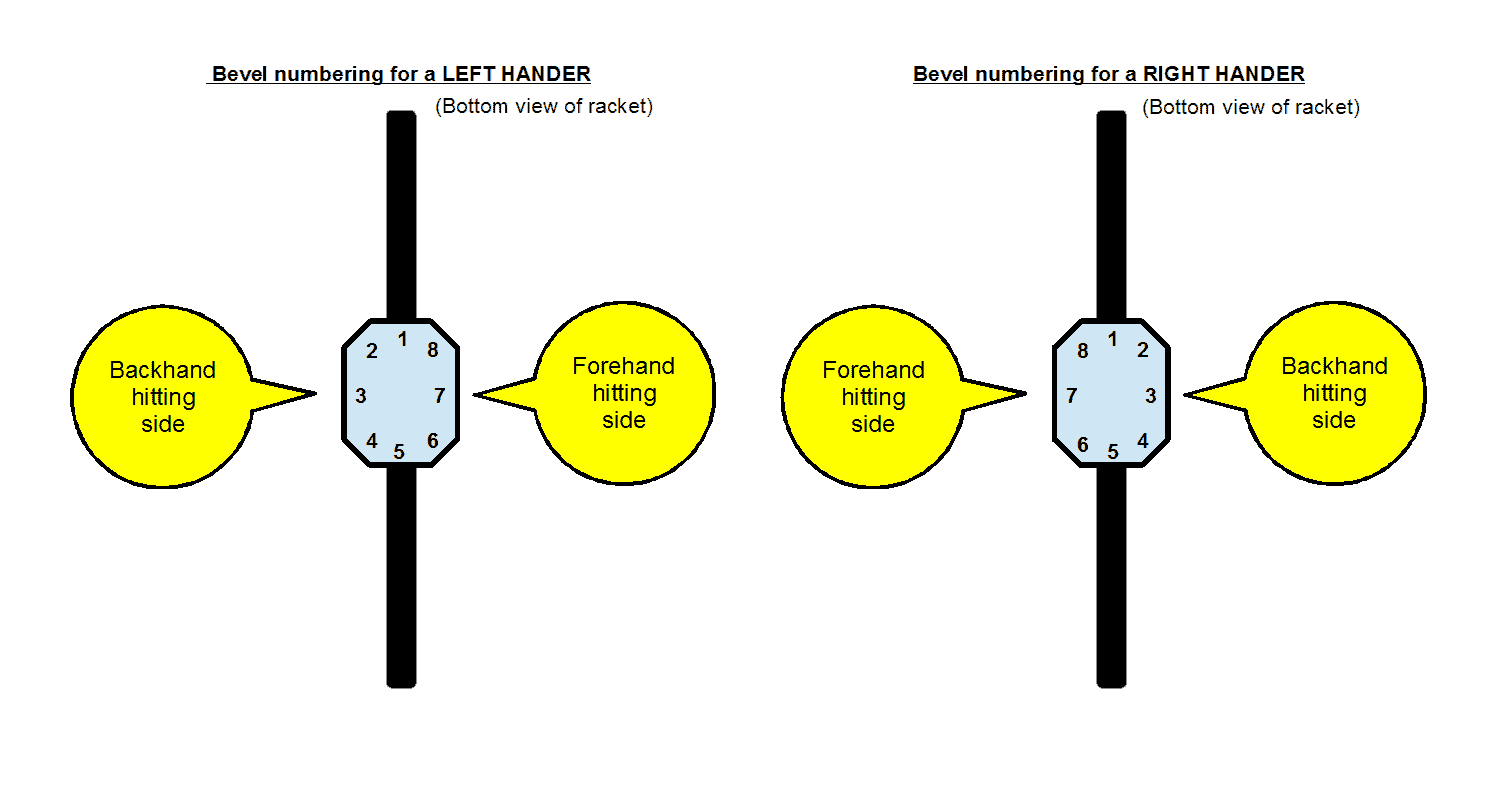
To know the basic things about the different grip types, you must look at the grip of a racket. It is shaped like an octagon and is divided into eight bevels. The way you position your hand on these eight bevels will result in the so-called grip you are using. 

To help make identifying the grip easier, we can label each bevel with a number 1 starting at the top and moving clockwise all the way around.

The Continental Grip

To form the continental grip as a right-handed player, you’ll place the pad of your index finger’s bottom-most knuckle against the second bevel and wrap your fingers around the handle. 

To form the continental grip as a left-handed player, you’ll place the pad of your index or pointer finger’s bottom-most knuckle against the eighth bevel and wrap your fingers around the handle.

With the continental grip, the tennis racquet angle is neutral, which means the racquet frame when you hold it in front of you is perpendicular to the ground.

The continental grip was once the universal grip used to hit forehands, backhands, specialty shots, volleys, and the serve. It originated on the soft, low bouncing clay courts of Europe, and although it has been superseded in today’s game, it serves as the foundation grip for the volley, serve, and overhead for most players.

As tennis has evolved, the continental forehand grip has become the least favorite grip. It requires an exceptionally strong forearm and impeccable timing. On the backhand side, the grip is used less often today to hit the power backhand. 

Though effective for producing a slice backhand, the continental grip does not provide the strength or stability in the racquet head to handle powerful groundstrokes from an opponent.

However, the continental grip offers the most support for the wrist and doesn’t require a grip change when playing volleys. It is ideal for volleys because the neutral racquet face created by the grip is perfect for blocking the ball back.

Nowadays, no professional tennis player uses the continental grip for their groundstrokes, only when hitting slices, volleys, serves, and overheads.

The Eastern Grip

To form the eastern grip, simply place the palm side of your index finger’s knuckle against the third bevel of the tennis racquet if you’re right-handed. If you’re left-handed, place it against the seventh bevel and then firmly wrap your fingers around the handle.

One of the advantages of an eastern grip is its proximity to the continental grip, which is great as it allows players to transition from a forehand to volleys and vice versa quickly. 

This is especially useful when a player transitions from the baseline to the net after hitting an approach shot. Because of how easy it is to change grips, the player is quickly ready for the follow-up volley. 

The eastern grip can also allow players to flatten out the ball and hit shots with less topspin – which is something not advised for beginners as flattened-out shots leave little margin for error. If a player wants to hit shots with more topspin the eastern grip is the wrong one to use. 

Roger Federer, for example, has one of the best forehands in the game and uses an Eastern forehand grip. Other professionals that mainly use the eastern grip are Juan Martin Del Potro and Stefanos Tsitsipas.

The Semi Western Grip

To form a semi-western grip, place the index knuckle and heel pad on bevel 4. The shortcut to finding this grip is to put the racket face flat on the ground and pick it up.

The primary benefit of the semi-western grip is a player’s ability to generate topspin. With a semi-western grip, the angle of the racquet face is closed or pointing toward the ground. As a result, when you swing and encounter the ball, you can easily brush up and over the top of a tennis ball to produce topspin.

Players using a semi-western grip can hit the ball higher over the net and ensure the ball drops back into the court due to the topspin generated. Ultimately, this allows players to hit much more aggressively and with a higher margin for error.

The disadvantages of this grip are that it can be challenging to transit quickly from a forehand to a volley – which can, however, be overcome with practice. 

In addition, it also can be challenging for players to hit an extremely low ball that’s only a few inches from the ground, because the semi-western grip forces a player to hit under and over the ball to generate topspin.

Professionals that use this grip are Rafael Nadal, Andy Murray, and Novak Djokovic.

The Western Grip

To find the Western grip, you should place the palm side of your index finger’s knuckle against the fifth bevel of the racquet handle. The western grip is great for a heavy baseline game with big groundstrokes that have a ton of topspin. 

It is without a doubt the main benefit of this grip but just like with the semi-western grip, it’s not easy to switch to a continental grip for slice shots or volleys. It requires a player to rotate the racquet quite a bit.

Inexperienced players might struggle with the transition – but can work on it in practice and eventually become quite comfortable with the transition. And just like with the semi-western grip, it is hard to hit a ball that bounces low. 

Professionals that use this grip are Nick Kyrgios, Karen Kachanov, and Jack Sock.

How To Choose The Right Grip For Your Game

The tennis grips you use have a significant influence on your style of play. This is because the tennis grip is one factor that determines how much spin you put and how much pace you generate. 

One grip is not better than another, and you should select a grip that helps your style of play. 

If you are an aggressive player, choose a grip that allows you to hit through the ball and put more pace (think Federer). If you are more of a consistent player, choose a grip that will enable you to put more spin (think Nadal).

Final Thoughts

Just like with the type of racket you use or your playing style, choosing a grip should depend on what matches your game and abilities. In the end, it comes down to personal preference and the success you are having with it. 

Even though each grip has its strengths and weaknesses, like previously stated, there is no right or wrong or better or worse grip. It all depends on the situation and the type of player you are.

How Much Does It Cost To Restring a Tennis Racket?


How much does it cost to restring a tennis racket?

Many club players only think about getting their racket restrung when they suffer a breakage. Unless they are a big hitter who frequently breaks strings, it is very likely that they have been suffering from a deterioration in string performance for some time prior to this. Strings lose tension and elasticity over time, which means that it becomes gradually harder to develop power and spin.

The player may not notice this, as the change happens gradually, but it is very likely that they would be able to play better tennis if they got their racket restrung more frequently. One thing that might discourage players from obtaining the restrings they need is the potential cost.

The average cost to restring a tennis racket is $40, but it can range from $15 to $75. Costs are split between labor ($10-25 per racket) and strings ($2-50 per set). Players should string their racket as many times per year as they play per week. Stringers can be found at your local club, sports shops, or online.

Cost Of Labor

Given the right equipment, anyone can string a tennis racket. However, it takes skill to produce consistent results and a tidy finish. Furthermore, it will take a beginner using a cheap machine up to two hours to complete a stringing job, and the resulting tension is not likely to be particularly accurate.

An experienced stringer using a good quality machine can complete the job in around 30 minutes, consistently producing something close to the desired tension.

Stringers will generally charge something between $10 and $25 per racket for the work, the difference reflecting the local cost of living, and the experience and overheads of the stringer.

For example, a top-quality stringing machine can cost thousands of dollars, and if the stringer is based in a shop there will be other expenses that they need to meet. At the professional level, players typically have contracts with stringing companies to do all of their stringing at tournaments and throughout the year, costing as much as $40-50,000.

Cost Of New Strings

There are many different types of tennis string, ranging from very cheap nylon to surprisingly expensive multifilaments and natural gut. The ‘big names’ in the field, such as Luxilon, tend to charge a premium for their strings.

Tennis strings can be bought in individual ‘sets’ containing enough for a single racket- around 12m – or reels typically containing 100m or 200m. You will not be surprised that it is significantly cheaper per set to buy string in reels.

This is one way that stringers can make money, as they can charge the same or slightly more than the standard price for an individual set, while paying markedly less by buying reels. As a customer, you normally have the option of buying your own string and just paying the stringer’s labour charge. This means that you can take advantage of the cheaper rate obtained by buying a reel, but you do need to be fairly sure that you are going to stick with one string type, as you may take some time to work your way through 16 restrings!

As an illustration of the kind of prices you might pay for string, Tennis Warehouse is, at the time of writing, is charging the following.

  • Luxilon 4G 16 gauge: $18.95 per set, or $269.95 per 200m reel (equivalent to under $17 per set).
  • Ashaway Liberty Synthetic Gut 16 gauge: $2.75 per set, or $35 per 220m reel (equivalent to under $2 per set).
  • Luxilon Natural Gut 1.30: $42.95 per set.

The Ashaway string is very much at the cheap end of the scale, and will not be very durable, but it should still have reasonable playability. The Luxilon 4G is a good polyester string, and natural gut is probably the most expensive type of string. Prices will vary, but it is generally cheaper to source string yourself than to buy it from a stringer.

How Often Should You Get A Racket Restrung?

The answer is not just: ‘When a string breaks’, as performance will have been declining for some time prior to that for the reasons explained earlier.

The general rule is to replace your string after about 50 sessions, which equates to the well-known rule that players should string their racket as many times per year as they play in a week.

However, some string types, like natural gut, are unlikely to last that long. Polyester is durable but is thought to lose some of its performance after about 20 hours of play, suggesting that restringing every couple of months might be better if you use polyester strings.

Where Can You Restring A Tennis Racket?

For many, the answer will be: ‘At your local club’, as there will generally be a stringer on hand. Depending upon their experience and the machine they use, this may not always be the best answer.

Other options of locations to get rackets restrung include sports shops, where a stringer may be employed, and various specialists whose services can be booked online. Once you find a stringer whose work you like and who charges a reasonable price, stick with them, as this way you can expect consistent results and no surprises.

If you need a lot of restrings, purchasing your own machine can be an option, as you will soon recoup the initial outlay.

Do Stringers Replace Racket Grips?

Stringers are generally happy to carry out additional racket maintenance, such as replacing grommet strips or grips. They will charge a small fee for this, but if you are not confident to do the job yourself it makes sense to get it done by a professional.

Final Thoughts

Rackets need to be restrung regularly if they are to perform at their best. Stringers charge a wide variety of fees, but you need to find an experienced stringer with a good quality machine to guarantee consistently good results.

Underhand Tennis Serve – Is It Legal? (Easy Rules)


Tennis Underhand Serve Rules

The rules for hitting a tennis serve say that you have to stand behind the baseline and hit the ball into the service box diagonally opposite. You should release the ball from your non-racket hand and hit it with your racket before it hits the ground. If it lands in the correct box without hitting the net, it is a valid serve. You are allowed to serve however you like as long as you stand in the right place, and the ball does not bounce before you hit it. Due to the far greater power that can be developed, it has become fashionable to serve the ball from above your head. Nonetheless, there is a growing trend towards introducing the occasional underhand serve.

The underhand serve is generally used as a variation. Players at the top level who consistently served underhand would not do well. However, some players tend to stand far behind the baseline when receiving serves and, against these opponents, it makes sense to hit a short underhand serve once in a while in the hope of catching them off guard.

How To Hit An Underhand Tennis Serve

The most effective type of underhand tennis serve is one hit with disguise. In other words, you have to make sure that your opponent believes you are going to hit a powerful overhead serve until the last possible moment.

To hit a successful underhand serve, players must go through the early stages of the serve motion as normal, but, prior to the point at which one would lift the non-racket arm above the waist to toss the ball, he must bring the racket forward with the head pointing downward, release the ball with the hand below hip-height and hit it with an underhand motion.

Try to apply slice or sidespin by cutting under or across the ball for it to stay low and stop quickly. Remember that the underhand serve is essentially a drop-shot and should never be hit flat or with topspin.

Are Underhand Tennis Serves Bad?

Emphatically not! It is almost universally agreed among serious amateur or professional players that using an underhand serve is a valid tactic that definitely has a place in the modern game. Leading Scottish coach Judy Murray, the mother of Andy and Jamie has described its use as ‘genius.’ Use of a well-played underhand serve is similar to the employment of a drop-shot in a rally: it adds subtlety to a game which at times can appear to be largely about power. So why do some people dislike it?

Part of the issue with underhand serving may be due to the transatlantic language barrier. In the UK and many parts of Europe, this style of serving is described as ‘underarm,’ which to an American suggests an area they may wish to shave. The word ‘underhand’ is solely used to mean ‘sneaky’ or ‘devious’ in the UK. Thus if you tell a British or European person that you plan to engage in underhand serving, they will immediately be suspicious.

In addition, there is a historical notion that if a player plans to serve underhand, they should notify their opponent in advance. This is obviously absurd, as it would negate the effect of the shot: it is like telling an opponent in the middle of a rally that you plan to play a drop-shot! Nonetheless, there are still a few people who believe this.

Why Underhand Serves Are Hated By Many

The primary reason why some might dislike underhand serving is that it is an effective tactic. If you face a big server and are prepared for a big, high-bouncing serve, you will obviously be in trouble if they can execute a well-disguised underhand serve. Nobody enjoys losing a point.

At the club level, some extra considerations apply. It could be considered a little unethical to hit an underhand serve in social doubles against an elderly or obese opponent, as it could be argued that you were simply trying to humiliate them. The same argument applies to drop-shotting them in a rally. In a match, of course, anything goes.

Players Who Serve Underhand

One of the most highly popular uses of an underhand serve was by 17-year-old Michael Chang in the final set of the 1989 French Open semi-final against Ivan Lendl. Chang was cramping, diminishing the power of his already modest overhead, so he threw in an underhand serve. This brought Lendl to the net, and the young American passed him, much to the delight of the crowd. This dealt a psychological blow to the Czech favorite, and Chang eventually went on to win the title.

Today, there are players who are more than happy to bring out the occasional underhand serve. Nick Kyrgios and Alexander Bublik both practice the shot and have used it in some high-profile matches. Daniil Medvedev used an underhand serve during his defeat of Alexander Zverev at the 2020 ATP Tour Finals, saying that he employed it instinctively because Zverev was standing so far back.

The tactic became quite popular at the French Open in 2020 due to the balls’ extra weight resulting from the cool, damp conditions. On the women’s side, Sara Errani and the queen of the sliced forehand, Monica Niculescu, both employed it with various degrees of success.

The 41-year-old legend Ivo Karlovic used the tactic to great effect in his qualifying defeat of Noah Rubin. He was not serving particularly well in the early stages but observed that Rubin was almost pressed against the back fence while waiting to return, so he used a couple of underhand serves to help him hold onto his service games at a crucial stage of the first set.

Final Thoughts

The underhand serve requires skill and practice to execute well, and it brings welcome variety into the game. If you ever hear anybody say that it is a bad tactic to use, you might want to remind them of the rules!

What Is The Most Popular Grip In Tennis?


Traditionally, the majority of big tournaments were played on grass, offering a low, potentially uneven bounce. This meant that most players tried to keep the ball low and made every effort to get to the net when possible. To make this easier, they tended to use a ‘continental’ forehand grip, and they would play a single-handed backhand without a significant grip change. As surfaces and technology have changed in recent decades, players have switched to using grips more suited to developing topspin, and the double-handed backhand has become increasingly popular. So which grips are most common at present?

The most popular forehand grip in tennis for serious players is somewhere between semi-western and full western, enabling them to hit topspin shots. The most popular backhand grip is the double-handed backhand. For the serve, a continental or chopper grip is almost exclusively used, and a similar grip is typically employed when volleying.

Most Popular Grip For Tennis Forehands

To describe the most popular grips, it will help to look at the ‘bevels,’ which are the flat sides of the racket grip. These can be numbered as below.

Image created by Tavernsenses, licensed under the Creative Commons Attribution-Share Alike 3.0 Unported license.

The key difference between the various grips is in the placement of the knuckle below the index finger and the heel of the hand.

A player who prefers faster courts will want to hit the ball hard without necessarily developing an enormous amount of topspin. They will probably find this easiest with either an eastern grip, where the heel of the hand and the index knuckle rest on bevel 3 or a semi-western grip, where the heel and index knuckle sit on bevel 4.

The eastern grip lends itself to faster, flatter shots, while the semi-western makes it easier to produce topspin and is perhaps better suited to higher-bouncing balls. Some players prefer to use a grip somewhere between eastern and semi-western as a compromise.

For players who prefer slow, high-bouncing surfaces such as clay, a more extreme grip can be helpful. This will make it really easier for them to apply a lot of topspin and enable them to deal with higher balls. Some players will adopt a western grip, where the index knuckle and heel are on bevel 5. This is ideal for creating topspin, although it can make playing low balls difficult and necessitates a significant grip change to play other types of shots such as volleys.

Others will prefer a semi-western grip, which also allows the creation of topspin, but lessens the difficulties associated with extreme grips. Again, some players will compromise by choosing a grip somewhere between western and semi-western.

Backhand

Since the 20th century’s latter part, the double-handed backhand has become the more popular option. For a right-hander, the double-handed backhand normally involves placing the right hand near the base of the grip, with the left hand further up. The right hand’s index knuckle will be on or near bevel 2, with the heel of the right hand on bevel 1. The heel and index knuckle of the left hand will be on or near bevel 7. This grip allows the ball to be hit flat and hard, but allowing the left hand to take over can produce more topspin.

A number of players do still adopt a single-handed backhand, which allows a greater reach and more variety of spin and angle. If they wish to slice the ball, the index knuckle and heel tend to be close to bevel 2 (continental grip). For topspin, the index knuckle and heel will typically be somewhere between bevel 8 (semi-western backhand) and bevel 1 (eastern backhand).

Serve

Most players will employ a continental grip when serving, typically spreading their fingers and extending their index finger along with the racket grip slightly. They will relax their wrist when serving, with the continental grip allowing them to ‘pronate’ the wrist at the correct point in the service action and develop racket head speed in a relaxed way.

Volleys

A continental grip is also preferred by most players when they move to the net to hit an orthodox volley. It is generally better to apply very little spin to these, and it can be necessary to quickly switch from forehand volley to backhand volley. The continental grip can really be used for both forehand and backhand and produces flat shots, so it is rare to see a good player using anything else when volleying.

What Grips Do The Pros Use?

Virtually all pros are likely to use a continental grip when serving or volleying, but their groundstrokes will be generated with differing grips. For example, Rafael Nadal, who is famed for his heavily topspun forehand, uses something approaching a full western grip for this, whilst his flatter double-handed backhand is produced using a grip similar to the popular one described earlier.

On the other hand, Roger Federer employs something between an eastern grip and a semi-western for his forehand. His single-handed backhand uses an eastern backhand grip. Novak Djokovic uses something between a semi-western grip and a full western for his forehand. His two-handed backhand grip is similar to Nadal’s, except that his non-dominant hand is closer to an eastern grip than the semi-western used by Nadal.

In the women’s game, there is a tendency to produce flatter shots, so grips are typically less extreme, and the two-handed backhand is very widely used. Serena Williams, for example, uses something between eastern and semi-western for her forehand whilst employing a fairly standard double-handed backhand grip on the other side.

Final Thoughts

If you are learning the game, consider trying the popular grips first, as they are generally popular for a reason. Nonetheless, keep in mind that it is all about what works best for you, as no two players are identical.