
The 5 Best Tennis Rackets For Doubles

The 5 Best Tennis Rackets For Doubles

Recent Articles

Tennis String Gauge: How To Choose (Easy Guide)


Tennis string gauge

It was once said that the strings are ‘the soul’ of your tennis racket. Essentially, this means that the way your racket feels when you play a shot, and the way the ball reacts, is determined primarily by the strings. The type and thickness of string you use is therefore critical to the way you play the game. Most club players take a recommendation from their local stringer and give the matter very little thought, but the thickness, or ‘gauge’ of string they use can make a big difference to both their control of the ball and how often their strings break. In this article we will talk about the different gauges and their characteristics, so that you can make an informed decision about what is best for you.

Essentially, tennis string gauge means the thickness of the string. The higher the gauge number, the thinner the string, so 17 gauge string is thinner than 16 gauge. There are also half-gauges between the main ones, denoted by the letter L.

Pros will tend to use slightly thinner strings than others because durability is irrelevant to them, whereas a beginner might want something more durable.

What Does Tennis String Gauge Mean?

The diameter of a tennis string will typically be between 0.6mm and 1.8mm. In practice it is very rare to see anyone using a string with a diameter outside of the range 1.1mm to 1.4mm. Although these differences may not seem like much, a 1.4mm string is over 27% larger in diameter than a 1.1mm string, and this can make a huge difference to performance and durability.

In order to avoid making players remember the exact diameter of the string they like, a series of ‘gauges’ have been invented to describe different bands of string thickness. Each gauge describes a string of a diameter within a range of, typically, 0.1mm, and players learn which gauges are thin or thick.

Difference Between 16 And 17 Gauge

The most popular string gauges are listed below, alongside the range of diameters that each covers

15                    1.41 – 1.49mm

15L                   1.33 – 1.41mm

16                    1.26 – 1.34mm

16L                   1.22 – 1.30mm

17                    1.16 – 1.24mm

18                    1.06 – 1.16mm

As an example, 16 gauge string has a diameter in the range 1.26-1.34mm, whereas 17 gauge will be in the range 1.16-1.24mm. As a result, 16 gauge string will be more durable, whereas 17 gauge will offer more feel.

Players need to try out different gauges to establish whether the benefits of a thinner string outweigh the costs in terms of frequent restrings.

Difference Between 16 and 16L

If 17 gauge string lacks the durability you require, but you want more feel than 16 gauge can offer, then something midway between the two should give you what you need.

There are ‘half-sizes’ available, which are denoted by the letter ‘L’ (short for ‘Light’), so in this case you would go for the 16L, which is a little thinner than the 16 gauge.

From the table above, you will see that there is some overlap between the allowed sizes, but a 16 gauge would typically have a diameter of around 1.30mm, whereas a 16L would typically be approximately 1.26mm across.

What Gauge String Do Tennis Pros Use?

For professionals, the main consideration is to obtain the best possible performance for the typical length of a match. The top players will be getting their rackets restrung every day during a tournament, so durability is not a big factor in their choice, although they will want to avoid mid-match string breakages. It should also be remembered that main strings (the ones running parallel to the racket handle) break more quickly than the cross strings, so it is possible to use a less durable string for the crosses.

Rafael Nadal uses a 15L polyester string for both main and cross strings. This is an indication of the stress which his heavily spun shots put on his strings, as this is still a fairly thick gauge, even though it only needs to last for a couple of hours. Federer uses a 16 gauge main string (but in his case this is natural gut, which offers good feel and limited durability) and a 16L gauge polyester cross string. Interestingly, despite his completely different playing style, Djokovic uses the same type and gauge of strings as Federer.

On the women’s side, Serena Williams uses a similar set-up to Federer and Djokovic, although she uses different models or brands of string, with a 16 gauge natural gut main string and a 16L polyester cross string. Naomi Osaka uses a 16L polyester string for both mains and crosses. Karolina Pliskova uses a 16 gauge natural gut cross string and a 17 gauge polyester cross string. The slightly finer cross string used by Pliskova may reflect the fact that she puts less stress on the strings by applying little spin.

What Is The Best Gauge For Beginners?

A beginner is unlikely to benefit greatly from the qualities of finer or more expensive string, so it would normally be recommended that they begin by using a cheap polyester string of medium thickness- perhaps a 16 gauge.

This will be reasonably durable, saving them the expense of frequent restrings, and will meet all of their playing requirements. As they become more advanced, they can try out finer, or more expensive strings.

Final Thoughts

Thinner strings offer great playability in terms of feel and spin potential. Unfortunately, they don’t last very long for most people, making them expensive to use. Unless you are a professional, for whom frequent restrings are part of the job, you will probably need to compromise and use a medium or thick string for durability. The only way to determine the best string gauge for you is to try a few out.


How Many Calories Does Tennis Burn?


How many calories does tennis burn?

The game of tennis, when played to a high standard, involves a lot of sprinting, lunging and jumping, and a Grand Slam match can go on for 5 hours or more. It is a type of high-intensity interval training, and will enhance strength and stamina. Even for those who play at a lower level, and are slightly less dynamic than Nadal and Djokovic, it provides a good workout for their core, upper and lower body, while helping co-ordination and bone density.

Regular play can also boost speed, agility, balance, and flexibility. On top of all of this, tennis is likely to burn a large number of calories, which will be welcomed by many. There is no simple answer to the question of how many calories you will use playing tennis, as a lot depends on how you play, but we will look at some of the possibilities here.

On average, a tennis player will burn about 400 calories per hour of tennis, but it can range from 200 to 600 depending heavily on intensity and body weight. Research has suggested that tennis is one of the best sports for burning calories, although high-intensity singles obviously uses far more than gentle doubles.

Similarly, if you play against a wall you can still use a lot of energy, but only if you keep moving and hitting with enthusiasm. A professional tennis player will typically use more energy than an amateur, due to the hard-hitting and sustained intensity.

Calories Burned Per Hour Of Tennis

This will vary according to the form of the game you are playing, and how hard you are trying. The more sprints, lunges, and jumps you perform, and the harder you attempt to hit the ball, the more energy you will use. Some coaches even run ‘cardio tennis’ sessions, designed to produce a hard physical workout based on playing tennis.

Another important factor is your own weight. Running around the court for two hours will use a lot more energy for a 280-pound man than it would for a 95-pound woman, for example. It is therefore impossible to generalize, but there are several ‘calculators’ available online which will give you an estimate.

The online energy calculators use the concept of ‘Metabolic Equivalents’ or ‘METS’. You use 1 MET if you are sitting still doing nothing, so if an activity uses 4 METS this means that it requires 4 times as much energy as sitting still. The online calculators use data about tennis and a person’s height, weight and age to estimate the number of METS and their Base Metabolic Rate or ‘BMR’ (being the number of calories they use when at rest).

These enable the number of calories used in a session to be calculated. Keisan offers a good example of such a calculator. Using this, a 35-year-old man weighing 160 pounds and 6 feet in height might expect to use 580 calories in an hour of singles. A 76-year-old woman weighing 90 lbs and 5 feet tall might use 242 calories in an hour of doubles.

Calories Burned Playing Singles vs Doubles vs Against A Wall

Singles is the most energy-intensive form of the game, with an estimated METS value of somewhere near 8. Doubles can also incorporate a lot of fast movements and powerful shots, but it requires less running, resulting in a typical METS value of around 6.

The energy used playing against a wall can vary hugely, as hitting a few gentle volleys without moving your feet will consume a lot less than running around playing and retrieving aggressive groundstrokes. It might be reasonable, on average, to equate this to a  moderate hitting session, to which the Keisan calculator allocates 5 METS.

Given this, a 25-year-old male tennis player, weighing 154 pounds and 5 feet 11 inches tall, might use 583 calories per hour of singles; 437 calories per hour of doubles; and 364 calories hitting against a wall.

To find your own estimates, try Keisan’s calculator for yourself.

Is Tennis A Good Sport To Burn Calories?

The answer to this is a resounding ‘yes’. Using estimates uncovered by brobible.com, tennis is considered to be the second best of the sports popular in North America for burning calories.

They use a similar estimate to that listed in the previous paragraph to calculate that a tough tennis match might burn over 1,600 calories. Other sports like basketball suffer in comparison, largely because they are team games and players spend a significant proportion of the game resting. Golf scores surprisingly highly due to the long walk, but still markedly less than tennis.

Somewhat controversially, the sport estimated to use the most calories is American Football, despite the long periods of inactivity experienced by many players. However, it is true that NFL players are often huge, giving them a high BMR, and meaning that even moderate activity will use a lot of calories. In any event, tennis is undoubtedly one of the most energy-intensive sports.

How Many Calories Does A Professional Tennis Player Burn?

This will be at the higher end of the estimates we were looking at earlier, as professional players hit the ball harder and run faster than most of us.

It is reasonable to assume that, during a tough match, a professional tennis player might burn 600 calories per hour, meaning that a Grand Slam epic could use 3,000 or more.

This emphasizes the importance of players refueling during matches to avoid weakening as the game goes on. It also goes a long way towards explaining why players who have won a long, tough match can find it difficult to win again the next day.

Final Thoughts

Tennis is a great sport for burning calories, although the actual energy used will depend on your build and what form of the game you are playing.

The Top 10 Best Tennis Colleges in the US


Top 10 Best Tennis Colleges

If you are a junior tennis player with ambitions of playing professionally, it is possible that, if you have a high world junior ranking and support from sponsors, you might be able to start out on tour at the age of 18. In practice, few teenage players, particularly men, are physically, mentally, and financially ready for this. The most logical step for everyone else is to find a place where they can train and play at a high level for the next few years while continuing their education.

In the USA, many leading colleges have excellent tennis programs. The standard in the upper echelons of NCAA competition is good enough that players can retain some hope of ultimately playing on the Pro Tour, and scholarships are available for the best prospects.

In this article we will look at 10 of the best tennis colleges, namely: Stanford; UCLA; USC; Wake Forest University; University of Georgia; Ohio State; University of Virginia; University of Texas at Austin; University of California, Berkeley; and the University of Florida. We will briefly summarise the strengths of each.

Stanford University

Stanford’s educational reputation is well known, but it has also operated one of the leading tennis programs for many years. In the years prior to 2000, they won 17 NCAA championships, and, while they have not enjoyed quite the same level of success in recent years, they are still competitive with the best, and seem to have recruited well for 2021. Famous alumni include John and Patrick McEnroe, and the Bryan Brothers.

UCLA

Another respected institution with a strong tennis history, UCLA has won 16 men’s NCAA championships and 4 women’s titles. In 2019, the Bruins won both men’s and women’s doubles events at the NCAA championships. They can point to a long list of successful former students, including Arthur Ashe, Jimmy Connors, Peter Fleming, and, more recently, Jean-Julien Rojer, Mackenzie McDonald and Jennifer Brady. The women’s team is currently coached by Stella Sampras, sister of Pete.

USC

USC has in the past suffered from probably unfair preconceptions that it was a place for the children of the wealthy. Its academic reputation has been gradually growing. In tennis, the USC Trojans have earned 21 NCAA men’s championships over the years, along with 7 women’s titles. The strength of their programme is shown by the regularity with which they produce players who succeed at NCAA or professional level.

Alumni include Stan Smith, Dennis Ralston and Stacy Margolin. In more recent times, current professional Steve Johnson enjoyed a dominant NCAA career at USC, winning his last 72 singles matches.

Wake Forest University

The Wake Forest campus is located in Winston-Salem, North Carolina. It is a relatively small university with a solid academic reputation. The sports teams are known as the Demon Deacons. In tennis, they have demonstrated an ability to challenge the very best in recent years, winning the NCAA national men’s championships in 2018. Current professional Noah Rubin is a Wake Forest alumnus, having won numerous accolades during his NCAA career, and earning the runner-up spot in the 2015 NCAA singles championship.

University Of Georgia

Based in Athens, Georgia, the University of Georgia is a public university which occupies a respectable position in various academic league tables. In tennis, the Bulldogs have won 6 men’s NCAA team championships (plus two indoor wins) and two women’s titles. They have established a reputation for running one of the strongest tennis programmes over a number of years, and their home venue often hosts the NCAA team championships. Former top 10 player and legendary server John Isner is a notable alumnus.

Ohio State University

Ohio State is another solidly performing public university. Based in Columbus, Ohio, they have a strong record in tennis, and enjoy an excellent facility with 12 outdoor and 6 indoor courts. Whilst the Buckeyes lack the overall national success enjoyed by some of the other colleges in this list, they have a strong record in their conference. Alumni such as Blaz Rola and Francesca Di Lorenzo have gone on to enjoy professional careers.

University Of Virginia

The University of Virginia is a large, well-respected public university. In tennis, the Cavaliers have risen to prominence relatively recently, winning four men’s NCAA titles between 2013 and 2017, as well as four individual NCAA singles titles. They have produced several players who have gone on to have solid professional careers, including doubles specialist Dominic Inglot and 2019 Australian Open semi-finalist (and double NCAA singles champion) Danielle Collins.

University Of Texas At Austin

The University of Texas at Austin was recently ranked 31 in the world in the Times Higher Education Reputation Ranking. In tennis, the Longhorns won two women’s NCAA championships in the 1990s. In 2019 they finally earned their first ever NCAA men’s championship. Their most famous alumnus is probably former Wimbledon finalist Kevin Curren.

University Of California, Berkeley

Academically, Berkeley is generally regarded as one of the top 10 universities in the world. Their tennis programme is solid, without too many big stars, although Grand Slam doubles champion Rajeev Ram is acting as an assistant coach when he is available. Former world number 1 Helen Jacobs, and former pro and now coach Mike Russell are alumni.

University Of Florida

The University of Florida is an attractively located college ranked as one of the top 10 public schools in the USA. In tennis terms, the Gators are particularly renowned for their women’s programme, which has earned 7 NCAA team championships, as well as producing three individual champions (including one double winner). The men’s team have been successful at Conference level, and have produced two individual NCAA champions. Alumni include Lisa Raymond, Jill Craybas and Ryan Sweeting.

Final Thoughts

There are some fantastic colleges to choose from if you can meet the academic and sporting requirements. Just remember that any scholarship has to be earned on an annual basis, so staying fit and motivated is vital.

What Are The Basic Rules In Tennis? (Quick Guide)


What are the basic rules in tennis?

If you are fairly new to the game of tennis, the rules must seem a little confusing. You’ll see immediately that you have to hit the ball over the net with your racket and make it bounce within the lines on the other side, but which lines are important? How many times can the ball bounce? How many chances do you get to hit a good serve? Where on Earth do those scores come from?

The good news is that when you have played the game a few times and had the rules explained to you, it all (or at least most of it!) starts to make sense. In this article, we will run through some of the most important things you need to know if you want to play tennis.

These are the basic tennis rules: the court contains certain lines which are important for serving, and others that are only relevant for singles or doubles. To win a point, you must hit the ball into the court and your opponent must fail to return it. You win points, then games, and finally sets. When you have won two, or occasionally three, sets you win.

Where To Hit The Ball

Without going into great detail about the measurements of the court, you will see that, on each side, the part closest to the net is split into two boxes. These are called the ‘service boxes’, and they are only relevant when a player is serving. To serve you have to start behind the line across the back of the court, called the ‘baseline’, and hit the ball into the service box diagonally opposite you. If it misses, or hits the net, it is a ‘fault’. If you serve two faults you lose the point.

Along the sides of the court are two sets of lines running perpendicular to the net, which are called the ‘tramlines’. The inner tramline represents the outer bound of the court during singles play, and in all cases defines the outer edge of the service box. The outer tramline defines the outer limit of the court when doubles is being played. Once a rally has been started with a valid serve, each shot must land within or on the lines marking out the court- essentially the baseline and the relevant tramlines. A player can choose to ‘volley’ the ball, hitting it before it bounces, although this is not allowed when receiving serve.

How To Win Points

During a match, your objective will be to hit the ball into areas of the court which make it difficult for your opponent to return it. If they fail to return your shot before it bounces twice you win the point. This applies both to the serve and any shot played during a rally. If your opponent serves two faults in succession, or hits the ball outside of the bounds of the court, a point is also added to your score.

How Does Tennis Scoring Work?

Each player takes it in turns to serve for a game. Every time they score a point, their score increases from 0 to 15 to 30 and finally to 40. If they win another point after reaching 40, they win the game – except if their opponent has reached 40 too, in which case the score is said to be ‘deuce’.

Here, a player has to win two points in succession to clinch the game: winning a single point gives them ‘advantage’, but by winning the next point their opponent can restore the score to deuce. When one player wins 6 games they win a ‘set’, as long as they are two games clear.

If the score reaches 6 games each a ‘tie-break’ game is played, in which the first player to win 7 points (or to have at least 7 points and be two clear) wins the set. Most matches are decided over the best of three sets.

How To Win A Tennis Match

You will normally win by being the first player to accrue two sets, although other scoring formats are possible.

Other Rules (Let, Changeovers, Code Violations)

There are many other rules which you will need to learn if you aim to play tennis competitively. For example:

Let rule. If a serve hits the net, but still lands in the appropriate service box, it is called a ‘let’, and the serve is replayed.  A let is also called if there is a disturbance or hazard, such as a ball rolling across from another court into a dangerous position. In the latter case, the server begins the point again with a first serve, whereas if their serve brushes the net they only get to repeat the serve they were taking (so if it was a second serve they get another second serve).

Changeovers. Tennis is primarily an outdoor game, and one end may be much more favourable than the other due to wind or sun. To prevent unfairness, players have to change ends regularly. This is done after the first game of the match and every two games thereafter. In addition, players change ends after every six points of a tie-break.

Code Violations. There is a code of conduct which players are expected to follow. When they are playing in events with referees or umpires they will be issued with  a ‘code violation’ if they breach the code. Example offences might include throwing a racket or swearing. The first code violation normally incurs a warning, but subsequent offences are likely to incur penalties like loss of point, loss of game, and ultimately loss of match.

Final Thoughts

The rules of tennis are not perfect, but they have largely stood the test of time. It is difficult not to believe that the game might benefit from a simpler scoring system, but there is a lot of fondness for the quirkiness of the existing one. 

What Does Lead Tape Do On A Tennis Racket?


What does lead tape do on a tennis racket?

It is always difficult to find a tennis racket which feels exactly the way you want it to. Your chosen racket might be a little lighter in the head than you would ideally like, or it may simply not feel as solid and stable as you would wish. Fortunately, there is a simple method of adjusting the weight and balance of your racket, which basically entails sticking heavy tape around the frame.

Lead tape is most commonly used to adjust the weight and balance of tennis rackets, and it is normally stuck on various parts of the racket head, depending upon the desired effect. Lead is poisonous to humans and Tungsten tape is a less toxic alternative, but big brands like Babolat still make excellent lead tapes.

Why Tennis Players Use Lead Tape

There are several reasons why a player might wish to apply lead tape to their racket. Firstly, they might not like the balance. If a racket feels too light in the head, applying lead tape will make the head heavier, which can produce more power.

It can be beneficial to make the racket heavier in the head whilst only moderately altering the balance, as this can give a more solid feel and move the sweet-spot slightly.

This requires lead tape to be added to other parts of the racket to counterbalance that which has been added to the head. It is also possible to add lead tape in such a way as to purely increase the weight of the racket without changing the balance in any way, although this obviously requires care.

Interestingly, not all rackets of the same model are precisely identical, and different batches can have different playing characteristics. It may sometimes be helpful to measure the balance of each of your rackets and apply a small amount of lead tape where necessary to ensure that they all feel like the one you prefer.

Where To Put Lead Tape On A Racket

If you want to achieve a specific effect through the application of lead tape, you must apply it with precision. The following suggestions are just guidelines, described using a simple clock-face analogy where appropriate. The tape is normally stuck to the inside of the frame in the positions described.

Twelve O’Clock: putting tape here will unequivocally make your racket more head-heavy. It is possible to significantly change the balance in such a way as to produce more power by doing this.

Three O’Clock and Nine O’Clock: applying tape to either side of the racket head will still make it more head-heavy, but less dramatically so than putting it at the top. This should also make the racket head more stable if the ball is struck off-centre, and will offer some additional power.

Two O’Clock and Ten O’Clock: this intermediate position will make the racket more head-heavy, but not as much as putting the tape at the top. It will tend to move the sweet-spot towards the top of the racket slightly.

Throat: putting tape here will increase the weight of the racket without significantly changing the balance.

Grip: tape can be placed under the grip to make a racket feel less head-heavy, or simply to counterbalance tape placed on the head if the objective is an increase in weight rather than a change in balance.

Are Lead Tapes Dangerous?

Lead is poisonous if ingested, so it is sensible to wear gloves whilst applying the tape. However, unless you are going to swallow it or absorb it through your skin, it should pose no risk.

Tennis Lead Tape Alternative: Tungsten Tape

If you have concerns about using lead tape, you may prefer to use a tungsten version. Tungsten has the advantage of being even more dense than lead, so smaller quantities are needed to produce the desired effect.

Unfortunately, Tungsten tape is also a little less soft than lead, which makes it less user-friendly, and it can be more difficult to securely stick to the racket frame. Nonetheless, some players will prefer to avoid lead tape, and will therefore use tungsten.

If the tungsten tape is secured using head tape this can render any problems with adhesion less problematic.

The Best Lead Tapes For Tennis

Babolat and Gamma both make popular tapes. Many prefer Babolat because it is thicker, meaning less tape is required, but conversely Gamma can be easier to work with.

A brief glance at Amazon will show you that there are many other brands available, most of which are reasonably well-reviewed by customers. As long as a tape has good adhesive properties it is difficult to go too far wrong.

Final Thoughts

Lead tape is extremely useful for making subtle changes to the playing characteristics of your rackets. It can easily be applied and removed to allow you to experiment with different weight and balance changes. Keep in mind, however, that if you feel dramatic alterations are required it may be simpler to purchase a new racket!

Why Are Tennis Balls Pressurized?


Why are tennis balls pressurized?

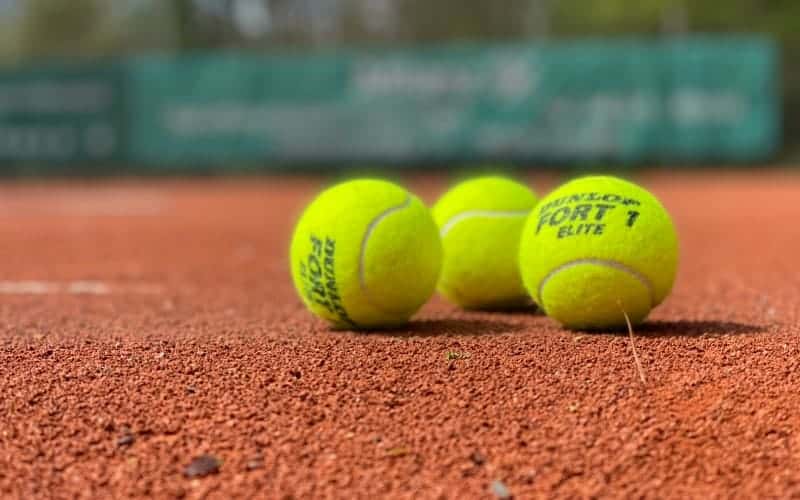
If you just play tennis occasionally, the odds are that, at least some of the time, you use old tennis balls that do not bounce as high as they did when they were new. They are likely to be soft enough that you can partly squash them with your fingers. New balls, on the other hand, are normally supplied in pressurised containers from which you have to remove a metal lid with a ring-pull before you can play with them.

As you open the tube, you will hear a hiss, as air escapes from inside the tube. New tennis balls are firm and bouncy, at least for a couple of weeks until loss of pressure leaves them soft and more suitable for the dog than the court. So why are tennis balls manufactured in this way if they deteriorate so quickly?

Pressurized balls are light, bounce well, and feel good on the racket. The pressurized cans in which they are supplied maintain this condition until they are opened. Non-pressurized balls last a long time and are great for coaching, but they are heavier and don’t feel the same. Pressurized balls have a fairly limited life, although they can be partially restored.

Do Tennis Balls Need To Be Pressurized?

If we value the lightweight and capacity to take spin of pressurized balls, then the answer is a resounding yes. A hollow ball like those generally used, but without a pressurized core, would seem permanently ‘flat’ to a tennis player, and would not offer any of the lively performance which can add to the enjoyment of the game.

By filling tennis balls with pressurized air, we ensure that they are more difficult to compress. This means that when they are squashed a little they recover their shape quickly, causing them to bounce to a good height from the ground or leave the racket quickly.

Why Are Tennis Balls Packaged In Pressurized Cans?

Tennis balls are made with a rubber core which provides a fairly good seal, keeping most of the pressurized air in. Unfortunately, tiny amounts of air can gradually escape if the balls are struck, or even stored at normal atmospheric pressure. To avoid the need to treat tennis balls as perishable goods, a way needed to be found to store them for long periods without significant deterioration.

The answer was to seal them in pressurized tubes, containing air at a pressure of around 26-28 psi, compared to the atmospheric pressure of 14.7 psi. This is slightly higher than the typical air pressure inside a tennis ball, and ensures that air does not leak out while they are being stored for periods of up to two years.

Pressurized vs Non-Pressurized Balls

Non-pressurized tennis balls have a thicker, firmer rubber core than pressurized balls. This enables them to bounce similarly to pressurized balls and mimic some of their playing characteristics. As loss of pressure is not a factor, these balls can last a long time, limited only by the rate at which the external felt wears off.

Unfortunately, they are not as pleasant to use as pressurized balls. They tend to be heavier and harder, offering less ‘feel’ and spin than the pressurized alternative, and can be rather tough on the racket arm. Nonetheless, their durability makes them ideal for use in coaching or with a ball machine.

How Long Do Pressurized Balls Last?

There is no definitive answer to this, as the life of a tennis ball depends upon how big a drop in performance you are prepared to accept before discarding it. In addition, the more you play with the ball, the more rapidly it will lose pressure. If you use balls a lot on hard courts, they will probably become unusable due to the felt being worn off before the pressure loss becomes unacceptable.

Considering pressure loss alone, a good quality ball might last for around 6 hours of play for high standard players, or around 2 weeks if used for less than 6 hours during that period.

Can You Pressurize Dead Tennis Balls?

Tennis balls can actually be pressurized after they become dead by using a specially made pressurizing machine. However, these machines can cost a few hundred dollars, and purchasing them might not make sense for players that only play during the weekend.

The first thing to consider here is the surface you play on. If you play on rough hard courts, the felt will wear off your tennis balls very rapidly, and there will be no point in repressurizing them. If, however, you play on softer surfaces and use a large number of balls, perhaps in coaching or with a ball machine, it may be worth investing in a device that can repressurize them once they become too soft.

An example would be reBounce’s Mini Green Tennis Machine, which uses a carbon dioxide cylinder to restore the pressure in the balls. As the machine retails at around $450, however, it is only financially worthwhile if you use large quantities of balls for practice.

Final Thoughts

Pressurized tennis balls typically offer better performance than non-pressurized options, and they are the only choice for competitive play. Nonetheless, they do not last very long, so if you use large quantities of practice balls, the greener option would be to consider purchasing a machine to repressurize them when they go soft, reducing waste.