The 5 Best Tennis Rackets For Doubles

The 5 Best Tennis Rackets For Doubles

Recent Articles

Wimbledon Beginner’s Guide: Venue, Dates, Ticket Costs


Wimbledon Beginner's Guide: Dates, Venus, Tickets Cost

The Championships at Wimbledon in Greater London is the oldest and most traditional of the four major tennis tournaments making up the grand slam. It is still played on grass, and players are required to wear predominantly white clothing and shoes. It is synonymous with enjoying top class tennis whilst eating strawberries and cream in an, admittedly rather crowded, immaculately kept grassy oasis.

In this guide, we will give you all of the important information about the event, including typical tournament dates and the cost of tickets. We will talk more about some of the most famous traditions, including the ongoing preference for grass courts, the quirky trophy design, and the reasons for the high status of the tournament.

Why Is Wimbledon Played On Grass?

The game of lawn tennis was devised in the 19th century. For much of the 20th century, three of the four major championships (the exception being the French Open) were played on grass. Although the US and Australian Opens eventually began to use hard courts, the All England Club, who run Wimbledon, were not keen to change.

Perhaps the strongest reason for sticking with grass is the fact that it is traditional, and Wimbledon is all about tradition. Many would argue that it is also good for the sport, as grand slam events played on hard courts can begin to look very similar, whereas grass is visually distinct and requires a different game style.

Why Is Wimbledon Considered The Most Prestigious Tournament?

Wimbledon’s prestige has a lot to do with the fact that it is the oldest of the four Grand Slams. The All England Club tries to maintain something of an ‘old world’ feel to the event by retaining rules like the requirement for clothing and footwear to be ‘predominantly white’, which were long since abandoned elsewhere.

Staging the tournament on grass also contributes to the feeling that you are playing tennis the way it used to be played. Competitors are encouraged to feel that they are fortunate to be playing at the historic home of the game, which enhances the prestige of the event. The All England Club has also continued to develop the facilities, with two courts now having a retractable roof, so that the site still stands in comparison with those of the other major events.

Why Is There A Pineapple On The Wimbledon Trophy?

The presence of a pineapple on the top of the Wimbledon men’s singles trophy is one of those oddities for which nobody has a definitive explanation. There are three popular theories.

Firstly, it may be mimicking the tradition of British Navy Captains placing a pineapple on top of their gatepost when they returned from sea, implying celebration and hospitality.

Secondly, it may simply be a reference to the association of pineapples with wealth, particularly in the 17th century when they were regarded as rare and exotic, and could only be purchased by the rich.

Finally, in the 18th and 19th centuries, pineapples were often included in paintings to represent hospitality and symbolized the welcoming of guests. Whatever the precise explanation, the trophy has become iconic in the world of tennis.

When Is Wimbledon Played?

The Championships take place between late June and mid-July, a few weeks after the French Open. For 2021, the dates are Monday 28 June until Sunday 11 July. Scheduling the event in the middle of the English summer gives the best chance of dry weather.

How Much Do Wimbledon Tickets Cost?

The All England Club takes an interesting approach to ticket prices, meaning that they are not as easy to access as those for the other major championships. Ground-pass tickets cost about £25, while main court tickets cost between £43 and £225. Companies and investors can also purchase hospitality packages that have main court tickets.

If you are wealthy, you can buy a ‘debenture’. This is a traded security, the most recent version of which was issued at a cost of £80,000 for Centre Court, and which covers a five-year period.

In return for this kind of money, the All England Club offers a ticket for a specified show court (the debenture prices vary by court) on each day of the Championships, plus a variety of perks like special lounges and restaurants. Debenture holders are free to resell their tickets by whatever means they choose.

Companies can purchase corporate hospitality packages, allowing them to entertain clients and guests at the Championships. These are not cheap either, being likely to cost something in the range of £1-10,000 per person.

After the rich investors and corporations have had their pick of the tickets, the remainder of the show court tickets are normally sold to the public by means of a range of ballots. These ballots are necessary because ticket prices are kept lower than the free market price, which explains why ticket holders, other than debenture holders, are banned from reselling them.

In 2019, Wimbledon show court seats were priced between £43 and £225 for days when main draw matches were scheduled. There was a ballot for the general public, but, on top of this, a number of tickets were distributed to tennis clubs, who would normally hold ballots among their membership to distribute these. Another batch of tickets was made available to people who fulfilled voluntary roles within the game.

It is also possible to obtain ground passes at Wimbledon, for around £25, to watch matches on the outside courts and soak up the atmosphere. Some of these are offered to coaches and players, but the bulk is normally distributed via a queue outside the grounds, which can form hours or days in advance.

The queue is another of Wimbledon’s great traditions, and the excitement is enhanced by the fact that the first few hundred in the queue each day earn the right to purchase show court tickets.

In 2021, because of the uncertainty about capacity due to coronavirus, there will be no ballots or queue, with the relevant tickets being sold online instead.

Final Thoughts

Wimbledon is a unique and historic event. You should try to visit at least once in order to experience the atmosphere.


The Top 10 Best Tennis Clubs In Dallas


Top 10 Best Tennis Clubs in Dallas

Dallas is cosmopolitan city which is home to more than 1.34 million people, making it the 9th most populous city in the US. As you would expect, there are plenty of options for tennis enthusiasts in the local area. So, which are the best tennis clubs in Dallas?

The answer is not clear and obvious, as there are a number of excellent public facilities, some private tennis clubs and even several very exclusive country clubs. In this article we will describe ten of the very best tennis facilities in and around Dallas, giving you the opportunity to make your own mind up about which would be best for you.

Search programs on tennis-academies.com

Fretz Tennis Center

At the Fretz Tennis Center there are 15 outdoor hard courts, with indoor courts planned for the near future, plus 4 PickleBall courts. The Center is renowned for its excellent group coaching sessions and welcoming atmosphere. It is run by Texas Impact Activities, and is one of the more affordable options, with an initial payment of $66 plus $16 per month allowing unlimited court time at any local Texas Impact facility. Alternatively, you can book a court for 1.5 hours at a cost of $4, and a ball machine can be hired for $17 per hour to facilitate individual practice. On the downside there have been reports of a few cracks on one or two of the courts, but they are generally in nice condition.

T Bar M Racquet Club

T Bar M styles itself the premier tennis facility in Dallas. It offers a total of 28 tennis courts, including 14 outdoor hard courts, 8 indoor hard courts, and 6 Har-Tru clay courts. In addition, there are facilities for Padel and PickleBall. The facility is of a high standard, but is not cheap, with individual membership available for an initial fee of $500 followed by $225 per month. Swimming and fitness facilities are also available, giving a genuine country club feel. Most reviewers like the atmosphere, and the coaches are popular.

Samuell Grand Tennis Center

The Samuell Grand Tennis Center has 18 outdoor hard courts plus 10 Pickle Ball courts. It is another facility run by Texas Impact Activities, so the same membership plan described under Fretz Tennis Center will cover you for unlimited court time at Samuell Grand. Individual bookings cost $3 for 1.5 hours, with ball machine hire available for $17 per hour. Reviews suggest that the facilities are good and there are often courts available. Group sessions are well-liked.

SMU Tennis Center

The tennis center at the Southern Methodist University, known as the Styslinger / Altec Tennis Complex, features 6 outdoor and 6 indoor hard courts. Student athletes train there all year round, and the center is due to host the ATP Dallas Open from 2022. It also features fitness facilities. The public are able to use the courts when not required by the University, and the coaching and courts are highly rated.

LB Houston Tennis Center

The LB Houston Center is run by Texas Impact Activities, so its membership costs are the same as for Fretz and Samuell Grand. It features 16 outdoor hard courts and 12 PickleBall courts. Court fees are $3 for 1.5 hours, and a ball machine can be hired for $17 per hour. Reviewers tend to like the quality of courts and coaching, although some observe that the courts can get busy at peak times and it can be difficult to get through to the Center by telephone.

Royal Oaks Tennis Center

Royal Oaks is another authentic country club, with golf being their highest profile activity, but with tennis certainly not neglected. The tennis facilities were completely renovated in 2013, and feature 13 floodlit outdoor courts along with two indoors. The club also offers a large fitness center. Membership is by invitation only, and the cost is not readily available online, which suggests that you need to be fairly wealthy to join. Reviewers are complimentary about the facilities.

Lakewood Country Club

Lakewood is an up-market golf & country club featuring eight hard tennis courts. It claims between 700 and 800 members who are eligible to use the tennis facilities. Membership is by invitation, with a substantial waiting list. Reviewers are impressed with the facilities, but you will need to be wealthy as well as patient to join: there is a $25,000 initiation fee if you wish to join as a tennis member, which is tripled if you aim to play golf.

Dallas Athletic Club

Dallas Athletic Club offers golf and tennis facilities featuring 10 floodlit hard courts. Again, the focus is on golf, but the tennis facilities and teaching are well reviewed. Membership costs are not readily published, which means that you will need access to substantial funds if you plan to join.

High Point Tennis Center

High Point is more of a traditional (and affordable) tennis center, with 21 floodlit outdoor hard courts and eight PickleBall courts. A large renovation project has recently been undertaken, so the bulk of the facilities should be in excellent condition. Court fees are $3 per hour per player for residents, or $4 for others.

Annual membership is available for $150 plus tax for residents, or $230 plus tax for non-residents. Ball machines are available for $15 per hour plus the court fee. The facility is well-reviewed, although one or two players found it a little noisy due to the proximity of two busy roads.

The Clubs Of Prestonwood – The Creek

The Creek is primarily a golf club, but it is also a country club offering six outdoor hard tennis courts. It offers a full range of tennis activities, including coaching and a ball machine. Reviewers are positive about the tennis operation, but the cost of joining is likely to be substantial.

Final Thoughts

There are some great tennis clubs in Dallas. If you have a substantial budget, one of the country clubs may entice you, but otherwise you still have a good choice of specialist tennis facilities. 

Australian Open Tennis Guide: Dates, Location, Courts


Australian Open Tennis Guide

The Australian Open is now well established as one of the four major events constituting the Grand Slam. It is the first of the four to be played in each calendar year, and it gives the leading players a chance to establish their dominance and set the tone for the rest of the season. The Australian Open is renowned for its friendly atmosphere, and is sometimes known as the ‘happy slam’. It is the highest attended of the four majors. As it is the only one of the big four tournaments taking place in the Southern Hemisphere, it is sometimes known as the ‘Grand Slam of Asia/Pacific’.

The key points to be aware of about the Australian Open are that it is played in Melbourne in January on acrylic courts, primarily outdoors. Like the other major events, the singles events feature 128 players, but with doubles events plus wheelchair, junior and seniors competition, the number of players involved in the event as a whole is very large. We will now look at these facts in more detail.

When Is The Australian Open Played?

The Australian Open takes place in the second fortnight in January. It follows the short off-season fairly closely, although it is preceded by two or three weeks of tournaments on similar surfaces in the Southern Hemisphere in order that the players can prepare.

Playing the event in the height of the Australian summer means that temperatures can get very high during matches.

Why Is The Australian Open Played In Melbourne?

The tournament began as the Australasian Championships in 1905, and the first edition was indeed staged in Melbourne. Over the next couple of decades it was held in a variety of different venues around Australia and New Zealand. It became the Australian Championships in 1927, but still moved around until 1972, when it was decided to hold it in Melbourne every year because the attendances were best there.

From 1972 to 1987 it was held at the Kooyong complex, but from 1988 onwards it has been staged at Melbourne Park, which is better able to handle large crowds. With the large investments that have been made in the Melbourne Park facilities, it is hard to imagine the tournament moving again.

What Are The Australian Open Courts Made Of?

Prior to the switch to Melbourne Park, the event was played on grass. From 1988 to 2007, green Rebound Ace hard courts were used, but these were controversial due to their tendency to become excessively grippy in extreme heat.

From 2008 to 2019, blue Plexicushion courts were used, similar to the surface used at Indian Wells. From 2020 onwards, a switch has been made to GreenSet courts, oddly still retaining the blue color! These are generally thought to be medium-paced, and consist of an acrylic top layer on a concrete base.

Having said this, several players at the 2021 Australian Open felt that the courts were playing faster than before, so they may have edged towards being medium-fast.

Is The Australian Open Played Indoors Or Outdoors?

The tournament is fundamentally an outdoor event, but each of the three main show courts is now fitted with a retractable roof.

This means that in the event of extreme heat or rain, matches can be played in a climate-controlled environment. In all likelihood, a few matches during the tournament will therefore, effectively, be played indoors.

How Many Rounds, Sets, and Players in the Australian Open?

In common with the other three major championships, the singles events at the Australian Open accept 128 players each, including 32 seeds. This means that if a player is to emerge victorious in the tournament they must win 7 rounds.

The format of the matches differs between the men’s and ladies’ events. The men play over the best of five sets, whereas the women play best of three. This means that the physical challenge in the men’s event can be considerable, given the very high temperatures that are sometimes experienced.

Traditionally, the final set in both events would continue beyond 6-6 without a tie-break until one player led by two clear games. Since 2019, however, the organisers have implemented a tie-break at 6 games all in the final set. In contrast to the tie-breaks in the earlier sets, the final set tie-break requires the winning player to accrue 10 points as well as being at least two points clear.

It is important to remember that a major championship like the Australian Open is not just about the main singles events. There are prestigious men’s, women’s and mixed doubles competitions, as well as junior singles and doubles. In addition there are wheelchair events. Overall, several hundred players take part in the tournament.

Final Thoughts

The Australian Open is a great event, offering considerable prestige and substantial prize money. It is normally played in front of large crowds who help to produce a great atmosphere. If you ever get the chance to visit the tournament, it is an opportunity not to be missed.

US Open Tennis Guide: Dates, Venue, Hotels & More


US Open Tennis Guide: Dates, Venue, Hotels

The US Open is a truly iconic event. One of the four major ‘grand slam’ events in the tennis calendar, the tournament is renowned for its lively atmosphere, and dramatic night sessions under the floodlights. It takes place in late summer, and is the last of the four majors to be played in a calendar year, which means that its outcome often goes a long way towards deciding who is the season’s number one player.

In this article, we will tell you some of the background and history of the US Open along with some crucial information you will require if you are considering a visit. Timing, location and cost will be discussed, along with the format and size of the event. Finally, we will look at some of the best and most affordable options for local accommodation.

When Is The US Open Played?

The tennis US Open event starts on the final Monday in August and runs for two weeks. In 2021, the tournament dates are 30 August to 12 September.

Where Is The US Open Played?

The tournament began as the US National Championships in 1881 at Newport, Rhode Island. Whilst a few venues were used in the following years, between 1915 and 1977 the tournament was primarily played at the West Side Tennis Club in New York, which from 1924 featured the Forest Hills Stadium. Until 1974, grass courts were used, but between 1975 and 1977 the surface was switched to clay.

In 1978, the event switched to its present home, Flushing Meadows in New York, where there was more space to build large stadia. This coincided with another switch of surface to hard courts, which are still used to this day.

How Much Do US Open Tennis Tickets Cost?

There is a very wide range of options if you are looking to buy tickets for the US Open. You can just buy a ground pass, or you can book a courtside seat for a big match on one of the major stadium courts.

Expect to pay around $120 for a ground pass in the early part of the tournament, increasing to over $10,000 for a close-up view of the greats in the latter stages.

How Many Players, Rounds And Sets In the US Open?

In common with the other major championships, the singles events at Flushing Meadows admit 128 players each. This means that to win the championship a player needs to win seven rounds. Men’s singles matches are decided over the best of five sets, whereas the women play best of three.

In both events, all sets are decided by a standard seven-point tie-break if the score reaches 6-6, in contrast to the other grand slam events which each use a different system in the final set.

Of course, the tournament includes a lot of other events apart from the main singles draws. The men’s doubles, women’s doubles and mixed doubles are all highly prestigious, and bring in a lot of players who do not get the oportunity to play in the singles. There are also junior singles and doubles events, which offer a great showcase for young players seeking sponsors.

There are seniors draws which, whilst played as exhibition events, serve to remind people that the heroes of the past can still produce some nice shots. Finally, there are wheelchair tournaments which are crucial in determining the world rankings for this category.

What Are The Best Hotels For The US Open?

You can expect to pay a fairly high price for comfortable and convenient accommodation during the US Open fortnight, as there will be a lot of demand from visiting tennis fans from around the world. Nonetheless, there are some good options starting at around $150 per night if you book early.

The most convenient hotels are in Flushing, close to the Tennis Center, but remember that this is close to the flight path of some fairly large jets, so there will be a significant amount of noise.

If this bothers you, take some ear plugs or stay somewhere else and travel on the day.

Budget Options

The Asiatic Hotel in Flushing is generally regarded as clean and pleasant by reviewers, although its location can be noisy.

Flushing Central Hotel offers good, basic accommodation at a fair price. It scores highly for the convenience of its location.

The Best Western Jamaica Inn is well regarded for its cleanliness and service, although once again it may be a little noisy due to the location. 

Mid-Priced

The Hilton Garden Inn Long Island City New York is a slightly more upmarket option, featuring a fitness center and well reviewed accommodation and service.

The Marco LaGuardia Hotel & Suites are once again popular with guests, offering a good standard of accommodation. The hotel even offers a shuttle to and from the US Open during the tournament.

If You Can Afford A Little More

The Sheraton LaGuardia East Hotel offers a great location and accommodation described by one reviewer as ‘spacious and luxurious’, although it may set you back more than $350 per night.

Final Thoughts

The US Open is one of the great sporting events. If you can afford it, try to get tickets and enjoy the atmosphere.

How Does Betting Work In Tennis? (Easy Guide)


How Does Betting Work In Tennis?

As you play and watch more tennis, you will become more knowledgeable about the game and will feel more able to predict the outcome of matches involving top players. While you may be satisfied with impressing your friends with your predictive powers, you may also feel that there is money to be made from placing a few well chosen bets. So, how does betting work in tennis?

You can bet on simple tennis match results, but there are also numerous handicap and in-play markets. Many bookmakers permit betting on tennis and have websites allowing you to bet online. When betting regularly, one can attempt to develop a system to maximize profits, although it is difficult to make a sustained profit from gambling.

Tennis Betting Odds Explained

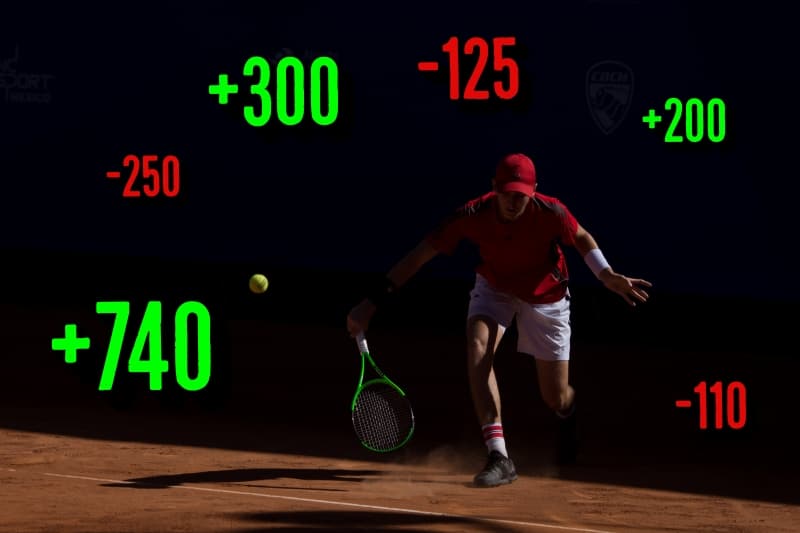
The easiest type of tennis betting to understand is match betting. Here, you decide who you think is going to win a match and place a bet on them to do so. You choose how much money to risk, known as the ‘stake’, and the bookmaker declares the odds they will give on your chosen outcome. For example, you think Garin is going to beat Opelka. The bookmaker is offering odds of 2/1. This means that if Garin is successful, the bookmaker will pay you 2 times your stake money, and will return your stake on top of this. Thus, a stake of $5 will result in a return of $15. However, if Opelka wins, the bookmaker will keep your stake and you will receive no payout.

Many betting sites offer in-play odds during matches. These change according to the state of the game. In the example above, if Garin is leading 6-3, 5-2 in a best of three sets match, the bookmaker might offer odds against an Opelka victory of 66/1. If you are watching the match and feel that a change of momentum is taking place, you may want to place a small bet on an Opelka win. In the unlikely event that you are correct, your stake will be returned multiplied by a factor of 66.

Certain bookmakers offer handicap odds. Going back to Garin and Opelka, they may offer +2.5 on Garin, and  -2.5 on Opelka. What this means is that they add up the total number of games won at the end of the match, and add 2.5 to Garin’s total or subtract 2.5 from Opelka’s. For the purposes of the bet, if Opelka wins three more games than Garin, or by any greater margin, Opelka wins. Otherwise, Garin wins. These handicaps are designed to level the playing field, so the odds offered on each player to win on this basis will be very similar and close to evens (1/1).

Some sites will also allow you to bet on exact match-scores, or even whether specific events like a tie-break will occur. You might also bet on which player will win a tournament.

How Does Over/Under Work In Tennis?

This is another form of handicap betting, and is often applied to the number of sets in a match, although it could equally be applied to the number of games. In a best of three sets match, odds might be given for ‘under 2.5’ or ‘over 2.5’. Thus, if the match is expected to be decided in straight sets, the ‘under’ odds’ will be significantly lower than those for ‘over’. You win by correctly predicting the number of sets played.

Where Can You Place Tennis Bets?

There are numerous online bookmakers offering a reputable tennis betting service. Some, such as Bet365, will offer live streaming of matches to encourage in-play bets. In most countries it is straightforward to open an account and place your bets, but in the USA the situation is more complex.

Until 2018, the majority of states banned sports betting. However, since then a legal ruling has permitted more states to allow it, and some have taken the opportunity to do so. If you live in the USA, check the position in your home state, as some will allow almost any form of sports betting, others just allow it at certain locally based venues, while a few still permit none at all.

Developing a Betting System

A good betting system will be based on as much information as you can obtain about the matches, players and venues If you know a player is carrying an injury, or dislikes a particular venue, or even the weather conditions are more likely to help their opponent’s style, you will want to bet on their opponent if the odds are reasonable. Similarly, if you know that a player plays well against a specific opponent, you may want to bet on them to win.

The key concept is ‘value’. If Fognini is 5/1 to beat Nadal, but your research suggests his chances are better than the 1 in 6 that this suggests, you may bet on him even if you do not believe he is favorite because he offers the best value. If you adopt a strategy of betting on outcomes where you think the odds are wrong, and you make a number of bets over a period, you should ultimately make money- but ONLY if you are right about the probabilities.

Is Tennis Betting Profitable?

You can only make money betting on tennis if you have better information than the bookmakers, who employ people to analyse the statistics and news in order to determine odds which will attract customers but allow the company to make a profit. Unless you have better information than these experts, for example through illegal information from players, you cannot expect to profit from tennis betting in the long term.

Final Thoughts

You are not likely to make a significant amount of money from tennis betting over any length of time, because the bookmakers work hard to be well informed. Nonetheless, it can be an enjoyable hobby and you may occasionally strike it lucky.

Do Tennis Rackets Come In Different Sizes?


Do Tennis Rackets Come In Different Sizes?

Tennis is a game for life. You can start playing it at a very young age and continue, fitness permitting, until you are 90 or older. As your body grows and then ages, you will need a racket that suits your height, physique, and strength. Manufacturers have been aware of this for many years, and there is now a vast range of different lengths, head sizes, thicknesses, and balances available.

Which you choose will be partly a matter of personal preference, but if you select a racket which is designed for someone of your build and technique, you will give yourself the best chance of playing good tennis.

Tennis rackets come in different lengths, weights, and thicknesses. Beginners will probably require a racket that is easy to play with, with a large sweet spot. Juniors will need a racket that is of an appropriate length for their size. More advanced players will often prefer thinner rackets with a relatively small head.

The weight and balance of a racket will also have a strong influence on how it performs.

The Different Sizes Of Tennis Rackets

There are three key aspects of tennis racket size: length, thickness and head size.

A typical adult tennis racket is about 27 inches long. There was a fashion a couple of decades ago for rackets that were an inch or more longer, as this offered a little more racket head speed when serving, allowing shorter players to get some additional pace out of their serve. However, such extra long (or ‘long body) rackets are rare today. Rackets for juniors start at 19 inches or less, and range up to 26 inches.

The thickness of the racket frame is known as the ‘beam’. Thinner frames (say 18-24mm) offer more feel and control, whereas a thicker frame (perhaps 25-30mm) will provide more power.

Head size is normally categorised as one of the following:

Mid size            Up to 96 inch²  

Mid plus           96 – 105 inch²

Oversize           106 – 115 inch²

Super Oversize 115 inch² plus

Each of these sizes has advantages for certain styles of player, with the smaller ones offering superior maneuverability and the larger ones having a larger sweet spot and hence being more responsive to off-center hits.

The Best Racket Size For Beginners

For an adult beginner, it will be best to start with a standard 27-inch length. As for head size, something in the mid-plus range is likely to be most suitable. This will offer a reasonably large sweet spot, making the racket forgiving of off-centre hits, but will not be too large and cumbersome to hinder the development of technically correct shots. Essentially, a beginner should look for a racquet that is likely to be easy to play with, without any extreme characteristics.

Tennis Racket Sizes By Age

The youngest children, aged 4 to 5, will start playing using a racket that is 17-19 inches long. As they grow, they will move up to 21 inch and 23 inch implements, until around the age of 8 when they will typically be ready for a 25 inch frame. At this stage, rackets begin to be constructed in a way more similar to that in which adult rackets are made.

Soon, perhaps at age 9, a player will be ready to play on a full-court with a reduced compression ball, and they will move up to a 26 inch frame, which will typically closely resemble an adult racket. Finally, by the age of around 11, a player will be ready to adopt a lightweight version of a 27 inch adult racket. It is important to realize that the ages here are just a guide. It is all about the size and strength of the player: there is no benefit in using an adult racket before they are ready.

What Tennis Racket Size Should You Choose?

A lot depends on the style and standard of your play. The length of the racket will normally be 27 inches unless you are a shorter person who is keen to add a little pace to your serve. Head size and beam will vary. If you are an advanced player, generating plenty of racket head speed and power, you will prefer a racket head in the mid size range with a fairly narrow beam due to its manoeuvrability and feel.

On the other hand, if you lack racket head speed or strength, you will be looking for something in the mid-plus or oversize range with a thicker beam. This will offer a larger sweet spot and more power, at the expense of some feel and maneuverability. If you are closer to the average in terms of swing speed and strength, you will probably want a head somewhere towards the lower end of the mid-plus range, with a medium beam, to provide you with a good balance of power and feel.

Other Racket Specs To Consider

The weight of a racket is a significant consideration. Physically stronger players with long swings will want a heavier frame, perhaps over 300g, especially if they prefer to play from the back of the court. A lighter frame will be more manoeuvrable, and may suit players who are less physically strong, or who like to volley.

The balance of the racket is also important. Physically stronger players looking for feel and control will look for a more neutral or head-light balance, whereas players seeking more power and stability will prefer a head-heavy balance.

As discussed in other articles on this website, grip size and string are also important. In particular, the more dense the stringing pattern the more control will be offered, whereas the more spread out the strings are, the more power and spin are generated.

Final Thoughts

Tennis rackets may all look fairly similar, but there are many differences. The only way to find the best specification for you is to try some frames and see which feels best.