The 5 Best Tennis Rackets For Doubles

The 5 Best Tennis Rackets For Doubles

Recent Articles

The Cheapest Tennis Stringing Machines (Review)


The string in your racket is absolutely crucial to your success in playing tennis, as it is, hopefully, the only part of your equipment that makes contact with the ball. It plays a significant role in determining the power and spin you can apply. This explains why top professionals tend to get their rackets restrung so frequently- they want the string to be in peak condition every time they play. For good juniors and aspiring professionals, regular restringing is essential.

Paying someone else to do this can become expensive: typically $500-$1,000 per year just for labor, excluding the cost of the string. Many players will therefore consider purchasing a stringing machine and doing the job themselves. However, good stringing machines can cost several thousand dollars, so they will be looking at the cheaper end of the market. What sort of options is worth considering?

In this article, we will mention five relatively affordable stringing machines and consider the pros and cons of each. The Gamma 5003 W is a ‘lock-out’ machine with a spring to set the tension, whereas the other four options, from Tourna, Gamma, Klippermate, and Eagnas, use a drop-weight. Their prices vary, so we will consider a balance between quality and value.

Gamma 5003 W/ 6 Point Mount Stringing Machine

The Gamma 5003 W is the most expensive machine we will be looking at here, currently retailing for around $1,200. It comes with its own adjustable stand. The racket is clamped in place on the turntable, and when the string is in place, the handle is turned. It will click and lock when the preset tension is reached: the string is then clamped, and the process is repeated. Lock-out machines like this are easy to use, although there can be some tension loss before the string is clamped, as the machine stops pulling when it is locked, giving the string time to stretch. The other disadvantage of this machine is that it is large and heavy, meaning that it is not practical to take it ‘on the road’ to tournaments, leaving you at the mercy of expensive on-site stringers. Overall, however, it is a solid, easy-to-use option.

Tourna 150-CS Stringing Machine

The Tourna 150-CS should be available for just under half the price of the Gamma 5003 W. It is a very different type of machine in that it creates the string tension using a lever with an adjustable weight on it. The turntable is similar to that of larger machines, but the Tourna 150-CS does not come with a stand, so it is essential to find a solid table to work on. When stringing with a ‘drop-weight’ machine like this, the tension is determined by the position of the weight on the lever. The lever should find a balance point parallel to the turntable: if it goes too far, tension will be excessive, or if it stops short, the tension will be too low. It is, therefore, difficult to tension the string accurately. On the other hand, there is no ‘lock-out,’ so the string is kept closer to the set tension prior to clamping, and this machine is far more portable than the Gamma 5003 W, so it could possibly be taken to tournaments.

Gamma Progression 200 Stringing Machine

The Gamma Progression 200 is a genuinely cheap machine, retailing for around $230. It looks more flimsy than the Tourna 150-CS, with string clamps that do not attach to the base. The turntable only offers two mounts, which can result in difficulties in holding the racket in a stable position. The other disadvantages of the Gamma Progression 200 are, as with any drop-weight machine, the difficulty in obtaining an exact tension and the time taken to string. The relatively spartan turntable area also brings some risk of damaging rackets for inexperienced stringers. Nonetheless, this is a solid, portable machine weighing in at 24 pounds, which can save you a lot of money.

Klippermate Tennis Racket Stringing Machine

The Klippermate is another very basic drop-weight machine, currently available for about $250. Its design is likely similar to that of the Gamma Progression 200, and it will have similar pros and cons. Therefore, it will be portable but not the quickest to use and not as precise with tensions as more expensive machines. It will also be tricky to keep the racket stable. Two of the biggest selling points of the Klippermate are that it is made in the USA and comes with a lifetime guarantee.

Eagnas Hawk 10

The Eagnas Hawk 10 is currently the cheapest machine reviewed here. At just over $200, it undercuts even the Gamma Progression 200. It looks very similar to the last two machines and should have similar advantages and disadvantages. However, several users have reported issues with using the machine in terms of setting tension, breaking clamps, etc. This probably does not mean that the machine itself is sub-standard, but rather that it is not the easiest to use. This may suggest that the Hawk 10 will not be the best choice for many.

Is It Worth Buying A Tennis Stringing Machine?

Stringing is not the most enjoyable job in the world, but if you do not have unlimited funds, you can save a lot of money and inconvenience in the long run by purchasing your own machine.

Final Thoughts

The cheapest machine here is the Eagnas Hawk 10, but reviews suggest that it is outperformed at the market’s bottom end by the Gamma Progression 200 and the Klippermate. The Tourna 150-CS is a drop-weight machine with a more solid turntable, which is likely to be easier to use but costs $300 extra. If you can afford $1,200, the Gamma 5003 W will allow you to string at home with less effort but is not portable. So there are some great options here, but your decision will depend on your needs and stringing experience, as well as price.

The Top 11 Best Tennis Academies In Europe


If you are an ambitious young tennis player, you will probably be looking to begin training more intensively, alongside players similar to and more advanced than yourself. Tennis academies are designed to satisfy this need by bringing together top coaches with leading juniors and professionals at a single site. Players can train full-time, and juniors are normally supported through their schooling. Many such academies exist across Europe, and this article will briefly review 11 of the very best.

We will look at the Piatti Tennis Academy, Schuttler-Waske Tennis Academy, Mouratoglou Tennis Academy, Barcelona Tennis Academy, Rafa Nadal Tennis Academy, Good to Great Tennis Academy, Soto Tennis Academy, Kim Clijsters Tennis Academy, BTT Tennis Academy, JC Ferrero Equelite Academy, and the Justine Henin Tennis Academy.

Search programs on tennis-academies.com

Piatti Tennis Academy

Riccardo Piatti is an experienced coach who has worked with several top 10 players. The academy is based on the Italian Riviera. There are four hard courts on-site, two of which are indoor, with access to two clay courts at a nearby club. They aim for high intensity in a ‘family’ atmosphere. Unusually, the academy does not offer full board, so you will need to sort out your own accommodation and schooling, but the annual cost is a relatively affordable $20,000.

Schuttler-Waske Tennis University

The Schuttler-Waske Tennis University was founded by former leading players Rainer Schuttler and Alexander Waske. Based near Frankfurt in Germany, the academy has 8 hard courts, including 4 indoor and 5 clay courts. At Schuttler-Waske, they aim to offer individual attention and develop a team atmosphere. The cost is not stated online.

Mouratoglou Tennis Academy

The Mouratoglou academy is located on the French Riviera. It boasts 34 courts, equally split between hard and clay, with 8 indoor. The impressive campus features two swimming pools and an athletics track. Several leading players train there, including Serena Williams, but they pride themselves in focusing on personal development and education. The cost is around €38,000 per year for training, plus €14-25,000 per year for accommodation.

Barcelona Tennis Academy

The Barcelona Tennis Academy, actually located 15km from the city, is based at a large club, with access to 21 clay courts and one hard court, as well as a gym, swimming pool, etc. The Barcelona setup is a small one, with around 14 full-time players. Schooling is available at a nearby school, and accommodation is arranged either with host families or in apartments. The small size of the academy allows for plenty of individual attention. There seems to be an emphasis on fitness and consistency. They do not specify fees online.

Rafa Nadal Tennis Academy

Rafa’s academy is based on his home island of Mallorca, and the coaching team is headed by his legendary Uncle Toni. It is another large academy, with 26 courts and a full-time program including education at the Rafa Nadal International School. The facilities are definitely of a high standard, and the weather is likely to be good. They emphasize their meticulous attention to detail, as you would expect from their association with Rafa. The cost for an annual program is likely to approach €60,000.

Good to Great Tennis Academy

The Good to Great academy is based in Danderyd, Sweden, which means that training will be indoors most of the year-round. They have seven indoor hard courts and five outdoor clay. The academy was set up by former players Magnus Norman, Nicklas Kulti, and Mikael Tillstrom. Their guiding principles are C.A.R.E.: Concentration, Attitude, Respect, Energy. A full year’s training and accommodation costs around $36,500, but education is normally done through online providers and costs extra.

Soto Tennis Academy

Unusually, Soto is an academy in Sotogrande, Spain, run almost entirely by Britons. The Director of Tennis is Dan Kiernan, and they have 10 hard courts, of which 7 are indoor and 3 outdoor clay. The environment would be ideal for English-speakers who would like to train in Spanish conditions with good coaches. Prices for the full-time program start at around €25,000.

Kim Clijsters Tennis Academy

Based in Bree, Belgium, the Kim Clijsters academy is run by the former world number one herself. It offers 3 indoor hard courts, 5 indoor gravel, and 10 outdoor clay for use in the Belgian summer. Education is available but will be online unless you speak Flemish. As you might expect from Kim’s image, the academy prides itself on its friendly atmosphere. The annual cost is not stated online.

BTT Tennis Academy

The BTT academy is another based near Barcelona, at Valldoreix. Like the Barcelona academy, it is based at a large club with good facilities, offering 2 hard courts and 16 clay courts. Accommodation is available offsite, but you will probably need to organize your own education. They aim to provide a customized program offering a high level of individual attention. Annual costs are not stated online.

JC Ferrero Equelite Academy

The JC Ferrero Equelite academy is based near Villena in Spain. Although not the founder, former world number 1 Ferrero maintains a significant presence. Education is provided in conjunction with the ‘King’s College’ school in Alicante. There are 10 clay courts and 9 hard courts, one of which is indoors, plus one grass court. They aim to develop players within a ‘family’ environment for an annual cost of around €48,000.

Justine Henin Tennis Academy

Established in 2007 by Belgium’s other former world number 1, the Justine Henin academy is based in Limelette in Belgium. There are 6 indoor hard courts, 3 indoor clay, and 10 outdoor clay. The emphasis is on characteristics close to Justine’s heart, such as courage, fighting spirit, respect, and discipline. Education is incorporated and can either be in-person or online. Prices are not stated online.

Final Thoughts

The academies listed here are all excellent in their own way. If you are looking to join one, the only real way to decide is to visit the ones you are interested in and experience the atmosphere.

How Many Games Are In A Set Of Tennis? (Easy Guide)


How Many Games Are In A Set Of Tennis?

The tennis is a game with its own unique scoring system. Many suggestions have been put forward to really explain why it is this way, but nobody really knows for certain what its origin is. Some believe that the point scores represent positions on an imaginary clockface, whilst others say that they indicate how far forward you were allowed to stand when serving in an archaic form of the game.

Whatever the true origin of the system, it has stood the test of time. In the modern game, there have been surprisingly few attempts to modify the point scoring system, with attention focusing on the structure of the sets. Historically, these were of unlimited length, but the general introduction of tie-breaks has made them more manageable. Sets are now sometimes lengthened to allow single-set matches or shortened to prevent matches lasting too long.

A standard set of tennis is played up to 6 games with a tie-break at 6-6. An average tennis match consists of 3 6-game sets. If a single set format is preferred, an 8-game set format is usually adopted. For one-day events, 4-game sets may be chosen to allow multiple matches. The French Open is the only tournament with a no-tiebreak 5th set rule.

Regular Sets To 6

This is the time-honored format. Players take it in turns to play and serve for a game, and the first to win 6 games wins the set, provided that they are at least 2 games ahead. If neither player can establish a two-game lead, a tie-break is normally played at 6 games all.

The tie-break is definitely won by the first player to reach 7 points, provided that they are 2 clear. The set is then scored 7-6 to the winner of the tie-break. The overall match will typically be played over the best of three sets or, in men’s Grand Slam events, the best of five.

A set in this format will typically take between 20 and 60 minutes, although greater extremes are possible.

8 Game Pro Set

An increasing number of league competitions are beginning to use ‘pro sets.’ These are played in an identical way to regular sets to 6, except that a player must win 8 games to win the set. There will normally be a tie-break played at 7 games, all if necessary.

The popularity of pro sets stems primarily from the fact that many amateur league matches take place in the evening, with players coming directly from work. Each match will typically feature two or three rounds, and many players will not want the contest to drag on until late in the evening. If they play each round as a pro set, rather than the best of three sets to 6, then each rubber will tend to last between 40 minutes and an hour, rendering the match more manageable.

Short Set Formats

With the increasing pressure on people’s time these days, there is a trend towards tournaments that only last a single day, both at junior and senior level. This means that matches cannot last too long, as players may be expected to complete three or four in a day. The simplest way to achieve this, whilst retaining the essence of the traditional scoring system, is to use what is known as ‘short sets.’

A short set is won by the first player to reach 4 games, provided that they are two games clear. A tie-break will decide close sets, and different versions of the format implement this at 3-3 or 4-4. In a typical one-day tournament, matches will be nominally decided over the best of three sets, with the first two being short sets and the third being a ‘championship’ tie-break where the winner is the first to 10 points.

Some events use an even shorter format, known as ‘Fast 4’. Here, the matches are also two short sets and a tie-break if necessary, but additional means are used to speed things up. Once again, different versions have been used, but, most importantly, when a game reaches deuce, a single point is played to decide it (‘sudden death deuce’), with the receiver choosing which side the server serves from.

In addition, the original version of Fast 4 used a ‘no let’ rule, whereby, if a serve clipped the net and clearly landed in, the point remained live, in contrast to the usual requirement to restart the point.

Sets With No Tie-Break

Many years ago, there was really no such thing as a tie-break, and a set continued until one player was two games ahead. This could take a very long time. Until recently, this rule was still used in the final set of Grand Slam matches and Davis Cup ties, but now the French Open is the last bastion of such time-consuming traditionalism.

An example of what can happen was seen at Wimbledon in 2010, when John Isner and Nicolas Mahut played a match that took over 11 hours, finally being decided 70-68 in the fifth set. Today, the possibility of such extended matches is generally considered unacceptable, not least because the exhausted winner will inevitably lose in the next round.

How Many Games Does An Average Tennis Match Take?

There are few statistics available on this, but the evidence that has been published suggests that around 10 games per set would be typical, equating to an ‘average’ score of 6-4. Given this, a best-of-three set match would be expected to comprise around 20 games if it is settled in straight sets or 30 if it goes to a third set.

By the same token, a best-of-five set match might last 50 games or more.

Final Thoughts

There are actually many different formats in use for tennis matches today, and all have their place. If you are running a tournament, make sure you choose the most appropriate one.

What Do Tennis Court Lines Mean?


The first time you see a tennis court, you will probably wonder why it has so many lines on it. If you understand the basics of the game, you will expect to see a rectangle that marks out the area into which the ball needs to be struck and a net across the middle of it, but what are all of the other lines about?

Historically, the court was not always even rectangular. The first accepted court for lawn tennis was designed by Walter Wingfield in 1874 and was hourglass shape with a net somewhere between 5 and 7 feet high. By 1877, the All England Club had implemented a rectangular court design in preparation for the first Wimbledon Championships, although the net was still 5 feet high, and some of the ‘boxes’ were larger than they are today. In 1882, the net was reduced to 3 feet high, lines similar to those used today were implemented, and the court has remained virtually unchanged since. This design has certainly stood the test of time, but what do all of these lines mean?

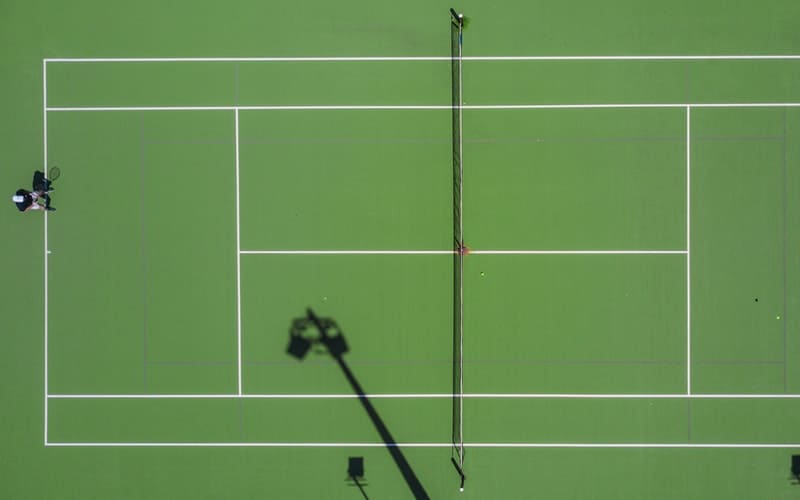
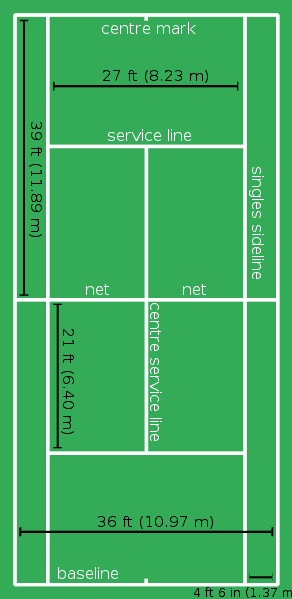
The lines on a tennis court define the area where the ball is allowed to land during the point. The baseline is the line that represents the furthest back a ball can land; the singles and doubles sidelines mark the outer edge along the side of the court; finally, the service box indicates where a serve has to land.

Image: Tennis.png by ed g2s. Licensed under: Creative Commons Sharealike 3.0 Unported License

The Baseline

As you actually see from the above diagram, there is a baseline at each end of a tennis court. For a standard court with both singles and doubles markings, each baseline will be 36 feet long. The baselines are sometimes the same thickness as the rest of the lines on the court, but they are allowed to be thicker. Most of the lines are 1 to 2 inches wide, but the baselines can be up to 4 inches across.

There is a small line called the center mark at the mid-point of each baseline, and this is used when a player is serving, as they are required to serve diagonally across the court and must stand on the correct side to do so.

The Singles Sideline

The singles sidelines mark the outer limits of the side of the court during a game of singles. They obviously run along the full length of the court, so they are each 78 feet long. Anything which lands outside these lines is said to be ‘out,’ and the player who hit the errant shot loses the point, irrespective of whether it was within the area marked out by the doubles sidelines. The strips along each side of the court between the singles and doubles sidelines are sometimes called the ‘tramlines.’

The Doubles Sideline

These are not labeled on the above diagram, but they are the outermost lines on the sides of the court, running parallel to the singles sidelines. The doubles sidelines mark the limits of the court for a game of doubles. The court is extended to reflect the presence of two additional players.

During a game of doubles, the singles sidelines can be ignored except when serving, as the service box is the only part of the court which is not made wider. The gap between the singles and doubles sidelines is 4 feet 6 inches.

The Service Box

The service boxes are the areas between the net and the service lines. Their edges are defined by the singles sidelines, and they are separated into left and right boxes by the centre service line. There are, therefore, as you will see on the diagram, four service boxes, two on either side of the net. Each box is 21 feet long and 13 feet 6 inches wide. When serving, a player has to stand behind the baseline and hit the ball, so it lands in the service box diagonally opposite the side of the court they are standing in. If it does not land in the correct box, it is a ‘fault.’

Are Lines Considered ‘In’ In Tennis?

If a tennis ball touches any part of the relevant line on its first bounce, it is said to be ‘in,’ and the rally continues. This can, of course, lead to disputes, as players often have differing opinions as to whether the ball might have grazed the edge of the line in question.

It is tempting for a player to take part in a match without an umpire to call an opponent’s shot out when they are not 100% sure. This happens at all levels, with accidental errors being common and deliberate ones not unheard of. Umpires and line judges can also make errors which can be equally frustrating for the players.

At the highest level, technology is taking over, with systems like ‘Hawkeye’ and ‘Hawkeye Live’ dealing with the close calls and removing any opportunity to dispute the outcome.

Final Thoughts

The lines on a tennis court will seem confusing at first, but once you have been playing the game for quite a while, you will not be able to envisage any other design. Nonetheless, they may change again, one day, for example, if the governing bodies decided to limit the dominance of the serve by making the service boxes smaller. The cost of changing every court in the world would mean that any such change would not be made lightly, however, so the current design is likely to be around for some time.

How Do Tennis Leagues Work?


How Do Tennis Leagues Work?

One of the enjoyable things about tennis at any level is being able to take part in competitions. You get the opportunity to test your game against people with different styles and abilities, and your mental strength is challenged by the need to stay focused.

One way to compete is to enter tournaments at an appropriate level. These can be great fun, but there might be an entry fee of around $50, a significant amount of travel, and an unknown time commitment. The alternative is to play in a league. There are many different types of these across the USA, but generally, they will be cheaper than tournaments, with more predictable timings and less traveling.

Tennis leagues work in singles and team formats, with matches scheduled during specific time periods. Players can join leagues online or through someone who already runs a team. Matches take a variety of forms, depending upon the players’ age, experience, and level. On average, fees to play in a league range from $20 – $100 per year.

How To Join Tennis Leagues

There are many organizations that run tennis leagues for adults, and each will have its own rules and method of joining. If you are new to league tennis, the easiest way to start is at your local club. Some will probably operate internal leagues, both singles and doubles, which will provide a perfect starting point. For a significant number of people, these internal leagues are all they need, as they offer regular matches at a modest cost with no extra traveling.

Others will want to challenge themselves by joining a league that includes players from other clubs and areas. The first thing you will have to do is obtain an NTRP rating by self-rating using the published descriptions or getting a recommendation from a pro. This will give you an idea of what level of team you should try to join. It is likely that your local club hosts at least one or two such teams, and if you approach the captain(s), you will be able to ask about being added to the squad.

If there is no space in your club’s teams, you will need to find another team to play for. The majority of leagues in the US are run by the USTA, and if you approach your Local League Coordinator, they will help you find a team. Alternatively, you could find a local USPTA league, either online or via a coach- these have a different format with a wider range of players in each team. If none of these appeals, go to ustennisleague.com and register for one of their leagues. The latter can either be singles or doubles, but you can arrange matches at a time to suit you, and, apart from your doubles partner, you do not need a team.

How Do League Matches Work?

An internal club league is likely to make matches relatively short, for example, playing a single set to 8. The club will probably set up a series of round-robin divisions, with promotion and relegation at the end of each month.

USTA leagues use a range of formats depending on the age group. Their ‘adult’ leagues, which will include men’s leagues and ladies’ leagues, will typically involve a combination of singles and doubles matches. Teams will be restricted as to the NTRP ratings of players they can include so that each league is balanced. There are leagues for over-18s, over-40s, and over-55s, as well as mixed leagues for over-18s and over-40s. The over-55s and the mixed leagues are doubles only, and there is a restriction on the total NTRP rating of each pair at the various levels. Individual matches will typically be played over the best of three sets, with the third set being a match tie-break. At the end of the season, successful teams can qualify for regional and national finals.

USPTA leagues differ from the USTA ones by virtue of requiring a range of NTRP ratings in each team, with four players or pairs competing at their own level. It also allows for the hosting of matches to be shared to enable clubs with limited courts to participate.

Best Beginner Tennis Leagues in the USA

If you are really new to the game and you have been told that your NTRP is 2.0 or below, you will probably not be quite ready for the USTA or USPTA leagues. At this stage, you will benefit from joining the lower levels of a club league or possibly registering with ustennisleague.com.

This will teach you about matchplay without the pressure of representing a team. Once you reach 2.5, both USTA and USPTA offer leagues that can give you the chance to enjoy team matches.

Best Adult Tennis Leagues

Typically, over 300,000 people per year play in leagues run by the USTA. The format and structure are tried and tested, and they offer the chance to play in national finals. The USPTA offers an interesting alternative format, which is definitely worth a try, especially if you want to be on a team with friends who are not the same standard as you. There are other leagues which could be enjoyable too, so check what is available near you.

How Much Does It Cost To Join A League?

This varies by region and whether indoor courts are needed. In New England, for example, the typical costs of playing in a USTA League are the following: $44 to join the USTA, $23 to register a team, and $90 for court fees. The latter two costs can be shared between 6 to 8 players, implying a cost of $14-20 per match.

Final Thoughts

League tennis is a great way to compete and can be fitted around work and other commitments. It can also be a great way to make friends!

How To Hit a Topspin Forehand (for Beginners)