
The 5 Best Tennis Rackets For Doubles

The 5 Best Tennis Rackets For Doubles

Recent Articles

How to Play Tennis With 5 Players (Drills Included)


Playing tennis with 5 players on one court can be tricky. However, you can definitely have a productive practice this way. It is unrealistic to have 3 people playing on one side of the court at once, so each drill mentioned in this article will avoid that. 

Playing tennis with 5 people on one court is possible with a bit of creativity. There are both doubles and singles based drills that you can practice with large groups of people. A lot of them include a rotation where one person sits out for a point or two at a time while their teammates play the point. When one person on the team misses, they will rotate out and be replaced. The key here is emphasizing quick rotations so nobody is forced to sit out for too long.

Doubles Based Drills

Photo: Regina Cortina Photography

One way to set up drills and points is 2 on 2 where if a player misses, they are replaced by a teammate. This way, the players rarely sit out for more than a couple points. These are awesome for working on your doubles game. There are tons of variations of this and you can get creative with it, but here are some of my favorites:

2 on 2 Baseline Points

This drill is great for the players to work on constructing points. Start with one team of 2 and one team of 3. Both teams will start with 2 players on the baseline. After the feed, anything goes. For the team of 3, if a players misses or a winner is hit on their side of the court, they will step out and the other team member will take their place. Play up to 11.

Strategy 

Teams should work on getting to the net quickly to end points. Usually the first team that comes forward will win the point if they can be aggressive. Just be sure to come forward on the right ball. Additionally, it is usually most effective to come to the net as a team. 

One Team Up, One Team Back

This drill is great because many doubles points end with one team at the net and the other on the baseline, so it is great to practice that situation. One team with start on the service line, the other will start on the baseline. The 5th player (the one sitting out on the team of 3) will feed the ball in. Remember if a player on the team of 3 misses or a winner is hit on their side, they are replaced. Keep the game moving as quickly as possible.

It doesn’t matter if the feed comes from the baseline or net side, but be sure to play both ways as they are different. After the feed anything goes, winners included. Play up to 11. Make sure you play enough games so that everyone gets a chance starting at the net and on the baseline. 

Strategy

Volleyers in this game should have a clear advantage as they are able to be more aggressive. Use angles and remember that the short and low volley can be really effective here. As the volleying team, close the net hard and try to keep the points short. 

The baseliners should try to produce shots that will set up easier balls. In other words, don’t try and hit winners on everything. Construct the point so that you make the volleyers pop the ball up, then go for the winner. Finally, be aware of how hard the volleyers are closing and keep them honest with the lob.

Both Teams at Net

I like this drill because it is a great way to work on making your hands quicker. Both teams will start on the service line and again, the 5th player will feed the ball in. Anything goes after the feed including winners and lobs, so be sure that the feed is not too easy. Play to 11 and make sure that everyone has a chance to be on the feeding side and the side receiving the feed. 

Strategy

The strategy here is pretty simple: earn a ball that you can finish the point with. In order to do this, your target should really be at the other team’s feet so that they will be forced to hit the ball up. Additionally, the team that is able to close the net more effectively will win the majority of the time, so try to get on offense as quickly as you can. 

Singles Based Drills

There are a couple of great drills that you can do to work on your singles game with 5 people on the court. These will work on your consistency and all-court game. Just make sure you are ready for a sweat before you get into these ones.

Photo: Regina Cortina Photography

The Marathon Drill

This drill is competitive and forces you to battle for every shot. If done correctly, it will teach you to create good margin on your balls and improve your ability to stay in long points. You can actually do this drill with as many players as you have. With 5 people, start with 3 players on one baseline and 2 on the other. Someone feeds the ball and the rally begins. Each time you hit a ball, you rotate out and the next person steps in. The style of drilling where you hit only one ball called “ping-pong.” 

The only two rules to this drill are that you cannot miss in the net and you cannot hit winners. If you miss the ball in the net, you lose and are eliminated from the game. If you happen to hit a winner, you restart the point with no consequences. This drill is most productive when the points are long and the errors eventually come from being fatigued.

Strategy

The strategy for this drill is pretty simple: don’t miss and make your opponents tired. Because you only miss if the ball goes in the net, you should eliminate that as a possibility. That means you should be clearing the net by several feet with lots of shape and spin on your ball. Push your opponents to the corners of the court so that they are forced to run more than you. 

King/Queen of the Court

This is a classic way to play points with an odd amount of players. You can do this starting with a serve or feeding the ball out of the hand. Here’s how it works:

Start with 1 player on the “king/queen” side and the rest of the players on the “challenger” side. The goal of this game is to earn your right to the king side and win as many points there as possible. In order to get to the king/queen side, a challenger must win 2 points in a row.

If you are playing with serve, the challenger side always serves. Play the first point front he deuce side and if the challenger wins, play the second point from the ad. If the challenger loses the first point, they must go to the back of the line and the next player comes in.

Every point that a player wins on the king/queen side is counted towards their score. The first person to get to 11 on the king side wins the game. The points do not have to be won all at once, as it will typically take multiple trips to the king/queen side to reach 11 points.

If you have an even number of 6 or more, you could always make pairs and do this as a doubles drill. Remember, get creative!

Strategy

The strategy for this game is pretty simple. Just commit to your style of tennis and see how you do against your friends. Get competitive and have some fun!

Final Thoughts

Hopefully by reading this article you found some inspiration for what to do with 5 players on a tennis court. Remember to think outside the box and be creative with these drills. All of them can be done with any unconventional number of players on the court, so don’t let an odd number keep your group from having fun and improving your games together. 

If you have any questions or comments on this article, please comment below and we will respond as promptly as we can!
What Do Tennis Players Carry In Their Bags?


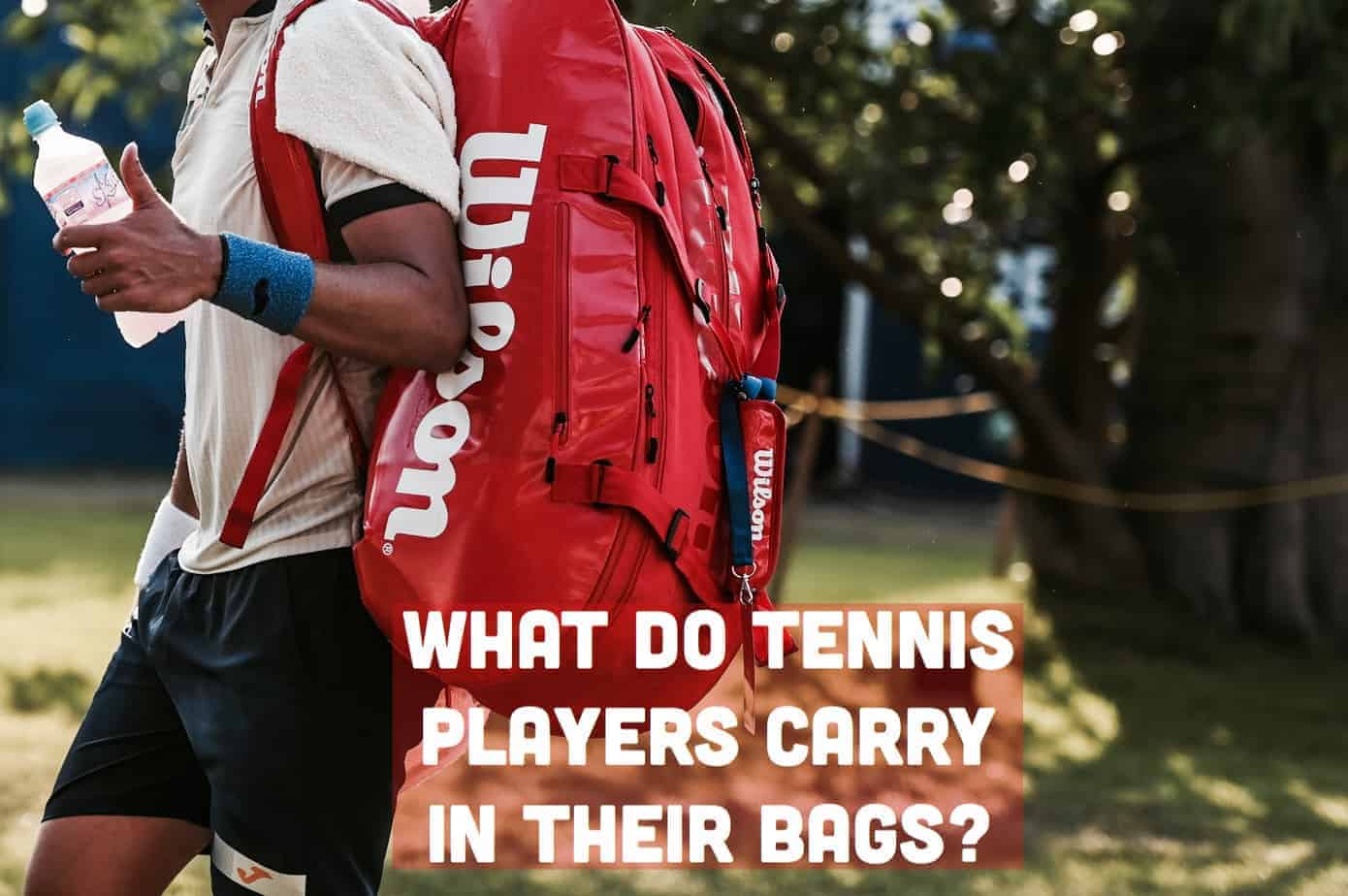
Today we are going to talk about gear. Tennis players pack a lot of it at all times in those massive bags they carry around. While the list of items is long, they all serve an important purpose and help players do their jobs more appropriately. In this article we will talk about the items most tennis carry with them everyday and we will also list some of our favorite gear in each category. So let’s get to it.

While every player carries a different combination of items that is suitable for their personal needs, here is a list of things players are most likely to carry in their bags:

  • Rackets: most players carry between 4 to 8 rackets with them (top pros can go up to 12);
  • Strings: players typically have 1 or 2 reels of strings;
  • Shoes: at least 2 pairs of tennis shoes and usually one pair of running shoes
  • Clothes: a few changes of clothes
  • Overgrips: top pros tend to change grips for every practice so they always carry a lot of grips with them;
  • Resistance Bands: one or two bands for warm ups and workouts;
  • Jump Rope: another item to help with warm up
  • Electrolyte mix: players use electrolyte mixes to stay hydrated during matches/practice;
  • Snacks – bars, chewies, trail mix, etc; 
  • Foam roller: for recovery;
  • Massage Gun: device used for massages, increasing in popularity among players;
  • Thermal Water Bottle to keep drinks cold;
  • Miscellaneous: notebook, personal memento, comfort item.

If you want to learn more about why players carry these items, we will talk about them in further detail below. We will also list some of our recommendations in each category if you are in the market for new items to carry in your bag.

Tennis Rackets

It goes without saying that tennis players carry multiple rackets with them. The exact number depends on each player’s individual needs, but in general, no professional tennis player carries less than 4 rackets with them. I typically always had 5 rackets with me when I was playing tournaments. In my experience working with players at the highest level, they usually carry 8 – 12 rackets with them. The reason for that is that they like to have rackets strung at different tensions so they have options during the match. In any case, the amount of rackets any given player carries boils down to personal preference. Here are some of our favorite rackets for 2020:

HEAD Graphene 360+ Speed MP Tennis Racquet

HEAD Graphene 360 Speed Pro Tennis Racquet

HEAD Graphene Touch Prestige Pro 16×19 Black/Red Tennis Racquet Strung with Complimentary String Colors (Marin Cilic’s Racket)

Babolat Pure Strike 100 Adult Tennis Racket

Babolat Pure Aero 2019 Racquets

DIADEM Elevate 98 Tennis Racquet (4 3/8)

Strings

Another indispensable item in every tennis player’s bag is strings. Professional players always have their racket strung before matches so they can play with fresh strings and the tension they prefer. Again, the amount of string players carry depends on their needs. However, I find that most players carry one or two reels of strings with them most of the time. Players may also choose to have individual sets of strings instead of reels for better portability. Here are some of the most popular strings among professional tennis players:

Luxilon ALU Power 130 Tennis String Reel, Silver

Wilson LUXILON 4G 125 Reel, Gold, 200m/16L-Gauge

Babolat RPM Blast 200m 1,30mm Tennis String

Babolat VS Touch Thermogut (Natural Gut) 16 Gauge in Natural Color (Best String for Performance)

Solinco Hyper-G (16-1.30mm) Tennis String Reel (660ft/200m)

Solinco Tour Bite Soft Tennis String Reel

Shoes

During tournaments, players often carry two pairs of tennis shoes in their bags. While most recreational players do not need to do this, professional athletes like to have a backup pair in case something goes wrong with their shoes. In addition, some players enjoy having a pair of running shoes for warm ups and walking around because they tend to be more comfortable than tennis shoes. We listed some of our favorite tennis and running shoes down below:

ASICS Men’s Gel-Challenger 12 Tennis Shoes

adidas Men’s Adizero Club Tennis Shoe

Clothes

Same as the shoes, players will always have extra clothing in their bags. Shorts, shirts, hoodies/jackets, wristbands, hats, socks, underwear and so on. Players know their individual needs and plan their clothes changes accordingly.

Overgrips

Overgrips is one of those items you will find in every tennis player bag, regardless of their level. Almost all of us prefer the feeling of a fresh overgrip in our hands and pros tend to use a new one for every practice/match. There are three overgrips worth your money:

TOURNA Grip XXL, Original Dry Feel Tennis Grips.

Wilson Pro Overgrip Grips

Yonex Super Grap 30 Pack ( Color:White) by Yonex

Now we are getting to some of the less known items that most professional players carry. These devices are aimed at helping with different on and off the court tasks such as warm ups, recovery and nutrition. Let’s check them out.

Resistance Bands

Resistance bands are a very important item in a tennis player’s bag. This piece of tennis equipment is incredibly functional and can help with warm ups, strengthening and recovery. Players use them in so many different ways we are working on a complete guide for you. Resistance bands are also super portable so it is a must have for every player out there. Here are some of the best resistance bands for you:

TheraBand Resistance Bands Set, Professional Non-Latex Elastic Band For Upper & Lower Body Exercise, Strength Training without Weights, Physical Therapy, Lower Pilates, Rehab, Beginner & Advanced

Black Mountain Products Resistance Band Set (Five Bands Included)

Jump Rope

Another important warm up tool is a jump rope. Not all players use jump ropes in their warm up routines but it is fairly popular among players. Jump ropes are easy to pack and have multiple purposes so it is common to find them in players bags. We have a couple good options for you:

Ballistyx Jump Rope – Premium Speed Jump Rope with 360 Degree Spin, Steel Handles, Silicone Grips and 2 x Adjustable Cables – for Crossfit, Gym & Home Fitness Workouts & More

Crossrope Get Lean – Weighted Jump Rope Set

Electrolyte Mix

Most tennis players use some form of electrolyte mix for hydration purposes. The most common ones are powder and tablet mixes. Players tend to steer away from the average sports drinks (i.e. gatorade, powerade) because they contain high amounts of sugar. Electrolyte mixes are a better and healthier way to stay hydrated. If you want to learn more about them, we have an article you might enjoy. We listed our favorite mixes below:

Electrolyte Powder, Lemonade Hydration Supplement: 90 Servings, Carb, Calorie & Sugar Free, Delicious Keto Replenishment Drink Mix. 6 Key Electrolytes – Magnesium, Potassium, Calcium & More.

Vitalyte Electrolyte Powder Sports Drink Mix, 80 Servings Per Container, Natural Electrolyte Replacement Supplement for Rapid Hydration & Energy – Cool Citrus

Nuun Electrolyte-Rich Sports Drink Tablets, Juice Box Mixed Flavor Pack, Box of 4 Tubes (40 Servings), Sports Drink for Replenishment of Essential Electrolytes Lost Through Sweat

Snacks

Nutrition is extremely important for high performance athletes so a lot of players have a few healthy snacks in their bags. Because tennis players have such rigorous training schedules, they need sources of energy to endure long days. Each player has their own preference on what snacks they eat but the most common ones are bars, nuts (trail mix) and chewies. Here are some good energy boosters for your next training session:

CLIF BAR – Energy Bars – Best Sellers Variety Pack – (2.4 Ounce Protein Bars, 16 Count) (Packaging May Vary)

Honey Stinger Organic Energy Chews, Fruit Smoothie, Sports Nutrition, 1.8 Ounce (Pack of 12)

Honey Stinger Organic Energy Gels – Variety Pack with Sticker ­– 12 Count – Energy Source for Any Activity – Vanilla, Chocolate, Mango Orange, Acai Pomegranate, Strawberry Kiwi & Fruit Smoothie

Foam Roller

Foam rollers have become an essential piece of recovery equipment in recent years. Most players spend a ton of time rolling out their muscles to make sure they are loose. While they are a bit tricky to carry inside a tennis bag, the majority of players have one at all times. Work on your recovery with these foam rollers:

LifePro 4-Speed Vibrating Foam Roller – High Intensity Vibrating Roller for Muscle Recovery, Mobility & Pliability Training – Deep Tissue Vibrant Massage for Awesome Trigger Point Sports Therapy

TriggerPoint GRID Foam Roller with Free Online Instructional Videos, Original (13-Inch)

Massage Gun

Another device that has become massively popular among players is the massage gun. While a bit expensive, a massage gun is a fantastic tool to keep your muscles free of knots. On top of that, most players can’t afford traveling with their own physio so it is definitely a good investment. And even the players who do travel with physios use the massage guns for their recovery work. I highly recommend it. Here is a well reviewed unit:

Massage Gun,Handheld Deep Muscle Massager,Cordless Vibration Massage Device Helps Relieve Muscle Soreness and Stiffness (Black)

Thermal Water Bottle 

You might not see players using their own bottles during a match given that the tournament provides water. However, during practice sessions, most players like to have a good thermal water bottle to keep their drinks cold. These are the best ones you can find:

Hydro Flask Wide Mouth 2.0 Water Bottle, Straw Lid – Multiple Sizes & Colors

Simple Modern 64 Ounce Summit Water Bottle – Large Stainless Steel Half Gallon Flask +2 Lids – Wide Mouth Double Wall Vacuum Insulated Black Leakproof – Midnight Black

Miscellaneous

Finally, players may carry random things in their bags. A common practice is to carry a notebook. Some players like to write down strategy before matches and they are allowed to read them during matches. Other players might use the notebook as a journal. Another common item is sunscreen. Most tennis players spend most of their time outside so having sunscreen is a must have.

Cossac Fitness Journal & Workout Planner – Designed by Experts Gym Notebook, Workout Tracker,Exercise Log Book for Men Women

Coppertone SPORT Continuous Sunscreen Spray Broad Spectrum SPF 30 (5.5 Ounce per Bottle, Pack of 2) (Packaging may vary)

Conclusion

Gear is something that we all enjoy. While it won’t help your game it feels good to have the proper equipment. Again, each player carries what they feel is best suitable for their needs. But most players will have some sort of combination of the items we listed in this article. Tell us in the comments what item is indispensable in your everyday carry.

How Do Tennis Players Get Wildcards?


How Do Tennis Players Get Wildcards?

Source: @reginacortina.photography

Tennis is an extremely difficult sport to break into. You are not drafted by a team if you show some signs of talent, you cannot join a practice squad, and there are no try-outs for tennis. No matter if you are one of the best junior players in the world or if you have never played a tennis tournament before, you need to start climbing the professional tennis ranking ladder from the absolute bottom.

Only when you start doing well in smaller tournaments (called ITF futures) can you move up to the next level – called ATP Challengers. After doing well in Challengers, you will finally move on to ATPs and Grand Slams, which are the tournaments you usually watch on TV. The journey to the top is long and difficult, and many players end up getting stuck in the middle. But there is one way that usually speeds up the process: wildcards. Only a few people get them at each tournament, but they can change a player’s whole career. 

So how can tennis players get these wildcards? Wildcards are usually awarded by a tournament’s organization, and these organizations normally give them to five different types of players: local players, young and up-and-coming players, players returning from injuries, winners of wildcard tournaments, and recipients of wildcard swaps. These invitations are given to players who the tournament’s organization thinks fans will like, so at the end of the day, all a player can do is ask for the wildcard and hope for the best. 

Below we will get more in-depth into how an organization decides who it will give the wildcard to, and we will explain the five types of players mentioned above. 

What Is A Wildcard?

You probably already know this, but a wildcard is an “invitation” that allows a player to participate in an event to which he or she would not qualify with their current ranking. For instance, a player ranked 500 in the world would not be able to compete in a Grand Slam; however, if given a wildcard, he or she would be able to compete directly in the main draw.

Who Gets Wildcards?

Each event, whether it’s a main draw or qualifying one, only has a certain number of spots reserved for wild card players. In Grand Slams and a few big ATP/WTA events, the number of wildcard spots can get up to 8. On some smaller tournaments, that number can be either 2 or 4. Needless to say, there are more people begging for those spots than wildcards to give. For that reason, the tournament’s organization needs to be pretty selective as to who they give those spots to. Below we will cover the main criteria those organizations use when deciding who will get those highly desirable wildcards.

Local Players

The first players to usually get wildcards are players who live in the same city, state, or country where the tournament is played. Tournament organizations do this in an effort both to bring local fans out and to give local players an amazing opportunity. Depending on the location of the tournament, it may or may not be the only opportunity during that year that a player will have to play a big tournament, and if he or she does not qualify for it through rankings, the player will certainly need a wildcard. These organizations often have multiple candidates for the wildcards, and more often than not there is a certain degree of lobbying that happens behind the scenes when deciding who to give the wildcard to. 

Young & Upcoming Players

Next, it is very common to see wildcards given to young and up-and-coming players who have a growing fanbase. These are players that people expect to have enough ranking to join the tournament through rankings in the future, but who don’t have the ranking just yet. By gifting them with a wildcard, a tournament expects to be the first place where those players draw national attention by defeating a big-name player. Up until recently, young players like Andrey Rublev, Denis Shapovalov, Felix Auger-Aliassime, and Janik Sinner all had to receive wild cards in order to participate in the big tournaments.

Players Returning From Injuries

Other common recipients of wildcards are well-known players who are coming back from injuries. These players usually have had to take some time off the court, and they may have lost their ranking as a result of that. By giving a wildcard to these players, the tournament’s organization is giving them an opportunity to get some valuable points back and return to the top sooner. In addition, this deal is also great for the tournament itself, as big-name players usually draw large crowds (which means more money).

Winners Of Wildcard Tournaments

Big tournaments usually hold wildcard tournaments to decide which player will be awarded a wildcard. These tournaments do not count for the ATP or ITF rankings, and usually only local players can compete in them. For instance, for the Australian Open, there were 3 wildcard tournaments in place: the Asia-Pacific Wildcard Playoff, the American Wildcard Playoff, and the Australian Wildcard Playoff. 

Wildcard Swap Recipients

Finally, another way of receiving a wildcard is through a wildcard swap. Some national tennis organizations have agreements in place where they exchange wildcards for tournaments. For instance, the United States Tennis Association and the French Tennis Federation have such an agreement in place where one wildcard for the US Open goes to French players, and one wildcard for the French Open goes to American players. It is then up to the foreign organization to decide who it will give the wildcard too. As we mentioned earlier, it is not uncommon for the organization to host a wildcard tournament in order to decide on who it will award the invite to. 

Example – Australian Open 2020

Now that we have covered the main criteria used to award wildcards, we will go through a real life example and show what this really looks like. Not many tournaments have been held so far in 2020, but the Australian Open is a great example. In the Men’s Singles Main Draw, the following wildcards were awarded: 

PlayerNationalityCriteria
Michael MmohUSAAmerican WC Challenge
Tatsuma ItoJapanAsia-Pacific WC Challenge
Hugo GastonFranceFrench Federation selection
John-Patrick SmithAustraliaAustralia WC Challenge
Christopher O’ConnellAustraliaAustralian Federation selection
Marc PolmansAustraliaAustralian Federation selection
Andrew HarrisAustraliaAustralian Federation selection
Alex BoltAustraliaAustralian Federation selection

As you can see, 3 wildcards were given through wildcard tournaments, 1 through a wildcard swap, and 4 were given to local players. All of these local players also happen to be young and upcoming, which makes them perfect recipients for wildcards for such a big tournament. 

Mental Block Tennis Forehand – How to Fix it


Any person who has watched me play tennis knows that I am not the guy you watch and say “wow that is a great forehand”. My backhand is the stroke that usually gets all the compliments (you can watch for yourself in this video of me training with Naomi Osaka). In my case, hitting backhands always felt incredibly natural while the forehand side was way more complicated. Because of that, my forehand was way more volatile.

Some weeks I felt like I was hitting it well and some weeks I would completely lose it. That feeling of losing a stroke is common in tennis and all tennis players at all levels experience it. So in this article I want to share some of my experience dealing with this issue and my tips on how to recover from a mental block on your forehand.

In order to recover from a mental block on your forehand you need to first understand that losing a stroke is natural, so do not panic. Tennis players go through ups and downs in every stroke and you need to embrace that. Your goal is not to eliminate these swings; it is to decrease the volatility of your strokes.

The second thing you should do is to understand your stroke. When you feel like you are hitting your forehand well, pay attention to everything. Analyze your footwork, the rotation of your body, the position of your arms and hands during the takeback and follow-through, the ball flight and so on.

Knowing these things will help you with the third tip which is establishing a baseline. By being self-aware you can understand what works and doesn’t for you which will help you regain confidence. Finally, the last tip is to have a good swing thought. Forget about the result of the shot and focus in an area of your swing that will help you properly execute the forehand.

This subject is complicated because we all experience mental blocks differently. So in this article, I will go through some of the steps I’ve taken in order to improve my forehand and control its ups and downs so I could become a more consistent player. Try to find one or two tips that might help you do the same. Let’s get to it!

Forehand Yips

A few months ago I was teaching a teenager whose forehand was definitely his weapon. We went to a tournament and he played the best tennis I’ve seen him play since we started working together. He was dominating opponents, especially with his forehand. After the tournament, we took a couple days off and restarted training.

First day back, he looks at me and says “I don’t know how to hit my forehand anymore”. I was shocked. I asked him what happened and he could not give me an answer, he just was not feeling it. Just like that, it was gone. He could not hit forehands for three weeks. During matchplay he would only chip forehands and if he tried to actually hit it he would miss by a LOT. It got to the point that we had to laugh about it.

But what happened? We did not change his stroke, we did not change the way we were training and he had just played an amazing tournament. I believe he had what we called the “yips”. The yips is a term we use to define a sudden loss of skill in experienced athletes. It is a state of extreme nervousness that causes players to not be able to perform at the level they are expected to. 

For most players, time and training will help them regain confidence. However, the time frame is different for each individual. The biggest problem is that players panic and the issue becomes mental and not physical. In the case of my student, he had one bad practice and his mind decided he could not perform something he was so used to doing. It took us a few weeks but he was able to recover from it.

It Is OK To Lose A Stroke

The first thing you need to understand is that it is completely normal to lose your stroke. It is not something you should look forward to but if it does happen, do not panic. In the case of my student, he quickly panicked which led him to believe there was something wrong with his forehand. It is important for you to understand that the issue is mental and not technical. If you immediately think you need to rebuild your forehand you will have a much harder time regaining confidence. 

Our brains can (and usually are) be our toughest opponents in tennis. A lot of us, including myself, work less on our minds than on the tennis court. So once a mental block happens we have a harder time responding appropriately. In my experience, I found that the best way to react once you have a mental block is to take a step back.

It is natural for us to have a bad day on the court and overthink it. We want to get back on the court and quickly fix the issue but if tennis has taught me something is that quick fixes will be detrimental in the long run. Try to take some time off, however many days you can step away from it (duration is up to you and the circumstance you find yourself in). A couple of days off can help you because you will feel more excited to play and muscle memory will take over. 

Don’t let the frustration get the best of you. Photo: Regina Cortina

Work on Self Awareness

A lot of people will say that “you just need to relax and stop thinking about it”. But if it was that easy we would all be mindlessly hopping around caring about nothing. We have brains and they are, for better or worse, made for thinking. Personally, I believe it is very important to have a deep understanding of yourself as a tennis player. Know your strengths and weaknesses from a technical, physical and mental standpoint. Understand what works and what doesn’t for you in order to develop as a player.

So when you work on becoming more self-aware and understanding your strokes, you can attempt to pinpoint where the block is affecting you the most. When a mental block happens, our minds get foggy and we tend to only focus on the result of the shot, which goes from “I want to hit the ball there” to “OMG I don’t want to miss my forehand again”.

So take a step back and forget about the outcome of your shot but try to understand how you are being affected by the block. Are you not moving your feet as well? Are you decelerating the racket head? Are you making the right decision before hitting? Ask yourself some questions, regardless if you can actually answer them or not.

Establishing a Baseline 

Once you become more comfortable with the fact that it is ok to lose a stroke and work on your self-awareness, it is time to establish a baseline. What I mean by that is that you should pay attention to what is working for you when you are at your best. Look into your footwork, racket head speed, follow-through or whatever it is that makes you feel like you are hitting the ball well, and remember that feeling. Then when you have a mental block on your forehand your goal in practice is to try to recreate that feeling. Let me explain.

After many years of trial and error, I found the formula that works for myself. First, I realized that I would hit my forehand better when I focused on three things: Proper distance, body rotation and high elbow follow through. On the other hand, I noticed my forehand would be less effective when I focused too much on my hands and arms. I figured out that I would be finecking too much with my swing once my mind paid too much attention to those two areas which led me to lose confidence on my forehand.

The solution I found in my case was spending extra time being fed lots of tennis balls. Feeding allowed me to focus really hard in the areas I mentioned earlier: body rotation, distance and the follow through. On top of that, feeding was a no pressure situation which I was allowed to miss as I worked on regaining confidence. During low confidence times, I rather go on the court and be fed for 30 mins than hit for one hour and a half. When you have a mental block on your forehand, it is easy to lose your range; there is no consistency on where your balls land. Finding back the range is really important during low confidence times. 

Working on my forehand using feeding during off season

Our Tips To Help You Recover From a Mental Block

First let me preface by saying that these tips might not work for some of you. We are all unique individuals and it is hard to tell what will help each person who reads this article. The following tips come from my experience as a tennis player and I found them to be extremely helpful in my case. However, I think you can try them out to see if one (or multiple) work for you. Be sure to continue to work with the tennis professional who’s been coaching you and be open about your issue. Let’s get to it!

Take Some Time Off

This is a simple one. It obviously depends on your situation. If you are in the middle of playing a sequence of tournaments, it might be hard to step away from tennis. But if you are able to, take some time off. However long it takes for you to really miss playing and just being out on the court enjoying the process instead of fearing your forehand. Give your mind some rest and allow your muscle memory to kick in. It is ok to take some time off. 

Feeding

Instead of going out and playing matches, have a coach or friend feed you a ton of balls. As I explained before, getting fed allows you to hit a lot of shots in a low pressure environment so you can work on your range. You (and your coach) can fine tune your forehand without worrying about mistakes. Handfeeding is usually a great way to start and you can slowly move into normal feeding. The key is to actively try to find a formula that works for you.

Coach

This is for more advanced players. While coaching may sound like an odd tip, you would be surprised on how effective it is. A while back I had the yips on my second serve, I just couldn’t figure it out. A few weeks later I was working tennis camps and I was teaching a group of kids how to hit kick serves. I gave them some tips and they hit their serves great and then I realized “wait, why don’t I do that one my serve???”. I haven’t had problems with my second serve since. When you are helping someone else, tennis is much clearer since you are the outsider. The game becomes easier in your head and you develop a better understanding of the sport. Highly recommend this one.

Make Good Decisions

It is so easy to let your mind takeover during times of low confidence. It almost makes us dumber. Mental blocks on your forehand walk hand in hand with poor decisions on the court. Mental fog is our worst enemy. Don’t be a hero, choose bigger targets, play safer shots. In short, have small goals. If you can’t put one forehand on the court, aim at hitting one. Then two, then three and so on. Don’t try to go from missing every forehand to “yeah I am Fernando Gonzalez”.

Scenario. Let’s say I am struggling with my forehand crosscourt. So to make up for it, I start hitting more down the line. But since I will do so at the wrong times, I will still make mistakes. Slowly I won’t trust any shots and have a complete mental block. In this case, poor decision making contributed to my loss of confidence. Fight that urge, make good decisions.

Find One Swing Thought

When we have a mental block on our forehands, our minds are always racing during the execution of our shot. We focus so hard on “making it” that we lose our swing thought. It works like this: instead of worrying about the result of the shot, find ONE specific area of your forehand you should focus on during the execution. And you can change it as you go until you find the one that works for you that day. You can focus on your feet, body rotation, contact with the ball in front, racket head speed, follow through and so on. Just pick one area and see the result you get. If it does not help you, move on. If it does, stick to it until it stops working. 

 Work With a Specialist

All that being said, sometimes your mental block just won’t go away. It happens and there is nothing for you to be ashamed of. If the problem is persistent and nothing is helping you, paying a visit to a sports psychologist could be beneficial. I believe working with a qualified professional is extremely important regardless if you are experiencing a mental block or not. But in this case, if it is something that is making you lose sleep, seek professional help (if you have the means to do it).

Conclusion

Developing a mental block on any stroke in tennis is one of the hardest parts of playing the sport. It can be incredibly frustrating to feel like you are going backwards on your progress as a players. But like I said before, it is part of playing tennis. Our path in tennis is packed with ups and downs and how we respond to adversity shapes us as players and also as people; it helps us on the court and in our daily lives. Do not let a mental block discourage you and enjoy your time on the court. If you want to keep reading about forehands, check out this tennis forehand ultimate guide we made for you. Also, visit our YouTube channel, where we have a few videos to help you out as well.

How Has the Coronavirus (COVID-19) Affected Pro Tennis?


Since this article was originally posted on March 17, 2020, it has been updated as are working to get you the most current news possible. This update is as of the morning of Thursday, March 19, 2020.

The Coronavirus (COVID-19) has had an effect on everyone’s life in the past month. It seems that everything is being put on hold and life as we know it is being halted. Most sports leagues around the US have been suspended for the time being and the NCAA has cancelled the seasons for all winter and spring sports. So how exactly has the pandemic affected pro tennis players around the world?

Most recent update:

On March 18, 2020, the ATP/WTA and ITF both sent out an email informing the players that the tour suspension would be extended an additional 6 weeks. This means that the next possible professional tournament will be played the week of June 7th at the earliest.

Email from ATP and WTA regarding most recent news.

How Will the 12 Week Suspension Affect Players?

A full 3 month suspension of the tour leaves players wondering what to do for that time period. It is clear that players cannot take the majority of that time off, but at the same time it is unrealistic for any player to train hard during that time. The biggest effect, though, will likely be mental. As professional athletes, these players’ lives revolve around tennis day in and day out. Everyone, pro athlete or not, is coping with how to manage this extra free time. Professional tennis players, however, will also try to figure out what will warrant their best level of tennis when the suspension is lifted.

Article/News as of Tuesday, March 17, 2020.

On March 12, 2020, the ATP and WTA tours announced that they would be suspending the professional tour for 6 weeks, effective immediately, due to health concerns over COVID-19. Shortly following that news, the ITF announced the same 6 week suspension of the futures level professional tour. The ITF was inevitable, as both tours play for the same ranking points. This meant that there would be no professional tournaments held in the world until at least the week of April 20th. On March 16, the WTA announced that they were furthering the suspension an extra 2 weeks through the week of May 2nd. 

The First Domino

The first domino to fall in the sports world happened to be in tennis. On the evening of Sunday, March 8th, the BNP Paribas Open announced that they would not be holding the event. The first match of the tournament was set to play less than 24 hours later. 

This message came as a shock to everyone including fans, players and coaches. Players had already been in Indian Wells for up to over a week preparing for the event. MyTennisHQ’s own Karue Sell was also on the grounds when the news broke. 

Naomi Osaka hitting with MyTennisHQ’s Karue Sell at Indian Wells 2020.

ATP/WTA Announces Suspension

On March 12, the ATP sent an email to all players announcing that the tour would be suspended for 6 weeks, effective immediately. As the news broke while some futures tournaments were going on, those were cancelled mid tournament.

This announcement left players wondering what their next move would be, whether that be start a training block, go home and rest, or somewhere in between. 

ATP email to players regarding news send March 12, 2020.

Why Was the Tour Suspended?

The tour was suspended for a few reasons. Obviously, large social gatherings are to be avoided until the virus is more contained to prevent quick spread. So why can’t the tournaments be played without fans?

As tennis is one of the most international sports in the world, the extensive international travel is required to get to the tournaments. If the tour was to go on without fans, the travel still puts players at severe risk of catching the Coronavirus. 

How Does This Affect Players?

This affects pro players at every level in multiple ways. The biggest component with the tour suspension is uncertainty. The tour is officially suspended for 6 weeks, but many are anticipating that it could be extended to 12 weeks.  

Income

Unlike other sports, professional tennis income is mostly prize money. No tournaments means no prize money. Sure, household names such as Nadal, Djokovic, and Federer are not going to struggle over these weeks as they have contracts that pay them regardless of if they are playing the events. However, what about players outside of the top 50 in the world? Top 100? Top 500? Most professional players do not have these contracts at their disposal. So how are tennis players making money during this off time?

There is widespread panic amongst struggling tennis professionals about money during this time. Most jobs across the country that are required to take time off still get paid, but tennis players are feeling unemployed. A lot of them have good resumes to make money coaching, but building clientele in this field is something that takes time. Some pros have taken to social media to announce that they are available for lessons in the coming 6 weeks. 

Noah Rubin, ranked 224 in the world, tweets in search for work during tour hiatus.

Pro tennis players around the world are doing their best to make ends meet while also taking the time to train and be sure they will be ready to go when the season resumes. This is no easy task, but they will do their best. It is pretty clear that all tennis players are eager for the season to start up again. 

Training

This makes it difficult for players to decide how to train. Doing 6 weeks of hard training is unrealistic because by the time the athlete is back to competing, their body will be completely shot. However, taking a lot of time off has its own obvious disadvantages.

So how are players handling it? The majority of players are treating this hiatus as a second off season. Many will take the first two weeks lightly, even if that means not playing much tennis at all. Weeks 3-5 of the suspension will be used to train at high intensity to get into top form. Week 6 will be used to taper off the training to make sure the body is healthy, fresh, and ready to go for the rest of the season.

Some players, on the other hand, are looking at this situation as a way to make improvements right out of the gates. Petros Chrysochos, who will be ranked 409 on the next rankings list, has committed to training immediately with no off time.

Chrysochos won a 25k in Las Vegas the week before the tour suspensions went into effect.

As tennis players create their own schedule, they can usually structure their training schedule down to the week. This next couple of months, however, is going to be different as players are going to have to adapt if the suspension is lengthened. 

What Happens to Players’ Ranking Points?

As players are forced to take this time off, many are wondering what will happen to the points that they were going to have to defend. In the ATP ranking system, points are earned weekly based on results. For a more detailed explanation of the ranking system, see our article on “How Players Earn Ranking Points.”

Up to this point, there have been no announcements on what will happen to ranking points falling off in the 6 week suspension. This is raising some concern for players, especially those who had good results during this time last year. The hope is that the ATP will respond with a rule that will be fair for everyone and players will be able to use those ranking points when play is resumed, but it is a complicated issue. We are told that this is being discussed at length and players will be told as soon as possible.

How are Players Responding?

It is apparent that most players hold the same opinion about the current situation. They are frustrated with the circumstance, but understand that this is what needs to happen for the safety of humanity. 

World number 7 Sascha Zverev takes to instagram to express his feelings about COVID-19.

Most players realize that this circumstance is bigger than tennis. The ATP and WTA, among other sports organizations, are doing what they have to in order to keep the world safe. The best way to describe the mood of tennis players around the world is an “understanding disappointment.”

Final Thoughts

There is no doubt that the Coronavirus has changed life as we know it for the time being. No matter who you are, COVID-19 has had an impact on your life in some way, shape, or form, even if it means not being able to conveniently go to the grocery store and pick up a box of pasta for dinner. 

In the chaos, I think that this pandemic will bring some larger issues to light. There are certain things that the ATP and WTA do not guarantee that other professional sports organizations do. Because our sport has no contracts, something like this comes along and it raises some serious questions. In an attempt to be optimistic, I believe this crisis will pass and people will be able to move on with their normal lives in the near future. My hope is that it will cause organizations like the ATP and WTA to see some flaws in the way things are currently run.

MyTennisHQ is happy to help with any questions that you have throughout the coming weeks. Everything we know to this point is in this article, but if you have follow up questions please feel free to reach out. Stay Safe everyone!

How Do Tennis Players Travel?


How Do Tennis Players Travel?

Tennis is usually thought of as a pretty “luxurious” sport, since players are known for making millions of dollars and traveling around the world. Which one of us wouldn’t like to live that lifestyle – even if just for a few weeks? 

It’s not uncommon for tennis players to play in 4 different countries in 4 consecutive weeks. While we usually only think about how cool that is, we often forget to think about the logistics behind it. If you’re traveling around all the time, that means that you need to figure out how, when, and how much it will cost for you to go to those places. While most of us rely on our cars for transportation, professional tennis players cannot afford to spend hours and hours inside a car going from one place to another.

So how do tennis players normally travel? Players often choose different types of transportation depending on the level of the tournaments they compete in. Bigger tournaments usually offer local transportation, but players need to travel a little further to play those. On the other hand, smaller tournaments are often geographically closer to each other and require less traveling. In general, tennis players travel by plane (private jets, first-class, or economy), train, or car.

It goes without saying that Roger Federer will normally travel a little differently than a player who is ranked 1000 in the world and cannot even financially break even. A player will usually travel according to what he or she can afford – and we’ll go a little more in-depth on how players at different levels usually travel.

Common Ways To Travel

Private Jet

It’s natural to assume that, since tennis players make so much money, they would be flying around with their private jets all the time. However, the reality is quite different from that. Only a handful or two of players can afford flying in private jets, and they are usually players like Roger Federer, Rafael Nadal, and Serena Williams. Instead of owning their own private jets, however, they most likely have fractional ownership – which means that they share the ownership of the jet with others, and can use it whenever the plane is available.

By doing so, these professional players can travel with a private jet and still keep costs reasonably low (for their standards). Federer has been a partner of NetJets for over a decade, which makes it even easier for him.

First Class

Probably the most popular method of traveling among the top tennis players, first class flights are a great alternative to combine comfort and cost-effectiveness. By buying first class tickets, the players can move from one country to another without feeling exhausted after the flight. When they fly first class, they are also able to maintain a certain level of privacy, which is also highly desirable for some players. For those reasons, flying first class is the preferred way to travel for the majority of top-ranked ATP and WTA players.

Economy Tickets

The majority of tennis players, however, needs to travel in economy class in order to keep costs low. These are players ranked from about 100 until 1500 in the world. Since they cannot make enough money to cover the costs of flying first class (or even business), they need to stick to this more affordable way of flying. 

Train

Trains can actually be a great way for players to travel – especially around Europe – if they are trying to keep costs low. Since in Europe tournaments are closer to each other than let’s say in South or North America, players are often able to travel between tournaments by train. 

Tournament Transportation

Lastly, during tournaments, players are usually provided transportation – paid for by the tournament’s organization. In lower-level tournaments, the official method of transportation is usually shuttles that take the players from the hotel to the club and vice-versa. However, when players start qualifying for ATP and Grand Slam tournaments, they are usually driven around by car. These tournaments are normally sponsored by a car-maker that provides the tournament with a fleet of cars to drive the players around.

How Often Tennis Players Travel

An important factor when thinking about how tennis players travel is how often they do it. Some players play more frequently than others, and as we previously mentioned, playing some types of tournaments will require players to travel further than others.

In order to give you a better understanding of the differences, we will analyze the calendars of 3 players who played different levels of tournaments in 2019: Dominic Thiem, a top 10 who only plays ATPs and Grand Slams; Facundo Arguello, a top 350 who pretty much only played Challengers; and our MyTennisHQ team member Austin Rapp, who played mostly ITF Futures.

Dominic Thiem – ATP

As you can see below, a top 10 player travels very frequently and to distant places. In 2019, Thiem went to Australia, South America, North America (2x), Europe (3x), and Asia. On top of that, these levels of tournaments often have a few weeks between them (which means that the players might choose to go home in between them). So these players are not only flying frequently, but very long flights (12 hours or more). 

TournamentLocationDates
Nitto ATP FinalsLondon, Great Britain2019.11.11 – 2019.11.17
ATP Masters 1000 ParisParis, France2019.10.28 – 2019.11.03
ViennaVienna, Austria2019.10.21 – 2019.10.27
ATP Masters 1000 ShanghaiShanghai, China2019.10.07 – 2019.10.13
BeijingBeijing, China2019.09.30 – 2019.10.06
Laver CupGeneva, Switzerland2019.09.16 – 2019.09.22
EAG1 FIN vs AUT Round 1Espoo, Finland2019.09.09 – 2019.09.14
US OpenNew York, NY, U.S.A.2019.08.26 – 2019.09.08
ATP Masters 1000 CanadaMontreal, Canada2019.08.05 – 2019.08.11
KitzbühelKitzbuhel, Austria2019.07.29 – 2019.08.03
HamburgHamburg, Germany2019.07.22 – 2019.07.28
WimbledonLondon, Great Britain2019.07.01 – 2019.07.14
Roland GarrosParis, France2019.05.27 – 2019.06.09
ATP Masters 1000 RomeRome, Italy2019.05.13 – 2019.05.19
ATP Masters 1000 MadridMadrid, Spain2019.05.06 – 2019.05.12
BarcelonaBarcelona, Spain2019.04.22 – 2019.04.28
ATP Masters 1000 Monte CarloMonte Carlo, Monaco2019.04.15 – 2019.04.21
ATP Masters 1000 MiamiMiami, FL, U.S.A.2019.03.18 – 2019.03.31
ATP Masters 1000 Indian WellsIndian Wells, CA, U.S.A.2019.03.04 – 2019.03.17
Rio de JaneiroRio de Janeiro, Brazil2019.02.18 – 2019.02.24
Buenos AiresBuenos Aires, Argentina2019.02.11 – 2019.02.17
Australian OpenMelbourne, Australia2019.01.14 – 2019.01.27
DohaDoha, Qatar2018.12.31 – 2019.01.05

Facundo Arguello – Challenger

Players who play mostly Challenger tournaments are still required to travel a bit, but the flights are usually significantly shorter. As you can see below, Facundo Arguello was able to play his whole calendar mainly staying in South America and Europe.

TournamentLocationDates
SibiuSibiu, Romania2019.09.16 – 2019.09.22
SzczecinSzczecin, Poland2019.09.09 – 2019.09.15
GenovaGenova, Italy2019.09.02 – 2019.09.08
BastadBastad, Sweden2019.07.15 – 2019.07.21
WimbledonLondon, Great Britain2019.07.01 – 2019.07.14
BloisBlois, France2019.06.17 – 2019.06.23
LyonLyon, France2019.06.10 – 2019.06.16
PoznanPoznan, Poland2019.06.03 – 2019.06.09
Roland GarrosParis, France2019.05.27 – 2019.06.09
VicenzaVicenza, Italy2019.05.27 – 2019.06.02
LisbonLisbon, Portugal2019.05.13 – 2019.05.19
FrancavillaFrancavilla, Italy2019.04.22 – 2019.04.28
TunisTunis, Tunisia2019.04.15 – 2019.04.21
MurciaMurcia, Spain2019.04.08 – 2019.04.14
AlicanteAlicante, Spain2019.04.01 – 2019.04.07
SantiagoSantiago, Chile2019.03.04 – 2019.03.10
Sao PauloSao Paulo, Brazil2019.02.25 – 2019.03.03
CordobaCordoba, Argentina2019.02.04 – 2019.02.10
Punta del EstePunta del Este, Uruguay2019.01.21 – 2019.01.27

Austin Rapp – ITFs

Finally, players playing mostly ITF tournaments are usually able to travel significantly less. Austin played the whole 2019 year in only 2 countries, US and Mexico. In addition, you will notice that these tournaments are often either in the same location or at least the same state. This means that players can even choose to travel by car if they wish to do so. 

TournamentLocationDates
ChampaignChampaign, IL, U.S.A.2019.11.11 – 2019.11.17
M25 MalibuMalibu, CA, U.S.A.2019.11.04 – 2019.11.10
M25 FayettevilleFayetteville, FL, U.S.A.2019.10.21 – 2019.10.27
M25 ClaremontClaremont, CA, U.S.A.2019.10.07 – 2019.10.13
M25 HarlingenHarlingen, TX, U.S.A.2019.09.23 – 2019.09.29
M25 HoustonHouston, TX, U.S.A.2019.09.16 – 2019.09.22
M15 ChampaignChampaign, IL, U.S.A.2019.09.09 – 2019.09.15
M25 MemphisMemphis, TN, U.S.A.2019.08.12 – 2019.08.18
M25 EdwardsvilleEdwardsville, IL, U.S.A.2019.08.05 – 2019.08.11
M25 DecaturDecatur, IL, U.S.A.2019.07.29 – 2019.08.04
M25 Iowa CityIowa City, IL, U.S.A.2019.07.15 – 2019.07.21
M15 NormanNorma, OK, U.S.A.2019.07.08 – 2019.07.14
M15 CancunCancun, Mexico2019.07.01 – 2019.07.07
M15 CancunCancun, Mexico2019.06.10 – 2019.06.16
M15 CancunCancun, Mexico2019.06.03 – 2019.06.09
M15 CancunCancun, Mexico2019.05.13 – 2019.05.19
M15 CancunCancun, Mexico2019.05.06 – 2019.05.12
M15 CancunCancun, Mexico2019.04.08 – 2019.04.14
M15 ArcadiaArcadia, CA, U.S.A.2019.03.11 – 2019.03.17

How Much Players Spend

Based on the calendars above, you can see how expenses will differ depending on the level of the tournaments played by the player. Players at the ATP levels need to purchase tickets for longer flights, and they usually fly business or first. Based on that, their flights will cost on average $1,000 to $1,500. On top of that, these players usually travel with a whole team (+3 members), and they are responsible for paying for those tickets as well.

Players in the Challenger levels need to travel internationally, but they usually play several consecutive tournaments on the same continent. They usually travel in economy class, with maybe a few business class tickets. Based on that, their average cost per ticket is usually $400 – $700. These players usually travel with one coach, and they are responsible for their coach’s ticket. 

Finally, players in the ITF level can find much cheaper flights, considering they are usually for domestic flights. They are on average $100 – $300 per ticket, which highlights the difference in expenses for an ATP and ITF player. These players normally travel by themselves, in order to cut back expenses.