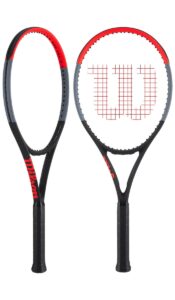
The 5 Best Tennis Rackets For Doubles

The 5 Best Tennis Rackets For Doubles

Recent Articles

How to Serve and Volley Effectively


In my own game, my serve has always been my biggest strength. My volleys were below average, but coaches told me that I had to learn to serve and volley to earn free points. Those coaches could not have been more right. It was a process because it was out of my comfort zone at first, but as I did it more it came together to become a staple of my game. My volleys improved naturally as I forced myself to come in and my serve became more of a weapon.

Knowing how to mix the serve and volley in can take your game to the next level. Being a serve and volleyer on a point to point basis is outdated, but the play is still very effective as more of a surprise attack.

The game has changed so drastically to the mentality of “get the return in and get the point started,” so you should be looking to sneak into the net and end points. However, this is a skill that requires development. This article will outline everything you need to know about how to serve and volley more effectively. 

Being able to serve and volley even as a changeup will make it easier to hold your serve. There are a couple of elements to being effective when serving and volleying: where and how you serve, volley placement, effective movement forward, and unpredictability.

You will be able to serve and volley effectively if you are able to get your opponent either jammed or reaching. If you have an aggressive serve that causes problems for your opponent, this play will work for you. Your goal with the volley here is to make your opponent uncomfortable. Most of the time, that means your target will be in the service box. If you hit a winner, it’s a bonus. Your forward movement should be explosive from the first two steps to get your body going, but smooth the rest of the way so that you can maintain control on the volley. Finally, you should try and execute this play in situations that your opponent does not expect it. For example, serving and volleying on every 30-30 point defeats the purpose. Mix it up so that you can catch your opponent off guard.

Serve Placement

The serve is the most important shot in tennis, and it is no different when serving and volleying. The most important things about serving when executing this play are where you serve and how you serve. There is no set rule of where and how to serve because everyone has different strengths and weaknesses, and it depends on who you are playing against. 

This isn’t rocket science, you know which serves you are most comfortable with. When serving and volleying, you typically want to try and stick to those ones as they are going to be most effective. If you know you have a good kick serve that gives people trouble, that is a good one to use because it gives you time to close the net a bit more. 

Faster Isn’t Necessarily Better

A general rule that I use when serving and volleying is to pick serves that are going to put your opponent in uncomfortable positions. Get it out of their strike zone whether that means reaching side to side, jamming them into their hips, or getting it up high. A lot of times that means getting the ball to move rather than just hitting it as big as you can and sprinting to the net. Good players will be able to handle a big serve right on their strings with ease.

Additionally, taking pace off of your serve when coming in behind it will allow you time to close the net that much more. If your “off speed” serve is still able to make your opponent feel out of position, it will be more effective than just blasting the serve right to them. 

Finally, placement is more important than speed when it comes to this tactic. If you have to take some pace off in order to hit your target, that is okay. Even if it means sacrificing some MPHs, so make sure to do whatever it takes to hit your target. 

Volley Placement

The next step is the volley. Before you hit the serve, you should have an idea where you want to place the volley that follows. A lot of this depends on the serve that you are hitting. 

Consider Going Behind Your Opponent

Remember: the volley does not have to go to the open court. In fact, it is often higher percentage to go back behind your opponent because it is easier to hit a volley back where it came from. This play works because as the opponent hits the return and sees that you are coming to the net, their first instinct is to cover the open court as quickly as possible.

As they are sprinting to the other side of the court, they have a better chance of passing you if you allow them to hit on the run. If they are forced to change direction and pass you, they will be off balance. 

Going behind your opponent on the first volley makes them out of position.

Analyze Where Your Opponent is Returning From

When deciding where to hit your first volley, you also need to consider where the returner is standing when they hit the return. Your goal is to find a high percentage first volley that you know you can execute while also making your opponent uncomfortable. For example, if the returner is standing far behind the baseline, a great play is hitting a short volley to the open court. This will make them cover a lot of ground. 
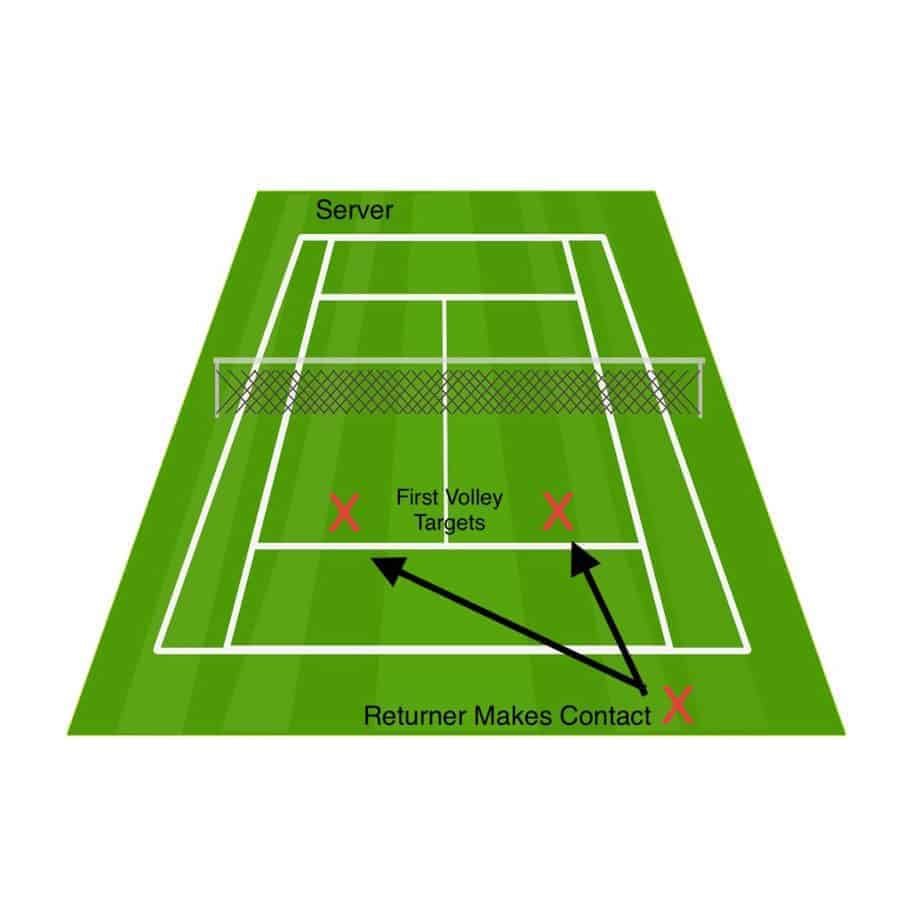
A short first volley forces your opponent to run further.

Play the Percentages

You don’t necessarily need to win the point with the first volley, but rather set up the point and win it with a very easy second volley. A common mistake that players make when serving and volleying is making the first volley too perfect.

Don’t be unrealistic, you should play with what you are dealt. If the returner hits a great return at your feet, do what you can. There’s no need to be a superhero. If you have an easy volley on top of the net with your opponent off the court, allow for more margin so you don’t give away the point. These simple things will lead to much more success in executing this play.

Movement Forward

Many players make the mistake of hitting the serve and sprinting to the net as fast as they can. This is such an aggressive play, so its normal to feel rushed in executing it. The goal is to get to a point that you feel relaxed coming in. Here are some tips that will help you feel like you have more time getting to the net.

Hit the Serve First

Hitting a good serve for this play is the most important part, so don’t sacrifice that in order to get to the net quicker. Hit the serve first, then follow. I’ve noticed that when a lot of players decide to serve and volley, they often miss the serve anyways. Obviously that is counterproductive, so be sure to focus on hitting the serve as you normally would. 

Explode Out of First Two Steps

The most important steps In serving and volleying are your first two. These will get your weight going from 0 to 100, so they have to be efficient and powerful. Watch below as Federer hits the serve, lands, and explodes out quickly to get his momentum going into the court.

Notice how explosive Federer’s first 2 steps are.

Glide Through the Court

After these first two steps, let your body glide through the rest of the court. Remember: the more relaxed you are as you hit the volley, the better you will execute. You should have generated enough power from your first two steps to allow you through to where you hit the volley. 

Stutter-Step to Gain Balance

When coming to the net, don’t focus too much on a full split step. This implies that you will come to a full stop. Think of it as more of a stutter-step that will allow you to slow your body down. Coming to a complete stop will mess up your timing and control on the volley.

Raonic split steps, but maintains forward momentum.

Your goal is to gain control of your body so that you can move in any direction to react,  yet still be able to move through the volley as you hit it. In the video above, Raonic easily moves up to the weak return because he did not come to a complete stop. His momentum allows him to move foreword and through the volley. Remaining fluid is the most efficient way to execute this play. 

Mirror the Ball

In order to cover the biggest percentage of the court possible, you have to mirror the ball. This is a pretty easy concept to learn, yet a lot of people do not do it correctly. When moving forward, many players sprint for the T of the service box leaving both the crosscourt and down the line passing shot open. 

In order to effectively cover the court, you should follow your serve. If you serve out wide, you need to cover the line more to account for the extra space your opponent has on that side of the court. If you hit the serve down the T, you can get away with covering more of the middle of the court as they don’t have as much angle to work with. As long as you mirror the ball, you will give yourself the best chance at a good volley.

Mirror your serve in order to cover the court effectively.

Unpredictability 

Being unpredictable with the serve and volley is very important. For most players, this play will be run as somewhat of a surprise attack. You want to break the returner’s rhythm and put it in their head that you could be throwing this in at any point. Eventually you want to get to the point where you feel comfortable enough serving and volleying on any point, regardless of importance. 

The real question is this: How can you catch your opponent off guard when serving and volleying? There is no hard and set rule as far as this goes. As a player, you’re going to have to analyze what is going on in the match to decide if it is a good time to use the play. How comfortable is your opponent returning your serve? Where are most of their returns landing? Are longer points favoring your opponent? How are his passing shots? How are you serving? 

Another thing to consider when working on your serve and volley is making your serve unreadable. A lot of people have small tells in their serve that show the opponent where and how they will serve. This relates mostly to the placement of the toss, so work on getting your toss consistent enough where you can hit any serve from any toss spot. 

Overall, the biggest key to being unpredictable is simply running the play when the opponent least expects it. If you feel that it is a big point and the other player might just push the return in, that is a great time to take advantage. 

Final Thoughts

Serving and volleying is something that every player can work on. No matter what game style you play, you can incorporate this into your game to add another dimension and make holding serve easier. 

This is a skill that you need to develop. Just because you have a good serve or good volleys does not mean that you will automatically be good at this. There may be a bit of a learning curve with it at first, but be okay with losing points at first in order to get better at it and be successful in the long run. I recommend starting to try this on 30-0, 40-0, and 40-15 points at first so that you feel there is not as much to lose. Experimenting is the best way to improve, and this is a skill that may take your game to the next level. 

As always, if you need some extra help to improve your game, feel free to reach out. We are always willing to talk some tennis!

Do Tennis Players Choose What They Wear?


The picture above illustrates something very common in tennis: players competing against each other wearing the same outfit. I have been asked several times by family members or friends outside of tennis why tennis players so often wear the same outfits, especially if they are playing against each other. The reason why this happens is because brands like Nike or Adidas sponsor multiple players and they are contractually obligated to wear the latest gear during tour events, even if they play against someone sponsored by the same brand. But do players get to choose what they wear?

In professional tennis, the vast majority of tennis players do not have a full choice of what they wear once they are under contract with a clothing brand. Tennis players are often sponsored by the same clothing brands (Nike, Adidas, Lacoste) and are required to wear the newest collection by their individual sponsors. While brands typically have a few options within each collection for players to choose from, ultimately the clothing sponsors have the final say in the matter. The latest clothing lines are pre-determined months, if not years in advance and most players have no input in the designs. The only players who work directly with brands during the design process are tennis’s biggest stars (Nadal, Federer, Osaka, Serena). Brands use this practice to highlight their stars in a field of players wearing similar clothes.

If you want to learn more about how the partnership between tennis players and clothing brands work, make sure you keep scrolling.

Tennis Players and Sponsorship Deals

While most people try to stay away from the subject of money, the fact of the matter is that clothing sponsorship deals between players and are a strictly business decision from both ends. For players, clothing deals are a source of income outside of prize money from tournaments. On the other hand, brands use the players as a marketing tool in order to drive up sales of their newest collection. This is a common practice and it has been around for a long time.

The reason why I want us to focus on the financial side of it is that players and brands often make it sound like there is a lot of brand loyalty involved between their partnerships but it ultimately comes down to money. Remember how shocked everyone was when Roger Federer switched from Nike to Uniqlo? We were so used to seeing Federer wearing Nike that it seemed crazy they could not reach a deal. However, when you look at the numbers, it all makes sense. Federer went from making ten million dollars a year with Nike to a staggering thirty million with Uniqlo.

Photo: Business Insider

At the end of the day, the choice of what a player will wear on the court comes down money: players will choose to wear the clothes of the brand that is willing to pay the most during negotiations. Regardless if the numbers are in the millions or thousands, the choice typically goes for the highest bidder. For brands, they are looking to sponsor players who have the largest amount of eyeballs on them. The further the player reaches in a tournament and the higher they climb up the rankings, the more attention they will get, making them more valuable for brands.

Clothing

Going back to the issue of players choosing what they wear, we need to learn about how sportswear brands operate in the tennis world. For starters, most companies launch four different lines per year; one for each grandslam. In each grandslam, brands establish a distribution area for players to try on and pick up their clothing for the event. This practice is mostly common among brands with large budgets like Nike and Adidas (smaller brands might deal directly with players before the event). The clothing lines for each grandslam are designed and produced up to fifteen months in advance. In this process, brands have their own vision on how the final product will look like. Some players might be consulted and give input on the final design but it ultimately it is the brand that decides the overall style of each line.

Naomi Osaka of Japan in action during her second round match at the 2020 Australian Open Grand Slam tennis tournament. Photo: Jimmie48 Photography

The only players who have a direct input on the design of their clothing are the sport’s biggest stars. Brands like to highlight their most popular athletes by giving them unique clothes. Nike is one of the brands that excels at this. Rafael Nadal, Naomi Osaka and Serena Williams have their own Nike lines and logos (Federer used to have it as well with the RF logo). In this case, brands work closely with players in order to create something that is a true representation of their characters. Companies understand that the top players have a massive following of loyal fans and they are the main drivers of sales. Therefore, making sure the star players are happy with their outfits is an important part of their business strategy.

You have a choice

While most professional tennis players don’t get to choose what they wear, you still can. We separated some of our favorite gear for you.

Tops:

Lacoste Men’s Sport Novak Djokovic Allover Print Technical Polo

Adidas Men’s Barricade Polo

Adidas Men’s NY Printed Tennis Tee

Bottoms:

Adidas Men’s Club 7 inch Tennis Short

ASICS Men’s Tennis Short

Shoes:

Adidas Men’s Courtjam Bounce Tennis Shoe

Adidas Men’s Adizero Club Tennis Shoe

What Do Tennis Players Do After They Retire?


What Do Tennis Players Do After They Retire?

At one point or another, every single tennis fan has wished that they could live the life of a professional tennis player. Traveling around the world, playing the sport you love, and still make a lot of money doing so sounds like the absolute dream. 

While this is in fact how the life of the top tennis players works, things are not as great for those players ranked outside the top 100 players in the world. These players do not make nearly as much money, they need to play tournaments in not-so-glamorous places, and oftentimes they need to stay in crappy hotels. 

While this is a big risk you’re going to need to take if you want to pursue a career as a tennis player, there is one much bigger risk you’ll be exposed to: you will probably have a pretty short career. Even if you’re lucky enough to avoid career-ending injuries, you will probably be done with professional tennis by the age of 35. And when that day comes, what are you supposed to do? 

After they retire, tennis players often have a difficult time figuring out what to do with their lives. In the majority of cases, they remain involved with tennis, whether through private coaching in tennis academies, college coaching, coaching high-level players on tour, or working with tennis organizations. Other players choose to go back to school or find a regular job after they retire. And finally, the most successful players get to just play on the ATP Champions tour and/or relax and enjoy their lives.

While tennis players do have somewhat limited career options after they retire, they do have some good choices. We’ll cover some of the most popular ones in depth below.

Coaching On Tour

Recently, it has become the norm for the top players to hire past players as their coaches. Players find that past tennis pros can help them develop in several areas, but the biggest advantage is usually related to the mental side. Having someone in your team who understands everything you’re going through can be a big game-changer. 

For the retired player (and now coach), this is a great deal. They get to make a good amount of money and still travel to tournaments, but without going through the physical strain. Several former ATP and WTA players are currently coaching on tour, including: Magnus Norman (Wawrinka’s coach), Ivan Ljubicic (Federer), Amelie Mauresmo (Murray), Michael Chang (Nishikori), Goran Ivanisevic (Djokovic), Carlos Moya (Nadal), and many others.

Private Coaching

Another commonly seen career path for retired tennis players is private tennis coaching. Depending on the level of success achieved by the player on tour, they go on to either open their own tennis academy or join an existing academy or club. Some successful players who have their own tennis academies are Brian Dabul, Juan Carlos Ferrero, and Justine Henin.

Players who have not reached the top of the rankings usually end up joining an existing club or academy. These are usually players who played in the Futures or Challengers level. They can coach either club players, juniors or kids, and they make a pretty good living out of it. You can usually make between $60 and $100 per lesson as a tennis coach, so it’s clearly not a terrible career path.

College Coaching

Another great career path for retired tennis players who want to stay involved with tennis is college coaching. This is a great choice for players who are tired of all the traveling and the instability; college coaches do not have to travel much, and they have a good base salary. This way, retired players can grow their families and their roots in one place – something they couldn’t really do while playing on tour. 

Play On Champions Tour

Players who were at the top of the rankings when they were on tour – and who were able to put up a show – get to enjoy their retired life playing on the ATP Champions Tour. These are tournaments (mainly exhibition-like matches) played at the same time as the main professional tournaments. These retired players get paid just to show up and entertain, which sounds like an awesome gig. Several famous players are currently playing on the Champions Tour, including Tommy Haas, David Ferrer, John McEnroe, Marat Safin, and many others.

Work With Tennis Organizations

Some of the most successful tennis players who also have a knack for business end up working with tennis organizations after they retire. Some of them continue working with the ATP or ITF in order to further develop those institutions, but most players end up working with their national tennis organizations. By doing so, they get to stay connected to tennis but from a different perspective. For instance, a successful Brazilian player who is also a friend of mine recently started a role with Tennis Australia as the Head of Player Liaison. 

Go Back To School

Several of my friends who played on the ITF or Challenger tour for some time decided to go back to school after they hung their rackets. Even though it may be a bit strange going back to school after a long gap, this path is actually great for retired players who are looking to transition into a “regular” life. Some of these players have already completed 3 years of university before going pro, so they end up going back just for a year in order to get their degree. Bobby Reynolds, an American tennis player who reached the 63rd position in the ATP, returned to Vanderbilt for a year after retiring in order to get his degree.

Find A Normal Job

Other retired players just simply go on and get a normal job. These players are able to transition everything they learned playing tennis – discipline, hard work, resilience – to a different job. While they may need to take some time to learn the technical skills of the job, their highly developed emotional intelligence will most likely make them successful in a short period of time.

Retire and Relax

Finally, some of the most successful players are able to just relax and enjoy their success after they retire. Most of them have enough money saved up so they won’t have to work again, and they choose to enjoy their time with their families – something they were not really able to do while playing. These players will often be seen at some tournaments enjoying the atmosphere and remembering the old days, but for the most part they just get to enjoy themselves. 

Final Thoughts

While tennis players usually have short careers (about 10 to 15 years on average), they usually end up staying connected to tennis in one way or another. Regardless of the path they choose, they are usually able to transfer all the experiences and lessons learned while on the tour, which compensated for the lack of experience in other areas. 

Best Wilson Tennis Rackets: Full Reviews


Trying to find a racket you like is no easy task simply because there are so many options out there. Don’t worry, you’ve come to the right place. We have tried every racket that Wilson has to offer, so this article will break down everything that we concluded. 

The most popular Wilson rackets on the market are the Blade, Burn, Prostaff and Clash. Wilson sells slightly different versions of some of these rackets, but these are the main ones. You can buy some of these rackets with different string patterns and weights, so keep that in mind as you are testing.

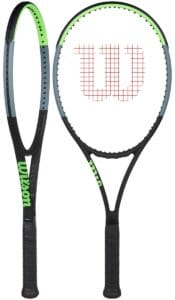
Blade v7 98

Recommended Game Style: Aggressive Baseliners, All-Court Players

Basic Specs:

  • Strung Weight: 11.4 oz (323g)
  • Head Size: 98 sq. inches
  • Balance: 4 pts HL
  • Swing Weight: 328
  • Stiffness: 62

Review: This racket has been Wilson’s most popular racket for years. It has enough pop, but this stick is more known for its control all around the court. The Blade fits players that don’t have trouble generating power on their own, but need something that has enough control for them to swing away as they please. The only real setback that I’ve found with the blade is the serve. It just doesn’t seem to come off nearly as big as it does with a Babolat or some of the other Wilson rackets. Overall, this racket is the favorite of many players for a reason: it is reliable on most shots and has enough control for just about anyone. 

Advantages: Ground strokes, volleys, slice. 

Disadvantages: Serve

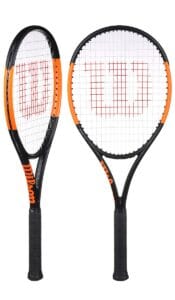
Burn 100S Countervail

Recommended Game Style: Counterpunchers, Grinders

Basic Specs:

  • Strung Weight: 11.3 oz (320g)
  • Head Size: 100 sq. inches
  • Balance: 1 pts HL
  • Swing Weight: 327
  • Stiffness: 73

Review: This racket is much different than all of the other WIlson rackets I have tried. I thought that it played much more similar to some of the Babolats. The string pattern is very open, so it naturally produced a ton of spin on the groundstrokes. It has a decent amount of power, but I thought it lacked control especially on the baseline. I found that the serve came off quite big, but again lacked some consistency. I would recommend this racket to lower level players that are looking for something to generate power and control for them.

Advantages: Spin, Power

Disadvantages: Control

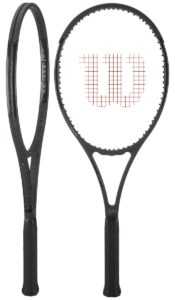
Pro Staff RF97 Autograph

Recommended Game Style: Aggressive Baseliner, All-Court Players

Basic Specs:

  • Strung Weight: 12.6. oz (357g)
  • Head Size: 97 sq. inches
  • Balance: 9 pts HL
  • Swing Weight: 335
  • Stiffness: 68

Review: Personally, this is my favorite Wilson racket (and not just because Roger uses it.) This racket feels very stable on every stroke; groundstrokes, slice, volleys, and serve. I don’t recommend this racket if you have a hard time generating power or spin on your own. It is not forgiving, so you will have to do a lot of the work on your own. However, if your game is at a place where you feel comfortable doing that, this may be a great racket for you. I like that the string pattern is fairly open too generate some easy spin, but the head size is small so it doesn’t feel like the ball escapes the strings too quickly. If you’re looking for a true “player’s racket,” it may be a good idea to give this one a shot.

Wilson makes the Pro Staff 97 Countervail racket as well, which is the same racket but lighter and more player friendly. I recommend trying both as they are similar, but the Countervail version is lighter and easier to swing. 

Advantages: Groundstrokes, Slice, Volleys, Control, Serve.

Disadvantages: No easy power.

The Clash 98

Recommended Game Style: Baseliners

Basic Specs:

  • Strung Weight: 11.5 (326g)
  • Head Size: 98 sq. inches
  • Balance: 9 pts HL
  • Swing Weight: 326
  • Stiffness: 55

Review: The Clash is Wilson’s most recently released racket. This racket was made for players of all levels, from beginner to professional. Generally, I would say that the racket is much more successful among recreational players. However, I do know some pros that use it on tour. The racket feels very soft on the arm. When I tried it, I found no problem generating spin and power. Although the control of this racket is fairly good, I found it hard to absorb pace. The volleys were average and the serve had a good feeling off the strings, but I had a hard time really popping it. Overall I would say that this racket is good, especially for players that prefer the racket to generate the pace. 

Advantages: Power and spin on groundstrokes. 

Disadvantages: Lack of stability.

Final Thoughts

At My Tennis HQ, we have personally tried all of these rackets and feel that Wilson has a lot of great ones on the market. Hopefully this article was helpful in giving you the information that you need about these rackets. As you can see, Wilson has a racket for just about every type of player.

If you need any extra guidance in finding a racket that fits you, let us know in the comments and we will do our best to help you out!

How Much Of Tennis Is Mental?


Let me tell you a quick story. A couple of years ago I was playing the second round of a 25K tournament against an upcoming player. I was 24 years old and he was 19 and had recently turned pro. He was undeniably talented and had incredibly powerful strokes. However, his attitude on the court was, to put it mildly, poor. He was complaining about every call, getting frustrated about the smallest inconveniences and after I won the first set he smashed his racket. He was so obnoxious that it made me want to beat him even more. When I closed him out in two sets I remember yelling towards my parents in the stands “It is all mental!! It is all mental!!”. I ended up winning that event.

When I look back to the tournaments I had success in my career, the part I vividly remember is how my mind was in the right place during those weeks. It is hard to explain why I felt that way, but I was just focused, poised, and nothing was going to stop me. I did not win those events because my game drastically improved, I did it because I felt mentally strong. This feeling of being “in the zone” is incredibly hard to replicate week in and week out. In tennis, success and failure walk hand in hand and we have several setbacks we have to face. All of us tennis players go through this and our ability to overcome problems on and off the court is key in our pursuit of success. 

It is well known that tennis is as much mental as it is physical. While it is hard to precisely quantify how mental tennis is, many argue that the sport is 80% mental and 20% physical. Achieving success as a tennis player, regardless of your level, is directly correlated with your ability to deal with the pressure of competitive tennis. The first opponent we face is ourselves; how we respond to the pressure and stress of a match will impact our results. Tennis players who have exceptional results do so because they are mentally strong and able to overcome the mental challenges that come with tennis. In short, players who are mentaly tough are much more likely to succeed than players who have nice strokes but are weak between the ears. 

Below we will dive deeper into the mental side of tennis. Specifically, we will cover what being mentally strong means, some key elements of mentally strong players and the correlation between mental strength and good results. We will also give you a few tips on how to improve your mental game (we are working on a more comprehensive guide on how to improve your mental toughness!!), so let’s get to it.

Mental Strength and Tennis

Let me preface by saying that the physical work in tennis is incredibly important. Having a good work ethic in practice, developing your strokes and physical strength is imperative for improving as a tennis player. This is especially important when you are beginning your tennis journey and learning how to properly hit every shot. However, as you reach a competitive level, you will be measuring yourself against players who have done similar work as you. Whoever is on the other side of the court also practiced their strokes and worked on their fitness so the outcome of a match is decided by who can navigate the tennis match better. Of course, one player might have clear physical advantages or more developed strokes (very common in junior tennis) than the other. But the difference between a mentally strong vs a mentally weak player is that mentally strong players are able to extract the maximum output out their tennis capabilities while enduring the pressures of a tennis match. You can’t control the outcome of the match (sometimes you’ll just be outplayed), but you can control how hard you fight for every point. 

Nadal is arguably the most mentally tough player of all time

Think of it this way. As we develop our tennis game we slowly build what I call a “tennis identity”. What this means is that we all have our own unique way to play tennis. First, we typically favor one stroke over another. For example, I always felt more comfortable hitting backhands over forehands. While I worked very hard to develop my forehand, it will never be as natural as my backhand. In addition to the strokes, there is also our style of play. Some players enjoy being aggressive and taking risks while others love to counterpunch. Regardless of your preferences, we all have a tennis identity and understanding who you are as a tennis player is the first step towards becoming a mentally strong player. By doing so, you’ll be able to understand your strengths and shortcomings during a tennis match and work towards making the proper adjustments. Self-awareness is the first component of becoming a mentally strong tennis player. 

Real Live Example

Last Sunday (March 1rst 2020), Thiago Seyborth Wild won the ATP 250 in Santiago, Chile. He is the first player born in the 2000s to win an ATP tour event. The 19 year old is one of the best players to come out of Brazil in a long time. In 2018, Wild won the junior US Open and since then, the expectations about his professional career drastically increased. Up until last week, his brief career had ups and downs. While he was steadily rising up the rankings, it appeared he was being held back by where he was mentally. The transition from juniors to pros and difficult for everyone and expectations are high for accomplished junior players like Wild. After Sunday’s title, his coach Joao Zwetsch credited a lot of the win to Wild’s maturing on and off the court. He said that the addition of the sports psychologist Felipe Vardiero to the team was essential for Wild’s rise. This is a fantastic example of how mental strength can elevate someone to a different level. Wild is unquestionably an excellent tennis player who has all the weapons to play at the highest level but he was being held back mentally. However, Thiago and his team have done a tremendous job creating an environment where the player is developing technically, physically and mentally and his title in Santiago demonstrates just that.

Thiago Wild in Santiago 2020

In professional tennis we often see commentators talking about a player’s mental strengths. The big 3 are praised for their abilities to overcome challenges and continue to develop their game in order to stay ahead of the competition. Federer, Nadal and Djokovic are the gold standard when it comes to mental toughness. On the other hand, we also see the discussions about players who are immensely talented but fail to live up to the expectations. The biggest example of this is Nick Kyrgios. The australian is a wizard with the tennis racket but struggles with the mental aspect of the game. I am not here to judge him, he appears to be happy with his career and with who he is and personally I think he is great for tennis. But we can agree that he has not reached his full potential. Nick is definitely not alone, we’ve seen other players like Zverev and Tsisipas having big mental breakdowns on the court in 2020 alone. In my assessment, the dubbed “next gen” is as talented as Novak, Rafa and Roger, but they are nowhere near as mentally strong as the big three.

Aspects of Mental Strength You Should Develop

Mental toughness:

Mental toughness is a hard subject because some of us are just better at it than others. However, it is something we can all improve upon and it will be beneficial on and off the court. In tennis, being mentaly tough is all about how a player can navigate the ups and downs in tennis. A mentally strong player is self aware of his/her shortcomings but not scared to fail because of them. They are disciplined and eager to improve despite frustrations and setbacks. In addition, they are able to accept their mistakes and continue to strive to get better. During matchplay, mentally strong players are able to handle pressure situations more clearly, especially during the important stages of the match. Finally, a mentally strong player understands that improving in tennis takes time and there will be setbacks and uncontrollable factors. The only thing we can control is our attitude and how we overcome obstacles. 

17 time Grand Slam Champion Gigi Fernandez has dedicated herself towards teaching mental toughness since her retirement. Fernandez says that working with a sports psychologist changed the course of her career. She now gives workshops on mental toughness and in an interview in 2019 she said the following:

“There’s not one thing about mental toughness that you can tell your students that will make them get better right away because mental toughness is very dependent on the situation, there’s not a straight line to mental toughness and there’s a lot of things you have to do off court before the match. You have to understand yourself and the physiology of your body under pressure. You have to try to learn tricks to counter the feelings you have when you’re competing. You have to set goals for yourself. If you want to do anything in life, you have to set goals”

You can read the rest of the interview here.

Gigi Fernandez. Source: gigifernandeztennis.com

Decision Making:

Decision making is incredibly important because it often dictates how the match is played. If during pressure situations you make the wrong decisions, it won’t matter how great your strokes are or how physically fit you feel. Being able to clear the mental fog that comes with pressure in order to make the proper decisions during a match is massively important. We’ve all experienced playing a match where we were in full control but we were unable to close it out; the good old “choking”. As the finish line gets closer and closer, the pressure increases and it can cloud our judgment. All of us experienced this at one point. The key is to learn from those experiences in order to make better decisions in the future. 

Positive Attitude:

It goes without saying that maintaining a positive attitude through adversity is incredibly important for developing mental strength. In tennis, losing is as much part of the game as winning. Therefore, players need to look to learn from every match. Sometimes your opponent has a better day and there is nothing you can do but if you give 100% you can be proud of yourself. On top of that, pay attention to what you did well and what you can improve on so you can work appropriately next time you hit the practice court. 

Conclusion

Mental strength and toughness are hard. It is something you need to work on as hard as you work on your serve or forehand. Yet a lot of us (including myself) don’t put in as much work into our minds as we should. Pressure, negative emotions, lack of confidence, all those things affect us differently as tennis players and it can be scary to face those challenges because we are afraid off failure. It took me a long time to mature into the player I am today. If I could go back in time and give myself one piece of advice it would be to work harder on my mental toughness early on in my career. You won’t become mentally stronger by reading this article but I hope you feel compelled to put more work between your ears. I guarantee it will be beneficial!

How Do Tennis Overgrips Work?


How Do Tennis Overgrips Work?

The more you become familiar with tennis, the more you will notice details you used to have no idea even mattered. And the more you understand tennis, the more you will realize how much good equipment matters.

When you’re just watching tennis on TV, one of the last things you’ll probably pay attention to are the overgrips placed on the players’ rackets. And when you start playing, you’re suddenly supposed to know which overgrip to buy, when, and how to replace them. We realize that not all of us are born knowing everything about overgrips, so today we’ll cover all the basics you should know.

In essence, how do tennis overgrips work? Overgrips are cloth-like tapes that are wrapped over the original grip of a tennis racket, working as an extra layer of comfort, stability, and sweat absorption for tennis players. Playing without overgrips can be uncomfortable, and you will need to replace them after about 10 – 15 hours of playing. You can buy them individually or in larger rolls, with each overgrip costing between $2 and $5.

If you’re just now starting to understand what an overgrip is, we highly recommend that you continue reading below. We’ll cover everything in more detail, and we’ll give you some great insights when it comes to what overgrip you should choose.

What Are Tennis Overgrips?

Overgrips are tape-like accessories that are used in racket sports in order to increase the comfort, stability, and sweat absorption of the player holding the racket. In tennis, these grips are wrapped over the racket’s original grip and need to be replaced once after a while. Tennis overgrips can usually be bought as individual units or in bulk (usually a roll of 15 or 30 units).

What Are Tennis Overgrips Made Of?

Overgrips are usually made out of specially designed materials, and most of the big brands have their own proprietary overgrip material. They usually feel cloth-like, but some of them are made of sticky materials while others are made of more absorbent products. 

Different Types Of Overgrips

When you buy a new racket, it will usually come with a black or white built-in grip. You should look into adding overgrips on top of the original grip, in order to improve sweat absorption or to increase thickness and/or comfort. 

You can find dozens of different overgrip options out there from all sorts of different brands, but essentially you can divide all of them into 3 different categories: dry, tacky, and all-around. Each one of them has different benefits, and you should choose the one that best fits your game. Below we will cover each one of the 3 categories. 

On a side note, you should usually stick to white or light blue overgrips. The majority of professional and advanced players choose these colors, and unless you want to be seen as a beginner, you should stay away from different grip colors.

Dry Overgrips

These overgrips are excellent for players who tend to sweat a lot or who normally play in humid weather. They are generally thinner and absorb moisture extremely well, giving you great control of your racket – even if you are drenched in sweat.

Unfortunately, I’ve gone through the experience of cracking a few rackets after they slipped out of my hand after a serve. Trust me, it’s a horrible feeling and you don’t want to go through that mistake. These dry grips really help to avoid that, so if you tend to sweat when you’re playing you might want to try these. The best dry grips I would recommend are from Tourna Grip, and you can get them for some nice prices on Tennis Warehouse. 

The drawback of these grips is that, since they are thinner, they can get old fairly quickly and you might need to change them often. If that doesn’t sound good to you, you can try some Tacky or All-Around overgrips. 

Tacky Overgrips

Tacky overgrips are on the other end of the spectrum, and they usually have a very “sticky” feel. They will give you a good grip on your racket at all times, and they are usually nicely cushioned and last longer than dry grips. 

I’ve personally used tacky overgrips throughout most of my career, as I loved the feeling I got when using them. I’ve never struggled with sweat too much, so the tacky overgrips provided me with the perfect grip. The best brands I recommend for tacky overgrips are Tourna Grip and Wilson. I’ve used both in the past and they are equally good. I find the Tourna Grip one to be the tackiest of both, but the Wilson overgrips are slightly cheaper. They are both good and you can also get them cheap on Tennis Warehouse. 

All-Around Overgrips

Finally, you also have the option of choosing all-around overgrips. They are a mix between both Dry and Tacky overgrips, as they start off with a tacky feel and turning into a drier grip after a few uses. They are a good option if you’re not particularly passionate about any of the two overgrips mentioned above. 

The best option of all-around overgrips is Babolat’s Pro Tour, as they provide both the tacky feel and still are considered very absorbent. 

When To Change The Overgrip

The more frequently you play tennis, the more often you will need to change your overgrip. After some time playing, the grip will start getting old and dry, and that means it’s time to change it. If you play once or twice a week, you can go up to a month without getting a new grip, but if you play every day you will end up having to change it pretty much every week. The better quality grips will last about 10 – 15 hours of playing time.

How To Install (Regrip) an Overgrip


Once the time comes to change your overgrip, you can either do it yourself or take it to a tennis shop and have someone change it for you. Most times, if you’re getting a racket restrung you can just ask the stringer to change your grip for you. However, it is incredibly easy to do so yourself and it’s something you should learn eventually if you want to call yourself a true tennis player. If you’re interested in doing it yourself, you can just follow the steps below. 

Changing A Tennis Overgrip – Step-by-Step

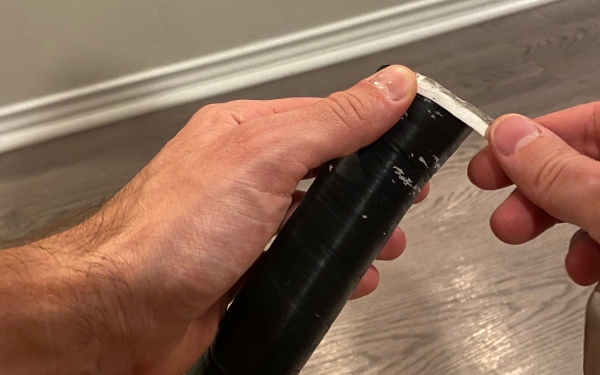
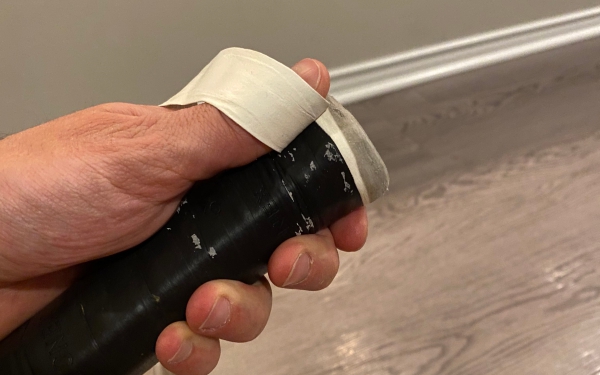
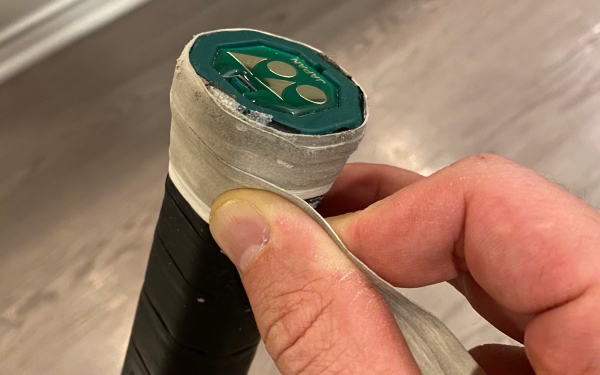
1) As you can see, tennis rackets come with an original grip (usually black or white), but it is usually not very comfortable. So when you’re changing your overgrip, you’re going to wrap it over the original grip. 

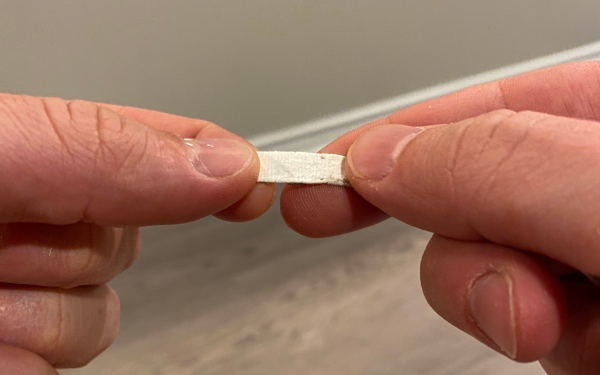
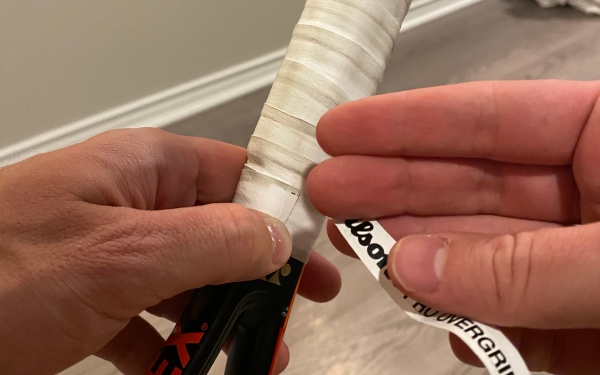
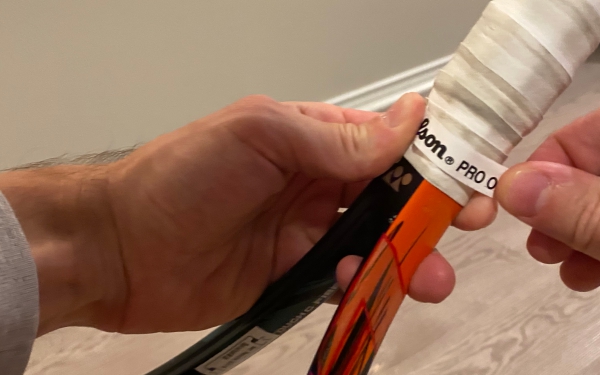
2) When you get a new overgrip, the first step is to find the small edge that has a sticky portion. In most cases, it will be covered with a small paper that you can just peel off. Only one of the sides will have those, so you’ll know which one it is. The side with the sticky portion will be the one in contact with the racket.

3) You should start by placing the sticky portion aligned with the bottom of the racket. If you’re right-handed, you will be holding the racket with the left hand and the grip with your right hand. If you’re left handed, you’ll do the opposite. 

4) The beginning is a little tricky, so you should hold the start of the overgrip in place with your thumb while you wrap the overgrip with your right hand, making sure the bottom of the overgrip is aligned with the bottom of the racket. 

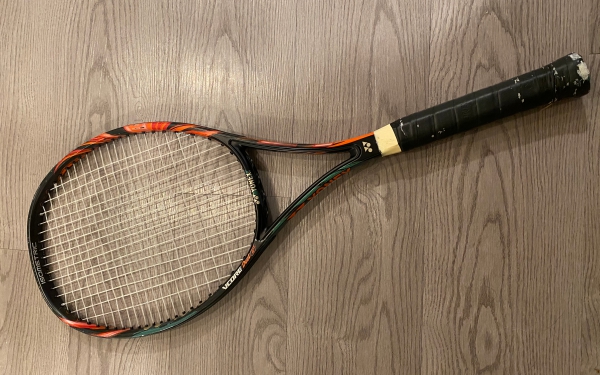
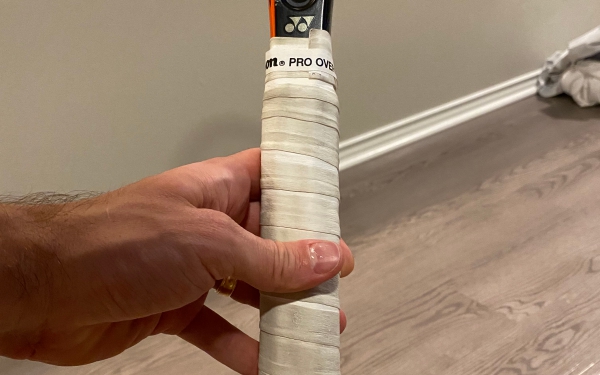
5) The grip in the photo is older, so you can see the mark that shows where the second turn of the grip lays on top of the first. You should leave only a small piece, otherwise your new overgrip won’t go all the way up to where it’s supposed to be. 

6) In order to have an easy time changing your grip, you need to hold it in the right way. What I usually do is I push the grip down with my thumb (to make sure it stays stretched at all times).

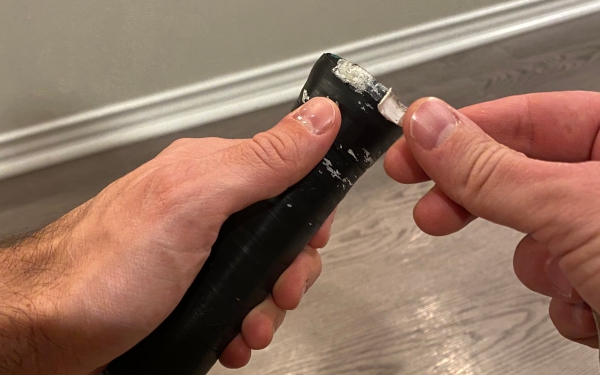
7) When you reach the top of the grip, you will need to use the small sticky tape that comes with the new overgrip. Just make sure you’re holding the newly placed overgrip in place with your left thumb, otherwise it will all fall apart. 

8) Just wrap the sticky tape around the end of the overgrip, and it will stay in place when you play. Keep it pretty tight!

9) Voila! You have successfully changed an overgrip. If you did it correctly, it should look somewhat like the photo below. The overgrip in the photo is quite old though, so yours should look a lot fresher.